DNA, genes and chromosomes
Chromosome
A chromosome is a structure made of a long DNA molecule associated with proteins that carries many genes.
Gene
A gene is a section of DNA that contains the instructions for making a particular protein.
Genome
The genome is the complete genetic material of an organism.
- DNA stores genetic information in its base sequence, the order of its bases.
- In a plant or animal cell, most DNA is packaged with proteins into chromosomes in the nucleus.
- A chromosome contains many genes, each occupying a particular position along its DNA.
- The base sequence of a protein-coding gene determines the order of amino acids in a protein.
- Proteins include enzymes, structural components and some hormones, so their activities help produce an organism's characteristics.
- The genome includes both coding DNA and non-coding DNA, rather than only the genes that code for proteins.
- Mitochondria also contain a small amount of DNA, and plant chloroplasts have DNA, so an organism's genetic material is not confined to its nuclear chromosomes.
- Most nucleated body cells of an individual contain the same genetic information, although different cell types use different genes.
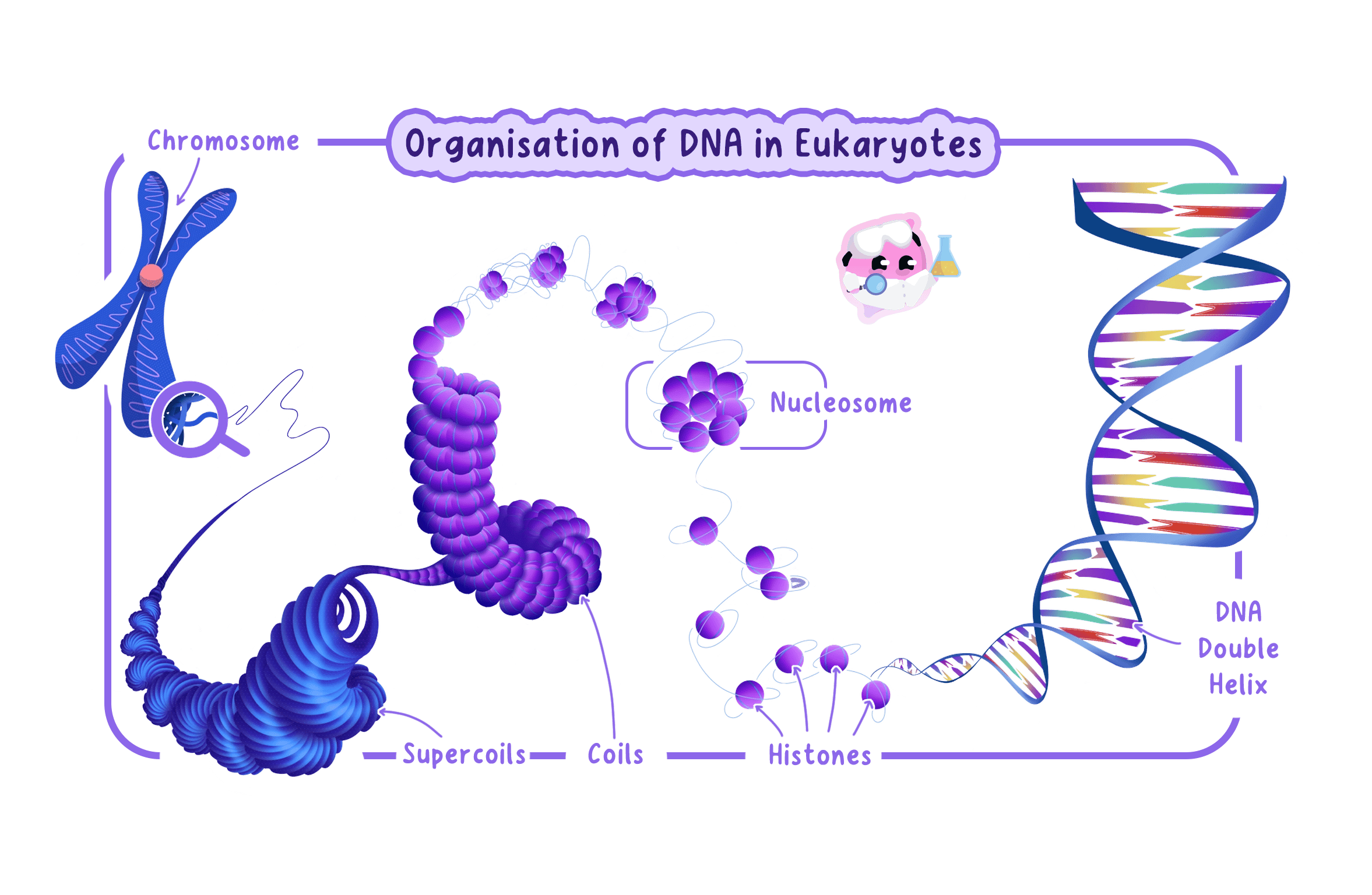
A genome is all of an organism's genetic material, a chromosome is a DNA-containing structure, and a gene is a section of DNA.
Alleles and characteristics
Allele
An allele is an alternative version of a gene.
Genotype
The genotype is the combination of alleles carried by an organism.
Phenotype
The phenotype is the observable or measurable characteristics of an organism produced by its genotype and its interaction with the environment.
- Individuals of the same species usually have the same types of genes but may carry different alleles of those genes.
- For a gene on an ordinary chromosome pair, an individual inherits one allele from each parent.
- A genotype describes the alleles present, whereas a phenotype describes the resulting observable or measurable characteristics.
- A phenotype can include a physical feature, such as flower colour, or a biochemical characteristic, such as a blood group.
- An organism's environment can also influence its phenotype, so knowing its genotype does not always predict its exact appearance or size.
Use gene for a section of DNA and allele for a version of that gene when explaining inherited differences.
Describing allele combinations
Dominant allele
A dominant allele determines the phenotype when present in a heterozygous genotype.
Recessive allele
A recessive allele determines the phenotype only when no dominant allele of the same gene is present.
Homozygous
Homozygous describes a genotype containing two identical alleles of a particular gene.
Heterozygous
Heterozygous describes a genotype containing two different alleles of a particular gene.
- For a simple gene with a dominant and a recessive allele, use the same letter in upper and lower case, such as AAA and aaa.
- The genotypes AAAAAA and aaaaaa are homozygous because each contains two copies of the same allele.
- The genotype AaAaAa is heterozygous because it contains two different alleles.
- With complete dominance, both AAAAAA and AaAaAa produce the dominant phenotype, whereas aaaaaa produces the recessive phenotype.
- A recessive allele is still present in a heterozygote and can be inherited even though it does not determine that individual's phenotype.
Dominant does not mean common, stronger or beneficial; it describes an allele's effect in a heterozygote.
Gametes carry inherited information
Gamete
A gamete is a haploid reproductive cell whose nucleus can fuse with another gamete nucleus during fertilisation.
- Animal gametes are sperm cells and egg cells, which carry genetic information from parents to offspring.
- The nucleus of each gamete carries one allele of each gene on an ordinary chromosome pair.
- When gamete nuclei fuse at fertilisation, their genetic information combines in the first cell of the offspring.
- This explains why an offspring inherits alleles from both parents while retaining its own combination of genetic information.
- How does a gene differ from a genome?
- What is an allele?
- How does genotype differ from phenotype?
- What makes a genotype heterozygous?
- What does a gamete carry from a parent?
