Efficiency measures biomass transfer
Definition
Biomass transfer efficiency
Biomass transfer efficiency is the percentage of biomass available at one trophic level that becomes new biomass at the next trophic level.
- Only part of the biomass available at one trophic level is converted into new biomass at the next level.
- Transfer efficiency describes how large that transferred part is compared with the starting amount.
- For a biomass transfer, use efficiency=biomass transferred to the next levelbiomass available at the previous level×100%\text{efficiency}=\dfrac{\text{biomass transferred to the next level}}{\text{biomass available at the previous level}}\times100\%efficiency=biomass available at the previous levelbiomass transferred to the next level×100%.
- Place the amount transferred in the numerator and the starting amount in the denominator.
- Use quantities measured on a comparable basis, including the same area and time period where those are specified.
- The masses must have the same units before division, so convert units first if necessary.
- Because identical units cancel in the ratio, an efficiency is given as a percentage, not in grams or kilograms.
Example
- Of 800 kg800\,\mathrm{kg}800kg of producer biomass available over a stated period, 120 kg120\,\mathrm{kg}120kg becomes new primary-consumer biomass.
- The transferred fraction is 120800=0.15\dfrac{120}{800}=0.15800120=0.15.
- The percentage transfer efficiency is 0.15×100%=15%0.15\times100\%=15\%0.15×100%=15%.
- The amount not transferred into that consumer biomass is 800−120=680 kg800-120=680\,\mathrm{kg}800−120=680kg.
- The percentage not transferred is 100%−15%=85%100\%-15\%=85\%100%−15%=85%.
Use the supplied values
- The often-used figure of about 10%10\%10% is an illustration, not a fixed value that applies to every ecosystem or feeding step.
- Differences in food digestibility, the proportion eaten and the amount used in respiration can produce different transfer efficiencies.
- An efficiency for one step cannot automatically be used for another step unless the question states that they are equal.
- Use the relevant data to calculate each transfer rather than replacing the data with an assumed percentage.
Common Mistake
Do not invert the fraction: dividing the larger starting biomass by the smaller transferred biomass gives a result above 100%100\%100% and does not calculate the transfer efficiency.
Convert units before dividing
- A mass stated in kilograms can be converted to grams using 1 kg=1000 g1\,\mathrm{kg}=1000\,\mathrm{g}1kg=1000g.
- Writing the conversion before the substitution makes it clear which quantities are being compared.
- Keep unrounded values during intermediate steps, then round the final result to the precision requested.
Example
- A transfer produces 450 g450\,\mathrm{g}450g of new consumer biomass from 3.0 kg3.0\,\mathrm{kg}3.0kg of available food biomass.
- Convert the starting mass: 3.0 kg=3000 g3.0\,\mathrm{kg}=3000\,\mathrm{g}3.0kg=3000g.
- Substitute comparable masses: efficiency=4503000×100%=15%\text{efficiency}=\dfrac{450}{3000}\times100\%=15\%efficiency=3000450×100%=15%.
- The same result follows from converting 450 g450\,\mathrm{g}450g to 0.450 kg0.450\,\mathrm{kg}0.450kg and calculating 0.4503.0×100%\dfrac{0.450}{3.0}\times100\%3.00.450×100%.
Calculate an unknown biomass
- To calculate the biomass transferred, multiply the starting biomass by the efficiency expressed as a decimal fraction.
- Use biomass transferred=starting biomass×percentage efficiency100\text{biomass transferred}=\text{starting biomass}\times\dfrac{\text{percentage efficiency}}{100}biomass transferred=starting biomass×100percentage efficiency.
- To calculate the starting biomass required, rearrange to starting biomass=biomass transferredpercentage efficiency/100\text{starting biomass}=\dfrac{\text{biomass transferred}}{\text{percentage efficiency}/100}starting biomass=percentage efficiency/100biomass transferred.
- A percentage must be divided by 100100100 before it is used as a multiplier, so 12%12\%12% becomes 0.120.120.12.
Example
- With a starting biomass of 250 kg250\,\mathrm{kg}250kg and an efficiency of 12%12\%12%, the transferred biomass is 250×0.12=30 kg250\times0.12=30\,\mathrm{kg}250×0.12=30kg.
- If 30 kg30\,\mathrm{kg}30kg is the transferred biomass and the efficiency is 12%12\%12%, the starting biomass is 300.12=250 kg\dfrac{30}{0.12}=250\,\mathrm{kg}0.1230=250kg.
- The reverse calculation gives a larger starting mass because only part of it was transferred.
Repeated transfers reduce available biomass
- Each additional feeding step retains only a fraction of the biomass available at the previous level.
- For successive transfers, multiply the fractional efficiencies rather than adding the percentage efficiencies.
- This means that the overall efficiency across several steps is smaller than the efficiency of an individual step.
Example
- Suppose 2000 kg2000\,\mathrm{kg}2000kg of producer biomass supplies a first transfer with efficiency 20%20\%20% and a second transfer with efficiency 15%15\%15%.
- The new primary-consumer biomass is 2000×0.20=400 kg2000\times0.20=400\,\mathrm{kg}2000×0.20=400kg.
- The new secondary-consumer biomass is 400×0.15=60 kg400\times0.15=60\,\mathrm{kg}400×0.15=60kg.
- The overall transfer from producers to secondary consumers is 602000×100%=3%\dfrac{60}{2000}\times100\%=3\%200060×100%=3%.
- Equivalently, 0.20×0.15=0.030.20\times0.15=0.030.20×0.15=0.03, which is 3%3\%3%, not 35%35\%35%.
Energy and biomass data
- An energy-transfer efficiency uses the same ratio method, but both quantities must be energy values, such as values measured in kJ\mathrm{kJ}kJ.
- Do not divide a biomass value in g\mathrm{g}g by an energy value in kJ\mathrm{kJ}kJ and label the result a percentage transfer efficiency.
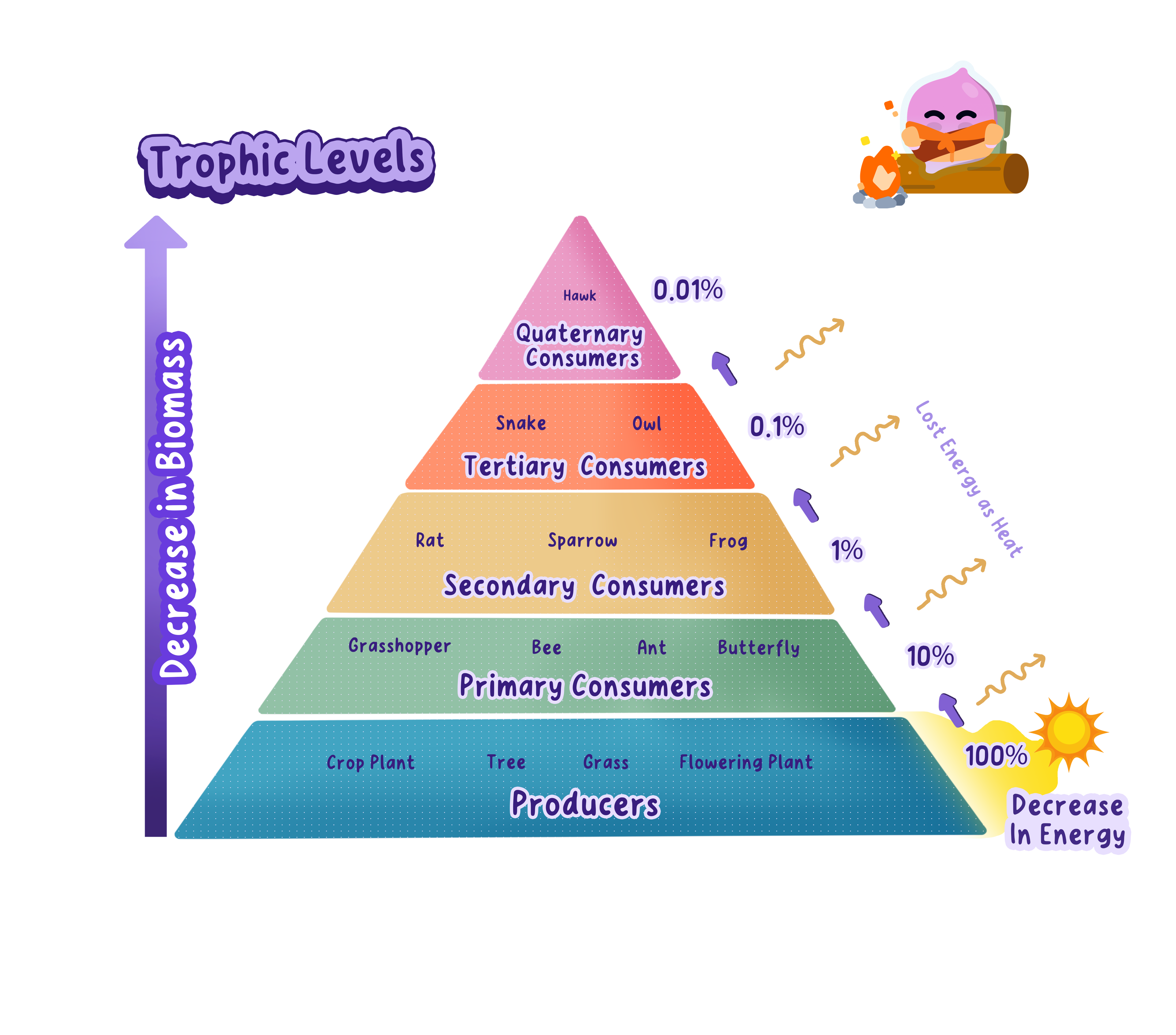
- The retained energy-pyramid diagram shows the declining energy supply through feeding levels and supports the explanation for limited food-chain length.
- A snapshot of biomass and a measured transfer over time describe different things, so interpret the quantities exactly as the data labels specify.
- When efficiencies are positive but below 100%100\%100%, energy and biomass available through that feeding route become progressively smaller, rather than suddenly disappearing at a fixed level.
Transfer losses limit food-chain length
- Biomass contains chemical energy that consumers need for maintenance, movement, growth and reproduction.
- At each feeding step, material fails to become new consumer biomass through the routes explained previously, leaving less biomass and associated energy for another level.
- Eventually the supply reaching a further level may be too small to maintain a viable population of consumers.
- This helps explain why food chains usually contain only a few trophic levels, rather than extending indefinitely.
- There is no single compulsory maximum number of levels: the amount produced at the base and the efficiencies of the transfers both affect what can be supported.
- Large top predators often occur at low densities and range over large areas to obtain enough prey.
- The percentages in this illustration show one possible sequence of transfers and should not replace measured values in a calculation.
Exam technique
- To explain a limit on food-chain length, link repeated inefficient transfers to too little biomass and energy reaching a further level to support a population.
- For a calculation, identify the two levels being compared, show the substituted values and state the final percentage.
Self review
- Which biomass belongs in the denominator of a transfer-efficiency calculation?
- Why must the two masses use the same units?
- How is a percentage converted into a multiplier?
- Why are successive transfer efficiencies multiplied rather than added?
- How do inefficient transfers limit the length of a food chain?
