Monomers and polymers
Monomer
A small molecule that can be joined to many others of the same kind to build a polymer.
Polymer
A large molecule built from many monomers joined together in a long chain.
Carbohydrate
A biological molecule made of carbon, hydrogen and oxygen only, built from sugar monomers and used mainly to release or store energy.
- A monomer is a small molecule that can be joined to many others of the same kind, and a polymer is the long chain that results.
- Cells build almost every large molecule this way, because it needs only a small set of subunits and one joining reaction to make an enormous variety of products.
- A carbohydrate is a molecule made of carbon, hydrogen and oxygen only, and its monomers are simple sugars.
- Glucose, the commonest of those sugars, has the formula C6H12O6C_6H_{12}O_6C6H12O6, so its ratio of carbon to hydrogen to oxygen is 1:2:11:2:11:2:1.
- Every carbohydrate keeps roughly that ratio, which is why carbohydrates hold so much oxygen compared with the other groups of biological molecule.
- The same joining reaction builds a carbohydrate from sugars, and the reverse reaction takes it apart again when the cell needs the sugars back.
- The word sugar covers both the single units and the small molecules made from two of them joined together.
- A polymer is not a mixture of different molecules; it is one molecule made of many repeats of the same kind of subunit.
Sugars as the monomers of carbohydrates
Monosaccharide
A single sugar unit, such as glucose or fructose, which is the monomer of every carbohydrate.
Disaccharide
A sugar made of two monosaccharides joined together by a condensation reaction, such as maltose or sucrose.
- A monosaccharide is a single sugar unit, and it is the monomer from which every carbohydrate is assembled.
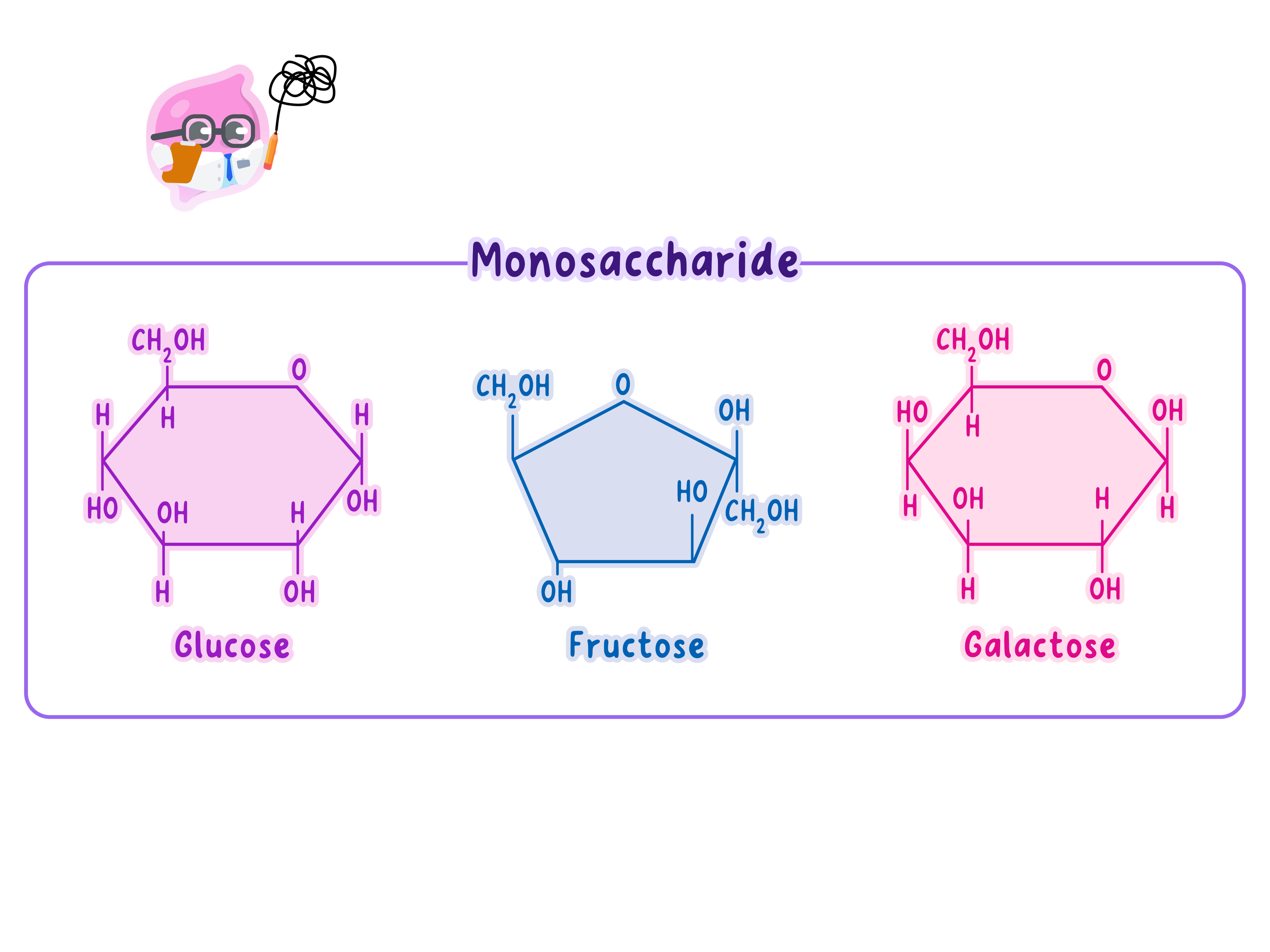
- Glucose, fructose and galactose are the monosaccharides you need to recognise, and all three share the formula C6H12O6C_6H_{12}O_6C6H12O6.
- They share a formula but not a shape, because their atoms are arranged differently, so they taste different and enzymes treat them differently.
- Glucose and galactose form six-sided rings while fructose forms a five-sided ring.
- A plant cell makes its own glucose by photosynthesis, while an animal cell receives glucose from digested food carried in the blood.
- A disaccharide is made when two monosaccharides are joined together.
- Maltose is glucose joined to glucose, sucrose is glucose joined to fructose, and lactose is glucose joined to galactose.
- Sucrose is the sugar a plant moves around in its phloem, and lactose is the sugar in milk.
- Both monosaccharides and disaccharides are soluble in water and taste sweet, which is what everyday use of the word sugar refers to.
Building and breaking carbohydrates
Condensation reaction
A reaction in which two smaller molecules join together and one molecule of water is released.
Hydrolysis
A reaction in which a large molecule is split into smaller ones by adding a molecule of water at each bond broken.
- A condensation reaction joins two sugars together and releases one molecule of water as the new bond forms.
- The water comes from the two sugars themselves, because a hydrogen atom is taken from one and a hydroxyl group from the other.
- Building a long chain means repeating that reaction, so joining nnn monomers into one polymer releases n−1n-1n−1 molecules of water.
- The reactions are controlled by enzymes and driven by energy from ATP, which is why a growing cell needs a fast supply of it.
- Hydrolysis is the reverse reaction, in which a molecule of water is added at each bond to break the chain back into its monomers.
- Hydrolysis is what happens when a carbohydrase enzyme digests a carbohydrate, so amylase hydrolyses starch and maltase hydrolyses maltose.
- Hydrolysis is essential because a polymer is far too large to cross a cell membrane, while a single sugar is small enough to be absorbed.
- Taken together, the two reactions let a cell store glucose safely when it is plentiful and release it again the moment it is needed.
Counting the water molecules released
- A plant cell joins 500500500 glucose molecules into one chain of starch.
- Each new bond releases one molecule of water, and a chain of 500500500 units contains 499499499 bonds.
- The number of water molecules released is therefore 500−1=499500 - 1 = 499500−1=499.
- Hydrolysing that chain back to single glucose molecules would use up the same 499499499 molecules of water.
- Do not describe condensation as adding water, because water is released when the bond forms and used up when it is broken.
- Do not treat glucose, fructose and galactose as the same molecule just because they share a formula, since their atoms are arranged differently.
- Do not call starch a sugar, because sugars are the small soluble molecules and starch is the insoluble polymer built from them.
The three polysaccharides
Polysaccharide
A carbohydrate polymer made of many monosaccharides joined in a long chain, such as starch, glycogen or cellulose.
Starch
The coiled, partly branched polysaccharide of glucose monomers that plants use to store glucose.
Glycogen
The highly branched polysaccharide of glucose monomers that animals and fungi use to store glucose, held mainly in the liver and muscles.
Cellulose
The polysaccharide of straight glucose chains, cross-linked into strong fibres, that forms the cell wall of a plant cell.
- A polysaccharide is a carbohydrate polymer of many monosaccharides joined in a long chain.
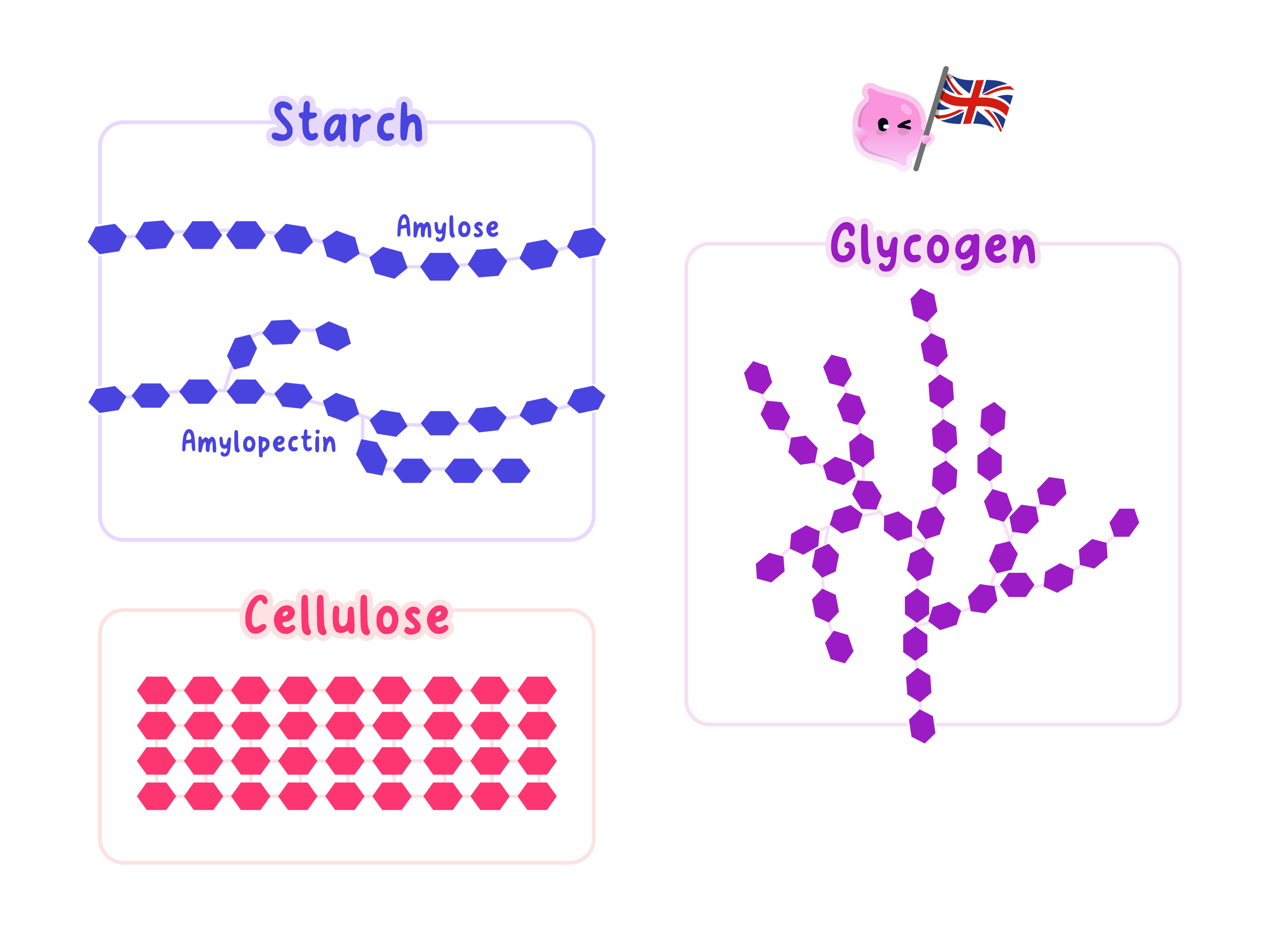
- Starch is the polysaccharide a plant uses to store glucose, and it is built from glucose monomers alone.
- Its chains are coiled, and some of them branch, which packs a very large number of glucose units into a small space inside a cell.
- Starch is insoluble, so it does not dissolve in the cytoplasm and does not draw water into the cell by osmosis the way stored glucose would.
- A plant lays down starch in its leaves during the day and in storage organs such as potato tubers and seeds for the longer term.
- Glycogen is the equivalent store in animals and fungi, and it is also built from glucose monomers alone.
- Its chains are much more highly branched than those of starch, which means many chain ends are exposed at once.
- Every exposed end is a place an enzyme can start hydrolysing, so glycogen can be broken back down to glucose very quickly when demand rises.
- That matters because an animal can move suddenly and needs glucose released within seconds, which is why glycogen is stored in the liver and muscles.
- Cellulose is not a store at all; it is a structural polysaccharide, and it too is built from glucose.
- Its glucose units are joined so that the chains stay straight rather than coiling, and neighbouring chains are then cross-linked to one another.
- Bundles of cross-linked chains form strong fibres that are laid down in layers to make the cell wall of a plant cell.
- Those fibres are what let a plant cell resist the outward pressure of the water inside it without bursting, and what makes celery stringy and wood strong.
- All three are made from the same monomer, so it is the arrangement of the chains, not the subunit, that decides what each polysaccharide can do.
Linking a polysaccharide to its job
- Name the monomer as glucose for starch, glycogen and cellulose alike, because all three are built from it.
- Follow a structural feature with the consequence it has, for example that heavy branching gives many ends for enzymes to work on.
- Say insoluble rather than does not dissolve well when you explain why starch is a safe store inside a cell.
- Use the word condensation for building and hydrolysis for breaking down, and state whether water is released or used.
- Give a plant example and an animal example when a question asks about storage, since a single example often limits the marks available.
- State what is meant by a monomer and by a polymer.
- Name the three monosaccharides and give the formula they share.
- Describe what happens to a molecule of water when two sugars are joined by a condensation reaction.
- Explain why glycogen can be broken down to glucose faster than starch can.
- Explain how the arrangement of cellulose chains suits the job of a plant cell wall.
