Amino acids as the monomers of proteins
Definition
Amino acid
The monomer from which every protein is built; there are about twenty different amino acids and they can be joined in any order.
Definition
Polymer
A large molecule built from many monomers joined together in a long chain.
- An amino acid is the monomer from which every protein is built, and a protein is the polymer that results from joining them.
- Amino acids contain carbon, hydrogen, oxygen and nitrogen, and a few of them contain sulfur as well.
- Nitrogen is what sets proteins apart from carbohydrates and lipids, which contain no nitrogen at all.
- There are about twenty different amino acids available to a cell, and each one has a different side group attached to the same basic structure.
- Because the basic structure is the same in every amino acid, any one of them can be joined to any other, in any order.
- The sequence, meaning the order in which the amino acids are joined, is different for every different protein.
- A short chain is called a polypeptide, and a protein is one or more of those chains folded into its finished shape.
- Even a small protein of a hundred amino acids can be assembled in an almost unimaginable number of different orders, which is why one set of twenty monomers can build every protein a body needs.
- A plant makes all its own amino acids by combining sugars with nitrates taken up from the soil, while an animal has to obtain most of its from protein in food.
Note
- The sequence of amino acids in a protein is set by the order of bases in the gene that codes for it.
- Change one amino acid in the sequence and the protein that is built is a different molecule, even though it is the same length.
Building and breaking proteins
Definition
Condensation reaction
A reaction in which two smaller molecules join together and one molecule of water is released.
Definition
Hydrolysis
A reaction in which a large molecule is split into smaller ones by adding a molecule of water at each bond broken.
- Amino acids are joined by condensation reactions, and each new bond releases one molecule of water.
- Joining nnn amino acids into a single chain therefore forms n−1n-1n−1 bonds and releases n−1n-1n−1 molecules of water.
- The joining happens on the ribosomes, and the energy needed for it comes from ATP supplied by respiration.
- Hydrolysis breaks a protein back down, adding one molecule of water at each bond to release the individual amino acids again.
- Protease enzymes hydrolyse the protein in food during digestion, because a whole protein molecule is far too large to be absorbed.
- The amino acids released are absorbed into the blood and delivered to cells, which then join them together in a completely new order to build the proteins that body needs.
- A protein eaten in a meal is therefore not used as it is; it is taken apart into its monomers and those monomers are reassembled.
- Amino acids cannot be stored, so any that are surplus to requirements are broken down in the liver rather than kept for later.
- Proteins in the body are also being hydrolysed and rebuilt all the time, which is why a steady supply of amino acids is needed even in an adult who is no longer growing.
Example
Counting the water released when a protein is built
- A cell joins 124124124 amino acids into a single polypeptide chain.
- A chain of 124124124 units is held together by 124−1=123124 - 1 = 123124−1=123 bonds.
- Each bond forms in a condensation reaction that releases one molecule of water, so 123123123 molecules of water are released.
- Hydrolysing the same chain right back to single amino acids would use up those same 123123123 molecules of water.
Folding gives each protein its shape
Definition
Protein
A polymer made of one or more chains of amino acids folded into a specific three-dimensional shape that suits the job it does.
- Once the chain has been assembled it does not stay stretched out; it folds into a particular three-dimensional shape.
- The folded shape is held in place by bonds between different parts of the same chain, formed wherever two side groups come close enough to attract one another.
- Which side groups end up close together depends entirely on the sequence, so the sequence determines the shape.
- A different sequence brings different side groups together, folds into a different shape, and therefore produces a protein that does a different job.
- Most proteins work by binding to another molecule, and binding only happens when the two shapes are complementary, which means they fit together.
- An enzyme is a protein whose folded shape leaves a pocket called the active site, and only a substrate with a matching shape will fit into it.
- The same principle explains why an antibody binds to one pathogen and not another, and why a receptor in a cell membrane responds to one hormone only.
- Structural proteins are shaped for strength instead of binding, which is how collagen makes tendons tough and keratin makes hair and nails hard.
- Carrier proteins in a cell membrane are folded so that a channel runs right through them, which is what lets particular substances pass into and out of the cell.
What happens when a protein loses its shape
Definition
Denaturation
The permanent change in the folded shape of a protein, caused by a high temperature or an extreme pH, which stops the protein working.
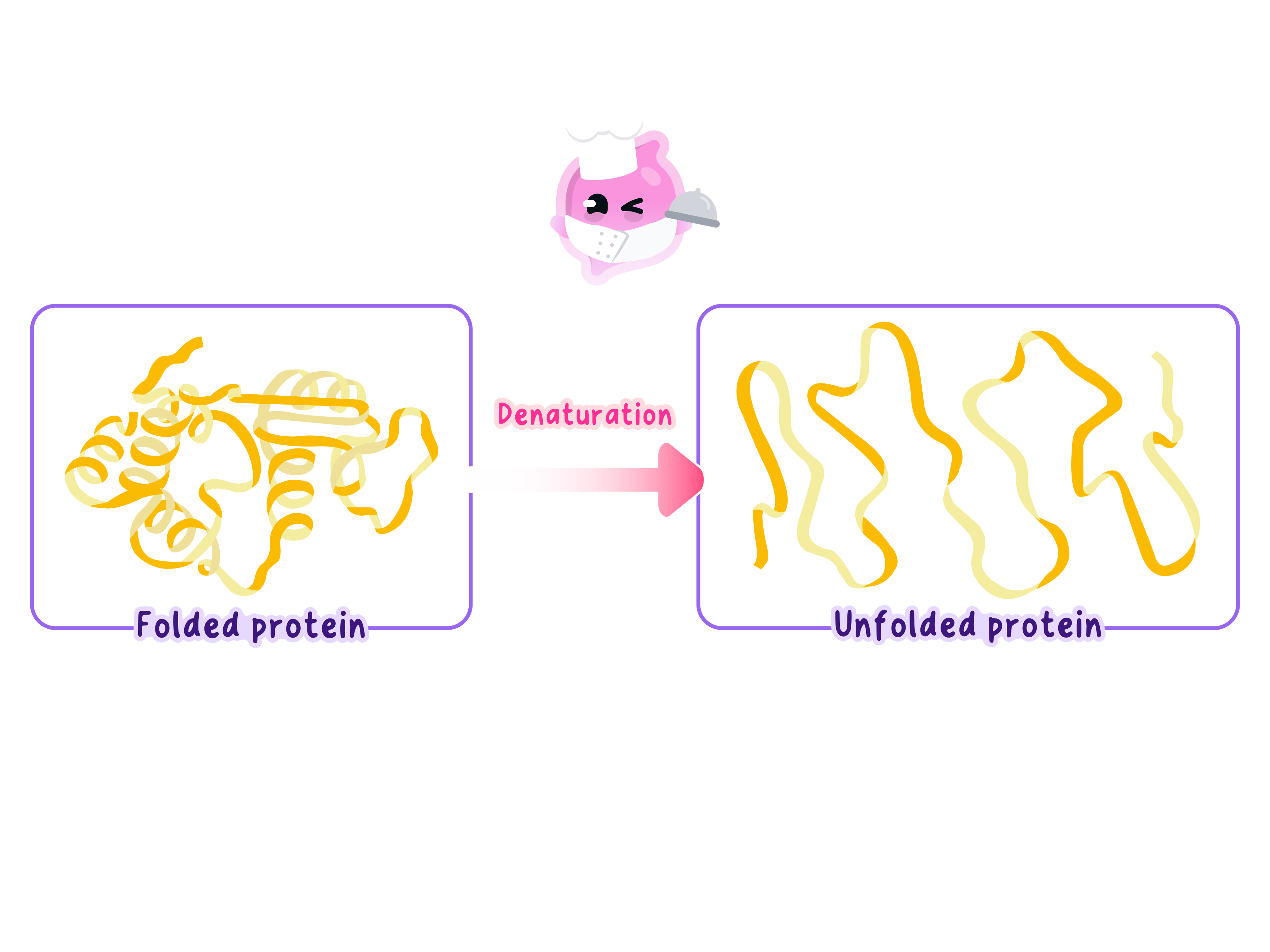
- Denaturation is the permanent change in a protein's folded shape that happens when the bonds holding the fold together are broken.
- A high temperature breaks those bonds because the chain vibrates so strongly that the weak attractions between side groups cannot hold.
- An extreme pH breaks them because it changes the charge on the side groups, so groups that were attracting each other no longer do.
- Once the fold is lost the chain takes up a different shape, and the binding site it used to carry no longer fits the molecule it was built for.
- The sequence of amino acids is not affected, because the bonds joining the amino acids into a chain are much stronger than the ones holding the fold.
- Denaturation is not reversible, so a denatured protein cannot be cooled or neutralised back into working order.
- You see it happen every time an egg is fried, because the clear runny protein in the white turns solid and white as it denatures and does not turn back.
Common Mistake
- Do not say an enzyme is killed by heat, because an enzyme is a molecule and was never alive; the correct word is denatured.
- Do not write that the amino acid sequence changes when a protein denatures, because only the folding is lost.
- Do not treat denaturation as temporary, since a denatured protein does not refold when the conditions are put back to normal.
- Do not describe a protein as simply a chain of amino acids when a question asks about function, because it is the folded shape that does the work.
Exam technique
Writing about protein structure and function
- Run the chain of reasoning in order when you explain function: sequence, then folding, then shape, then the molecule it binds.
- Use the word complementary for two shapes that fit together, rather than saying they are the same shape.
- Name the reaction as condensation when proteins are built and hydrolysis when they are digested, and say whether water is released or used.
- Give a specific protein and its job when a question asks for an example, because enzymes, antibodies and collagen all do different things.
- Say denatured, then add that the shape of the binding site has changed, since the term on its own seldom gains the explanation mark.
Self review
- Name the monomer of a protein and state which four elements it always contains.
- Explain how many molecules of water are released when 606060 amino acids are joined into one chain.
- Explain why the sequence of amino acids decides what a protein can do.
- Describe two conditions that cause a protein to become denatured.
- Explain why a protein eaten in food has to be hydrolysed before the body can use it.
