Aerobic respiration
Definition
Aerobic respiration
Respiration that uses oxygen to break glucose down completely into carbon dioxide and water, transferring enough energy to make a large yield of ATP.
Definition
Mitochondrion
The organelle that contains the enzymes for aerobic respiration and is where most of a cell's energy is released.
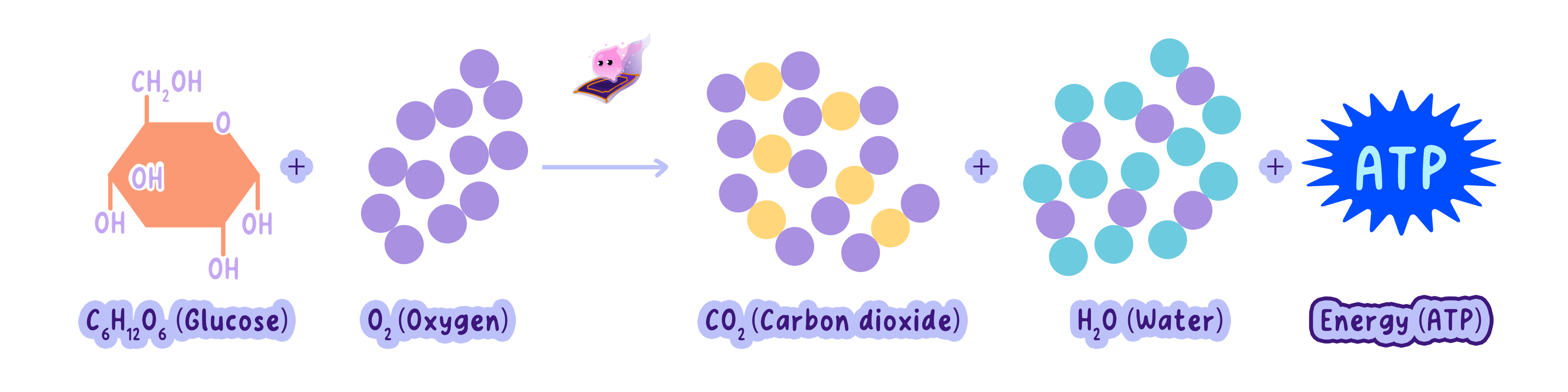
- Aerobic respiration is respiration that uses oxygen, and it is the pathway a cell uses whenever enough oxygen is reaching it.
- The substrate is glucose, and because oxygen is available the glucose is broken down completely.
- Complete breakdown means every carbon atom in the glucose ends up in carbon dioxide and every hydrogen atom ends up in water, so none of the chemical energy is left locked in a leftover molecule.
- The word equation is glucose + oxygen →\rightarrow→ carbon dioxide + water.
- The balanced symbol equation is C6H12O6+6O2→6CO2+6H2OC_6H_{12}O_6 + 6O_2 \rightarrow 6CO_2 + 6H_2OC6H12O6+6O2→6CO2+6H2O.
- Check the balancing by counting atoms: there are 666 carbon, 121212 hydrogen and 181818 oxygen atoms on each side of the arrow.
- The first steps take place in the cytoplasm, and the reactions that need oxygen are completed inside the mitochondria.
- A cell with a heavy demand for ATP, such as a muscle fibre or a liver cell, is therefore packed with mitochondria.
- Because the glucose is used up completely, aerobic respiration gives a large yield of ATP, roughly thirty molecules of ATP from each molecule of glucose.
- Oxygen has to be delivered continuously by the blood, so the maximum rate of aerobic respiration is set by how fast the heart and lungs can supply it.
Common Mistake
- Do not give heat or energy as a product in the equation, because the products are carbon dioxide and water and the energy is transferred to ATP.
- Do not write that aerobic respiration happens only in mitochondria, because the first stage takes place in the cytoplasm.
- Do not forget the large numbers in the symbol equation, since an unbalanced equation earns no mark.
Anaerobic respiration in animal cells
Definition
Anaerobic respiration
Respiration that breaks glucose down incompletely without using oxygen, giving a much smaller yield of ATP.
- Anaerobic respiration is respiration without oxygen, and an animal cell switches to it when oxygen is being used faster than the blood can deliver it.
- The clearest example is a muscle during vigorous exercise, when the heart and lungs cannot keep up with the demand of the working fibres.
- The substrate is still glucose, but without oxygen the glucose is broken down only incompletely.
- The word equation is glucose →\rightarrow→ lactic acid.
- All of these reactions happen in the cytoplasm, because the stages that use the mitochondria cannot run without oxygen.
- The yield of ATP is small, only about two molecules of ATP per molecule of glucose, which is roughly fifteen times less than the aerobic pathway gives.
- The yield is small because lactic acid still holds a great deal of unreleased chemical energy in its bonds.
- The advantage of the pathway is speed, because it supplies ATP quickly enough to keep a muscle contracting during a short burst of hard effort.
- The disadvantage is that lactic acid builds up in the muscle and the blood, causing muscle fatigue and pain, so the pathway can only be used for a short time.
- The lactic acid is later broken down once oxygen is available again, which is why heavy breathing continues after the exercise has stopped.
Common Mistake
- Do not name carbon dioxide or water as products of anaerobic respiration in an animal cell, because the only product is lactic acid.
- Do not say the muscle runs out of oxygen completely, since anaerobic respiration takes over when oxygen supply falls behind demand.
- Do not claim anaerobic respiration releases no energy, because it still transfers enough to make a small amount of ATP.
Anaerobic respiration in plant and fungal cells
Definition
Fermentation
Anaerobic respiration in plant and yeast cells, in which glucose is broken down into ethanol and carbon dioxide.
- In plant cells and in fungi such as yeast, anaerobic respiration follows a different route and is called fermentation.
- The conditions are the same, which is an absence of oxygen, and the substrate is again glucose broken down incompletely.
- The word equation is glucose →\rightarrow→ ethanol + carbon dioxide.
- These reactions also take place entirely in the cytoplasm, and the yield is the same small amount of about two molecules of ATP per glucose.
- The energy that is not transferred stays locked in the bonds of the ethanol, which is why ethanol burns so readily.
- Plant roots ferment when the soil becomes waterlogged, because water fills the air spaces and no oxygen can reach them.
- Yeast ferments whenever it is sealed away from air, which is what makes it useful for making bread and for brewing.
Example
Fermentation in a loaf and in a brewery
- A baker mixes yeast into dough, where the yeast ferments the sugars in the flour.
- The carbon dioxide released is trapped as bubbles in the stretchy dough, which is what makes the loaf rise.
- The small amount of ethanol produced evaporates in the heat of the oven, so the baked bread contains none.
- A brewer keeps yeast in a sealed vessel of sugary liquid so that no oxygen gets in and fermentation continues.
- Here it is the ethanol that is wanted and the carbon dioxide that bubbles away, which is the same reaction being used for the opposite product.
Comparing the pathways
- Conditions
- Aerobic respiration needs a supply of oxygen, while both forms of anaerobic respiration run only when oxygen is absent or in short supply.
- Substrate
- All three pathways start with glucose, so the substrate is not what makes them different.
- Extent of breakdown
- Aerobic respiration breaks the glucose down completely, whereas anaerobic respiration leaves an energy-rich product behind.
- Products
- Aerobic respiration gives carbon dioxide and water, an animal cell respiring anaerobically gives lactic acid, and a plant or yeast cell gives ethanol and carbon dioxide.
- Site in the cell
- Aerobic respiration begins in the cytoplasm and is completed in the mitochondria, while anaerobic respiration is confined to the cytoplasm.
- Relative yield of ATP
- Aerobic respiration gives roughly thirty ATP per glucose and anaerobic respiration only about two, so the aerobic pathway is around fifteen times more productive.
- A cell will always use the aerobic pathway when it can, because using glucose anaerobically wastes most of the energy the molecule holds.
Example
How much more ATP the aerobic pathway gives
- A muscle fibre respires 121212 molecules of glucose aerobically.
- At about 303030 molecules of ATP per glucose, that gives 12×30=36012 \times 30 = 36012×30=360 molecules of ATP.
- The same 121212 molecules of glucose respired anaerobically give only 12×2=2412 \times 2 = 2412×2=24 molecules of ATP.
- The ratio is 36024=15\dfrac{360}{24} = 1524360=15, so the fibre would need fifteen times as much glucose to do the same work without oxygen.
Exam technique
Comparing the two types of respiration
- Compare the pathways point by point on the same features: oxygen, extent of breakdown, products, site and ATP yield.
- Use comparative wording such as more ATP than or less complete than, because two separate descriptions with no link do not answer a compare question.
- Name lactic acid for animal cells and ethanol with carbon dioxide for plant and yeast cells, since the marks are usually split between the two.
- Write about a relatively large or relatively small yield of ATP if you are unsure of the figures, because the comparison is what is being assessed.
- Balance the symbol equation before moving on, and keep the state of every substance consistent across the arrow.
Self review
- Write the balanced symbol equation for aerobic respiration and check that it balances.
- State where in a cell each stage of aerobic respiration takes place.
- Give the word equation for anaerobic respiration in a muscle cell and name the product.
- Give the word equation for fermentation in yeast and name both products.
- Explain why anaerobic respiration transfers so much less energy from each glucose molecule than aerobic respiration does.
