Eukaryotic and prokaryotic cells
Eukaryotic cell
A cell whose genetic material is enclosed inside a nucleus.
Prokaryotic cell
A cell whose genetic material lies free in the cytoplasm rather than inside a nucleus.
Organelle
A structure inside a cell that is specialised to carry out one particular function.
- Every living organism is built from cells, and all cells fall into one of two groups according to where the genetic material is kept.
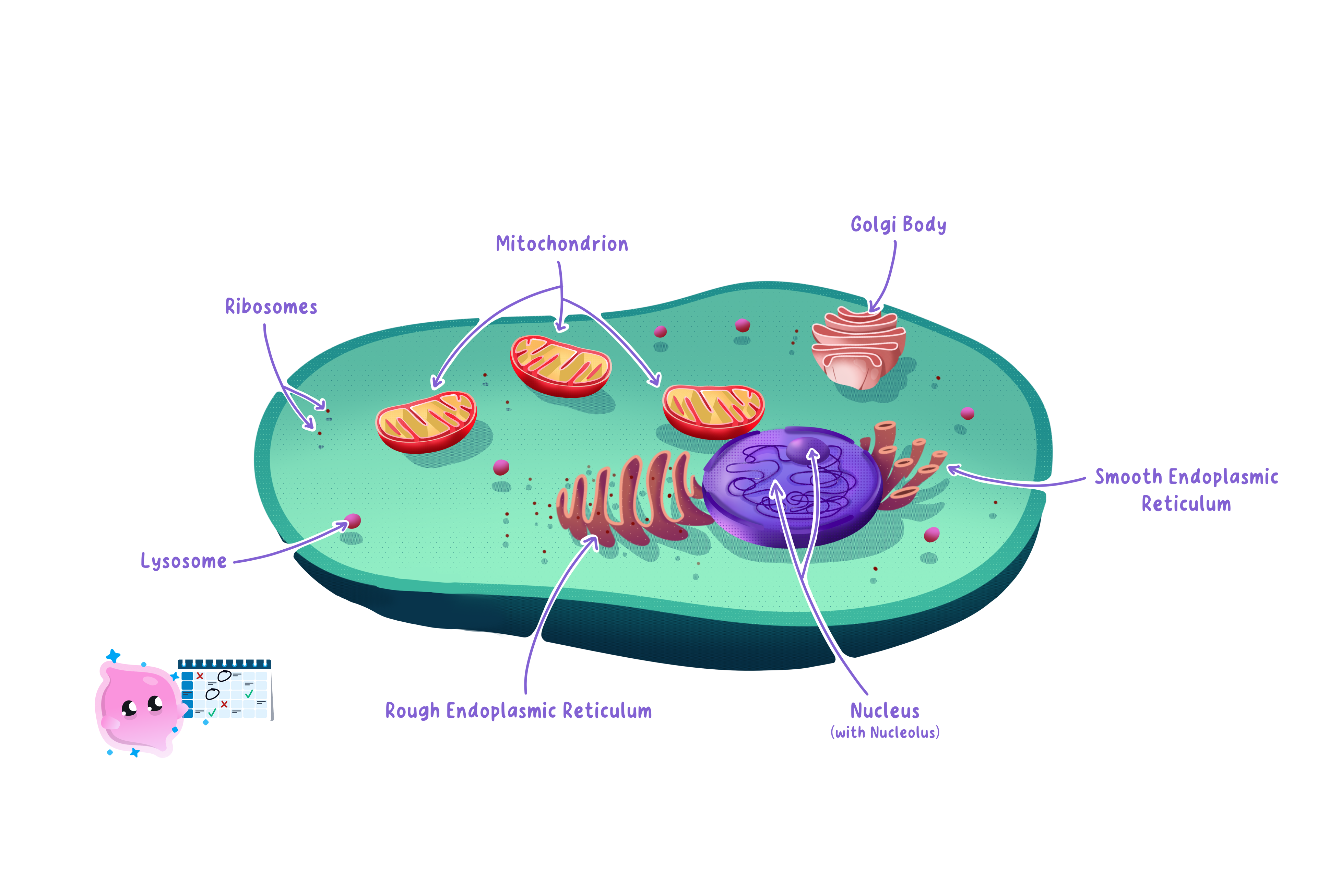
- A eukaryotic cell keeps its genetic material inside a nucleus, a compartment sealed off by its own membrane, and animals, plants and fungi are all built from eukaryotic cells.
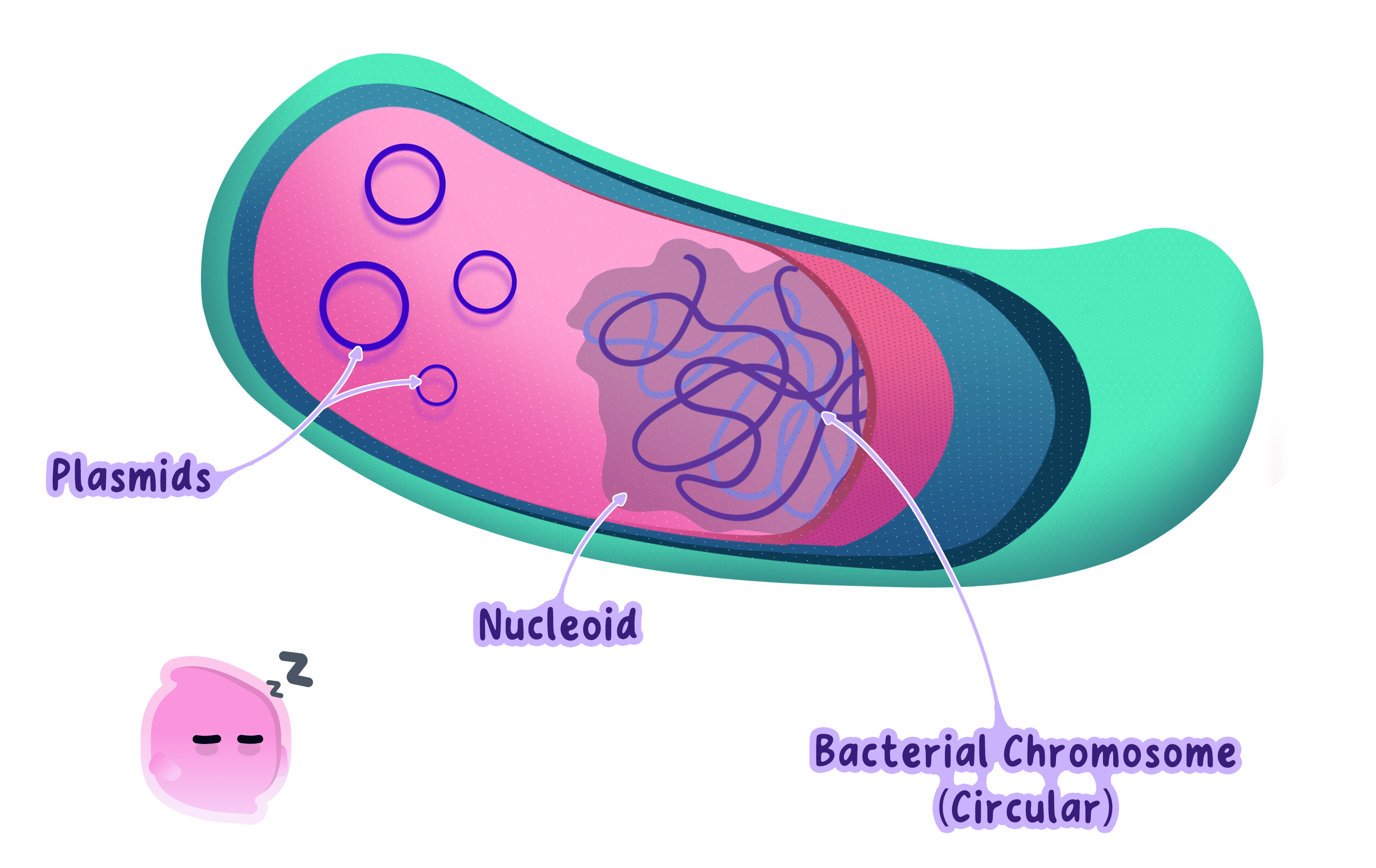
- A prokaryotic cell has no nucleus, so its genetic material lies loose in the cytoplasm, and bacteria are prokaryotic.
- Eukaryotic cells are much the larger of the two, typically 10 μm10\ \mu\text{m}10 μm to 100 μm100\ \mu\text{m}100 μm across, while prokaryotic cells are typically 1 μm1\ \mu\text{m}1 μm to 5 μm5\ \mu\text{m}5 μm long.
- A eukaryotic cell contains many membrane-bound organelles, each a separate compartment specialised for one job.
- Dividing the cell into compartments lets different reactions run at the same time without interfering with one another, because each organelle holds the particular enzymes its own reaction needs.
- A prokaryotic cell has no membrane-bound organelles at all, so its reactions take place in the cytoplasm or at the cell membrane.
- Both types of cell have cytoplasm, a cell membrane and ribosomes, because every cell has to hold its contents together, control what crosses its surface and make its own proteins.
- A prokaryotic cell is a complete living cell in its own right, not a simplified piece of a eukaryotic one.
- The absence of a nucleus is the single feature that defines a prokaryotic cell, so start there whenever you are asked to tell the two types apart.
Where the genetic material is kept
Nucleus
The membrane-bound organelle that contains the chromosomes and controls the activities of the cell.
Chromosome
A long, coiled molecule of DNA that carries the genes of an organism.
Plasmid
A small circular loop of DNA in the cytoplasm of a prokaryotic cell, separate from its main chromosome.
- The nucleus of a eukaryotic cell is enclosed by its own membrane and is usually the largest structure that can be picked out under a light microscope.
- Inside the nucleus the DNA is coiled into long structures called chromosomes, and a human body cell holds 464646 of them arranged in 232323 pairs.
- Each chromosome carries many genes, and a gene is a length of DNA that codes for one protein.
- The nucleus controls the activities of the cell because the proteins built from those instructions include the enzymes that decide which reactions the cell can carry out.
- Enclosing the DNA in a membrane keeps it apart from the reactions going on in the surrounding cytoplasm, which protects it from damage.
- A prokaryotic cell instead has a single circular loop of DNA lying free in the cytoplasm, and this loop does the job the chromosomes do in a eukaryotic cell.
- Many prokaryotic cells also carry plasmids, which are small extra rings of DNA kept separate from the main loop.
- A plasmid usually carries genes that are only useful in particular conditions, such as genes giving resistance to an antibiotic.
- Plasmids can be copied and passed from one bacterium to another, so a useful gene can spread through a population of bacteria quickly.
- Do not confuse a plasmid with a nucleus, because a plasmid is a small ring of DNA and a nucleus is a membrane-bound compartment.
- Do not write that a bacterium has no DNA, because it has a circular chromosome lying free in its cytoplasm.
- Do not say the nucleus makes the proteins, because it holds the instructions and the proteins are built elsewhere.
Mitochondria, chloroplasts and ribosomes
Mitochondrion
The organelle that contains the enzymes for aerobic respiration and is where most of a cell's energy is released.
Chloroplast
The organelle in plant and algal cells that contains chlorophyll and is the site of photosynthesis.
Chlorophyll
The green pigment held inside chloroplasts that absorbs the light energy used in photosynthesis.
Ribosome
The sub-cellular structure in the cytoplasm at which amino acids are joined together to make a protein.
- Mitochondria are rod-shaped organelles with a double membrane, and the inner one is deeply folded.
- They hold the enzymes that catalyse the reactions of aerobic respiration, which is the process that transfers energy from glucose for the cell to use.
- The folds of the inner membrane give a large surface area for those enzymes, so more respiration can take place inside the same small volume.
- Cells that use a great deal of energy contain far more mitochondria, so a muscle cell holds thousands while a fat-storage cell holds very few.
- The number of mitochondria in a cell is therefore a direct clue to how much energy that cell demands.
- Chloroplasts are found in plant and algal cells and are the site of photosynthesis.
- Each chloroplast contains chlorophyll, the green pigment that absorbs the light energy used to build glucose from carbon dioxide and water.
- The chlorophyll is held on stacks of internal membranes, which spreads it out so that as much light as possible is absorbed.
- Chloroplasts are found only in the plant cells that receive light, so leaf cells are packed with them and root cells have none.
- Ribosomes are the smallest of these organelles and are the site of protein synthesis.
- At a ribosome, amino acids are joined together in the order coded by a gene, and the chain that results is a protein.
- Ribosomes are found in every cell, prokaryotic cells included, because every cell has to build its own enzymes and other proteins.
- Some ribosomes float free in the cytoplasm while others are attached to membranes, and a cell that secretes a lot of protein carries very large numbers of them.
Reading a cell's job from its organelles
- A heart muscle cell contracts without resting and needs a constant supply of energy, so it is packed with mitochondria.
- A palisade cell sits just below the upper surface of a leaf where the light is strongest, so it is packed with chloroplasts.
- A gland cell in the pancreas releases large amounts of digestive enzyme, so it carries an unusually high number of ribosomes.
- A root hair cell absorbs water and mineral ions but never receives light, so it has many mitochondria and no chloroplasts.
The cell membrane and its receptors
Cell membrane
The partially permeable layer around every cell that controls which substances enter and leave it.
Partially permeable
Describing a membrane that lets some substances pass through it while holding others back.
Receptor molecule
A protein in the cell membrane that binds to one specific substance and triggers a response inside the cell.
- The cell membrane surrounds every cell, holding the cytoplasm and organelles inside and separating them from the surroundings.
- It is built from a double layer of lipid molecules with proteins set into it, which is why it is flexible rather than rigid.
- The membrane acts as a selective barrier because it is partially permeable, letting some substances through while holding others back.
- Small molecules such as oxygen, carbon dioxide and water cross it easily, while large molecules such as starch and proteins, and charged ions, do not cross freely.
- Controlling what crosses the surface lets the cell hold its internal conditions steady even when the surroundings change, and steady conditions are what keep its enzymes working.
- The membrane also carries receptor molecules, which are proteins that project from its outer surface.
- Each receptor has a shape that matches one particular molecule, so only that molecule can bind to it.
- When the matching molecule binds, the receptor sets off a change inside the cell, which is how a cell detects a chemical signal and responds to it.
- Different cells carry different receptors, so a hormone carried in the blood past every cell in the body changes the behaviour of only the cells whose receptors match it.
- Do not describe the cell membrane as fully permeable, because it lets some substances through and blocks others.
- Do not swap the roles of the membrane and the wall, because the membrane controls what enters and leaves while the wall supports the cell.
Structures found only in plant cells
Cytoplasm
The jelly-like material inside a cell in which most of the cell's chemical reactions take place.
Cell wall
The rigid layer of cellulose outside the cell membrane of a plant cell that supports and strengthens it.
Permanent vacuole
The large fluid-filled sac in a plant cell that contains cell sap and helps keep the cell firm.
- Cytoplasm fills both plant and animal cells, holds the organelles in place and is where most of the cell's chemical reactions happen.
- A plant cell has three structures that an animal cell never has: a cell wall, a permanent vacuole and chloroplasts.
- The cell wall lies outside the cell membrane and is made of cellulose, a tough carbohydrate laid down as criss-crossing fibres.
- Those crossed fibres make the wall strong in every direction, so it stops the cell bursting when water enters and holds the plant upright.
- The wall is fully permeable, so it plays no part in choosing what enters the cell, and that job is left entirely to the membrane beneath it.
- The permanent vacuole is a large sac filled with cell sap, a solution of sugars and mineral ions.
- A full vacuole pushes the cytoplasm outwards against the wall and keeps the cell firm, and a plant whose cells lose that pressure wilts.
- The vacuole also stores the sugars and ions the cell is not using at that moment.
- Fungal cells also have a cell wall, but it is made of chitin rather than cellulose, and a fungal cell has no chloroplasts because it does not photosynthesise.
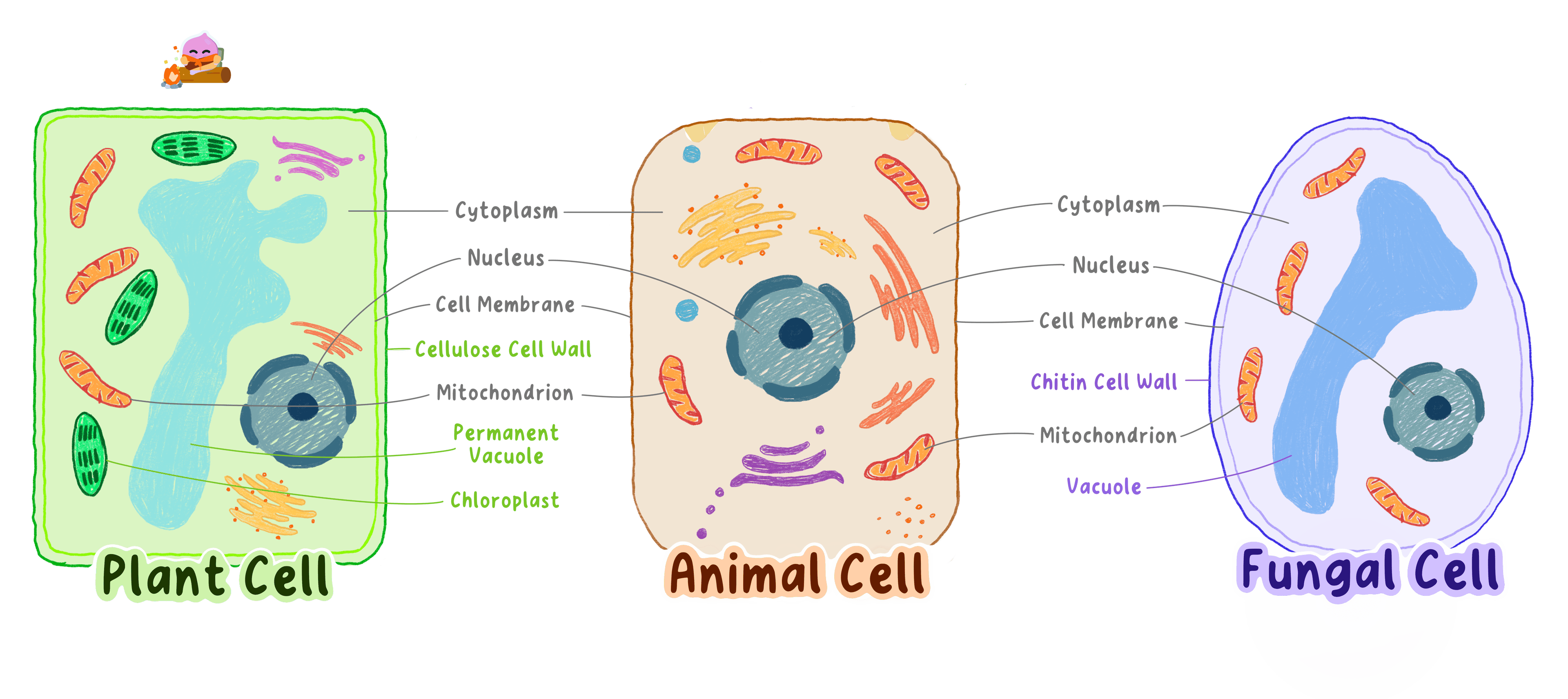
- A cell wall is fully permeable while a cell membrane is partially permeable, so the wall gives support and the membrane does the controlling.
- A root hair cell is a plant cell with no chloroplasts, so a cell without chloroplasts is not automatically an animal cell.
- State the one feature that decides whether a cell is prokaryotic or eukaryotic.
- Describe where the genetic material is found in a bacterial cell and name the extra rings of DNA it may also carry.
- Explain why a muscle cell contains far more mitochondria than a fat-storage cell.
- Name the organelle that is the site of protein synthesis and explain why it is found in prokaryotic cells as well as eukaryotic ones.
- Explain how receptor molecules in the cell membrane allow a hormone to affect some cells and not others.
- Give one function of the cell wall and one function of the permanent vacuole in a plant cell.
