DNA stores the genetic information of a cell
DNA
The molecule that stores the genetic information of a cell, made of two strands of nucleotides wound into a double helix.
- DNA stands for deoxyribonucleic acid, and it is the chemical that stores the genetic information of a living organism.
- In an animal or plant cell, almost all of the DNA is held inside the nucleus, packaged into thread-like structures called chromosomes.
- The information is stored as a chemical code written along the length of the molecule.
- The cell reads that code to build proteins, and the proteins it builds decide what the cell is able to do.
- Every body cell of an organism contains the same DNA, so the same complete set of instructions is available in each one.
DNA is a store of coded instructions, and the cell uses those instructions to build proteins.
DNA is a polymer built from nucleotides
Polymer
A large molecule made of many small repeating units joined together in a long chain.
Nucleotide
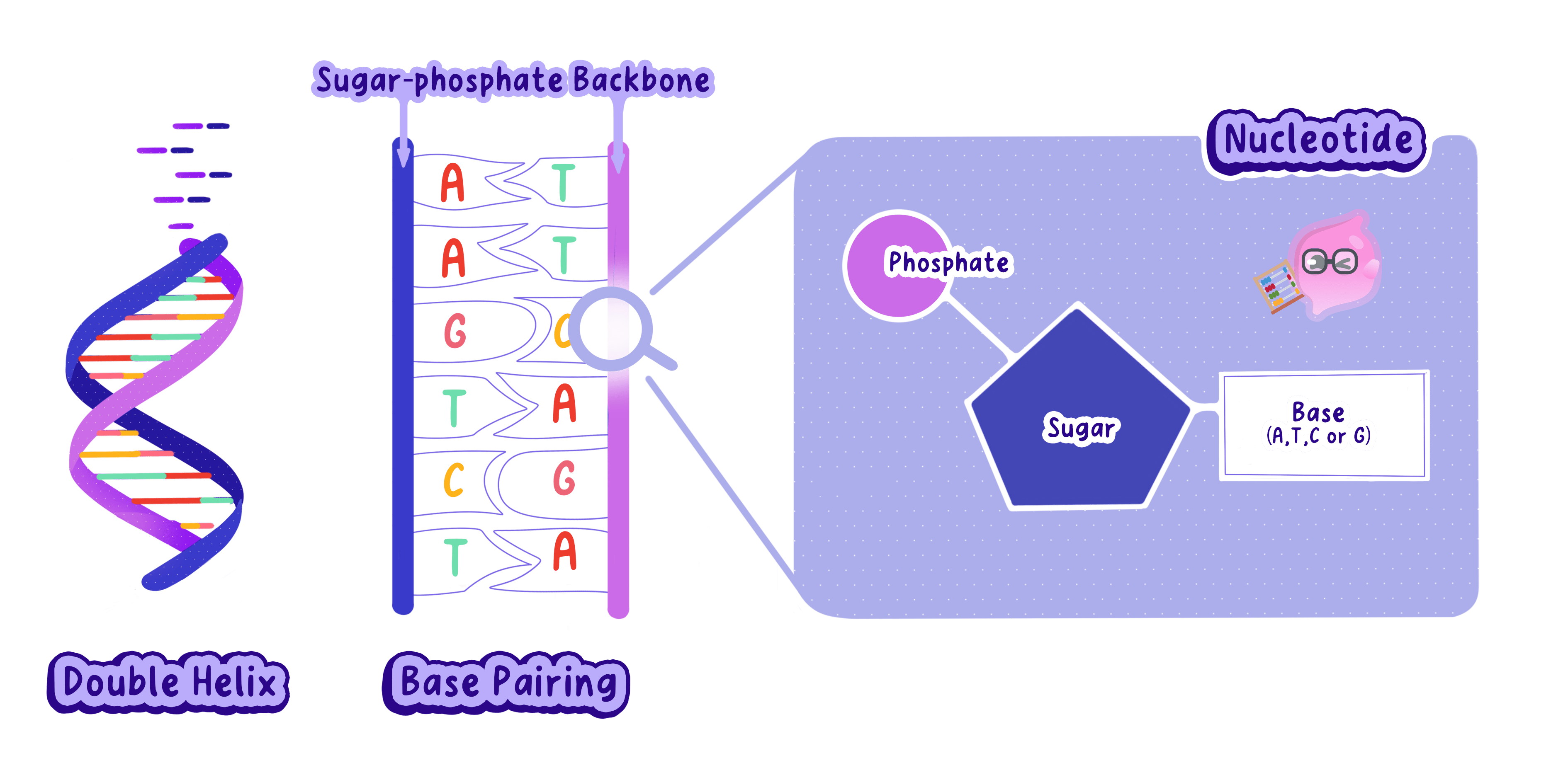
The repeating unit of DNA, made of a sugar, a phosphate group and one of four bases.
Sugar-phosphate backbone
The chain of alternating sugars and phosphate groups that runs along the outside of each DNA strand.
- A polymer is a long molecule made by joining many small repeating units, called monomers, into a chain.
- The monomer of DNA is a nucleotide, so DNA is described as a polymer of nucleotides.
- Each nucleotide is made of three parts joined together: a sugar, a phosphate group and one base.
- The sugar and the phosphate group are identical in every nucleotide, which is what makes them the repeating part of the chain.
- The base is the only part that varies, and there are four bases to choose from: A\text{A}A, C\text{C}C, G\text{G}G and T\text{T}T.
- Nucleotides join into a chain when the sugar of one nucleotide bonds to the phosphate group of the next.
- This alternating run of sugars and phosphate groups is the sugar-phosphate backbone, and it forms the outside edge of the strand.
- One base is attached to each sugar along the backbone, and every base points sideways, off the edge of the chain.
- A single strand of DNA is therefore a backbone with a row of bases hanging from it, and the order of those bases is the coded information.
Counting the parts of a strand
- A single strand of DNA is 121212 nucleotides long.
- It therefore contains 121212 sugars, 121212 phosphate groups and 121212 bases.
- The 121212 sugars and 121212 phosphate groups alternate along the backbone in a fixed pattern.
- Only the order of the 121212 bases differs between this strand and any other strand of the same length.
A nucleotide is not the same thing as a base, because the base is only one of the three parts a nucleotide is made from.
Two strands twist together into a double helix
Double helix
The shape of a DNA molecule, in which two strands are twisted around each other into a spiral.
- A complete DNA molecule is made of two strands, not one.
- The two strands lie alongside each other with their backbones on the outside and their bases pointing inwards, towards the other strand.
- Each base on one strand lines up with a base on the other strand, and the two joined bases are called a base pair.
- The base pairs act as the rungs of a ladder, holding the two backbones a fixed distance apart along the whole length of the molecule.
- The bonds holding each base pair together are weak, so the two strands can be separated when the cell needs to read or copy the code, then joined again afterwards.
- The two strands are also twisted around each other into a spiral, and this two-stranded spiral shape is the double helix.
- The two strands run in opposite directions to each other, which is why a flat diagram of DNA shows one strand drawn the other way up.
- Winding the molecule into a helix keeps a very long chain compact enough to fit inside a nucleus and holds the bases protected in the middle.
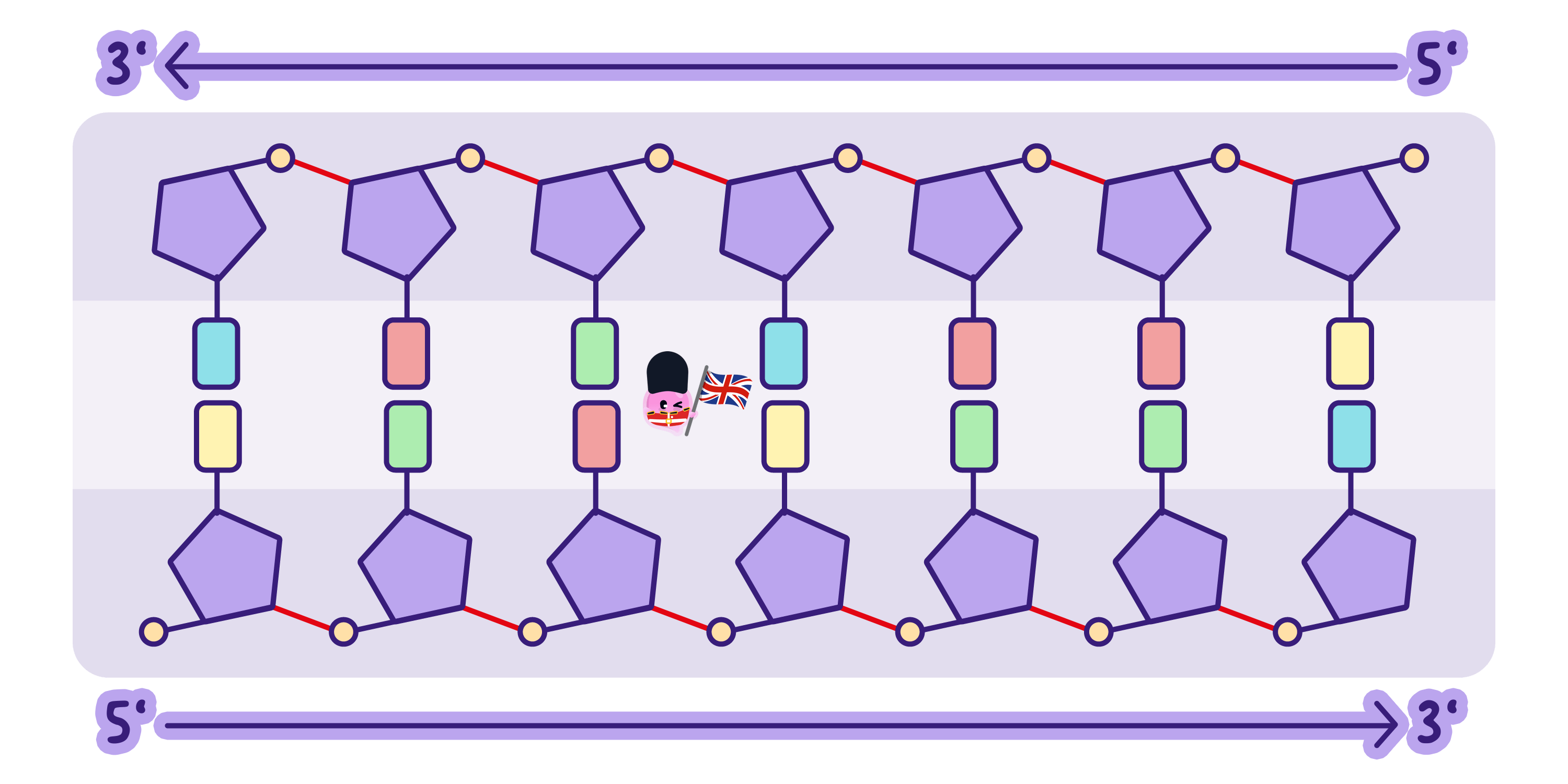
A double helix is a rope ladder that has been gripped at both ends and twisted, with the two backbones as the sides and the base pairs as the rungs.
Describing the structure of DNA
- Give the number of strands, the shape and what holds the strands together, because a three-mark description question is usually marking those three points.
- Use the phrase sugar-phosphate backbone rather than just saying sugar and phosphate, since the backbone is the labelled feature on a diagram.
- Say the strands are held together by base pairs in the middle, because writing only that they are twisted together does not score.
The two strands are joined by the base pairs in the middle of the molecule, not by the sugar-phosphate backbones on the outside.
- How many strands does a DNA molecule contain, and what shape do they form?
- What are the three parts of a nucleotide?
- Which part of a nucleotide varies, and how many versions of it are there?
- What runs along the outside of each DNA strand, and what points into the middle?
- Why is it useful that the bonds holding the two strands together are weak?
