There are four different nucleotides
Nucleotide
The repeating unit of DNA, made of a sugar, a phosphate group and one of four bases.
- All four nucleotides in DNA share the same sugar and the same phosphate group.
- The one part that differs between them is the base attached to the sugar.
- The four bases are adenine (A\text{A}A), thymine (T\text{T}T), cytosine (C\text{C}C) and guanine (G\text{G}G).
- Because there are four possible bases, there are exactly four different nucleotides, and DNA is built from those four alone.
- A strand of DNA is a chain of these four nucleotides in a particular order, and that order is what carries the coded information.
- A single gene can be thousands of nucleotides long, so the number of possible orders is enormous, which is how a four-letter alphabet codes for every protein an organism makes.
The sugar and the phosphate group never change from one nucleotide to the next, so a question asking what makes the four nucleotides different is asking about the base.
Bases join in fixed complementary pairs
Complementary base pairing
The fixed pairing of bases between the two DNA strands, in which adenine pairs with thymine and cytosine pairs with guanine.
Hydrogen bond
A weak bond that forms between a pair of bases and holds the two DNA strands together.
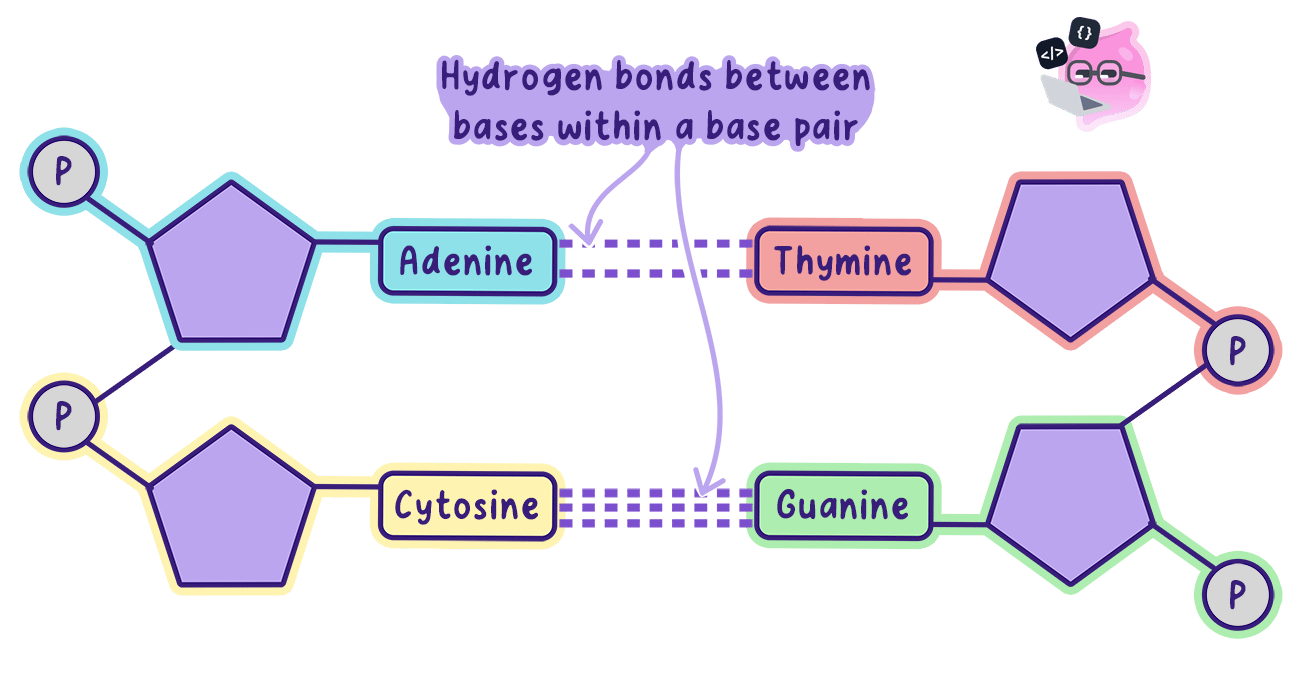
- The bases on the two strands are not paired at random, they follow a fixed rule called complementary base pairing.
- Adenine always pairs with thymine, written as the pair A\text{A}A and T\text{T}T.
- Cytosine always pairs with guanine, written as the pair C\text{C}C and G\text{G}G.
- Each base pair is held together by weak hydrogen bonds that form across the middle of the molecule.
- One hydrogen bond on its own is easily broken, but a DNA molecule contains millions of them, so together they hold the two strands firmly.
- Every pair contains one larger base and one smaller base, so each rung of the ladder is the same width and the helix keeps a constant shape along its length.
- A pairing such as A\text{A}A with G\text{G}G never happens, because the shapes of those two bases do not fit together across the gap.
A\text{A}A and T\text{T}T are both straight-sided letters and C\text{C}C and G\text{G}G are both curved letters, which is a quick way of keeping the two pairs apart under pressure.
Never write that A\text{A}A pairs with G\text{G}G or that C\text{C}C pairs with T\text{T}T, because only the pairs A\text{A}A with T\text{T}T and C\text{C}C with G\text{G}G occur in DNA.
One strand sets the sequence of the other
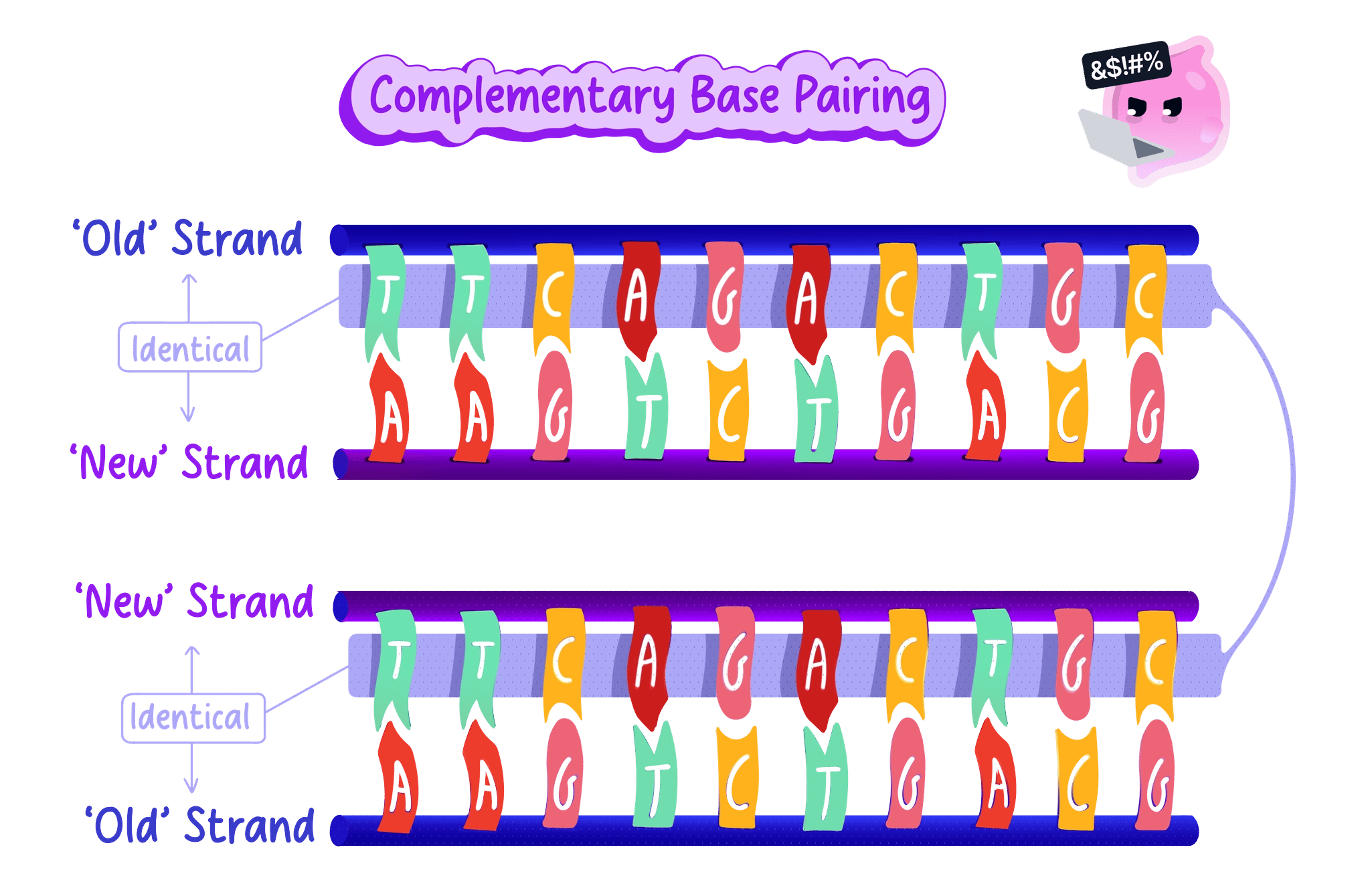
- Because the pairing rule is fixed, knowing the base order of one strand tells you the base order of the other.
- To work out the partner strand, replace every A\text{A}A with T\text{T}T, every T\text{T}T with A\text{A}A, every C\text{C}C with G\text{G}G and every G\text{G}G with C\text{C}C.
- The two strands are called complementary because each is the matching partner of the other, not an identical copy of it.
- This also means the amount of A\text{A}A in a DNA molecule always equals the amount of T\text{T}T, and the amount of C\text{C}C always equals the amount of G\text{G}G.
- When the hydrogen bonds break and the strands separate, each exposed strand can act as a template, because the pairing rule leaves only one possible partner for each base.
- Fixed pairing is therefore what lets the base sequence be rebuilt without error whenever the molecule is copied or read.
Building the complementary strand
- One strand of a DNA molecule reads T\text{T}T A\text{A}A C\text{C}C G\text{G}G G\text{G}G A\text{A}A.
- Take the bases one at a time and swap each for its partner: T\text{T}T gives A\text{A}A, A\text{A}A gives T\text{T}T, C\text{C}C gives G\text{G}G, G\text{G}G gives C\text{C}C, G\text{G}G gives C\text{C}C and A\text{A}A gives T\text{T}T.
- The complementary strand therefore reads A\text{A}A T\text{T}T G\text{G}G C\text{C}C C\text{C}C T\text{T}T.
- Both strands contain six bases, which is the check that no base has been missed out.
Working out the proportion of each base
- A sample of DNA is found to contain 30%30\%30% adenine.
- Adenine pairs only with thymine, so thymine must also make up 30%30\%30% of the bases.
- That accounts for 30+30=60%30 + 30 = 60\%30+30=60%, leaving 100−60=40%100 - 60 = 40\%100−60=40% for cytosine and guanine together.
- Cytosine and guanine pair with each other in equal numbers, so each makes up 40÷2=20%40 \div 2 = 20\%40÷2=20%.
Completing a base sequence
- Work along the sequence base by base rather than trying to read the whole strand at once, because a single slip loses the mark for the entire line.
- Count that your answer has exactly as many bases as the strand you were given.
- Write the letters as clear capitals, since a G\text{G}G that looks like a C\text{C}C cannot be credited.
- If the question asks you to explain the pairing, name the bases in full rather than using only the letters.
- Why are there exactly four different nucleotides in DNA?
- Name the base that pairs with adenine and the base that pairs with cytosine.
- What type of bond holds a base pair together, and why does a molecule need so many of them?
- Write the complementary strand for the sequence G\text{G}G C\text{C}C A\text{A}A T\text{T}T T\text{T}T G\text{G}G.
- A DNA sample contains 22%22\%22% guanine. What percentage is adenine?
