Definition
Stem cell
An undifferentiated cell that can divide to make more cells of the same kind and can differentiate into specialised cells.
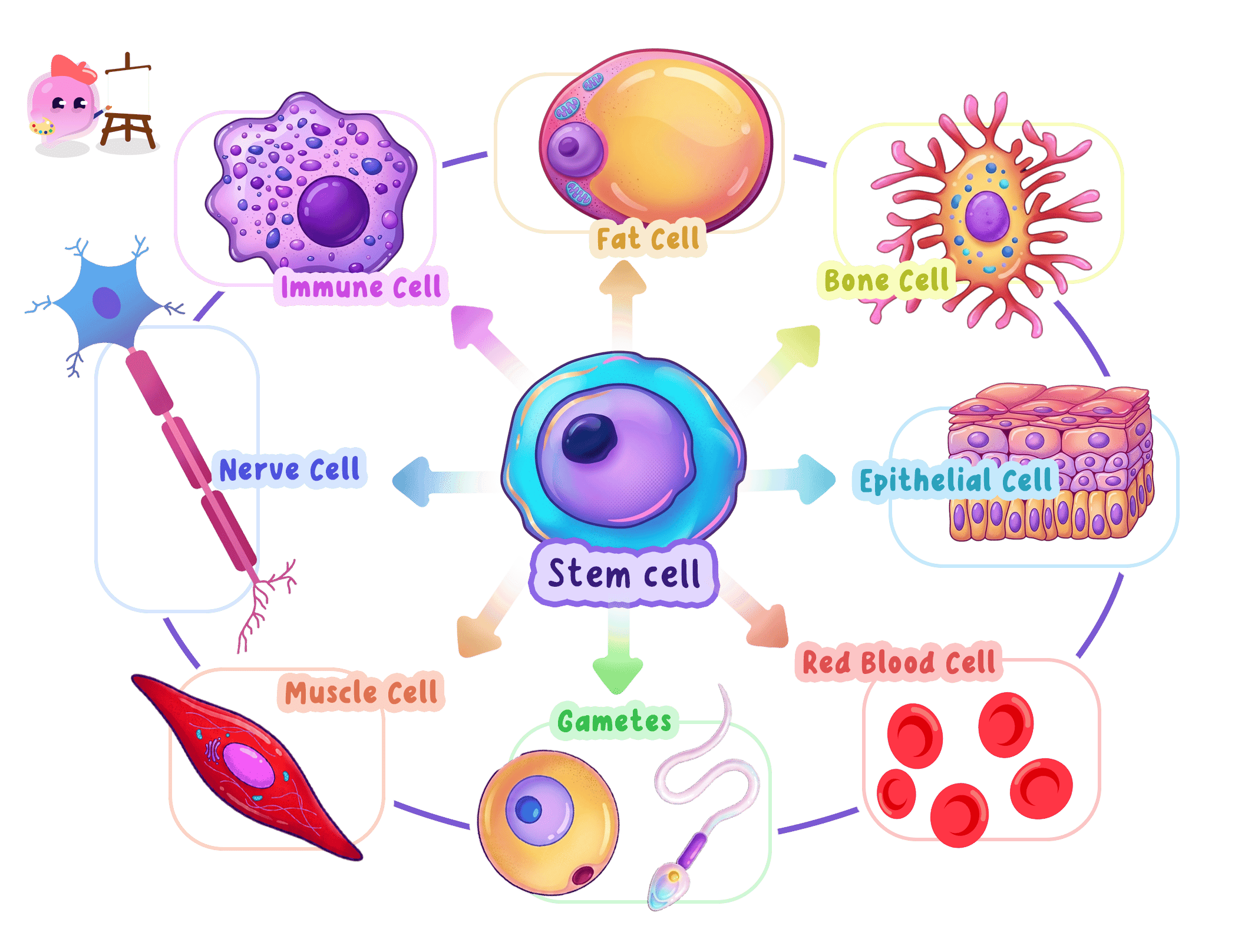
- A stem cell is undifferentiated, which means it has not developed the features of any particular cell type.
- Two abilities define a stem cell: it can divide by mitosis to make more cells like itself, and it can differentiate into specialised cells.
- Dividing to produce more stem cells keeps a supply available for the organism to draw on later.
- Differentiating works the same way as in any other cell: a different set of genes is switched on for each cell type produced.
- Animals have stem cells in early embryos and in a few adult tissues, and plants have them in tissues called meristems.
- The range of cell types a stem cell can produce depends on where it comes from.
Embryonic stem cells
Definition
Embryonic stem cell
A stem cell taken from an early embryo that can differentiate into any type of cell in the body.
- In animals, stem cells are present in the early embryo, from the first few divisions of a fertilised egg cell onwards.
- About five days after fertilisation the embryo is a hollow ball of cells, and the stem cells lie in a cluster inside it.
- Embryonic stem cells can differentiate into any type of cell found in the body.
- Their function is to produce every cell type the growing organism needs, so they drive the development of the whole animal from a single cell.
- They divide rapidly, which is how an embryo builds up the huge number of cells a body needs.
- As development continues the cells commit to particular tissues and lose the ability to become any cell type.
Adult stem cells
Definition
Adult stem cell
A stem cell found in certain tissues of a fully developed animal that can differentiate into only a limited range of cell types.
- Adult stem cells are present in certain tissues of a fully grown animal, most importantly in the bone marrow.
- Bone marrow stem cells divide and then differentiate into the different types of blood cell, including red blood cells and white blood cells.
- They are also found in the skin, where they replace the surface cells rubbed away every day, and in the lining of the small intestine, which is renewed every few days.
- Their function is growth and repair: they replace cells that are worn out, damaged or lost.
- Adult stem cells can differentiate into only a limited range of cell types, usually the types found in the tissue they came from.
- A stem cell from bone marrow can become a red blood cell or a white blood cell, but it cannot become a nerve cell.
Differences between embryonic and adult stem cells
- Embryonic stem cells come from an early embryo, while adult stem cells come from tissues of a fully developed animal.
- Embryonic stem cells can form any type of cell, while adult stem cells can form only a limited range of types.
- Embryonic stem cells exist only during early development, while adult stem cells remain in the body throughout life.
- Embryonic stem cells divide rapidly and in large numbers, while adult stem cells are present in small numbers and divide more slowly.
- Embryonic stem cells build the whole organism, while adult stem cells maintain and repair tissues that already exist.
Meristems in plants
Definition
Meristem
A region of a plant, found at the tips of roots and shoots, in which cells divide and can differentiate into any type of plant cell throughout the plant's life.
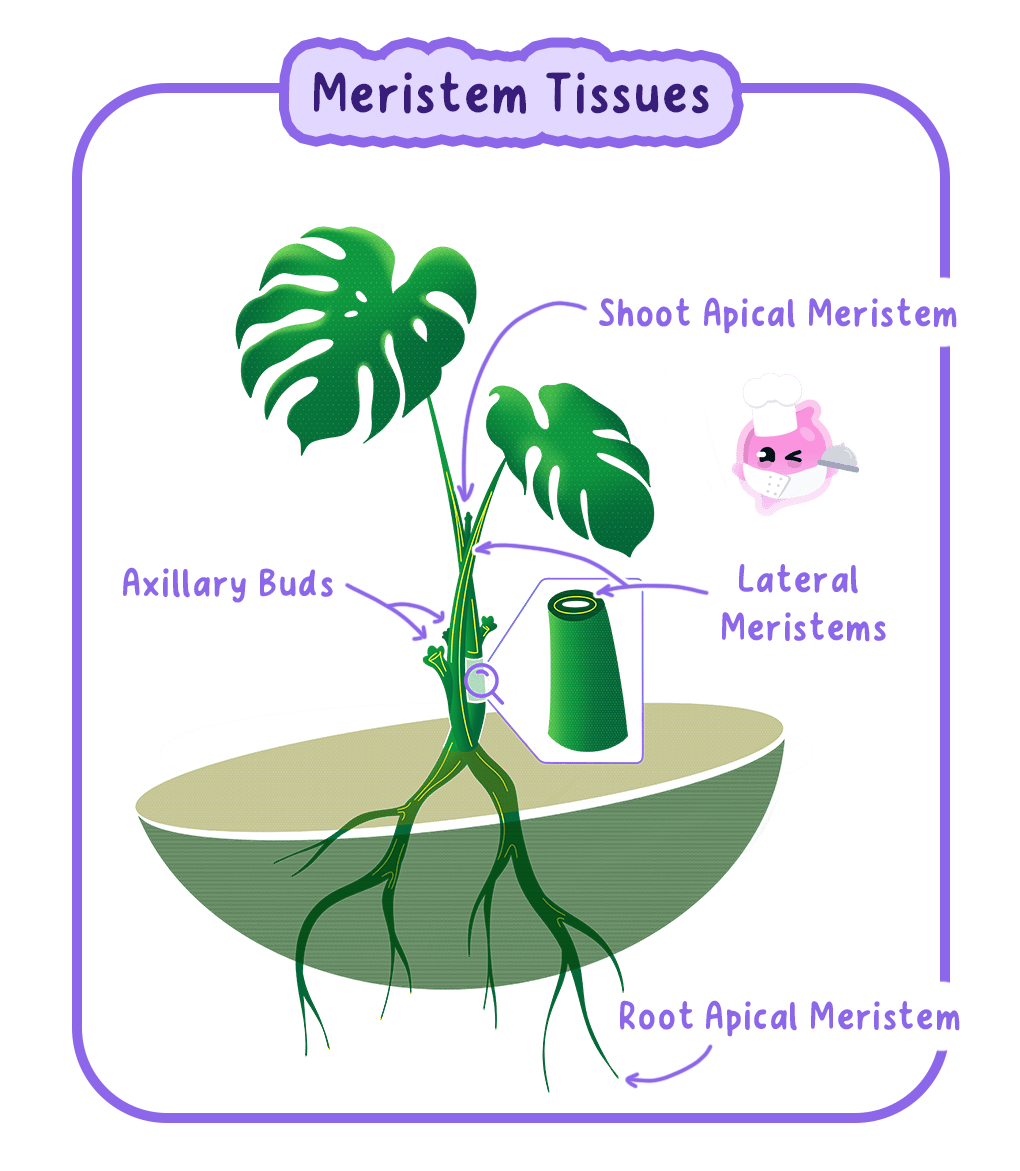
- Plant stem cells are found in tissues called meristems.
- Meristems sit at the tips of roots and shoots, and in a ring of tissue called the cambium inside stems and roots.
- Meristem cells divide by mitosis throughout the whole life of the plant, which is why a plant never stops being able to grow.
- Cells produced at a root tip or shoot tip first grow longer, and this pushes the tip further into the soil or up towards the light.
- Meristem cells can differentiate into any type of plant cell, including xylem vessels, phloem sieve tubes, palisade cells and root hair cells.
- Cambium cells differentiate into new xylem and phloem, which is what makes a stem or root grow thicker.
- Because meristem cells keep this ability, a small piece of meristem tissue can be grown into a complete new plant that is genetically identical to the parent, a clone.
Practical
Cloning cauliflower from meristem tissue
- Aim: to grow genetically identical plantlets from small pieces of cauliflower meristem tissue.
- Apparatus: a fresh cauliflower, a scalpel, forceps, a white tile, a sterilising solution such as dilute bleach, sterile distilled water, universal bottles of sterile agar growth medium containing nutrients and plant hormones, a Bunsen burner, ethanol for flaming the instruments, a marker pen and a warm, well-lit place at about 25 ∘C25\ ^{\circ}\text{C}25 ∘C.
- Method, working cleanly:
- Wipe the bench with disinfectant and wash your hands, because a single bacterial or fungal spore will grow far faster than the plant tissue and take over the medium.
- Dip the scalpel and forceps in ethanol, pass them briefly through the Bunsen flame and let them cool before touching any tissue.
- Method, preparing the tissue:
- Cut small florets about 5 mm5\ \text{mm}5 mm across from the surface of the cauliflower head, because the tip of each floret is a shoot meristem full of undifferentiated cells.
- Leave the florets in sterilising solution for about 151515 minutes to kill the microorganisms living on their surface.
- Rinse them three times in sterile distilled water, since any sterilising solution left behind would kill the plant tissue as well.
- Method, growing them on:
- Lift each floret with sterile forceps, stand it upright on the surface of the agar growth medium and replace the cap immediately.
- Label each bottle, then leave them closed at about 25 ∘C25\ ^{\circ}\text{C}25 ∘C in the light for several weeks.
- Why it works: the meristem cells are undifferentiated, so the hormones in the medium make them divide and then differentiate into roots and shoots.
- What you see: a successful explant swells, turns green and pushes out fine white roots and a tiny shoot, while a contaminated one grows fuzzy mould or a cloudy film and has to be discarded without opening it.
- Results: every plantlet produced is a clone of the parent cauliflower, so all of them carry identical genes.
- Watch out: keep every bottle closed except during the transfer itself, because most failures come from contamination rather than from the tissue.
- Safety: bleach is corrosive, so wear eye protection and gloves, tie hair back near the Bunsen flame, and never return a lit instrument to the ethanol.
Exam technique
Answering on stem cells
- Define a stem cell using both of its abilities, since an answer that only says it can turn into other cells usually loses a mark.
- Use the word undifferentiated when you describe what a stem cell is.
- Give both the location and the range of cell types when a question asks you to compare embryonic and adult stem cells.
- Name meristem as the tissue and the root tip or shoot tip as the place when a question asks where plant stem cells are found.
- In a comparison, write about both sides in one sentence, such as embryonic stem cells forming any cell type while adult stem cells form only a limited range.
Common Mistake
- Do not describe a stem cell as one that has already specialised, because a stem cell is undifferentiated.
- Do not say adult stem cells are found in every tissue, because they are present only in certain tissues such as bone marrow and skin.
- Do not claim adult stem cells can form any type of cell; only embryonic stem cells and plant meristem cells can do that.
- Do not use the word meristem for animal tissue, because meristems are found only in plants.
- Do not confuse an embryonic stem cell with a fertilised egg cell, because the stem cells appear only after the egg has divided several times.
Self review
- Give the two abilities that define a stem cell.
- State where embryonic stem cells and adult stem cells are each found in an animal.
- Describe the function of the adult stem cells in bone marrow.
- Explain two differences between embryonic and adult stem cells.
- Describe where meristems are found and what the cells in them are able to do.
