Surface area to volume ratio
Definition
Surface area to volume ratio
The surface area to volume ratio is the total surface area of an organism divided by its volume.
- Every substance an organism needs has to cross a surface to get in, and every waste substance has to cross a surface to get out.
- The amount of surface available for that exchange is the surface area, and the amount of living material that has to be supplied is the volume.
- The surface area to volume ratio sets one against the other and is written SA:V\text{SA}:\text{V}SA:V.
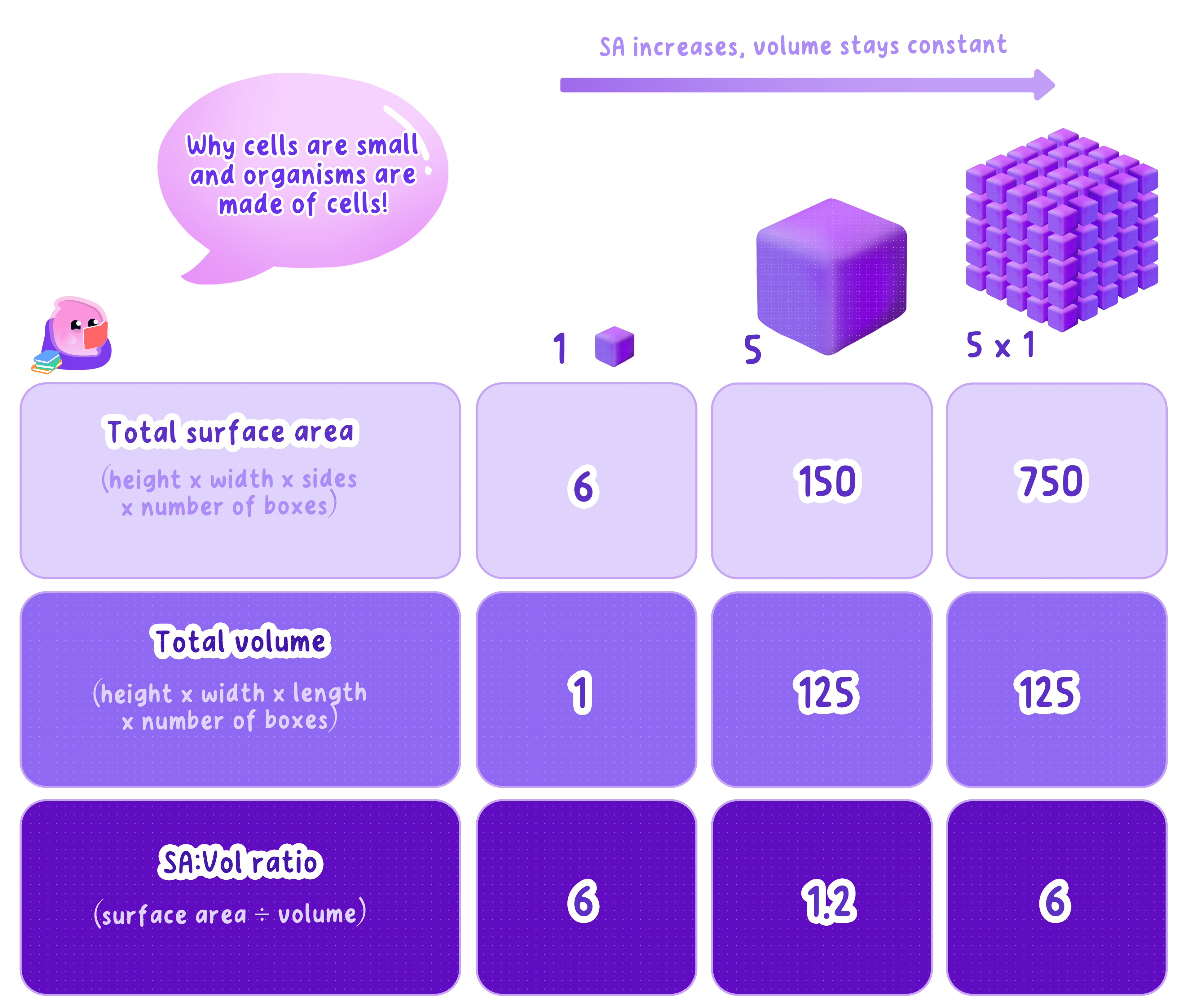
- When an organism grows larger its surface area increases with the square of its length while its volume increases with the cube of its length.
- For a cube of side lll the surface area is 6l26l^{2}6l2 and the volume is l3l^{3}l3, so the ratio is 6l2l3=6l\dfrac{6l^{2}}{l^{3}}=\dfrac{6}{l}l36l2=l6.
- That expression gets smaller as lll gets bigger, which is why a small organism has a large ratio and a large organism has a small ratio.
- A large ratio means there is a great deal of surface serving each unit of living material, so substances can be supplied across that surface quickly enough.
- A small ratio means there is very little surface serving each unit of living material, so the outer surface on its own cannot supply the cells inside.
- Shape matters as well as size, because a flattened or folded body has a larger ratio than a compact body of the same volume.
- That is why a flatworm can be several centimetres long and still survive without a transport system, since it is only a fraction of a millimetre thick.
Calculating the ratio
- Work out the total surface area first by adding the area of every exposed face.
- A cube of side lll has six identical faces of area l2l^{2}l2, so its surface area is 6l26l^{2}6l2.
- A cuboid of sides aaa, bbb and ccc has surface area 2(ab+ac+bc)2(ab+ac+bc)2(ab+ac+bc).
- Work out the volume next, which is l3l^{3}l3 for a cube and abcabcabc for a cuboid.
- Divide one by the other using ratio=surface areavolume\text{ratio}=\dfrac{\text{surface area}}{\text{volume}}ratio=volumesurface area
- Give the answer either as a single number or in the form n:1n:1n:1, so a value of 333 is written 3:13:13:1.
- Both quantities must use the same length unit, because an area in cm2\text{cm}^{2}cm2 divided by a volume in mm3\text{mm}^{3}mm3 gives a meaningless figure.
- Comparing two organisms only works when both ratios are worked out the same way round and in the same units.
Example
Comparing two cubes
- A small cube has sides of 1 cm1\ \text{cm}1 cm and a larger cube has sides of 3 cm3\ \text{cm}3 cm.
- Small cube surface area: 6×(1)2=6 cm26\times(1)^{2}=6\ \text{cm}^{2}6×(1)2=6 cm2.
- Small cube volume: (1)3=1 cm3(1)^{3}=1\ \text{cm}^{3}(1)3=1 cm3.
- Small cube ratio: 61=6\dfrac{6}{1}=616=6, written 6:16:16:1.
- Large cube surface area: 6×(3)2=54 cm26\times(3)^{2}=54\ \text{cm}^{2}6×(3)2=54 cm2.
- Large cube volume: (3)3=27 cm3(3)^{3}=27\ \text{cm}^{3}(3)3=27 cm3.
- Large cube ratio: 5427=2\dfrac{54}{27}=22754=2, written 2:12:12:1.
- The larger cube has the smaller ratio, so each unit of its volume is served by only a third as much surface.
Example
The effect of a flattened shape
- A flat block measures 4 cm4\ \text{cm}4 cm by 2 cm2\ \text{cm}2 cm by 1 cm1\ \text{cm}1 cm.
- Surface area: 2[(4×2)+(4×1)+(2×1)]=2(8+4+2)=28 cm22\big[(4\times2)+(4\times1)+(2\times1)\big]=2(8+4+2)=28\ \text{cm}^{2}2[(4×2)+(4×1)+(2×1)]=2(8+4+2)=28 cm2.
- Volume: 4×2×1=8 cm34\times2\times1=8\ \text{cm}^{3}4×2×1=8 cm3.
- Ratio: 288=3.5\dfrac{28}{8}=3.5828=3.5, written 3.5:13.5:13.5:1.
- A cube holding the same 8 cm38\ \text{cm}^{3}8 cm3 has sides of 2 cm2\ \text{cm}2 cm and a ratio of 248=3\dfrac{24}{8}=3824=3.
- Flattening the same volume raises the ratio from 3:13:13:1 to 3.5:13.5:13.5:1, which is the principle behind every flattened exchange surface.
Exam technique
Setting out a ratio calculation
- Write the surface area and the volume on separate lines before dividing, because each figure carries its own mark even if the division goes wrong.
- Find the area of one face and multiply by six rather than adding six separate figures, which is where most arithmetic slips happen.
- Answer in the form the question asks for, either a decimal or n:1n:1n:1, and never divide volume by surface area.
- When two organisms are compared, state which ratio is larger and then say what that means for the rate of exchange, because the explanation is where the second mark sits.
Why diffusion alone is not enough
Definition
Diffusion distance
The diffusion distance is the distance a particle has to travel by diffusion between an exchange surface and the cell that uses it.
Definition
Concentration gradient
A concentration gradient is the difference in the concentration of a substance between two regions.
- Diffusion moves particles down a concentration gradient and needs no energy from the organism.
- Diffusion is fast when the surface area is large, when the gradient is steep and when the diffusion distance is short.
- The time diffusion takes rises far more steeply than the distance, so doubling the distance more than doubles the time.
- In a single-celled organism such as an amoeba, no part of the cytoplasm is more than a fraction of a millimetre from the surface, so oxygen reaches every part in a moment.
- In a large animal the innermost cells sit tens of centimetres from the body surface, and diffusion over that distance would take days rather than seconds.
- A large organism also has far more respiring cells, so its total demand for oxygen and glucose is much greater.
- Demand rises with volume while supply across the outer surface rises only with surface area, so demand outgrows supply as size increases.
- Waste products build up for the same reason, because carbon dioxide and urea also have to travel further to reach a surface where they can leave.
- That mismatch is why a multicellular organism needs specialised exchange surfaces and a transport system rather than relying on its outer surface.
Practical
Modelling diffusion with agar cubes
- Aim: to investigate how the surface area to volume ratio of a block affects the time a substance takes to diffuse right through it, using agar cubes cut to different sizes.
- Apparatus: a block of agar containing dilute sodium hydroxide and phenolphthalein indicator, a white tile, a scalpel, a 30 cm30\ \text{cm}30 cm ruler, three beakers, dilute hydrochloric acid, a measuring cylinder, forceps, a spatula, a stopclock, paper towel, gloves and eye protection.
- Variables: the side length of the cube, and so its surface area to volume ratio, is the independent variable; the time for the pink colour to disappear completely is the dependent variable; the acid concentration, the volume of acid, the temperature, the agar batch and the cube shape are controlled.
- Method, preparing the cubes:
- Lay the agar block on a white tile. It is pink throughout because the sodium hydroxide inside it has turned the phenolphthalein pink.
- Measure and cut cubes of side 1 cm1\ \text{cm}1 cm, 2 cm2\ \text{cm}2 cm and 3 cm3\ \text{cm}3 cm, drawing the scalpel away from your fingers.
- Check all three sides of each cube against the ruler, because a block that is not truly cubic no longer has the ratio you calculated.
- Blot each cube on paper towel so that surface liquid does not dilute the acid.
- Method, running the investigation:
- Measure the same volume of dilute hydrochloric acid into each beaker, enough to cover the largest cube completely.
- Lower one cube into each beaker with forceps at the same moment and start the stopclock.
- Acid diffuses inwards through the agar, neutralises the sodium hydroxide and turns the jelly colourless from the outside in.
- Lift each cube out with a spatula the moment the last trace of pink at its centre vanishes, and record that time.
- Cut a finished cube in half to confirm that no pink core remains, since the centre of a large cube is hard to judge from the outside.
- Repeat the whole run at least three times for each size and calculate a mean time.
- Results: the 1 cm1\ \text{cm}1 cm cube turns colourless first and the 3 cm3\ \text{cm}3 cm cube last, so the block with the largest surface area to volume ratio is penetrated fully in the shortest time.
- Maths: the ratios from 6l2l3\dfrac{6l^{2}}{l^{3}}l36l2 are 6:16:16:1, 3:13:13:1 and 2:12:12:1; calculate a rate as 1mean time\dfrac{1}{\text{mean time}}mean time1 and plot rate against ratio to show a positive correlation.
- Watch out: cubes cut inaccurately, different volumes of acid, cubes entering the acid at different moments and an endpoint judged by eye are the main sources of error, and all three cubes must come from the same agar batch.
- Safety: wear eye protection and gloves, cut on a tile away from your fingers, treat the acid and the sodium hydroxide as irritants and rinse any splash off the skin at once.
Features of an efficient exchange surface
Definition
Exchange surface
An exchange surface is a surface across which substances pass between an organism and its surroundings.
- A large surface area lets more particles cross at the same time, and it is produced by folding, branching or flattening the surface.
- A thin surface, usually a single layer of flattened cells, keeps the diffusion distance short so particles cross in seconds.
- A steep concentration gradient is maintained by keeping the medium moving on one side and the blood moving on the other.
- A good blood supply carries absorbed substances away and delivers waste substances, which is what stops the gradient falling to zero.
- A moist surface lets gases dissolve before they diffuse across the membrane.
- In the lungs the alveoli provide the area, their walls are one cell thick and capillaries are pressed directly against them.
- In the small intestine the villi and microvilli fold the lining into a vast area for absorbing digested food.
- In a fish the gill filaments are stacked into thin plates washed continuously by water flowing in the opposite direction to the blood.
- In a plant the root hair cells push the root surface out into the soil, and the air spaces inside a leaf give a large moist surface for gas exchange.
Common Mistake
- Do not say a large organism has a large surface area to volume ratio, because its surface area is large but its volume is larger still, so the ratio is small.
- Do not divide volume by surface area, since the ratio always has surface area on top.
- Do not confuse surface area with surface area to volume ratio, because an elephant has an enormous surface area and a tiny ratio.
- Do not offer a thick surface as an adaptation for exchange, because a short diffusion distance requires the surface to be thin.
The need for a transport system
Definition
Transport system
A transport system is a network of vessels that carries substances between an organism's exchange surfaces and its cells.
- An exchange surface brings substances into the body, but those substances still have to reach cells that may be a long way off.
- A transport system carries them in a moving liquid, so the long part of the journey is covered by mass flow rather than by diffusion.
- Mass flow moves substances many thousands of times faster than diffusion over the same distance.
- In a mammal that system is the circulatory system, which pumps blood through vessels that pass within a fraction of a millimetre of almost every cell.
- The final short step out of a vessel and into a cell is still made by diffusion, but the distance is now tiny, so it takes only a moment.
- In a flowering plant the transport tissues are the xylem and the phloem, which run continuously through the roots, stem and leaves.
- Every transport system therefore does two jobs: it moves substances quickly over long distances and it delivers them close enough for diffusion to finish the journey.
Self review
- State what happens to the surface area to volume ratio of an organism as it grows larger, and explain why.
- Calculate the surface area to volume ratio of a cube of side 2 cm2\ \text{cm}2 cm.
- Explain why a single-celled organism can survive by diffusion across its surface but a mammal cannot.
- List four features that make an exchange surface efficient and give the reason for each.
- Explain why a multicellular organism needs a transport system as well as exchange surfaces.
