Cell differentiation
Definition
Differentiation
The process by which an unspecialised cell develops the structures and shape it needs to carry out one particular function.
Definition
Specialised cell
A cell whose structure is adapted so that it carries out one particular function efficiently.
- Every cell in a multicellular organism starts out unspecialised, with no particular job to do.
- Differentiation is the process that turns an unspecialised cell into a specialised cell.
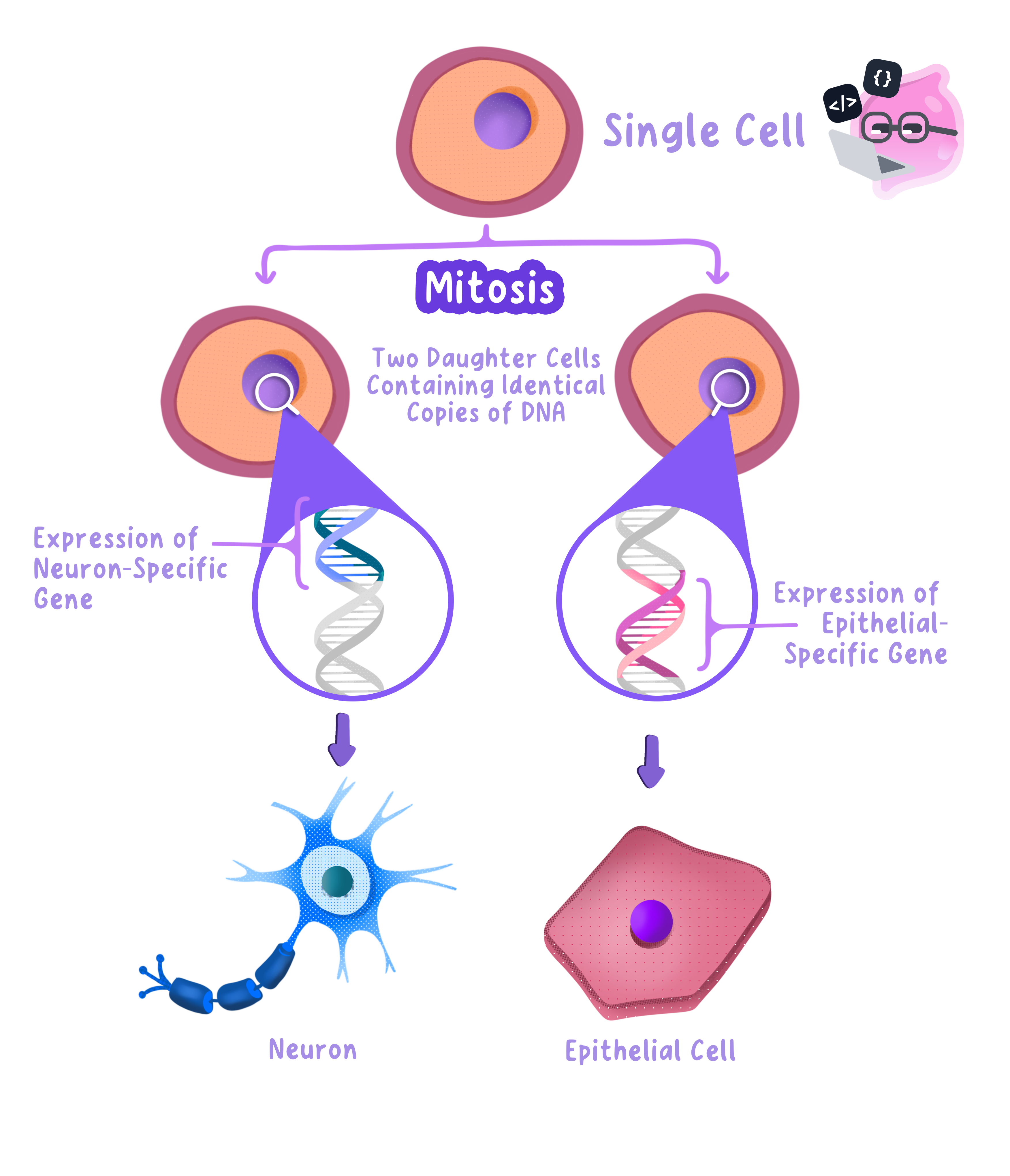
- All the body cells of one organism carry the same genes, because they were all produced from a single fertilised egg cell by mitosis.
- Cells end up different because only some of those genes are switched on in each cell type, and the rest stay switched off.
- The proteins built from the genes that are switched on determine the cell's structure and what it is able to do.
- As a cell differentiates it changes shape and builds the sub-cellular structures its job requires, such as extra mitochondria or extra chloroplasts.
- A cell divides first and differentiates afterwards, so cell division and differentiation are two separate processes.
- In most animal cells the change cannot be undone; once a cell has specialised it stays that type for the rest of its life.
Why specialised cells make organisms more efficient
Definition
Tissue
A group of specialised cells of similar type working together to carry out a shared function.
- An unspecialised cell has to carry out every process at once, and does none of them particularly well.
- A specialised cell carries out one job, so its whole structure can be shaped around that single job.
- Sharing the work between different cell types is called division of labour, and it means each process is carried out faster and more effectively than one cell could manage alone.
- Cells of the same type group together into a tissue, different tissues combine into an organ, and organs work together in an organ system.
- Muscle cells form muscle tissue, muscle tissue helps form the heart, and the heart works with the blood vessels as the circulatory system.
- This organisation allows an organism to grow large, because whole regions of the body can be given over to one task.
- Differentiation is therefore what makes complex multicellular life possible, since a large organism cannot rely on every cell doing everything.
Specialised animal cells
- A red blood cell is a biconcave disc with no nucleus, so there is more room for haemoglobin and a larger surface area for absorbing oxygen.
- A sperm cell has a tail for swimming, many mitochondria to release the energy that swimming needs, and an enzyme-filled acrosome that digests a path through the membrane of the egg cell.
- A nerve cell is extremely long and has branched endings, so it carries electrical impulses over long distances and connects to many other cells.
- A muscle cell contains protein fibres that slide over one another to shorten the cell, and many mitochondria to supply the energy for contraction.
- A ciliated epithelial cell carries hair-like cilia on its surface that beat together to sweep mucus and trapped dirt out of the airways.

Specialised plant cells
- A root hair cell has a long, thin extension that greatly increases the surface area touching soil water, and many mitochondria to power the uptake of mineral ions.
- A xylem vessel is a hollow tube of dead cells with no end walls and with walls strengthened by lignin, so water flows up it freely and the tube does not collapse.
- A phloem sieve tube keeps its end walls but they are perforated with pores, so dissolved sugars can pass from one cell to the next.
- A palisade mesophyll cell is tall, box-shaped and packed with chloroplasts, and sits near the upper surface of the leaf where the light is strongest.
- A guard cell is kidney-shaped and works in a pair to open and close a stoma, which controls gas exchange and water loss.
- In every one of these cells the shape and the sub-cellular structures follow directly from the job the cell has to do.
When cells differentiate
- In animals, most cells differentiate at an early stage of development, while the embryo is still forming.
- Once an animal is mature, cell division is used mainly to repair damage and replace worn-out cells rather than to produce new cell types.
- In plants, many cells keep the ability to differentiate throughout the plant's life.
- This is why a plant can go on producing new roots, shoots and leaves for as long as it is alive.
- It is also why a cutting taken from a plant can grow into a whole new plant, while a piece cut from an animal cannot.
Practical
Examining specialised cells
- Aim: to observe a range of specialised cells with a light microscope and link the features you can see to the job each cell does.
- Apparatus: a light microscope, prepared slides of a blood smear, ciliated epithelium, striated muscle and a transverse section through a leaf, an onion bulb, forceps, a scalpel, a white tile, slides and cover slips, iodine solution, a mounted needle and paper towel.
- Method, viewing the prepared slides:
- Start each slide on the lowest power objective, find a clear patch of tissue, then move to a higher power and refocus with the fine adjustment only.
- Close the diaphragm slightly for the pale unstained slides, because faint outlines show up better in less light.
- For each slide write down one feature you can actually see and the job it does, such as the dark fringe of cilia along one edge of an epithelial cell.
- Method, preparing your own slide of plant cells:
- Snap an onion scale in half and peel a single layer of epidermis from the inner surface with forceps, so the tissue is one cell thick and light can pass through it.
- Lay the piece out flat in a drop of water on a slide, taking care that it does not fold back on itself.
- Add one drop of iodine solution, which stains the nucleus of each cell so it can be picked out from the cytoplasm.
- Lower the cover slip from one edge with a mounted needle to keep air bubbles out, then blot the excess liquid away.
- What you see: red blood cells appear as pale pink discs with a lighter centre and no nucleus, ciliated cells carry a dark fringe along one edge, muscle fibres are long with faint stripes, palisade cells in the leaf section are tall and crowded with green chloroplasts near the upper surface, and onion epidermis cells are brick-shaped with a clear wall and a single stained nucleus.
- Recording: draw only what you can see, using clean single lines and no shading, label each structure with a ruled straight line, and write down the magnification you used.
- Watch out: an air bubble has a thick black rim and a bright centre, and is easily mistaken for a cell.
- Safety: iodine solution stains skin and clothing, and the scalpel should always be drawn away from your fingers on a tile.
Example
Linking structure to function
- A cell from the lining of the small intestine is covered in thousands of tiny folds and contains an unusually large number of mitochondria.
- The folds increase the surface area of the cell membrane.
- A larger surface area means more digested food molecules can be absorbed in the same time.
- The mitochondria release energy by respiration.
- That energy powers active transport, which lets the cell take in glucose even once the concentration in the gut has fallen below the concentration inside the cell.
- A full answer therefore names the feature, states what it does and links it to the job of the cell.
Exam technique
Explaining a specialised cell
- Name the feature, say what it does, then link it to the cell's job, because a feature listed on its own is a description and not an explanation.
- Write surface area rather than bigger, and follow it with what the larger surface area is used for.
- When you mention mitochondria, say that they release energy by respiration and then say what that energy is used for in this particular cell.
- Explain differentiation as different genes being switched on, never as a cell gaining or losing genes.
- If a question shows you an unfamiliar cell, work from its shape and its sub-cellular structures rather than trying to recall it.
Common Mistake
- Do not say a specialised cell has different genes from other body cells; it has the same genes with a different set of them switched on.
- Do not describe a mature red blood cell as having a small nucleus, because it has no nucleus at all.
- Do not confuse a cell with a tissue; a tissue is a group of similar cells working together.
- Do not write that every plant cell can still differentiate, because the ability is kept only in certain regions of the plant.
- Do not treat differentiation and cell division as the same process, because a cell divides first and differentiates afterwards.
Self review
- Define differentiation and explain how cells with identical genes end up different from one another.
- Explain why specialised cells make an organism more efficient.
- Describe two features of a red blood cell and give the function of each.
- Describe how a root hair cell and a palisade mesophyll cell are each adapted to their job.
- State one difference between animals and plants in when their cells differentiate.
