How pathogens pass between hosts
Transmission
The passing of a pathogen from an infected host to an uninfected organism.
Host
An organism in or on which a pathogen lives and reproduces.
Pathogen
A microorganism that causes a communicable disease, such as a virus, a bacterium, a fungus or a protist.
- Transmission is the passing of a pathogen from an infected host to an uninfected organism, and without it a communicable disease dies out with its host.
- A pathogen can only reproduce inside or on a host, so reaching a new host before the old one recovers or dies is essential to its survival.
- The route a pathogen uses depends on where it lives in the body, because a pathogen in the gut leaves in the faeces while one in the lungs leaves in exhaled droplets.
- The main routes are direct contact, body fluids, the air, water, food and vectors, and most pathogens use one or two of them rather than all six.
- Every method of controlling a communicable disease works by blocking one of these routes.
- Working out how a pathogen travels is therefore the first step in deciding how to stop it.
Direct contact and body fluids
Infection
The entry and reproduction of a pathogen inside the tissues of a host organism.
- Direct contact spreads a pathogen when infected skin touches healthy skin, or when both people touch the same surface.
- Athlete's foot is picked up from wet changing room floors and shared towels, where the fungus survives in warm damp conditions.
- Body fluids carry pathogens that cannot survive long in the open air, including blood, semen, vaginal fluid and breast milk.
- HIV passes between people during unprotected sexual intercourse, through needles shared between drug users, in a transfusion of infected blood, and from a mother to her baby during pregnancy, birth or breastfeeding.
- A pathogen that needs body fluids to travel cannot be caught from sharing a cup, a toilet seat or a hug, because it dries out and dies once outside the body.
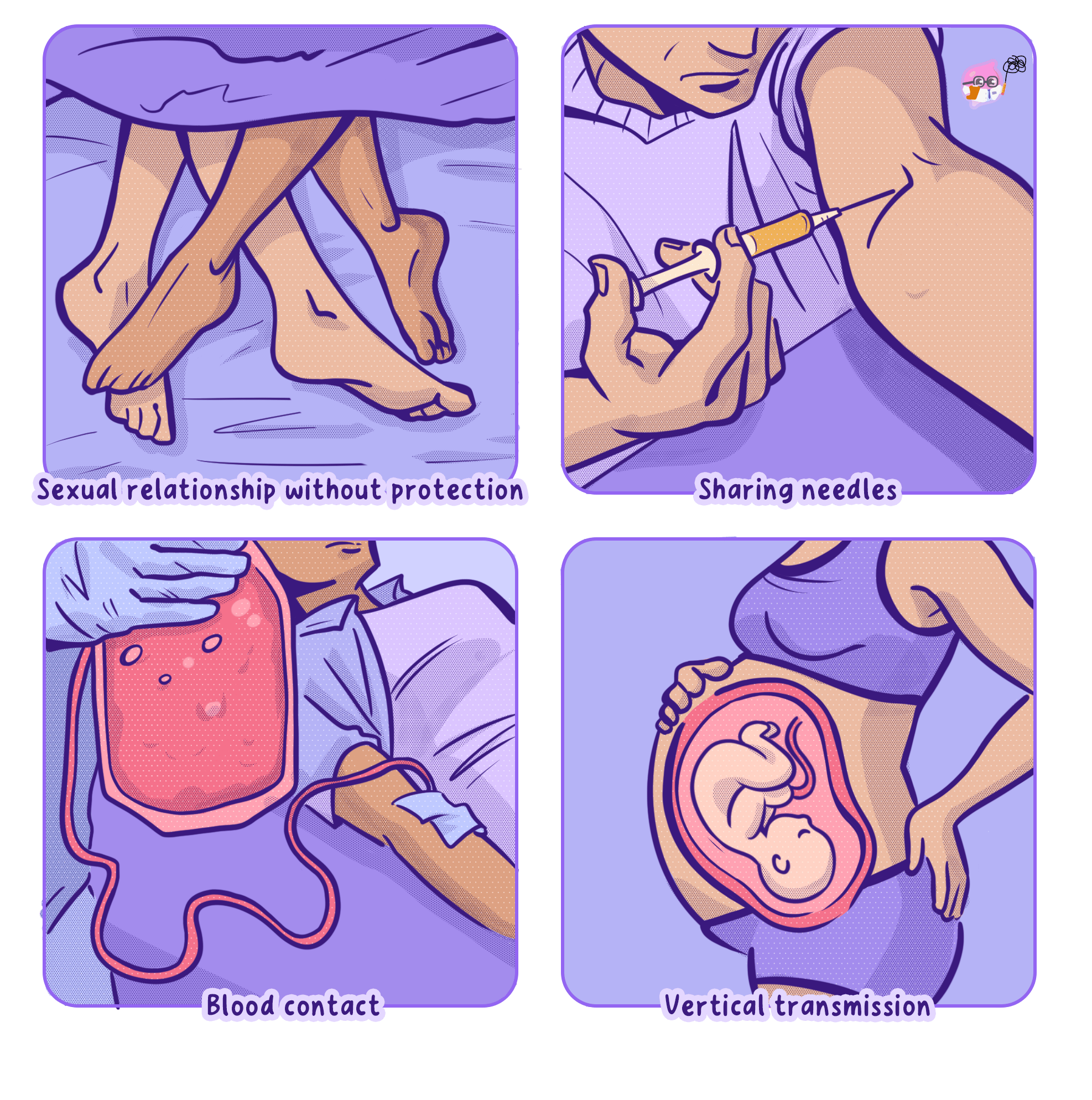
The fragility of a pathogen outside the body is exactly what makes barrier methods such as condoms and sterile needles so effective against it.
Air, water and food
- Airborne pathogens travel in the tiny droplets of liquid released when an infected person coughs, sneezes or talks.
- A single sneeze can release many thousands of droplets, which are then breathed in by anyone standing nearby or settle onto surfaces that are later touched.
- Influenza, measles and tuberculosis all spread this way, which is why they move quickly through crowded indoor spaces.
- Water-borne pathogens leave the body in faeces and enter drinking water that has been contaminated with sewage.
- Cholera spreads in this way, so outbreaks follow floods, earthquakes and any other event that mixes sewage with the water supply.
- Food-borne pathogens are swallowed in food that has been undercooked, stored too warm or handled with dirty hands.
- Salmonella grows in raw poultry and eggs, and also transfers onto salad when the same board or knife is used for both.
- Do not write that a disease is "spread by air" and leave it there.
- Say that droplets containing the pathogen are released in a cough or sneeze and then breathed in by another person.
Vectors and spread between plants
Vector
An organism that carries a pathogen from one host to another without developing the disease itself.
- A vector carries a pathogen from one host to another without developing the disease itself, so it acts as a living delivery system.
- A female mosquito takes up the malarial protist when it feeds on the blood of an infected person, then injects it into the next person it bites.
- Plants have no immune system and cannot move away from infection, so pathogens reach them by several distinct routes.
- Insects such as aphids and whitefly act as vectors, pushing their mouthparts into the phloem of one plant after another and carrying viruses with them.
- Wind carries the spores of fungal pathogens such as powdery mildew across whole fields in a single day.
- Rain splashes spores from infected soil and fallen leaves upwards onto healthy foliage.
- Direct contact passes pathogens between touching leaves, and gardeners transfer them on unsterilised secateurs, boots and hands.
- Infected seeds, tubers and cuttings carry a pathogen straight into a new crop before it has even germinated.
Crops are grown as dense stands of genetically identical plants, so a pathogen that infects one plant usually finds every neighbour equally easy to attack.
Reducing and preventing spread
- Hygiene removes pathogens before they reach a new host, because soap lifts them off the skin and running water washes them away.
- Disinfectants applied to kitchen worktops, door handles and hospital surfaces kill the pathogens that survive there between touches.
- Isolating infected people keeps them apart from others for as long as they remain infectious, so there is nobody nearby for droplets or contact to reach.
- Controlling vectors cuts transmission by removing the carrier, using insecticides, draining the standing water where mosquitoes breed and sleeping under treated nets.
- Treating water and sewage breaks the water-borne route, because filtration and chlorination kill the pathogens before the water is drunk.
- Safe food handling means cooking food right through, chilling it below the temperature at which bacteria reproduce quickly, and keeping raw meat away from food that will be eaten uncooked.
- In crops, growers remove and burn infected plants, rotate crops so a soil pathogen loses its host, sterilise tools between plants, control insect vectors and plant resistant varieties.
- Match the control measure to the route of transmission the question describes, because suggesting bed nets for a water-borne disease gains nothing.
- Every control measure needs its reason attached, so write that boiling water kills the bacteria rather than simply writing "boil the water".
- Where a question asks for more than one method, give methods that block different routes rather than three versions of washing your hands.
Vaccination and herd immunity
Herd immunity
The protection of unvaccinated individuals that results when so many members of a population are immune that a pathogen can no longer spread easily.
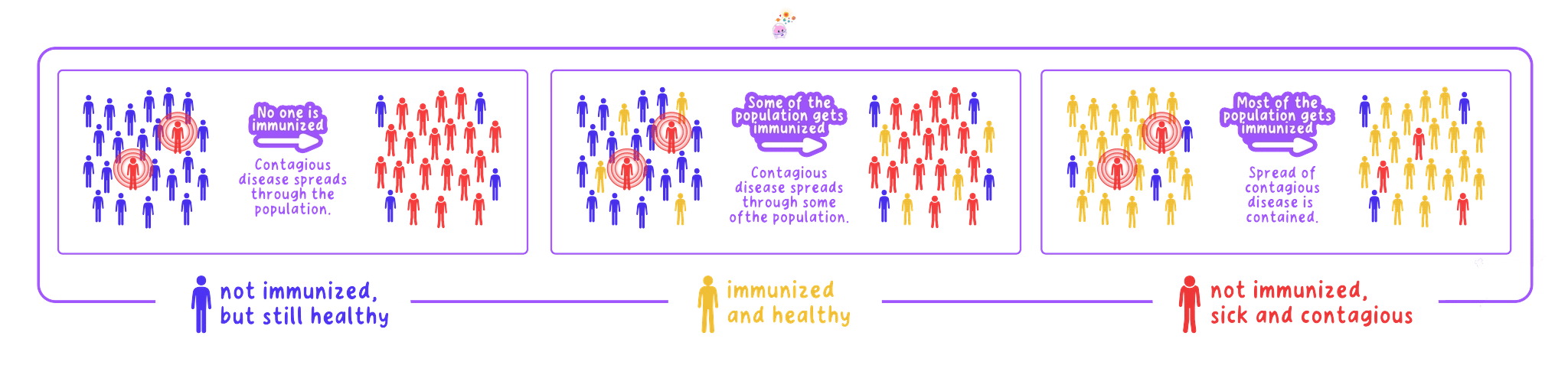
- A vaccinated person is already immune, so a pathogen that reaches them is destroyed before it can reproduce in large numbers.
- Because the pathogen never builds up inside that person, they do not pass it on, and the chain of transmission stops at them.
- As the proportion of vaccinated people rises, each infected person meets fewer and fewer susceptible people, so the average number of new infections caused by each case falls.
- Once that average drops below one new case per infected person the outbreak shrinks instead of growing, and the unvaccinated are protected as well, which is herd immunity.
- The proportion needed depends on how infectious the pathogen is, and measles is so infectious that roughly 95%95\%95% of a population must be vaccinated.
- Herd immunity matters most for babies too young to be vaccinated and for people whose immune systems are damaged, since neither group can be protected directly.
- If the vaccination rate slips below the threshold the pathogen begins to spread again, which is why outbreaks reappear in areas where uptake has fallen.
Working with numbers of cases
Incidence
The number of new cases of a disease that appear in a stated population over a stated period of time.
Epidemic
A rapid rise in the number of cases of a communicable disease within a population in a particular area.
- A raw count of cases cannot be compared between two places of different size, so figures are reported as an incidence per fixed number of people.
- Incidence is calculated using incidence=number of new casespopulation×100 000\text{incidence} = \dfrac{\text{number of new cases}}{\text{population}} \times 100\,000incidence=populationnumber of new cases×100000.
- The number of cases expected in another population is then estimated by reversing the calculation, multiplying the incidence by that population and dividing by 100 000100\,000100000.
- Numbers of pathogens grow in the same exponential way, because a bacterium divides in two by binary fission, giving N=N0×2nN = N_0 \times 2^nN=N0×2n where nnn is the number of divisions.
- Very large or very small values are written in standard form, so 512 000512\,000512000 bacteria is recorded as 5.12×1055.12 \times 10^{5}5.12×10⁵.
- A sharp rise in incidence above the level normally expected in an area is described as an epidemic, and one that spreads across several countries is a pandemic.
- A town of 250 000250\,000250000 people records 606060 new cases of an infection during one month.
- The incidence is 60250 000×100 000=24\dfrac{60}{250\,000} \times 100\,000 = 2425000060×100000=24 cases per 100 000100\,000100000 people.
- A nearby city of 900 000900\,000900000 people with the same incidence would be expected to record 24×900 000100 000=216\dfrac{24 \times 900\,000}{100\,000} = 21610000024×900000=216 new cases in the same month.
- One bacterium is left in warm food and divides every 202020 minutes for 333 hours.
- The number of divisions is n=18020=9n = \dfrac{180}{20} = 9n=20180=9.
- The number of bacteria present is N=1×29=512N = 1 \times 2^{9} = 512N=1×29=512, which shows how quickly a single pathogen becomes an infectious dose.
- Define transmission.
- Describe how a pathogen spreads from one person to another in exhaled droplets.
- Name three ways a pathogen can reach a healthy plant.
- Explain how vaccinating most of a population protects the people who are not vaccinated.
- Calculate the incidence per 100 000 people when 45 new cases occur in a population of 300 000.
