How one disease leads to another
Comorbidity
The presence of two or more diseases or disorders in the same individual at the same time.
Pathogen
A microorganism that causes a communicable disease, such as a virus, a bacterium, a fungus or a protist.
- Diseases do not act in isolation, because having one disease often makes a second disease more likely to develop or more severe when it does.
- When a person has two or more diseases at the same time this is called comorbidity, and the combination is usually harder to treat than either disease alone.
- There are four routes by which one disease opens the door to another.
- Damage to the immune system leaves the body unable to destroy pathogens it would normally deal with easily.
- A virus infecting host cells can disturb how those cells divide and so trigger a cancer.
- An immune response to a pathogen can leave the body reacting to harmless substances afterwards, producing an allergy.
- Severe physical illness can lead to mental illness, because pain, disability and uncertainty all take a toll.
- A communicable disease can be the starting point of a non-communicable one.
- The second disease is still non-communicable, because it is the pathogen that spreads and not the condition it triggers.
HIV and tuberculosis
Immunosuppression
A reduction in the ability of the immune system to defend the body against pathogens.
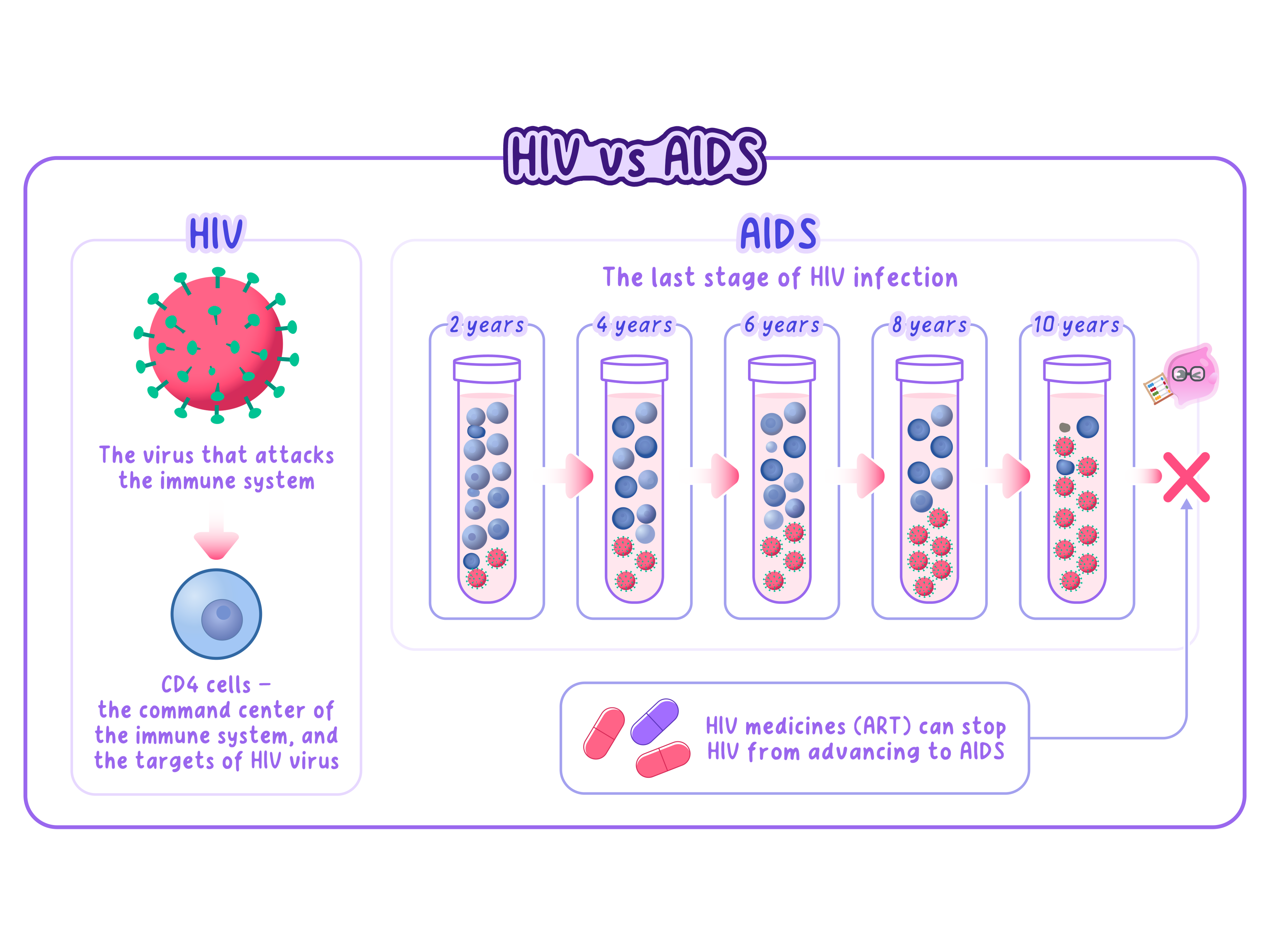
- HIV, the human immunodeficiency virus, infects a group of white blood cells called helper T lymphocytes, also known as CD4 cells, which coordinate the body's response to infection.
- The virus reproduces inside these cells and destroys them, so the number of CD4 cells in the blood falls steadily over several years while the number of virus particles rises.
- Soon after infection the person has a short flu-like illness, after which they may feel well for years even though the virus is still reproducing.
- Once the CD4 count drops far enough the immune system can no longer control pathogens, and the person is said to have AIDS, acquired immune deficiency syndrome.
- Tuberculosis is a communicable disease of the lungs caused by the bacterium Mycobacterium tuberculosis, which spreads in droplets breathed out by an infected person.
- In a healthy person white blood cells surround the bacteria and seal them inside small lumps of tissue in the lung, so the infection stays dormant and causes no symptoms.
- In a person with HIV there are too few working lymphocytes to hold the bacteria in place, so the dormant infection breaks out into active tuberculosis with a persistent cough, weight loss and fever.
- This is why tuberculosis is the infection that most often kills people living with untreated HIV, even though HIV itself destroys no lung tissue.
- Antiretroviral therapy slows the reproduction of HIV, so the CD4 count stays high, the immune system keeps working and the risk of tuberculosis falls sharply.
- Do not write that HIV kills a person directly.
- HIV destroys lymphocytes, and it is the infections that follow which cause the serious illness.
- HIV and AIDS are not the same thing, because AIDS is the late stage that develops only once the immune system has been badly damaged.
HPV and cervical cancer
Virus
A very small infectious particle made of genetic material inside a protein coat that can only reproduce inside a living host cell.
Non-communicable disease
A disease that is not caused by a pathogen and cannot be transmitted from one organism to another.
- Human papillomavirus, usually shortened to HPV, is passed on by skin to skin contact during sexual activity and infects the cells lining the cervix.
- Most HPV infections are cleared by the immune system within about two years and cause no lasting harm.
- A few strains of HPV insert their genetic material into the DNA of the cervix cells and make proteins that switch off the controls on cell division.
- The infected cells then divide uncontrollably, forming a mass of abnormal cells that can develop over many years into cervical cancer.
- The cancer itself is a non-communicable disease, because the tumour cannot pass to another person, yet the virus that started it is communicable.
- Cervical screening finds abnormal cells before they become cancerous, and vaccination against HPV before a person becomes sexually active stops the infection that starts the whole sequence.
Vaccinating against a virus is therefore one way of reducing the number of cases of a cancer, even though the cancer itself cannot be caught.
Other interactions between diseases
Allergy
A damaging immune response made by the body against a substance that is normally harmless.
- The immune response raised against a pathogen can leave the body over-reacting to harmless substances afterwards, which is why some children develop asthma or skin rashes following a viral infection of the airways.
- Physical damage to a barrier lets pathogens reach tissues that are normally sealed off, so a deep wound or a burn is frequently followed by a bacterial infection of the skin.
- A non-communicable disease can also make a communicable one more likely, because poorly controlled diabetes reduces blood flow to the feet and slows healing, so small wounds there become infected.
- Long or severe physical illness raises the risk of depression and other mental illness, because of continuing pain, loss of independence and the strain of an uncertain future.
- For all these reasons a doctor treats the whole patient rather than one illness in isolation, and controlling the first disease is often the most effective way of preventing the second.
- An interaction question is marked on the chain of reasoning, so set out each link in order rather than naming the two diseases and stopping.
- For HIV and tuberculosis the chain runs: HIV destroys lymphocytes, the immune response weakens, dormant tuberculosis bacteria are no longer controlled, active disease develops.
- Where a question gives data on rates of two diseases, quote a figure from the graph or table in your answer, because a comparison without numbers is rarely given full credit.
- Which cells does HIV infect, and what happens to their number over time?
- Explain why tuberculosis becomes active in a person infected with HIV.
- Describe how infection with HPV can lead to cervical cancer.
- Give one way a non-communicable disease can make a communicable disease more likely.
- What is meant by comorbidity?
