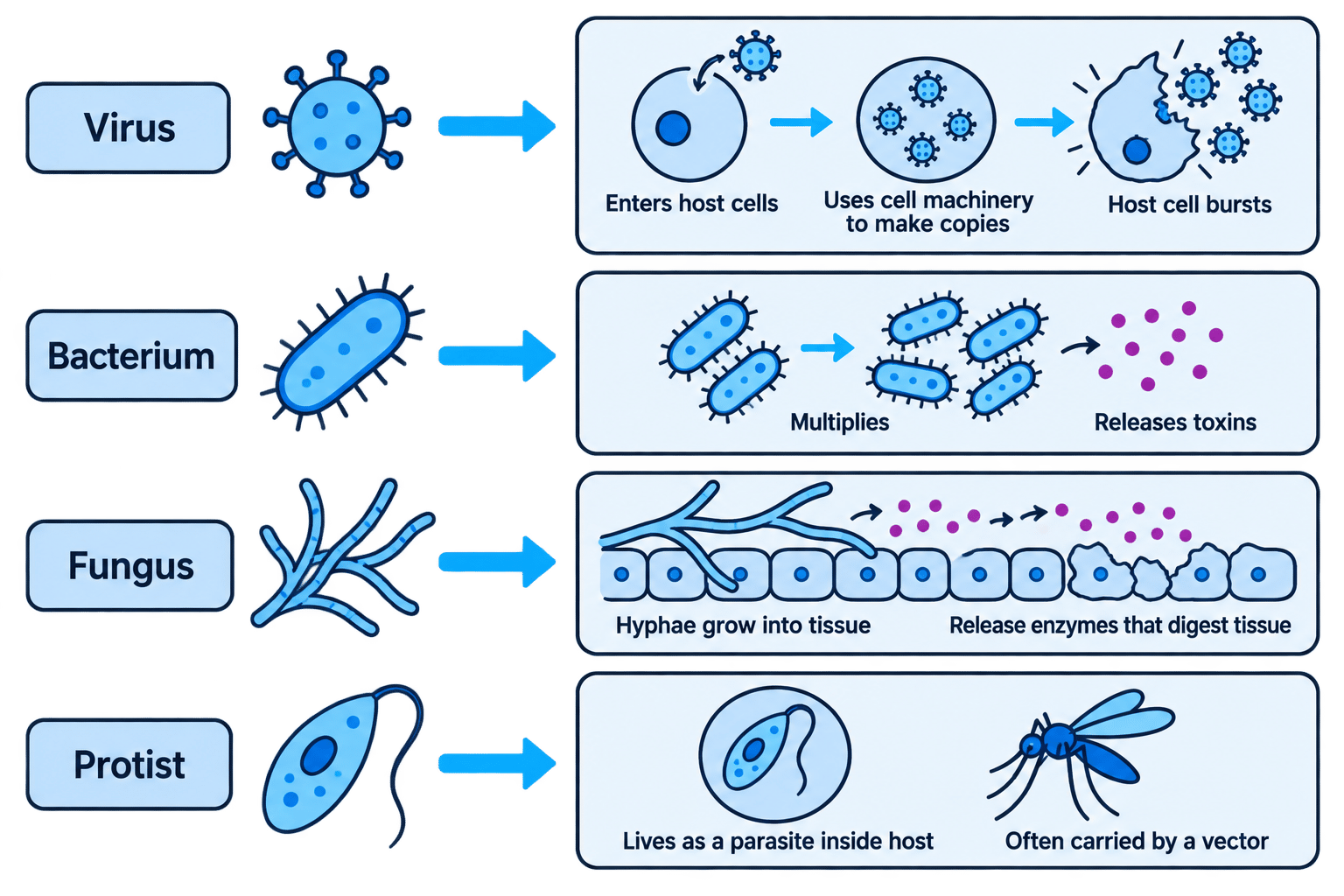
The four groups of pathogen
Virus
A very small infectious particle made of genetic material inside a protein coat that can only reproduce inside a living host cell.
Bacterium
A single-celled prokaryotic microorganism with no nucleus, some species of which are pathogens.
Fungus
A eukaryotic organism that is either single-celled or built from threads called hyphae and feeds by releasing enzymes onto its food.
Protist
A single-celled eukaryotic organism, some species of which are parasites that cause disease in a host.
- Communicable diseases of humans and of plants are caused by four groups of pathogen, and each group damages its host in a characteristic way.
- Viruses are not cells, so they take over the machinery of a host cell to make copies of themselves and the cell is destroyed as the new virus particles are released.
- Bacteria are cells that reproduce rapidly inside the body and damage tissues mainly by releasing poisonous toxins.
- Fungi grow threads called hyphae into the tissues of the host and release enzymes that digest those tissues so the fungus can absorb the products.
- Protists are single-celled organisms that live as parasites inside the host, and most of them rely on a vector to carry them from one host to the next.
Naming the group a pathogen belongs to also tells you how the disease can be treated, because antibiotics kill bacteria but have no effect at all on a virus.
Influenza, a viral infection
Infection
The entry and reproduction of a pathogen inside the tissues of a host organism.
- Influenza is caused by the influenza virus, which infects the cells lining the nose, throat and lungs.
- The virus attaches to a lining cell, enters it and forces the cell to build hundreds of new virus particles, which are released as the cell bursts and dies.
- Destroying the lining strips away the mucus and cilia that normally trap and sweep out dirt, which is why a bacterial chest infection often follows influenza.
- The symptoms are a sudden high temperature, aching muscles, headache, a dry cough and severe tiredness that lasts for a week or more.
- The virus is spread in droplets released when an infected person coughs or sneezes, and on hands and surfaces those droplets land on.
- There is no antibiotic treatment, so recovery depends on the immune system, and the yearly vaccine is offered to people most at risk of serious illness.
- Never suggest antibiotics as a treatment for a viral disease.
- Antibiotics work on structures and processes that only bacterial cells have, and a virus reproduces inside your own cells where the drug cannot reach it without killing them too.
Cholera, a bacterial infection
Toxin
A poisonous substance released by a pathogen that damages host cells and produces the symptoms of the disease.
- Cholera is caused by the bacterium Vibrio cholerae, which is swallowed in water or food contaminated by the faeces of an infected person.
- The bacteria that survive the stomach acid reach the small intestine, attach to its lining and multiply there in huge numbers.
- They release a toxin that acts on the lining cells and makes them pump salts out of the blood and into the gut.
- The contents of the gut are now a more concentrated solution than the blood, so water moves out of the blood and into the gut by osmosis through the partially permeable cell membranes.
- The gut fills with fluid, producing the severe watery diarrhoea that is the main symptom, and an adult can lose several litres in a few hours.
- Losing water and salts this quickly causes dehydration, the blood volume falls, and without treatment the person can die within a day.
- Treatment is an oral rehydration solution of clean water with salts and sugar dissolved in it, because the sugar helps the salts and therefore the water to be absorbed back across the gut wall.
- Do not write that the toxin digests or eats away the lining of the gut.
- The toxin moves salts into the gut and the water follows them by osmosis, so it is a movement of water down a concentration gradient rather than any damage to the tissue.
Athlete's foot, a fungal infection
- Athlete's foot is caused by a fungus that grows in the warm moist skin between the toes, conditions it needs to reproduce.
- Its hyphae grow into the dead outer layer of the skin and release enzymes that digest the protein keratin, and the fungus absorbs the products.
- The damaged skin becomes itchy, red, dry and cracked, and it flakes away carrying fungal spores with it.
- Those flakes are how the infection spreads, which is why it passes between people on wet changing room floors, in shared showers and on shared towels.
- It is treated with an antifungal cream or powder, and kept away by drying between the toes and wearing sandals in communal showers.
An antifungal is needed rather than an antibiotic, because a fungus is a eukaryote whose cells are far more similar to our own than a bacterial cell is.
Sexually transmitted infections
Sexually transmitted infection
A communicable disease transmitted from one person to another through sexual contact and the exchange of body fluids.
- A sexually transmitted infection is passed on during sexual contact, because the pathogens involved survive only in the moist conditions of body fluids.
- HIV is a virus that causes a short flu-like illness and then infects and destroys the lymphocytes that coordinate the immune response.
- Once too few of those cells remain, the body can no longer fight off other pathogens and the person is said to have AIDS.
- Antiretroviral drugs hold the virus at very low levels so the immune system keeps working, but they do not remove the virus from the body.
- Chlamydia is caused by a bacterium and often produces no symptoms at all, so it is passed on unknowingly for months.
- Untreated it scars the oviducts and sperm ducts, which is why it is a common cause of infertility, and it is cured with antibiotics if it is found.
- Gonorrhoea is also bacterial and gives a thick yellow or green discharge and pain on urinating, and strains resistant to the usual antibiotics are now common.
- Spread of all three is reduced by using a condom as a barrier, by screening people who have no symptoms, by treating partners at the same time and by not sharing needles.
- Learn each named disease as a set of four facts: the pathogen group, how it spreads, its symptoms and how it is treated or prevented.
- A question asking why an infection is hard to control is usually pointing at symptoms that are absent or mild, so say that an infected person passes it on without knowing.
- The mark most often lost is giving a symptom when the question asked for the effect on the body, so link the symptom back to the tissue the pathogen damages.
Tobacco mosaic virus in plants
Pathogen
A microorganism that causes a communicable disease, such as a virus, a bacterium, a fungus or a protist.
- Tobacco mosaic virus, usually shortened to TMV, infects tobacco, tomato, pepper and more than a hundred other species.
- It gives the leaves a distinctive mottled mosaic pattern of light green, yellow and dark green patches, and the leaves are often crinkled or narrowed.
- The pale patches contain far less chlorophyll, so they absorb less light, the rate of photosynthesis falls and the plant makes less glucose.
- With less glucose available for respiration and for building new tissue, growth is stunted and the crop yield drops.
- TMV is spread by contact between leaves and on the hands, clothing and tools of anyone working among the plants.
- The virus is unusually stable and survives for years in dried plant debris and in the soil, so infected material must be removed and destroyed rather than dug in.
There is no treatment once a plant is infected, so growers rely on removing diseased plants and on varieties bred to resist the virus.
Barley powdery mildew
- Barley powdery mildew is caused by the fungus Erysiphe graminis, one of the most damaging diseases of cereal crops.
- White fluffy pustules of fungal hyphae and spores appear on the upper surface of the leaves, later turning grey and brown.
- Fine hyphae push through the cell wall into the epidermal cells and absorb sugars directly from them, so food the plant made for itself is taken by the fungus.
- The white covering also blocks light from reaching the chloroplasts underneath, which lowers the rate of photosynthesis still further.
- Leaves yellow and die early, the grain that forms is small and light, and yields can fall by a fifth or more in a badly infected field.
- Spores are carried long distances on the wind, and the disease builds up fastest in mild damp weather and in crops sown thickly.
- Growers control it with fungicide sprays, by sowing resistant varieties and by avoiding heavy nitrogen fertiliser, which produces the soft leafy growth the fungus prefers.
The fungus takes sugars from living cells rather than killing them outright, because a dead leaf would stop photosynthesising and leave it with nothing to feed on.
Crown gall disease
- Crown gall disease is caused by the soil bacterium Agrobacterium tumefaciens, which attacks fruit trees, roses, grapevines and many other woody plants.
- The bacterium lives in the soil and can only get in through a wound, such as the damage done by a spade, a graft or frost at the base of the stem.
- Once inside it transfers a piece of its own DNA into the DNA of the plant cells around the wound.
- That inserted DNA switches on uncontrolled cell division, so the infected cells keep dividing and form a swollen lumpy growth called a gall.
- The disorganised gall tissue crushes and interrupts the xylem and phloem running through the stem, so water and dissolved sugars can no longer be transported properly.
- The plant above the gall is left short of water and minerals, so it grows poorly, wilts in dry weather and may die.
- Control depends on prevention, using clean planting stock, sterilised tools and careful handling so that the roots and stem base are not wounded.
- State how a virus damages the cells of its host.
- Explain how the cholera toxin causes severe diarrhoea.
- Name one sexually transmitted infection caused by a bacterium and one caused by a virus.
- Explain why tobacco mosaic virus reduces the growth of a tomato plant.
- Describe how crown gall disease stops a plant transporting water.