Genes and alleles
Gene
A gene is a section of DNA that contains the instructions for making a particular protein.
Allele
An allele is an alternative version of a gene.
- A gene is a section of DNA carrying the instructions for one protein, and it sits at a fixed position on a chromosome called its locus.
- Because chromosomes come in homologous pairs, a body cell carries two copies of every gene, one on each chromosome of the pair.
- The two copies may be the same version or two different versions, and each version is called an allele.
- New alleles arise when a mutation changes the base sequence of a gene, which changes the instruction and often changes the protein made from it.
- A gene may have many alleles across a whole population, but any one diploid individual carries only two of them.
- Alleles are written as letters, and both alleles of the same gene are written with the same letter, for example TTT and ttt.
Gene and allele are not interchangeable words: the gene is the instruction for a characteristic, and an allele is one particular version of that instruction.
Dominant and recessive alleles
Dominant allele
A dominant allele determines the phenotype when present in a heterozygous genotype.
Recessive allele
A recessive allele determines the phenotype only when no dominant allele of the same gene is present.
- A dominant allele determines the phenotype whenever it is present, so one copy is enough for its effect to show.
- A recessive allele determines the phenotype only when no dominant allele of that gene is present, so two copies are needed.
- Dominant alleles are written as capital letters and recessive alleles as the matching lower case letter, so TTT and ttt are two alleles of one gene.
- Writing TTT alongside sss would suggest two separate genes rather than two versions of the same gene, so the letters must always match.
- When a dominant and a recessive allele are present together, the protein coded by the dominant allele is enough to produce the dominant characteristic.
- A recessive characteristic can therefore disappear for a generation and reappear later, whenever two recessive alleles meet in the same individual.
- In pea plants the allele TTT codes for a tall stem and the allele ttt codes for a short stem.
- A plant with the alleles TTT and ttt makes enough of the protein coded by TTT to grow tall, so it has a tall stem.
- Only a plant with the alleles ttt and ttt grows short, because it has no dominant allele at all.
Genotype and phenotype
Genotype
The genotype is the combination of alleles carried by an organism.
Phenotype
The phenotype is the observable or measurable characteristics of an organism produced by its genotype and its interaction with the environment.
- The genotype is the pair of alleles an individual carries for a gene, written as two letters such as TTTTTT, TtTtTt or tttttt.
- The phenotype is the characteristic that can be seen or measured, such as a tall stem or a short stem.
- The genotype decides which proteins the cell can make, and those proteins, together with the conditions the organism grows in, produce the phenotype.
- Two individuals with different genotypes can share one phenotype, because TTTTTT and TtTtTt both give a tall stem.
- The recessive phenotype has only one possible genotype, because a short stem can only come from tttttt.
Do not answer with a phenotype when a question asks for a genotype. A genotype is always written as two allele letters and a phenotype is always described in words.
Homozygous and heterozygous
Homozygous
Homozygous describes a genotype containing two identical alleles of a particular gene.
Heterozygous
Heterozygous describes a genotype containing two different alleles of a particular gene.
Carrier
A carrier is a heterozygous individual that carries one recessive allele but does not show the recessive characteristic.
- An individual is homozygous for a gene when its two alleles are identical, written TTTTTT for homozygous dominant and tttttt for homozygous recessive.
- An individual is heterozygous when its two alleles are different, written TtTtTt.
- A homozygous individual can pass on only one kind of allele, so it is described as pure-breeding for that characteristic.
- A heterozygous individual can pass on either of its two alleles, so its offspring are not all alike.
- A heterozygous individual that shows the dominant characteristic while carrying a recessive allele is a carrier of that allele.
- A carrier passes the recessive allele on unseen, which is how a recessive characteristic can appear in offspring whose parents do not show it.
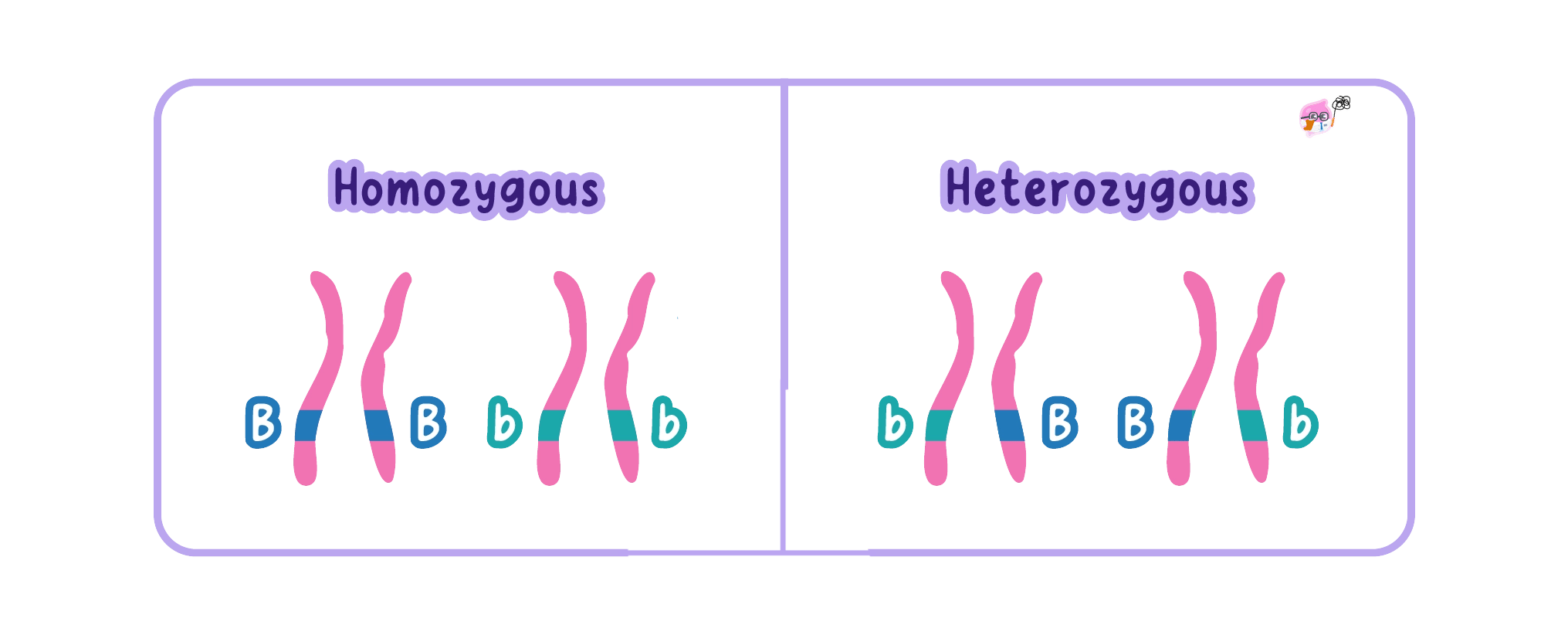
The prefixes carry the meaning: homo- means the same, so a homozygote has two identical alleles, and hetero- means different, so a heterozygote has two different alleles.
A tall plant is not automatically pure-breeding. Its genotype could be TTTTTT or TtTtTt, and nothing about its appearance separates the two.
How alleles pass to offspring
Monohybrid cross
A monohybrid cross is a genetic cross that follows the inheritance of a single gene from two parents to their offspring.
- Meiosis separates the two alleles of a gene, because the homologous chromosomes carrying them are pulled into different gametes.
- Every gamete therefore carries one allele of the gene and never both.
- A homozygous TTTTTT parent makes only TTT gametes, and a homozygous tttttt parent makes only ttt gametes.
- A heterozygous TtTtTt parent makes TTT gametes and ttt gametes in equal numbers.
- At fertilisation one allele carried by the male gamete joins one allele carried by the female gamete, which rebuilds the pair in the zygote.
- A cross that follows one gene through this route is a monohybrid cross, and it is set out as a genetic diagram.
- A genetic diagram is written in a fixed order, and every line of it earns credit.
- Line 1: the phenotypes of the two parents, described in words.
- Line 2: the genotypes of the two parents, written as pairs of allele letters.
- Line 3: the gametes each parent can make, written as single alleles.
- Line 4: the offspring genotypes produced by combining those gametes.
- Line 5: the offspring phenotypes that follow from those genotypes.
Gametes are normally drawn inside circles in a genetic diagram, which makes clear that each one holds a single allele rather than a whole genotype.
Crosses between the genotypes
- A cross between two homozygous parents, TT×ttTT \times ttTT×tt, gives every offspring the genotype TtTtTt, so all of them show the dominant characteristic.
- A cross between two heterozygous parents, Tt×TtTt \times TtTt×Tt, gives offspring of genotype TTTTTT, TtTtTt, TtTtTt and tttttt.
- Three of those four offspring carry at least one TTT and show the dominant characteristic, while the fourth is tttttt and shows the recessive characteristic.
- A cross between a heterozygote and a homozygous recessive parent, Tt×ttTt \times ttTt×tt, gives offspring of genotype TtTtTt, TtTtTt, tttttt and tttttt.
- Half of those offspring show the dominant characteristic and half show the recessive characteristic.
- Any cross involving a homozygous dominant parent, such as TT×TtTT \times TtTT×Tt, gives no recessive offspring at all, because every offspring receives at least one TTT.
- The recessive characteristic appears only in an offspring that receives a recessive allele from both parents at once.
- Two pea plants of genotype TtTtTt are crossed, where TTT codes for a tall stem and ttt codes for a short stem.
- Both parents are tall, because each carries one dominant allele.
- Each parent makes two kinds of gamete in equal numbers, TTT and ttt.
- Combining the gametes gives the offspring genotypes TTTTTT, TtTtTt, TtTtTt and tttttt.
- The offspring phenotypes are tall, tall, tall and short, so two tall parents can produce a short plant whenever both pass on ttt.
- Say what each allele letter stands for before using it, because an unexplained letter cannot be credited.
- Lay the genetic diagram out in the same order every time, since the gamete line carries marks of its own.
- Write gametes as single alleles, never as pairs, because a gamete carrying TtTtTt would be diploid.
- Keep the same letters from the parent line to the offspring line, as switching from TTT to LLL partway through breaks the link between them.
- What is the difference between a gene and an allele?
- How many alleles of one gene does a gamete carry, and why?
- Write the three possible genotypes for a gene with alleles TTT and ttt, and give the phenotype of each.
- Explain what a carrier is and how a carrier can have offspring showing a recessive characteristic.
- Which offspring genotypes come from the cross Tt×ttTt \times ttTt×tt?
