Meiosis and gametes
Meiosis
Meiosis is a form of cell division in which one diploid cell divides twice to produce four genetically different haploid gametes.
Gamete
A gamete is a haploid reproductive cell whose nucleus can fuse with another gamete nucleus during fertilisation.
- Meiosis is the form of cell division that produces gametes, and in humans it takes place only in the testes and the ovaries.
- In flowering plants the same division occurs in the anthers, which make pollen, and in the ovules, which make egg cells.
- One diploid parent cell that enters meiosis gives rise to four haploid daughter cells.
- A diploid human body cell holds 464646 chromosomes arranged as 232323 homologous pairs, one chromosome of each pair having come from each parent.
- Each gamete formed from that cell holds 232323 chromosomes, exactly one taken from every pair.
- The change is written 2n→n2n \rightarrow n2n→n, where nnn stands for one complete set of chromosomes.
- In humans n=23n = 23n=23, so a body cell is 2n=462n = 462n=46 and a sperm cell or egg cell is n=23n = 23n=23.
- Meiosis is the only division in the body that changes the chromosome number, which is why it is confined to the reproductive organs.
The gametes are sperm cells and egg cells in animals, and pollen nuclei and egg cells in flowering plants.
Why the number is halved
Fertilisation
Fertilisation is the fusion of male and female gamete nuclei to form a zygote.
Zygote
A zygote is the single diploid cell produced when the nuclei of two haploid gametes fuse at fertilisation.
- Fertilisation is the fusion of a male gamete nucleus with a female gamete nucleus.
- Two haploid nuclei fuse, so the zygote that forms carries 23+23=4623 + 23 = 4623+23=46 chromosomes.
- The diploid number is restored exactly, and the zygote then divides repeatedly by mitosis to build the whole organism.
- Every body cell of the new individual therefore carries the same 464646 chromosomes as the body cells of its parents.
- Because one full set arrives from each parent, every homologous pair holds one maternal chromosome and one paternal chromosome.
- If gametes were diploid, the chromosome number would double at every fertilisation, running 46→92→18446 \rightarrow 92 \rightarrow 18446→92→184 in three generations.
- A cell with the wrong chromosome number carries the wrong number of copies of every gene on the extra chromosomes, so it cannot develop normally.
- Meiosis is described as a reduction division because it is the step that takes one chromosome away from every pair.
Meiosis and fertilisation work as a pair: meiosis takes the chromosome number down to nnn and fertilisation returns it to 2n2n2n, so the diploid number of the species stays the same generation after generation.
Fertilisation is not a type of cell division. No cell divides when two gamete nuclei fuse, so a cross that describes fertilisation as halving or copying chromosomes has the two processes the wrong way round.
The two divisions of meiosis
Homologous chromosomes
Homologous chromosomes are a pair of chromosomes carrying the same genes at the same positions, with one inherited from each parent.
- Before meiosis starts, every chromosome is copied during interphase, so it becomes two identical sister chromatids joined at a centromere.
- Meiosis I separates the homologous pairs, and it is this division that halves the chromosome number.
- Prophase I: the chromosomes condense and each one pairs up alongside its homologous partner.
- Metaphase I: the pairs line up along the equator of the cell, each pair positioned independently of the others.
- Anaphase I: spindle fibres pull one whole chromosome of each pair to each pole, so the sister chromatids stay joined together.
- Telophase I: two nuclei form and the cell divides, producing two cells that are already haploid.
- Meiosis II separates the sister chromatids and runs in the same way as mitosis.
- Prophase II: the chromosomes condense again inside each of the two new cells.
- Metaphase II: the chromosomes line up singly along the equator.
- Anaphase II: each centromere divides and the sister chromatids are pulled to opposite poles.
- Telophase II: four nuclei form and both cells divide, giving four haploid cells in total.
- The overall result is one diploid cell becoming four haploid cells, each carrying one chromosome from every original pair.
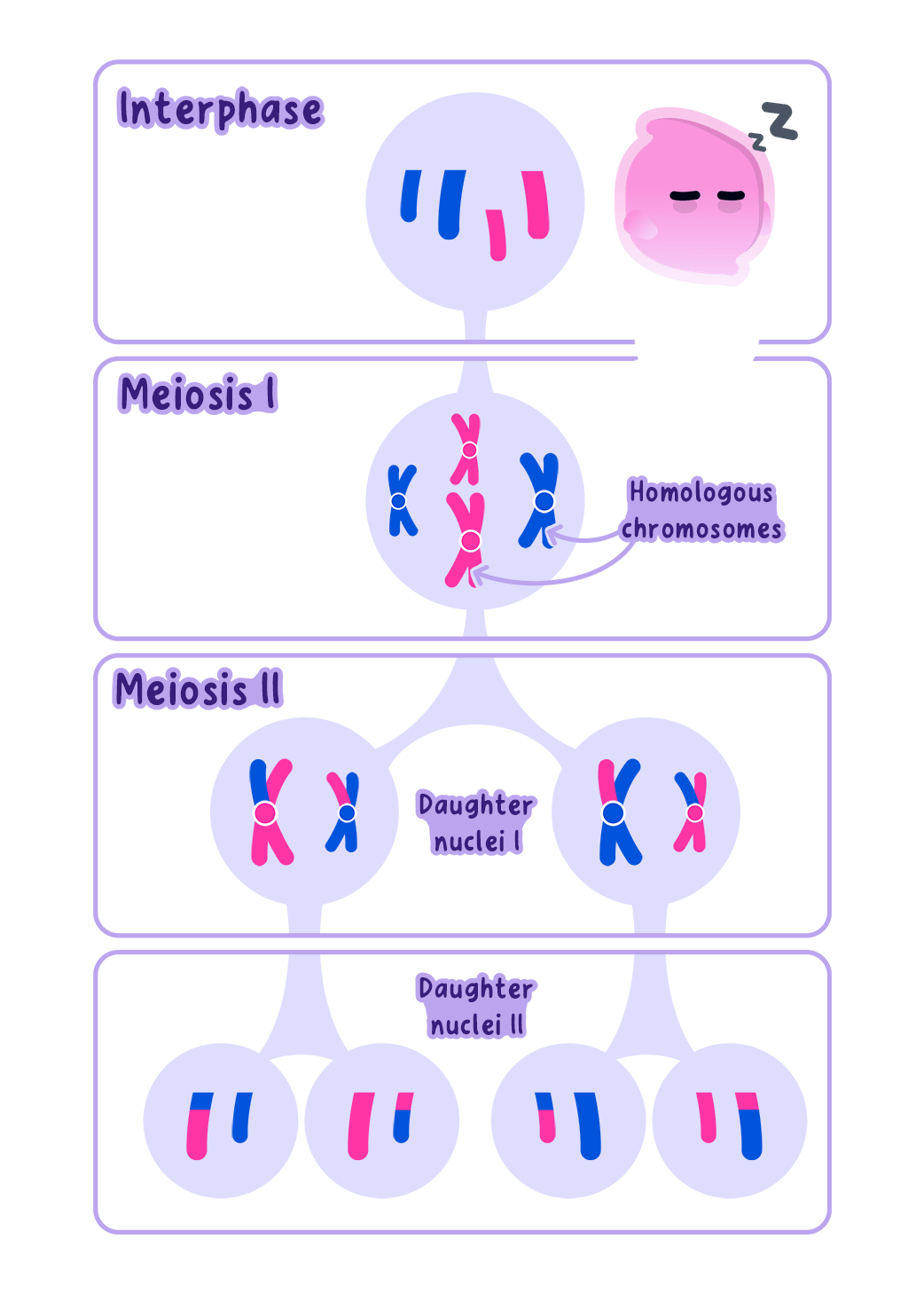
Both divisions run through the same four stages in the same order, so only the Roman numeral changes: prophase, metaphase, anaphase, telophase.
How meiosis creates variation
- Crossing over happens in prophase I, when the chromatids of a homologous pair lie against each other and swap matching sections of DNA.
- The point at which they join and exchange material is called a chiasma, and every chromatid that leaves it carries a new combination of alleles.
- Independent assortment happens at metaphase I, because the way one pair lines up at the equator has no effect on the way any other pair lines up.
- Either chromosome of a pair can end up facing either pole, so each pair contributes one of two possible outcomes to the gamete.
- For nnn homologous pairs the number of possible chromosome combinations in a gamete is 2n2^{n}2n.
- With n=23n = 23n=23 in humans this gives 223=8 388 6082^{23} = 8\,388\,608223=8388608 combinations from independent assortment alone, before crossing over is counted.
- Random fertilisation adds a further step, because any one of those sperm cells can fuse with any one of those egg cells.
- The four gametes produced by one meiosis are therefore genetically different from one another, and offspring differ from their parents and from each other.
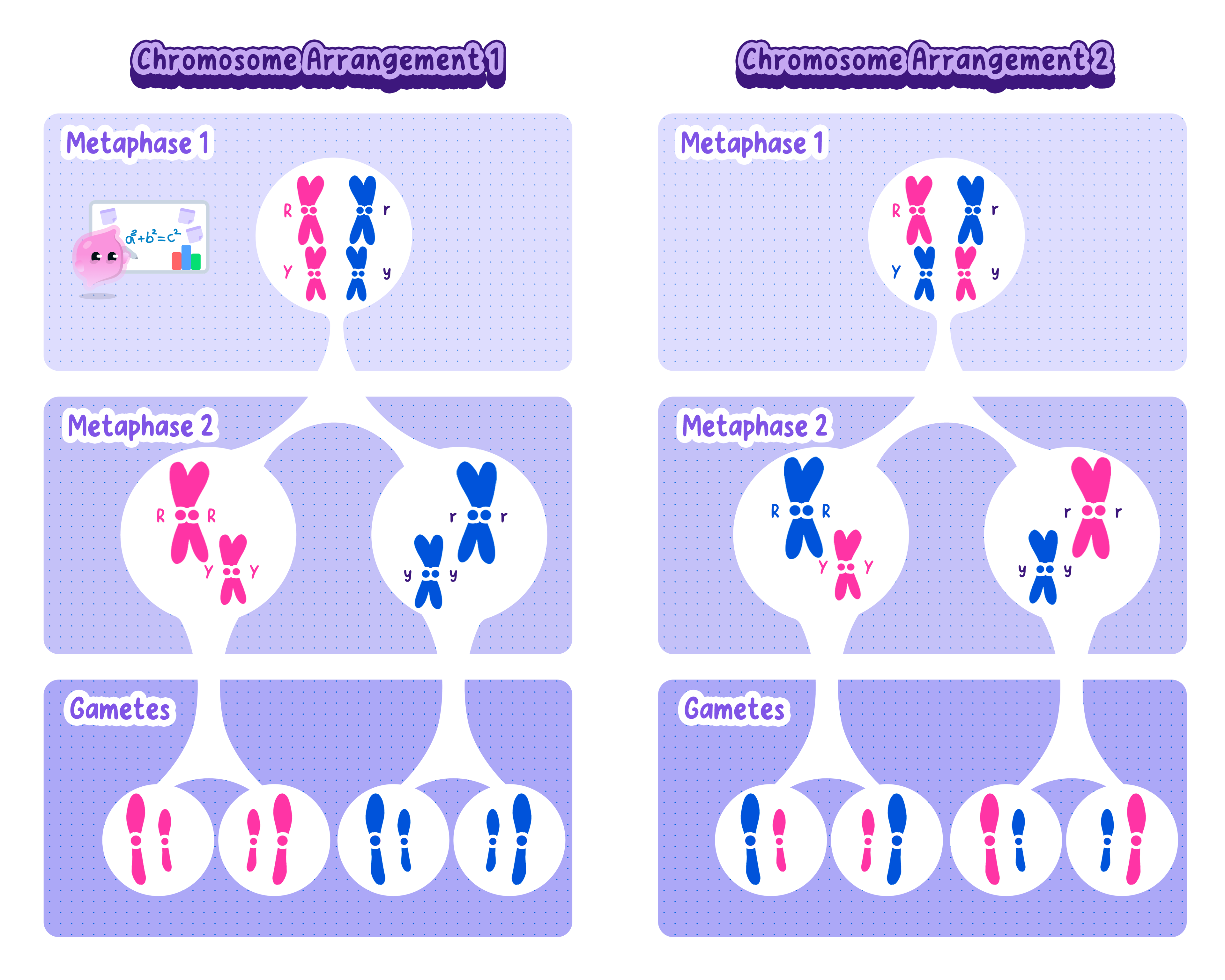
- A parent cell holds two homologous pairs, one pair carrying the alleles RRR and rrr and the other carrying YYY and yyy.
- At metaphase I the pairs can line up so that RRR faces the same pole as YYY, which sends RYRYRY into one gamete and ryryry into the other.
- They can equally line up so that RRR faces the same pole as yyy, which sends RyRyRy into one gamete and rYrYrY into the other.
- Four different gamete types are therefore possible from one parent cell, matching 2n2^{n}2n with n=2n = 2n=2 pairs, so 22=42^{2} = 422=4.
- A question asking how meiosis produces genetic variation is looking for a named process placed at a named stage.
- Name crossing over and put it in prophase I, then say that sections of DNA are exchanged between the chromatids of a homologous pair.
- Name independent assortment and put it at metaphase I, then say that each pair lines up at random with respect to the others.
- Finish with the outcome, that the four gametes are genetically different from one another.
Meiosis compared with mitosis
Mitosis
Mitosis is the stage of the cell cycle in which the nucleus divides to produce two nuclei with identical sets of chromosomes.
- Mitosis produces two daughter cells, whereas meiosis produces four.
- Mitosis keeps the chromosome number at 2n2n2n, whereas meiosis reduces it to nnn.
- Mitosis involves a single division, whereas meiosis involves two divisions one straight after the other.
- The cells made by mitosis are genetically identical to the parent cell, whereas the cells made by meiosis are all genetically different.
- Mitosis occurs throughout the body for growth, repair and asexual reproduction, whereas meiosis occurs only in the reproductive organs.
- Neither crossing over nor independent assortment occurs in mitosis, which is why mitosis produces no genetic variation.
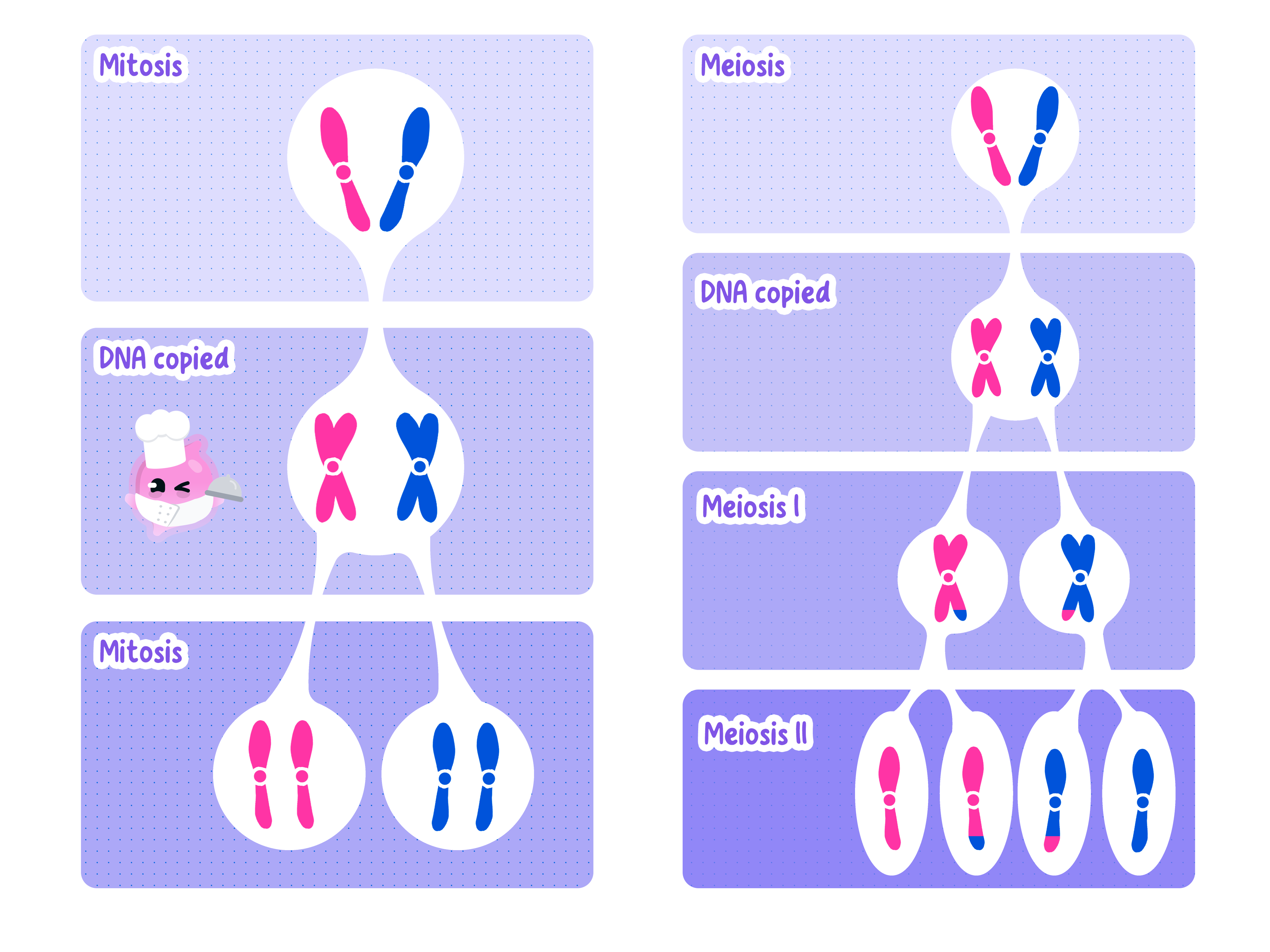
Do not write that meiosis gives two cells or that mitosis gives gametes. The number of daughter cells and the type of cell produced are the two details mixed up most often.
- Where in the human body does meiosis take place?
- How many daughter cells does one meiosis produce, and how many chromosomes does each one carry?
- Explain why gametes must be haploid rather than diploid.
- Name the two processes in meiosis I that produce genetic variation, and state the stage at which each occurs.
- Give three differences between mitosis and meiosis.
