Building a Punnett square
Punnett square
A Punnett square is a grid that combines the alleles carried by the gametes of two parents to show every possible genotype of their offspring.
Monohybrid cross
A monohybrid cross is a genetic cross that follows the inheritance of a single gene from two parents to their offspring.
- A Punnett square is a grid that combines the gametes of two parents so that every possible offspring genotype appears in the table.
- The grid is built in the same six steps every time.
- Write the genotype of each parent, for example BbBbBb for the father and BbBbBb for the mother.
- Work out the gametes each parent can make, writing single alleles only, so a BbBbBb parent makes BBB and bbb.
- Draw a 2×22 \times 22×2 grid, place one parent's gametes above the two columns and the other parent's gametes beside the two rows.
- Fill each box by combining the allele at the head of its column with the allele at the start of its row.
- Write the dominant allele first inside each box, so a box holding bbb and BBB is written BbBbBb.
- Read off the phenotype of each box, remembering that one dominant allele is enough to give the dominant characteristic.
- Two gamete types from each parent give 2×2=42 \times 2 = 42×2=4 boxes, and each box is one equally likely outcome of fertilisation.
- A parent that is homozygous makes only one kind of gamete, so its allele is simply repeated along its side of the grid.
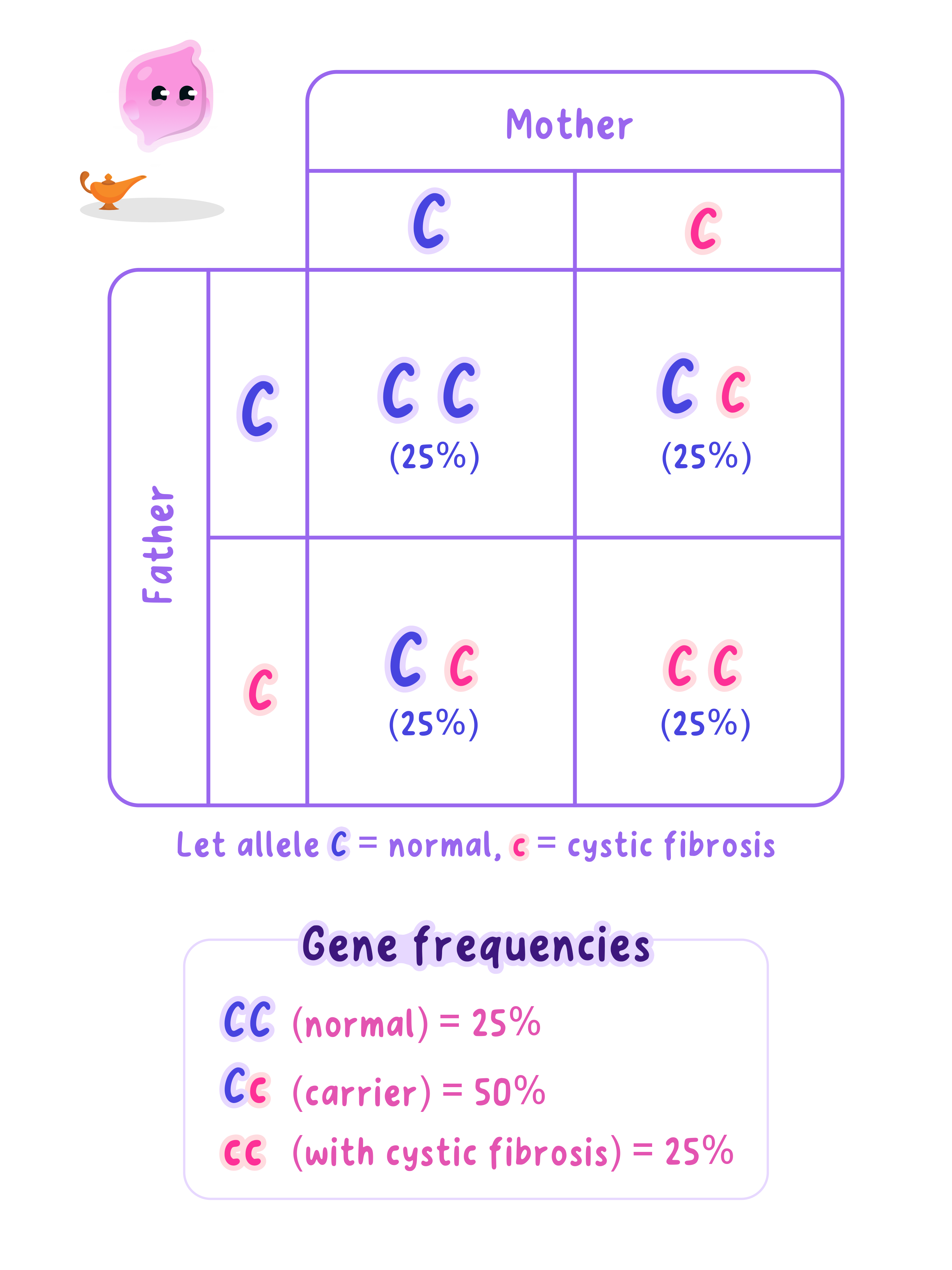
Put single alleles on the edges of the grid and never whole genotypes, because a gamete carries one allele of the gene and not both.
Do not read the four boxes as four children. Each box is one possible outcome, and the same four outcomes apply afresh to every offspring.
Reading ratios from the grid
- The genotype ratio counts the boxes by genotype, so Bb×BbBb \times BbBb×Bb gives 1 BB:2 Bb:1 bb1\,BB : 2\,Bb : 1\,bb1BB:2Bb:1bb.
- The phenotype ratio counts the boxes by appearance, so the same cross gives 3:13 : 13:1 dominant to recessive.
- The cross Bb×bbBb \times bbBb×bb gives BbBbBb, BbBbBb, bbbbbb and bbbbbb, which is 1:11:11:1 by genotype and 1:11:11:1 by phenotype.
- The cross BB×bbBB \times bbBB×bb fills all four boxes with BbBbBb, so every offspring shows the dominant characteristic.
- The cross BB×BbBB \times BbBB×Bb gives BBBBBB, BBBBBB, BbBbBb and BbBbBb, which is 1:11:11:1 by genotype but gives no recessive offspring at all.
- A ratio is converted to a fraction using fraction=parts of interesttotal parts\text{fraction} = \dfrac{\text{parts of interest}}{\text{total parts}}fraction=total partsparts of interest.
- A ratio of 3:13:13:1 therefore means 333 parts out of 444, which is 34\frac{3}{4}43, and 34×100=75%\frac{3}{4} \times 100 = 75\%43×100=75%.
- A ratio of 1:11:11:1 means 111 part out of 222, which is 12\frac{1}{2}21 and therefore 50%50\%50%.
- A ratio is simplified by dividing both parts by their highest common factor, so 27:927:927:9 becomes 3:13:13:1.
- A brown eyed father of genotype BbBbBb and a brown eyed mother of genotype BbBbBb have children, where BBB codes for brown eyes and bbb codes for blue eyes.
- Each parent makes BBB gametes and bbb gametes in equal numbers.
- Filling the grid gives the offspring genotypes BBBBBB, BbBbBb, BbBbBb and bbbbbb.
- Three of the four boxes hold at least one BBB, so the phenotype ratio is 333 brown to 111 blue.
- Written the other two ways, that is 34\frac{3}{4}43 brown and 14\frac{1}{4}41 blue, or 75%75\%75% brown and 25%25\%25% blue.
Do not give a genotype ratio when the question asks for a phenotype ratio. The cross Bb×BbBb \times BbBb×Bb is 1:2:11:2:11:2:1 by genotype and 3:13:13:1 by appearance, and only one of those answers fits each question.
Probability for one offspring
- Each box of a completed grid is one equally likely outcome, so a single box carries a probability of 14\frac{1}{4}41.
- The probability of any genotype is the number of boxes showing it divided by the total number of boxes.
- From Bb×BbBb \times BbBb×Bb the probability of bbbbbb is 14\frac{1}{4}41, of BbBbBb is 24=12\frac{2}{4} = \frac{1}{2}42=21 and of BBBBBB is 14\frac{1}{4}41.
- The probability of the dominant phenotype from that cross is 34\frac{3}{4}43, which is 0.750.750.75 as a decimal and 75%75\%75% as a percentage.
- Every probability lies between 000 and 111, and the probabilities of all possible outcomes of a cross add up to 111.
- Each fertilisation is an independent event, so the outcome of one offspring has no effect on the next.
- Parents who already have three children showing the dominant characteristic still face a probability of 14\frac{1}{4}41 that the fourth shows the recessive one.
A probability can be written as a fraction, a decimal or a percentage, and a question will usually name the form the answer should take.
Expected and observed numbers
- The expected number of offspring of one type is found from expected number=probability×total number of offspring\text{expected number} = \text{probability} \times \text{total number of offspring}expected number=probability×total number of offspring.
- From Bb×BbBb \times BbBb×Bb with 404040 offspring, the expected number showing the recessive characteristic is 14×40=10\frac{1}{4} \times 40 = 1041×40=10.
- The expected number showing the dominant characteristic is 34×40=30\frac{3}{4} \times 40 = 3043×40=30.
- Observed numbers rarely match expected numbers exactly, because which gamete fuses with which is a matter of chance.
- The more offspring are counted, the closer the observed proportions usually come to the expected ones.
- Observed results close to the expected ratio support the genotypes proposed for the parents.
- Observed results a long way from the expected ratio suggest that one of the parent genotypes was wrong, or that too few offspring were counted.
Modelling a monohybrid cross with beads
- Aim: to model the cross Bb×BbBb \times BbBb×Bb using beads drawn at random, and to compare the offspring ratio actually obtained with the 3:13:13:1 ratio predicted by a Punnett square.
- Apparatus: two opaque containers such as beakers covered with card, 505050 red beads, 505050 white beads, a marker pen, a tally chart on paper, a pencil and a calculator.
- Method:
- Label one container as the male parent and the other as the female parent, since each container will supply one gamete for every offspring.
- Place 252525 red beads, standing for the allele BBB, and 252525 white beads, standing for the allele bbb, into each container.
- Check that both containers hold equal numbers of the two colours, because a heterozygous parent makes its two gamete types in equal numbers.
- Shake each container for several seconds so the beads are thoroughly mixed and no colour is left sitting on top.
- Look away from the containers and draw one bead from each with the other hand, so that neither draw is influenced by what can be seen.
- Record the pair as a genotype with the dominant allele written first, so one red bead and one white bead is recorded as BbBbBb.
- Return each bead to the container it came from and shake again before the next draw, because taking beads out would change the proportion of alleles left behind.
- Repeat the draw until 100100100 offspring have been recorded, tallying in groups of five so the totals can be counted quickly.
- Add up the tallies to give the observed numbers of BBBBBB, BbBbBb and bbbbbb, then group BBBBBB and BbBbBb together as the dominant phenotype.
- Results: a typical run gives roughly 252525 BBBBBB, 505050 BbBbBb and 252525 bbbbbb, which is about 757575 offspring with the dominant phenotype and 252525 with the recessive one.
- Maths: the expected numbers are 34×100=75\frac{3}{4} \times 100 = 7543×100=75 dominant and 14×100=25\frac{1}{4} \times 100 = 2541×100=25 recessive, and dividing the observed 75:2575:2575:25 by 252525 simplifies it to 3:13:13:1.
- Watch out: failing to replace the beads changes the allele proportions and drags the ratio away from 3:13:13:1, glancing into the container makes the draw non-random, and stopping after only 202020 draws can give a ratio as far out as 2:12:12:1 purely by chance.
- Safety: the hazard is low, but keep spilled beads off the floor because they are a slipping hazard, and never put beads near the mouth.
- What goes along the two edges of a Punnett square, and why?
- Give the genotype ratio and the phenotype ratio produced by the cross Bb×BbBb \times BbBb×Bb.
- What is the probability that a single offspring of the cross Bb×bbBb \times bbBb×bb shows the recessive characteristic?
- Calculate the expected number of recessive offspring when 606060 offspring come from the cross Bb×BbBb \times BbBb×Bb.
- Explain why observed offspring numbers do not always match the expected ratio.
