The sex chromosomes
Definition
Sex chromosomes
The sex chromosomes are the pair of chromosomes that determine the sex of an individual, which in humans are XX in a female and XY in a male.
- A human body cell holds 232323 pairs of chromosomes, and 222222 of those pairs are autosomes, which look the same in both sexes.
- The twenty third pair is the pair of sex chromosomes, and this pair decides whether an individual develops as female or male.
- A female has two X chromosomes, written XXXXXX, so this pair is fully matched like any other pair.
- A male has one X chromosome and one Y chromosome, written XYXYXY, and the Y is much shorter than the X.
- The Y chromosome carries a gene that switches on the development of testes in the early embryo.
- An embryo with no Y chromosome has no copy of that gene, so it develops ovaries instead.
- The X chromosome also carries many genes with nothing to do with sex, so every individual needs at least one copy of it.
Note
The X chromosome is far larger than the Y and carries many more genes, so the two members of this pair are not matched in the way an autosomal pair is.
Gametes and a child's sex
Definition
Gamete
A gamete is a haploid reproductive cell whose nucleus can fuse with another gamete nucleus during fertilisation.
- Meiosis separates the two sex chromosomes, so every gamete receives exactly one of them.
- A female is XXXXXX, so every egg cell she makes carries an X chromosome.
- A male is XYXYXY, so half the sperm cells he makes carry an X chromosome and half carry a Y chromosome.
- The egg cell always supplies an X, so the sex of the child depends entirely on which kind of sperm reaches it first.
- An X sperm fusing with the egg gives a zygote of genotype XXXXXX, which develops as a female.
- A Y sperm fusing with the egg gives a zygote of genotype XYXYXY, which develops as a male.
- Equal numbers of X sperm and Y sperm are made, which is why the two outcomes are equally likely.
Common Mistake
The mother does not decide the sex of the child. Every egg cell carries an X, so it is the sperm cell that brings either the X or the Y that settles it.
The genetic cross for sex
Definition
Punnett square
A Punnett square is a grid that combines the alleles carried by the gametes of two parents to show every possible genotype of their offspring.
- Sex determination is set out as a genetic cross in exactly the same way as any other single gene cross.
- Parent genotypes: the mother is XXXXXX and the father is XYXYXY.
- Gametes: the mother produces XXX and XXX, while the father produces XXX and YYY.
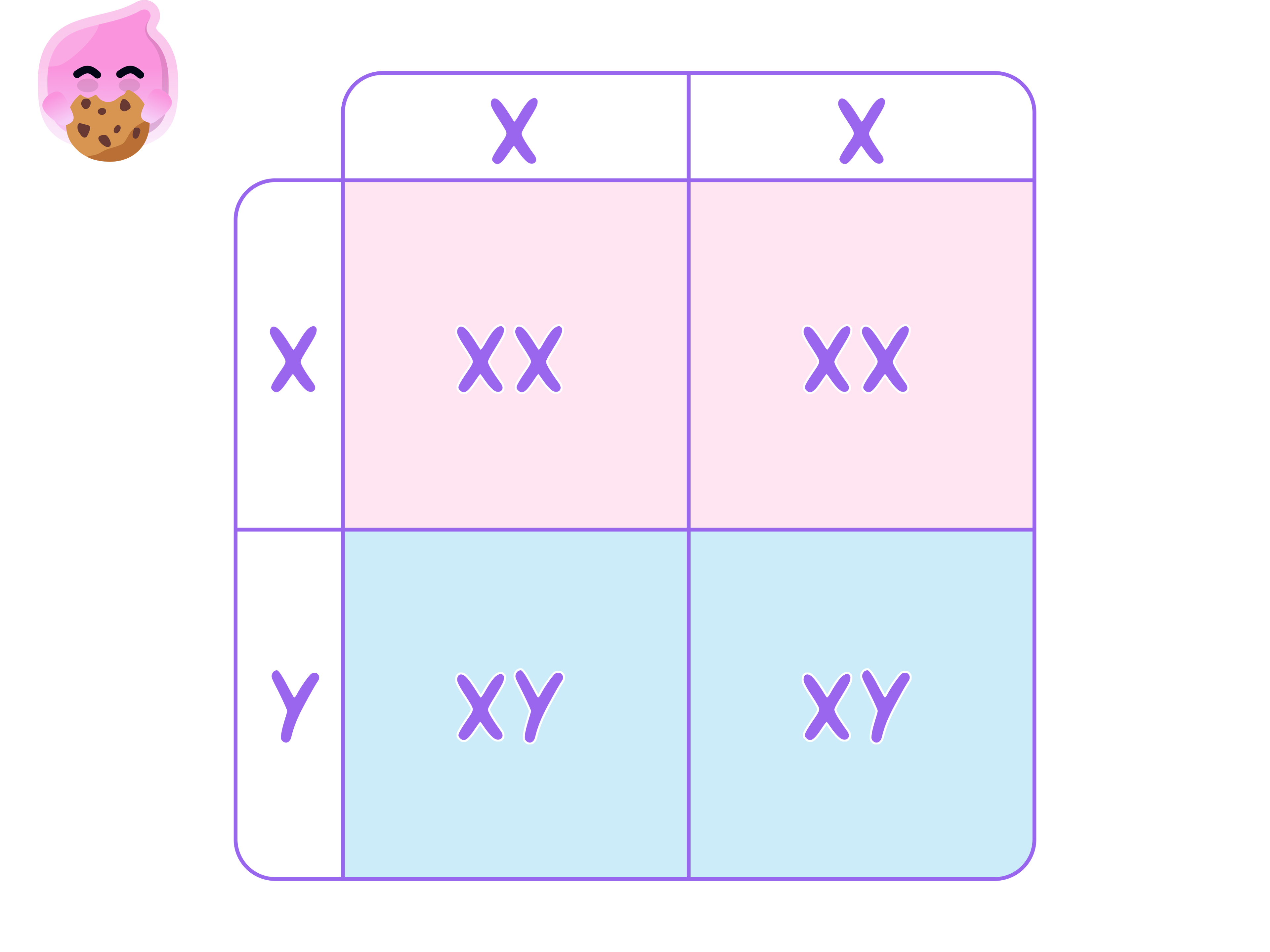
- Grid: the mother's gametes go along the top of a 2×22 \times 22×2 Punnett square and the father's gametes go down the side.
- Offspring genotypes: the four boxes give XXXXXX, XXXXXX, XYXYXY and XYXYXY.
- Offspring phenotypes: two female and two male.
- The phenotype ratio is therefore 1:11:11:1 female to male.
- The probability that any one child is male is 24=12\frac{2}{4} = \frac{1}{2}42=21, which is 50%50\%50%.
- That prediction applies afresh to every pregnancy, because each fertilisation is an independent event.
- Birth records show slightly more boys than girls born each year, which is close to but not exactly the predicted 1:11:11:1.
Example
- A couple who already have three daughters are expecting a fourth child.
- The cross is still XX×XYXX \times XYXX×XY, because the genotypes of the parents have not changed.
- The completed grid still gives XXXXXX, XXXXXX, XYXYXY and XYXYXY, so two of the four outcomes are male.
- The probability that the fourth child is a boy is 24=12\frac{2}{4} = \frac{1}{2}42=21, or 50%50\%50%.
- The three daughters make no difference to that figure, because the sperm that fertilises each egg is selected independently of every earlier fertilisation.
Exam technique
- Label the chromosomes as XXX and YYY in the genetic diagram rather than as male and female, because the credit is for the chromosomes.
- Show the gamete line, since a mark is often given for two kinds of sperm alongside one kind of egg.
- Give the answer in the form asked for, whether that is a ratio of 1:11:11:1, a probability of 12\frac{1}{2}21 or a percentage of 50%50\%50%.
- Say that each fertilisation is independent whenever a question mentions the children a family already has.
Self review
- Which sex chromosomes does a human female have, and which does a human male have?
- Which sex chromosome does every egg cell carry?
- Explain why the sperm cell determines the sex of a child.
- Give the four offspring genotypes produced by the cross XX×XYXX \times XYXX×XY.
- What is the probability that a couple's next child is a girl, and why does it not change with each pregnancy?
