Protein synthesis happens in two stages
Gene
A gene is a section of DNA that contains the instructions for making a particular protein.
Protein synthesis
The making of a protein from the coded instructions in a gene, by transcription and then translation.
- A gene is a section of DNA that carries the code for one protein, and that code is simply the order of the bases along the gene.
- Protein synthesis is the process that turns that coded order into an actual protein molecule.
- The DNA itself never leaves the nucleus, because the molecule is far too large to pass out through the pores in the nuclear membrane.
- Proteins are assembled at ribosomes out in the cytoplasm, so a copy of the gene has to be carried from the nucleus to the ribosome.
- That need for a copy is why the process is split into two stages: transcription in the nucleus, then translation in the cytoplasm.
- Only the genes a cell currently needs are used, which is why a muscle cell and a liver cell carry identical DNA but build very different sets of proteins.
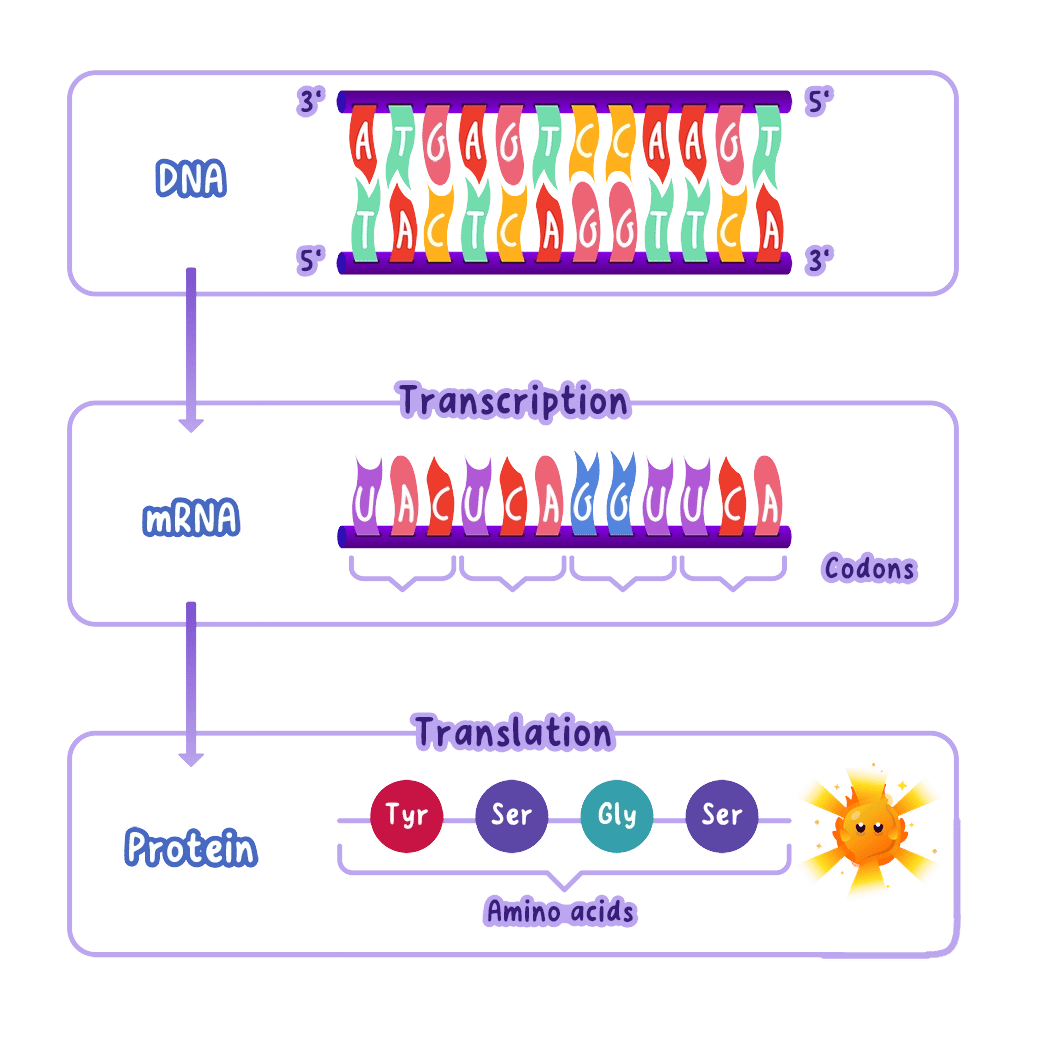
The gene stays in the nucleus and a working copy of it travels to the ribosome, which is the whole reason protein synthesis needs two separate stages.
Transcription copies the gene into mRNA
Transcription
The stage of protein synthesis in which the base sequence of a gene is copied into a molecule of mRNA inside the nucleus.
Messenger RNA
A single-stranded molecule that carries a copy of a gene's base sequence from the nucleus to a ribosome.
- Transcription begins when the DNA unzips along the length of the gene that is being used.
- The weak hydrogen bonds between the base pairs break, the two strands come apart, and the bases of the gene are left exposed.
- The enzyme RNA polymerase attaches at the start of the gene and moves along one of the exposed strands, which acts as the template.
- Free RNA nucleotides floating in the nucleus line up against the template strand by complementary base pairing, so the copy matches the gene base for base.
- RNA carries the base uracil (U\text{U}U) in place of thymine, so a T\text{T}T appears as a U\text{U}U in the copy while A\text{A}A, C\text{C}C and G\text{G}G stay the same.
- RNA polymerase joins the lined-up nucleotides into one continuous strand of messenger RNA (mRNA).
- When the end of the gene is reached the mRNA is released, and the two DNA strands pair up again so the gene is left undamaged.
- The mRNA is short and single-stranded, so unlike the DNA it is small enough to pass out through a nuclear pore into the cytoplasm.
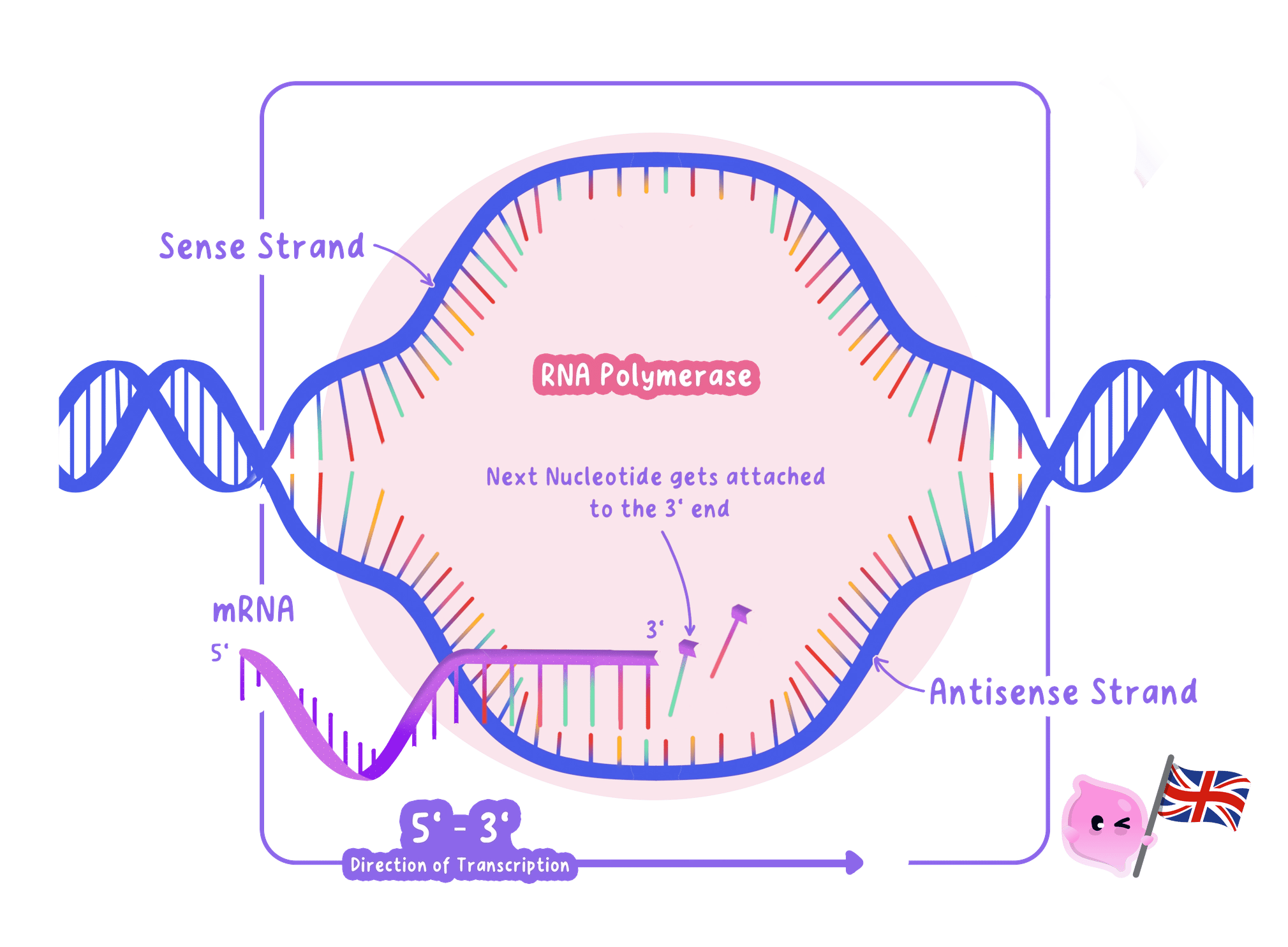
Only the gene in use is unzipped and copied, so do not write that the whole chromosome or the whole DNA molecule is transcribed.
Describing transcription
- Name the nucleus as the location before describing anything else, because location is often the first marking point.
- Say that the DNA unzips and that one strand is used as a template, since saying only that the gene is copied is too vague to credit.
- Name RNA polymerase if the question asks which enzyme is involved.
- End with the mRNA leaving the nucleus, which is the point that links this stage to the next one.
Translation builds the protein at a ribosome
Translation
The stage of protein synthesis in which the base sequence of mRNA is read at a ribosome so that amino acids are joined in the coded order.
Ribosome
The sub-cellular structure in the cytoplasm at which amino acids are joined together to make a protein.
Transfer RNA
A molecule that carries a particular amino acid to the ribosome during translation.
- Out in the cytoplasm the mRNA attaches to a ribosome, which grips the strand between its two halves.
- The ribosome reads the mRNA in groups of three bases at a time, working steadily from one end of the strand to the other.
- Transfer RNA (tRNA) molecules in the cytoplasm collect amino acids and carry them to the ribosome.
- Each tRNA carries one particular amino acid and can only slot into the ribosome opposite the group of three mRNA bases that matches it.
- The ribosome joins each delivered amino acid onto the end of the growing chain, then moves on to the next group of three bases.
- The empty tRNA leaves the ribosome, picks up another amino acid of the same type and is used again.
- Because the tRNA molecules can only bind where they match, the amino acids are joined in exactly the order set out by the mRNA.
- When the ribosome reaches a stop signal at the end of the mRNA, the finished chain of amino acids is released.
- The released chain then folds up into a particular three-dimensional shape, and the folded chain is the finished protein.
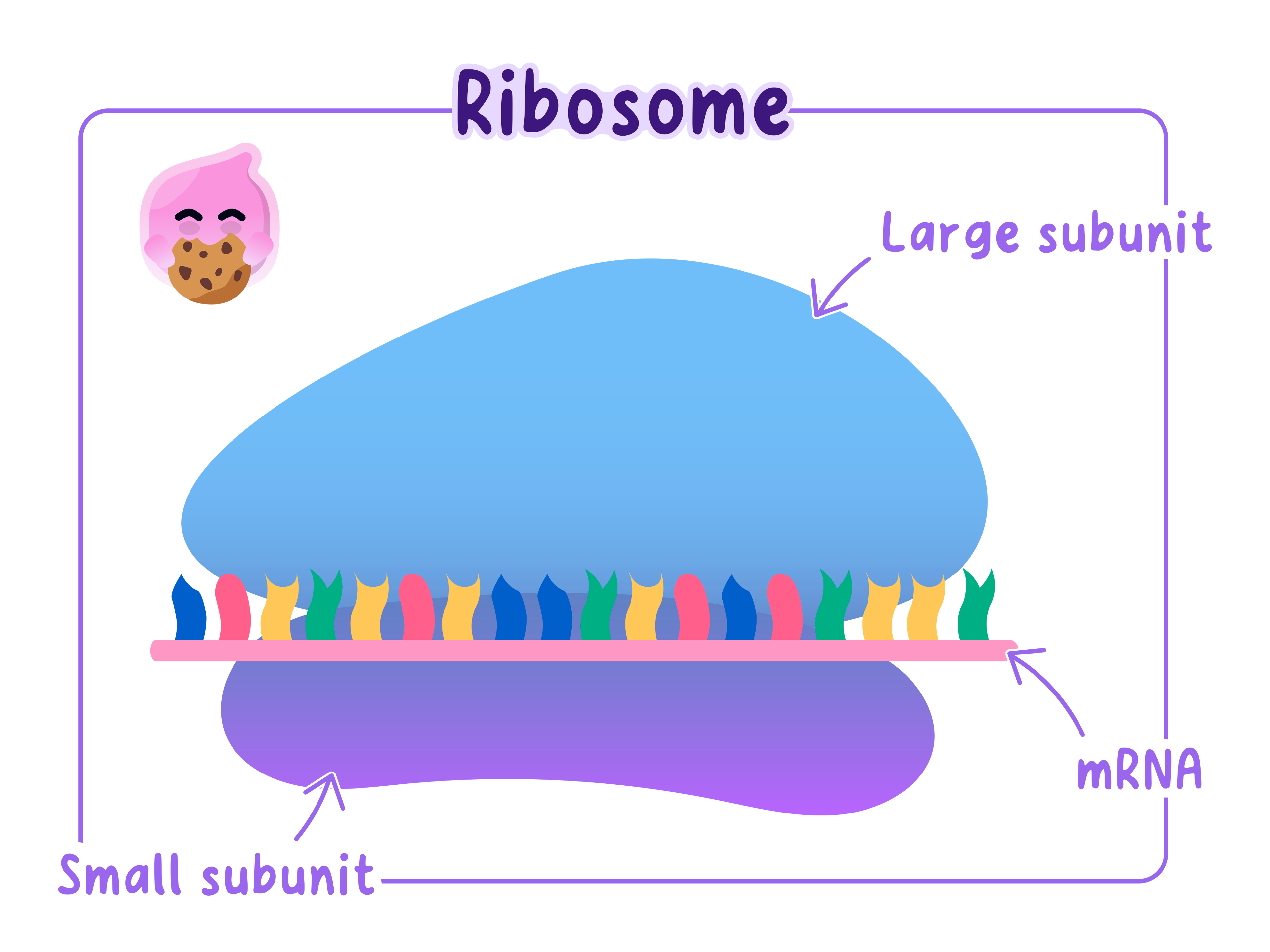
The mRNA is a written order, the ribosome is the worker reading it one line at a time, and the tRNA molecules are the deliveries that bring the right part to the bench at the right moment.
Following one gene through to its protein
- A gene in the nucleus has a coding sequence 900900900 bases long.
- Transcription copies it into an mRNA molecule that is also 900900900 bases long, and that mRNA leaves the nucleus.
- At the ribosome the mRNA is read three bases at a time, giving 900÷3=300900 \div 3 = 300900÷3=300 readings.
- Each reading brings in one amino acid, so the finished chain contains 300300300 amino acids.
The ribosome does not decide the order of the amino acids, it only reads the order already written in the mRNA.
- Why can the DNA not travel to the ribosome itself?
- Where does transcription take place, and which enzyme carries it out?
- What happens to the DNA strands before the mRNA is built, and what happens to them afterwards?
- What is the job of a transfer RNA molecule during translation?
- An mRNA molecule is 150150150 bases long. How many amino acids will the chain contain?
