Three bases code for one amino acid
Definition
Triplet code
The rule that each sequence of three bases in DNA codes for one amino acid.
Definition
Amino acid
The small molecule that is the building block of a protein.
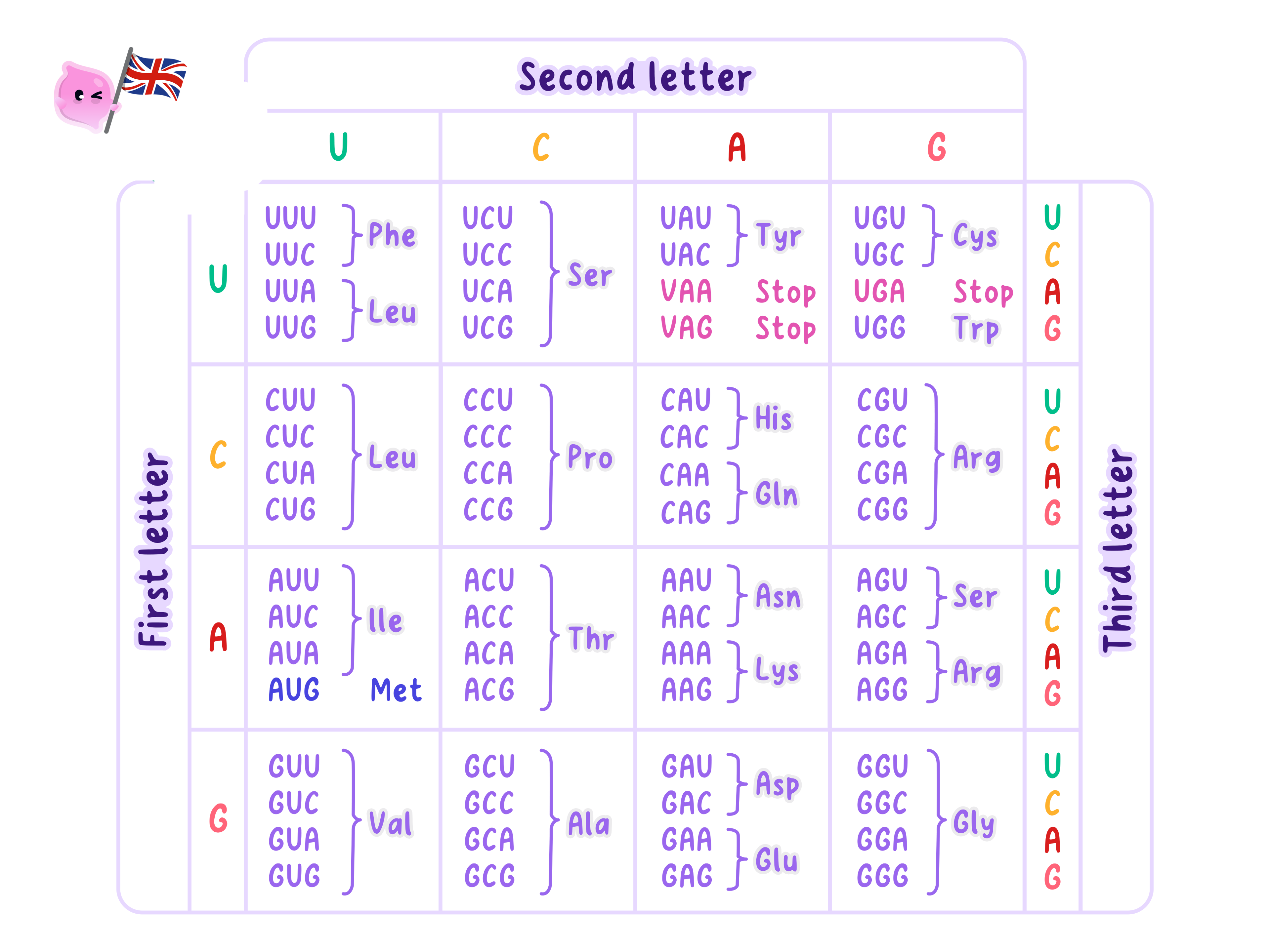
- The bases along a gene are read in groups of three, and each group of three is called a triplet.
- Every triplet stands for one amino acid, and this rule is known as the triplet code.
- The triplets are read in order from one end of the gene to the other, so the order of the triplets fixes the order in which the amino acids are joined.
- Reading in threes gives 4×4×4=644 \times 4 \times 4 = 644×4×4=64 possible triplets, which is comfortably more than the 202020 amino acids used to build proteins.
- Reading in pairs would give only 4×4=164 \times 4 = 164×4=16 combinations, which is too few, and that is why the code works in threes rather than twos.
- Because there are more triplets than amino acids, several different triplets can stand for the same amino acid.
- A few triplets code for no amino acid at all and act as a stop signal, marking the end of the chain.
- The number of amino acids in a protein is therefore the number of coding bases in the gene divided by three.
Example
Splitting a base sequence into triplets
- Part of a gene reads C A T G G A T T C\text{C}\ \text{A}\ \text{T}\ \text{G}\ \text{G}\ \text{A}\ \text{T}\ \text{T}\ \text{C}C A T G G A T T C.
- Divide it from the left into groups of three: CAT\text{CAT}CAT, GGA\text{GGA}GGA, TTC\text{TTC}TTC.
- Nine bases give 9÷3=39 \div 3 = 39÷3=3 triplets, so three amino acids are joined.
- They are joined in the order CAT\text{CAT}CAT first, then GGA\text{GGA}GGA, then TTC\text{TTC}TTC, because the triplets are read in sequence.
Exam technique
Converting between bases and amino acids
- Divide by three to go from bases to amino acids, and multiply by three to go the other way.
- Show the division as working, because the calculation mark is often separate from the answer mark.
- Read the question carefully for whether it gives you bases or triplets, since the two are easy to confuse under time pressure.
Amino acid order sets shape, and shape sets function
Definition
Protein
A polymer made of a chain of amino acids folded into a particular three-dimensional shape.
- The amino acids are joined into a long chain in the exact order the gene specifies.
- There are 202020 different amino acids, and each has its own chemical properties, so different parts of the chain attract or repel each other.
- Those attractions pull the chain into a folded, three-dimensional shape.
- The same order of amino acids always produces the same pattern of attractions, so the chain always folds into the same shape.
- A protein can only do its job if it has the correct shape, so the shape of a protein determines its function.
- An enzyme works because the folding leaves a pocket whose shape matches the molecule it acts on.
- A structural protein such as collagen works because its chains fold into long, strong fibres that hold tissues together.
- A hormone such as insulin works because its shape fits the receptor on the cells it acts on.
- Antibodies and the carrier proteins in a cell membrane work in the same way, each with a shape suited to the one job it does.
Key Idea
The base order sets the amino acid order, the amino acid order sets the folded shape, and the shape sets the job the protein can do.
A change in the bases can change the protein
Definition
Mutation
A mutation is a change in the base sequence of DNA.
- A mutation is a change in the base sequence of DNA, and because the bases are the code, changing them can change the message.
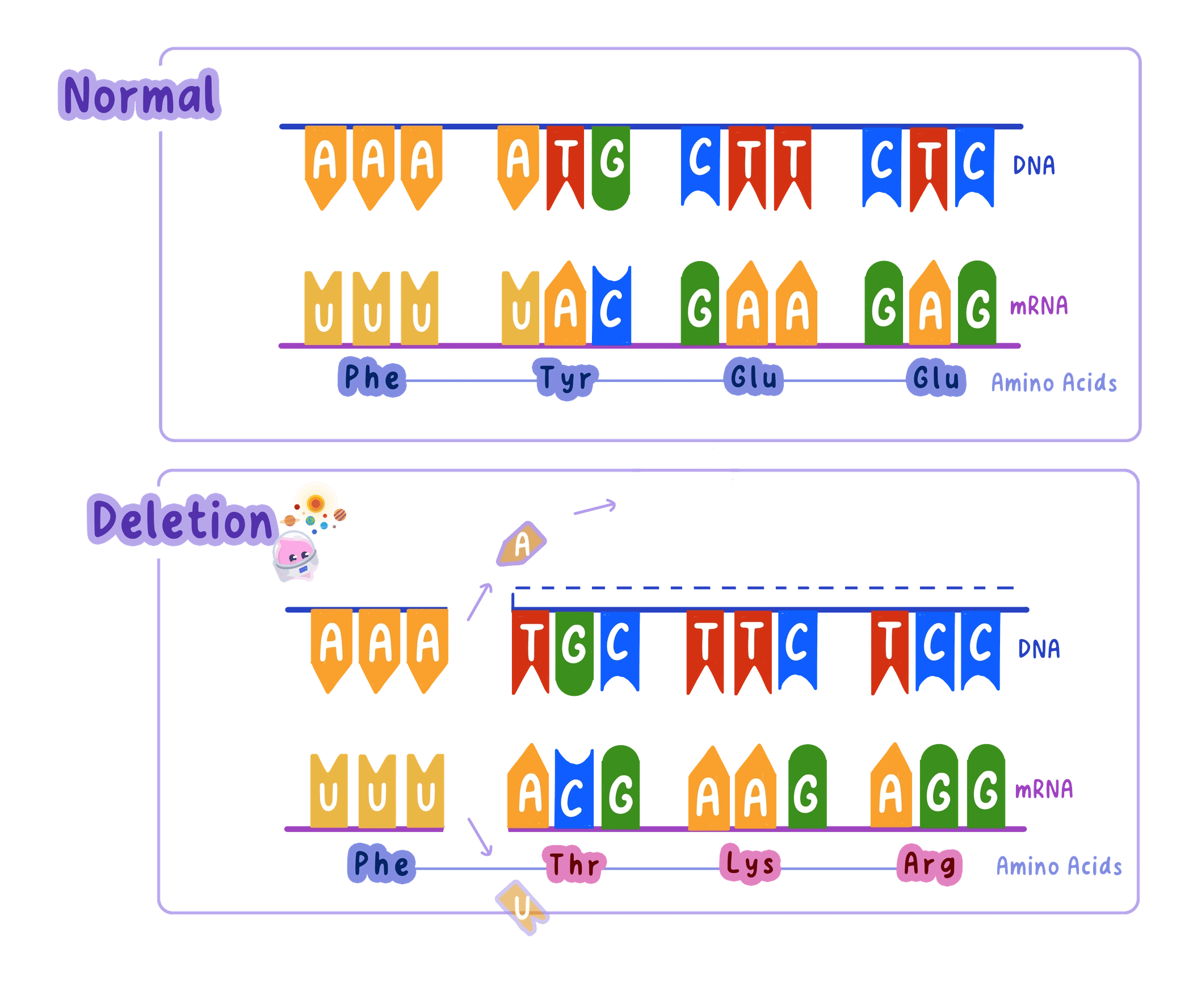
- If one base is swapped for another, only the triplet containing it changes, so at most one amino acid in the chain is replaced.
- If a base is removed instead, every base after it shifts along, so all the triplets from that point on are grouped differently and most of the remaining amino acids change.
- A different amino acid brings different attractions into the chain, so the chain can fold into a different shape.
- Once the shape is wrong, the protein works less well or stops working altogether.
- In an enzyme, a change to the shape of the pocket can mean the molecule it normally acts on no longer fits, so that reaction is no longer speeded up.
- In a structural protein, a change to the shape can weaken the fibre it forms, so the tissue it supports is weaker.
- Many changes to the bases have no effect at all, either because the new triplet codes for the same amino acid or because the change falls in DNA that does not code for a protein.
- A change can also fall in a part of the DNA that switches a gene on or off, in which case the protein itself is normal but the amount of it produced changes.
Example
Following a single base change
- A triplet in a gene reads CTT\text{CTT}CTT and codes for one particular amino acid.
- A mutation swaps the middle base, so the triplet becomes CAT\text{CAT}CAT.
- The triplets before and after it are untouched, so only that one position in the chain is affected.
- CAT\text{CAT}CAT stands for a different amino acid, so one amino acid in the chain is replaced and the chain may fold differently around that point.
Common Mistake
Do not write that every mutation changes the protein, because most changes to the bases make no difference to how the finished protein works.
Self review
- How many bases code for one amino acid, and what is that group called?
- A coding sequence is 360360360 bases long. How many amino acids will the protein contain?
- Explain the chain of cause and effect from base order to the job a protein does.
- Why does removing one base usually change more of the protein than swapping one base?
- Give two reasons why a change in the DNA bases might have no effect on an organism.
