Tropisms in plants
Definition
Tropism
A growth response of a plant in which the direction of growth is determined by the direction of a stimulus.
Definition
Phototropism
A growth response of a plant in which the direction of growth is determined by the direction of light.
Definition
Gravitropism
A growth response of a plant in which the direction of growth is determined by the direction of gravity.
- A plant cannot move, so it responds to a stimulus by changing the direction in which it grows.
- A tropism is a growth response in which the direction of growth is set by the direction of the stimulus.
- A response towards the stimulus is positive, and a response away from the stimulus is negative.
- Phototropism is a growth response to light, and shoots show positive phototropism while roots show negative phototropism.
- Gravitropism is a growth response to gravity, and roots show positive gravitropism while shoots show negative gravitropism.
- Growing shoots towards light raises the light the leaves receive, so the rate of photosynthesis increases.
- Growing roots downwards takes them into the soil, where they absorb water and mineral ions and anchor the plant.
Auxin and cell elongation
Definition
Auxin
A plant hormone made in the tips of shoots and roots that controls growth by changing the rate at which cells elongate.
- Auxin is a plant hormone made in the tip of a growing shoot or root.
- It then moves back from the tip into the region of cells just behind it.
- In a shoot, auxin makes the cell walls looser so the cells take in more water and elongate faster.
- Faster elongation on one side of a shoot makes that side longer, which bends the shoot the other way.
- In a root, a high auxin concentration has the opposite effect and inhibits cell elongation.
- Because auxin is made in the tip, cutting the tip off removes the source and the growth response stops.
- Auxin is only redistributed after it has been made, so the size of the response depends on how much reaches each side.
Phototropism in shoots
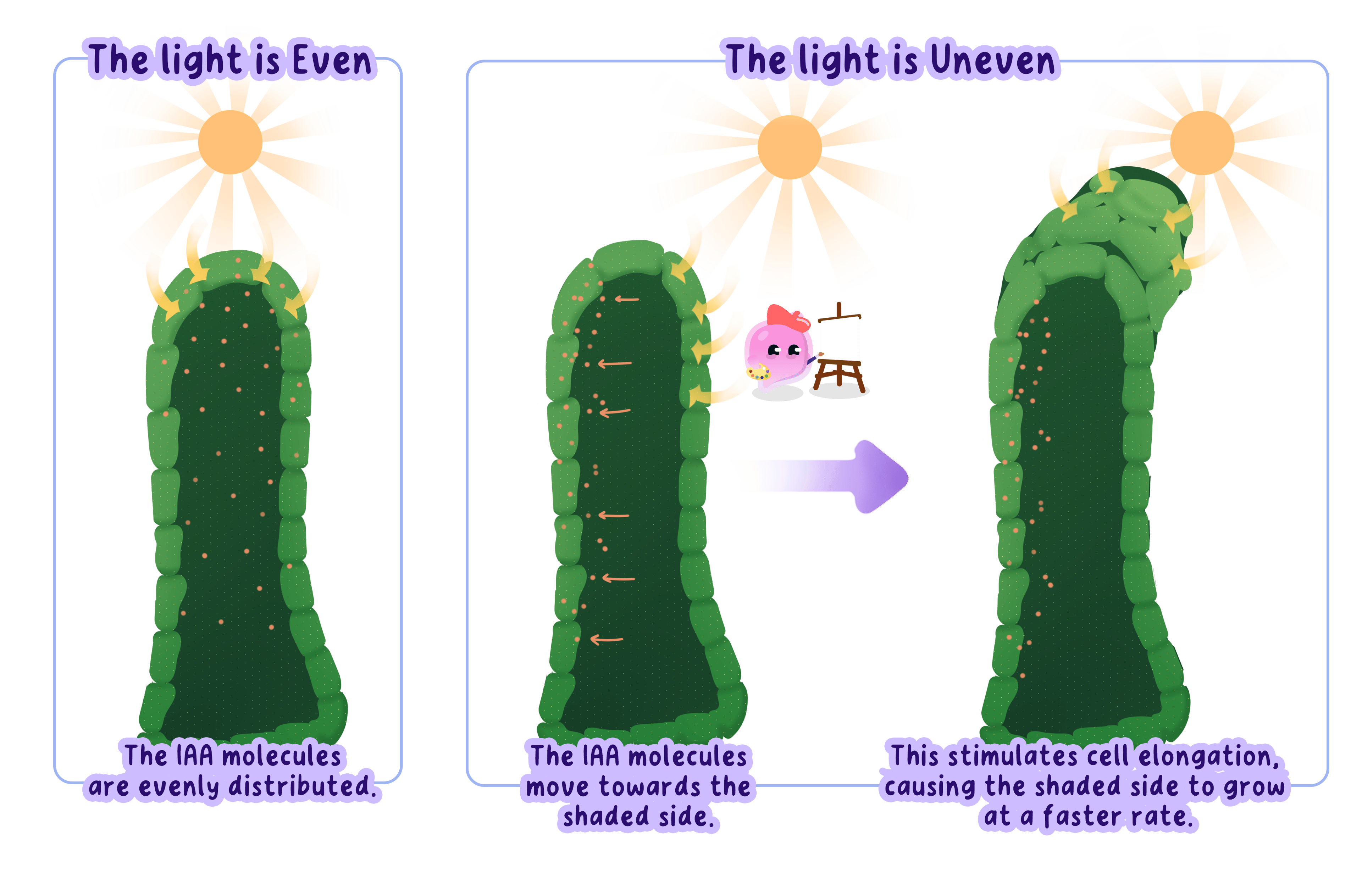
- A shoot lit from one side receives more light on one side than the other.
- Auxin made in the tip moves across towards the shaded side, giving an unequal distribution of auxin.
- The shaded side therefore has a higher auxin concentration than the lit side.
- Cells on the shaded side elongate more than the cells on the lit side.
- The shaded side grows longer, so the shoot bends towards the light.
- Once the shoot faces the light, auxin is shared evenly again and the shoot grows straight.
Example
Removing the shoot tip
- Three identical seedlings are lit from the left and their tips are treated differently.
- Seedling A keeps its tip, so auxin collects on the shaded right side and the shoot bends left towards the light.
- Seedling B has its tip cut off, so no auxin is made and the shoot grows straight upwards.
- Seedling C has an opaque cap over the tip, so the tip cannot detect the direction of the light and the shoot grows straight.
- Comparing the three shows that the tip both detects the light and makes the auxin.
Gravitropism in roots and shoots
- A germinating seed is buried in soil, so it has no light to respond to and uses gravity instead.
- When a root or a shoot lies horizontally, gravity makes auxin collect on its lower side.
- In a shoot, the extra auxin on the lower side makes those cells elongate faster.
- The lower side of the shoot grows longer, so the shoot curves upwards, away from gravity.
- In a root, the extra auxin on the lower side inhibits elongation instead.
- The upper side of the root therefore elongates faster, so the root curves downwards, towards gravity.
- The same unequal distribution produces opposite results because auxin promotes elongation in shoots and inhibits it in roots.
- The outcome is a shoot that reaches the light and a root that reaches water, whichever way up the seed happens to land.
Practical
Investigating phototropism
- Aim: to find out how the direction of light affects the direction in which cress seedlings grow.
- Apparatus: four Petri dishes, cotton wool, cress seeds, a measuring cylinder, distilled water, four cardboard boxes, scissors, a lamp, a ruler, a protractor and a klinostat.
- Variables: the direction of the light is the independent variable and the angle of the shoots from the vertical is the dependent variable.
- Controlled variables: the number of seeds, the volume of water, the temperature, the light intensity, the distance from the lamp and the growing time are all kept the same.
- Method, setting up:
- Line each Petri dish with cotton wool of the same thickness.
- Add 10 cm310\ \text{cm}^{3}10 cm3 of distilled water to each dish using a measuring cylinder.
- Sprinkle 202020 cress seeds evenly across the cotton wool in each dish.
- Leave all four dishes in the dark at room temperature for two days so the seeds germinate.
- Method, applying the light:
- Cut a narrow vertical slit in one side of three of the cardboard boxes.
- Place one dish in a box with the slit on the left, one in a box with the slit on the right, and one in a box with the slit at the top.
- Place the fourth dish on a slowly turning klinostat in the open, so every side receives the same light and it acts as the control.
- Set the lamp the same distance from every box and switch it on for the same number of hours each day.
- Add the same volume of water to every dish each day so the cotton wool never dries out.
- Method, measuring:
- After five days, open each box and hold a protractor against the side of the dish.
- Measure the angle between each shoot and the vertical, reading to the nearest degree.
- Repeat for at least ten seedlings in each dish, choosing them at random rather than picking the most bent ones.
- Results: the shoots in each closed box bend towards the slit, while the shoots on the klinostat stay vertical.
- Maths: calculate the mean angle for each dish using xˉ=∑xn\bar{x}=\dfrac{\sum x}{n}xˉ=n∑x and plot the means as a bar chart against the direction of the light.
- Watch out: keep the volume of water identical in every dish, otherwise differences in growth could be caused by water rather than by light.
- Watch out: close the boxes fully apart from the slit, since stray light from the room weakens the difference between the dishes.
- Watch out: use seedlings of the same age, because older shoots have already bent further than younger ones.
- Safety: wash your hands after handling seeds and damp cotton wool, and do not eat the seedlings.
Exam technique
Explaining a bending shoot
- Write the chain in order: the tip makes auxin, auxin moves to the shaded side, those cells elongate more, and the shoot bends.
- Use unequal distribution of auxin rather than saying the auxin moves away from the light.
- Say elongate rather than divide, because auxin changes cell length rather than the rate of cell division.
- State the direction of the bend at the end, since a mark is usually reserved for it.
Common Mistake
- Do not write that auxin makes cells divide faster, because it makes them take in water and elongate.
- Do not write that auxin is destroyed by light, because the explanation required is that auxin moves to the shaded side.
- Do not give a root the same response as a shoot, because auxin inhibits elongation in roots and promotes it in shoots.
- Do not describe a plant as moving towards the light, because it grows towards it.
Self review
- Define a tropism and give one example in a shoot and one in a root.
- Where in a plant is auxin made, and where does it act?
- Explain why a shoot lit from one side bends towards the light.
- Explain why a horizontal root curves downwards while a horizontal shoot curves upwards.
- Why is a klinostat used as the control in the phototropism investigation?
