Causes of infertility
Definition
Infertility
The inability of a couple to conceive a child naturally after a long period of trying.
- Infertility has several causes, and only some of them can be treated with hormones.
- If the pituitary gland secretes too little FSH, no follicle is stimulated and no egg matures.
- If it secretes too little LH, an egg may mature but ovulation never happens.
- Both of these causes are hormonal, so giving the missing hormone can restore the cycle.
- Blocked oviducts stop sperm reaching the egg, and hormones cannot clear the blockage.
- A low sperm count or poorly swimming sperm also prevent fertilisation, and again hormones do not help.
- Treatment is chosen to match the cause, so the first step is always to find out which part of the process is failing.
Fertility drugs
- A fertility drug contains FSH and LH, the same hormones the pituitary gland normally secretes.
- The drug is given by injection over the first part of the cycle.
- FSH stimulates follicles in the ovaries so that eggs mature.
- LH is then given to trigger ovulation, releasing the mature eggs into the oviducts.
- The natural cycle is restored, so the couple can conceive through intercourse in the usual way.
- Because the dose stimulates more than one follicle, several eggs can be released at once.
- That raises the chance of twins or triplets, which carries greater risk for the mother and the babies.
Steps in IVF
Definition
IVF (in vitro fertilisation)
A fertility treatment in which eggs collected from the ovaries are fertilised by sperm in a laboratory and one or more of the resulting embryos are transferred into the uterus.
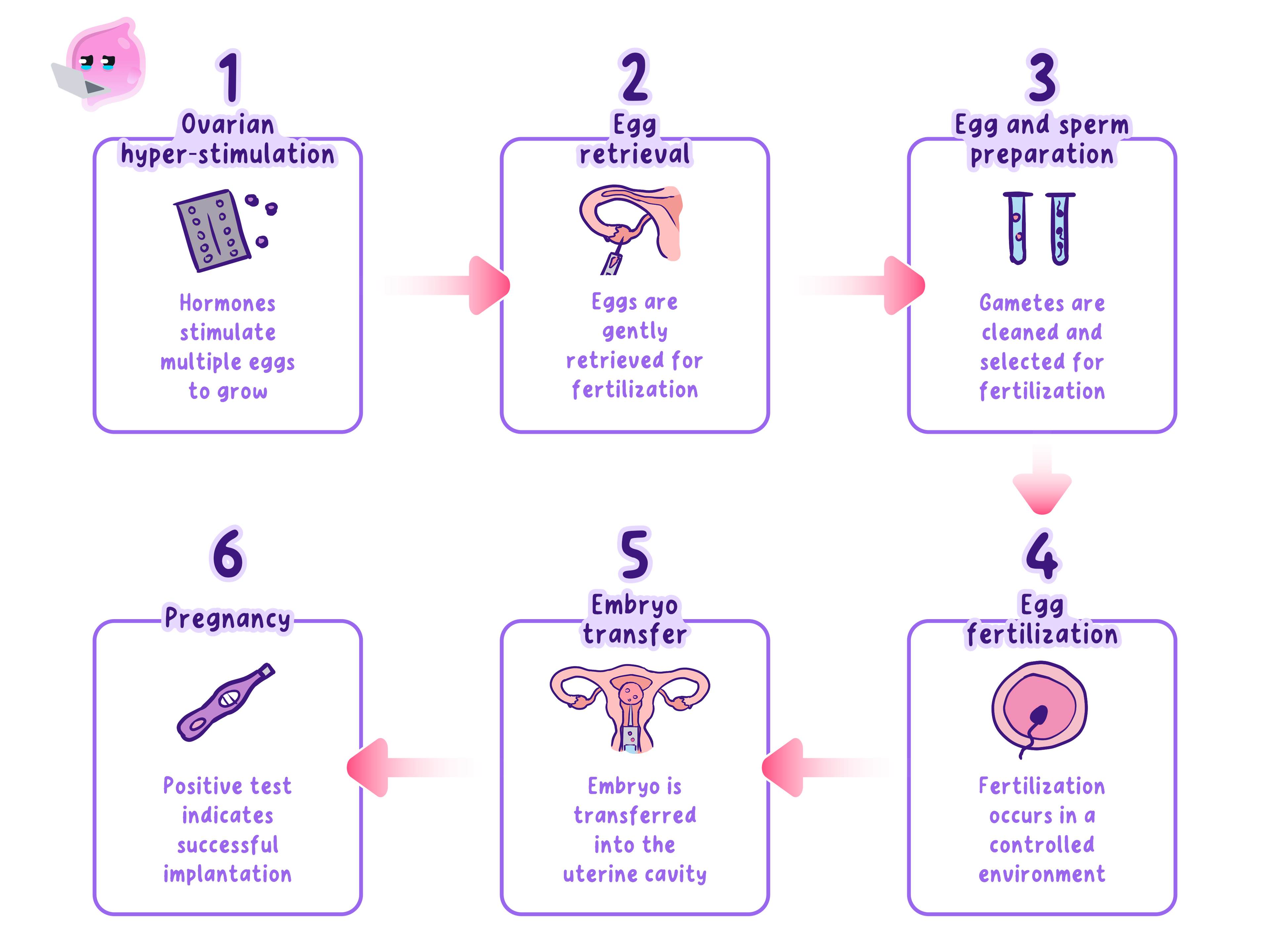
- FSH and LH are given first, so several eggs mature in the ovaries at the same time.
- The mature eggs are collected from the ovaries through a fine needle.
- Each egg is mixed with the father's sperm in a dish in the laboratory, where fertilisation takes place.
- The fertilised eggs are kept in an incubator and allowed to divide into embryos.
- When each embryo is a small ball of cells, one or two are inserted into the uterus through the cervix.
- Progesterone is often given so the uterus lining is maintained and the embryo can implant.
- A pregnancy test taken about two weeks later shows whether implantation was successful.
- Any remaining embryos can be frozen and stored for a later attempt.
Evaluating IVF
- IVF allows couples who could not conceive naturally to have a child of their own, which is its main benefit.
- Success rates are low, at roughly 32%32\%32% of cycles for patients under 353535 and falling below 5%5\%5% above the age of 434343.
- Several attempts are often needed, so the emotional strain of repeated failure is considerable.
- The hormone injections have physical side effects including abdominal pain, vomiting and, rarely, a dangerous over-response of the ovaries.
- Transferring more than one embryo raises the chance of multiple births, which brings a higher risk of premature birth and low birth mass.
- Each cycle is expensive, often over £5000\pounds5000£5000 privately, and funding on the NHS varies between areas.
- Spare embryos are frozen or destroyed, and some people object to this because they regard an embryo as a potential life.
- A judgement therefore weighs the chance of a much wanted child against the cost, the risks and the ethical objections.
Example
Working out a success rate
- A clinic begins 250250250 IVF cycles in one year for patients under 353535.
- Of those cycles, 808080 end in a live birth.
- The success rate is 80250×100=32%\dfrac{80}{250}\times100=32\%25080×100=32%.
- The same clinic records 121212 live births from 300300300 cycles for patients over 434343, which is 12300×100=4%\dfrac{12}{300}\times100=4\%30012×100=4%.
- Success falls with age because fewer eggs of good quality can be collected.
Exam technique
Describing IVF clearly
- Put the stages in order and name the hormone used at each one, since marks follow the sequence.
- Say that fertilisation happens outside the body in a laboratory, because that is what separates IVF from a fertility drug.
- Balance an evaluation with the benefit as well as the risks, then finish with a judgement.
- Quote a success rate as a percentage of cycles started, not as a percentage of embryos transferred.
Common Mistake
- Do not write that IVF guarantees a pregnancy, because most cycles do not result in a live birth.
- Do not confuse a fertility drug with IVF, because a fertility drug leaves fertilisation to happen inside the body.
- Do not write that the embryo is placed in the ovary, because it is transferred into the uterus.
Self review
- Name two causes of infertility that hormones can treat and one that they cannot.
- Which two hormones are given as a fertility drug, and what does each one do?
- List the stages of IVF in order from hormone treatment to the pregnancy test.
- Why is transferring two embryos rather than one a risk?
- Give one ethical objection people raise against IVF.
