Auxins and plant growth
Definition
Auxin
A plant hormone made in the tips of shoots and roots that controls growth by changing the rate at which cells elongate.
Definition
Apical dominance
The suppression of growth in the side buds of a plant by auxin made in the shoot tip, so the main shoot grows fastest.
- Auxin controls growth by changing how much the cells behind a shoot or root tip elongate.
- Auxin made in the shoot tip travels down the stem and reaches the side buds lower down.
- At the concentration that reaches them, auxin inhibits those side buds from growing, which is apical dominance.
- The main shoot therefore grows tallest and reaches the light before its neighbours shade it out.
- If the shoot tip is removed, auxin no longer reaches the side buds and they start to grow.
- The plant then produces many side shoots and becomes short and bushy rather than tall.
- Auxin also stimulates the growth of new roots from the cut end of a stem.
- The effect depends on concentration, because a low auxin concentration promotes root growth while a high one inhibits it.
Gibberellins
Definition
Gibberellin
A plant hormone that ends seed dormancy and starts germination, and that also promotes stem elongation and flowering.
Definition
Dormancy
A resting state in which a living seed does not germinate until the right conditions are met.
- Gibberellins are plant hormones made in seeds, young leaves and roots.
- They end seed dormancy, which is the resting state that stops a living seed germinating.
- Gibberellin makes the seed produce enzymes such as amylase inside the seed.
- Amylase breaks the stored starch down into sugars such as maltose and glucose.
- Those sugars are used in respiration to release the energy the embryo needs to grow, so germination begins.
- Gibberellins also promote stem elongation, so treated plants grow taller than untreated ones.
- They promote flowering, and can make a plant flower without the day length it would normally need.
- They also increase the size of fruit, because larger cells make a larger fruit.
Example
Effect on stem height
- Ten pea plants are sprayed with gibberellin solution and ten identical plants are sprayed with water.
- After 141414 days the treated plants have a mean height of 32 cm32\ \text{cm}32 cm and the untreated plants 20 cm20\ \text{cm}20 cm.
- The increase is 32−20=12 cm32-20=12\ \text{cm}32−20=12 cm.
- As a percentage of the untreated height this is 1220×100=60%\dfrac{12}{20}\times100=60\%2012×100=60%.
- The extra height comes from gibberellin promoting elongation of the cells in the stem.
Ethene and fruit ripening
Definition
Ethene
A gaseous plant hormone that controls cell division and causes fruit to ripen.
- Ethene is unusual among plant hormones because it is a gas.
- It is released by ripening fruit and by ageing plant tissue.
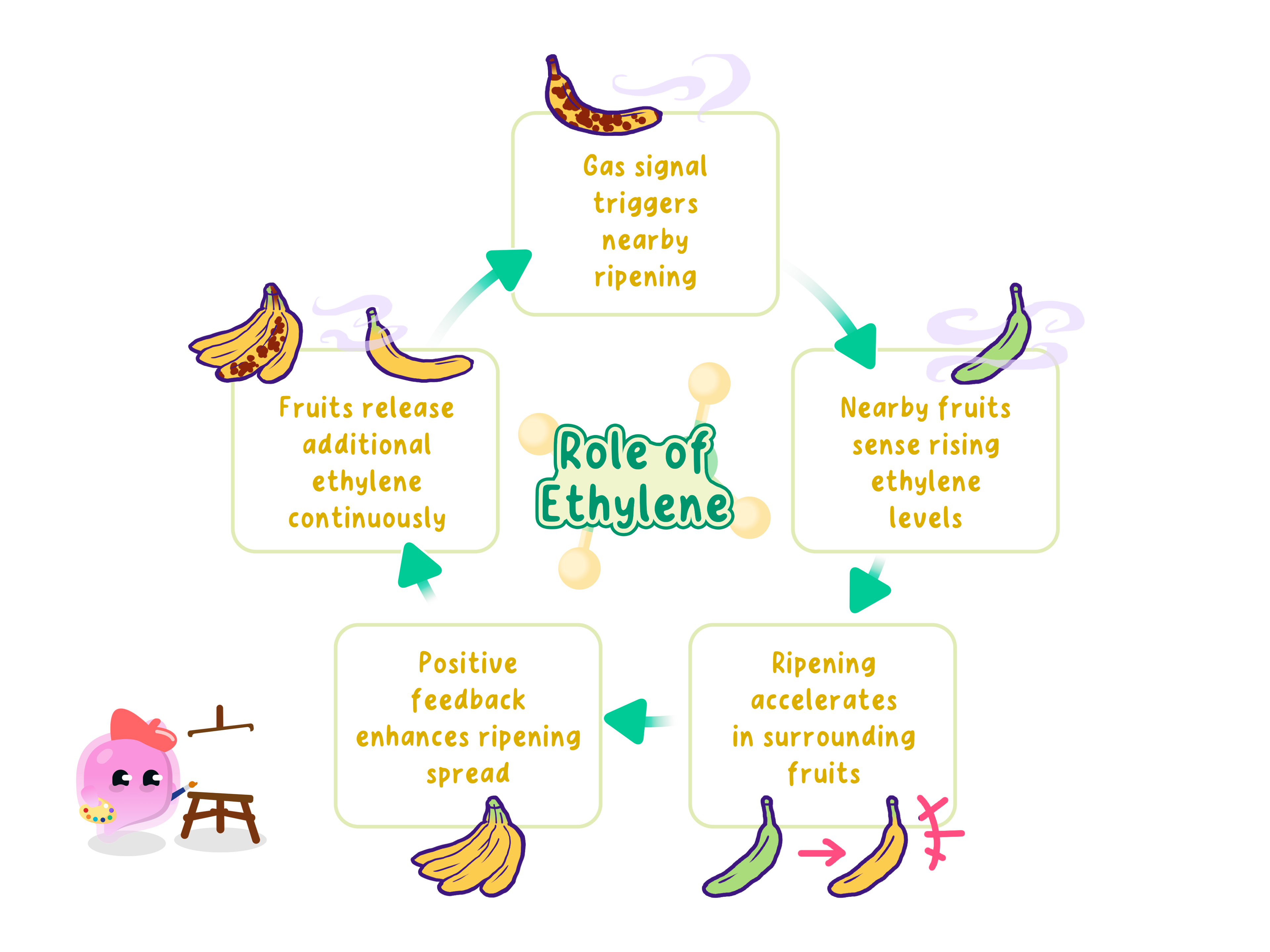
- Being a gas, ethene spreads through the air and reaches fruit that is not touching the source.
- Ethene switches on enzymes that convert stored starch into sugars, making the fruit taste sweeter.
- Other enzymes break down the cell walls, which is what makes a ripe fruit soft.
- Further enzymes break down green chlorophyll and reveal or make other pigments, so the fruit changes colour.
- Ripening fruit releases still more ethene, so ripening spreads from one fruit to the whole crate.
- Ethene also controls cell division in growing parts of the plant.
Flowering and leaf fall
- Gibberellins promote flower opening, so treated plants flower earlier or at an unusual time of year.
- Ethene speeds up the ageing of an open flower, so the petals wilt and are shed sooner.
- Leaf fall, called abscission, is controlled by the balance between auxin and ethene.
- A healthy leaf makes auxin, and that auxin keeps the leaf attached to the stem.
- As autumn approaches the leaf makes less auxin, so the balance shifts towards ethene.
- Ethene makes a weak abscission layer of cells form across the base of the leaf stalk.
- The layer breaks and the leaf falls, sealing the scar so water is not lost from it.
- Shedding leaves cuts water loss in winter, when frozen soil makes it hard for the roots to replace that water.
Practical
Investigating fruit ripening
- Aim: to find out how ethene released by a ripe banana affects the ripening of unripe pears.
- Apparatus: nine unripe pears, one ripe banana, three sealable transparent bags, a balance, a printed colour chart, a knife, a white tile, iodine solution, a dropping pipette and eye protection.
- Variables: the presence of ethene is the independent variable and the ripeness of the pears is the dependent variable.
- Controlled variables: the mass and starting colour of the pears, the temperature, the light and the number of days are all kept the same.
- Method, setting up:
- Weigh nine unripe pears and choose ones of similar mass and colour so they start at the same stage.
- Divide them into three groups of three and record the starting colour of each pear against the colour chart.
- Seal group A in a bag with the ripe banana, which is the source of ethene.
- Seal group B in a bag on its own, so it has no extra ethene but the same still air.
- Leave group C in the open air as a second control.
- Method, taking readings:
- Keep all three groups in the same dark cupboard at the same temperature.
- Each day for six days, score the colour of every pear against the colour chart without opening the bags for longer than needed.
- Record every score in a results table with the day number.
- Method, testing for starch:
- On day six, cut a thin slice from one pear in each group and place it on a white tile.
- Add three drops of iodine solution to each slice with a pipette.
- Record whether the slice turns blue-black, which shows starch, or stays orange-brown, which shows the starch has been converted.
- Results: the pears kept with the banana ripen fastest and give the least blue-black colour with iodine.
- Maths: calculate the mean colour score for each group each day using xˉ=∑xn\bar{x}=\dfrac{\sum x}{n}xˉ=n∑x and plot the three means against day on one set of axes.
- Watch out: match the pears for mass and starting colour, because fruit that is already riper will finish first whatever the ethene does.
- Watch out: seal the bags properly, since ethene that escapes reduces the difference between group A and group B.
- Watch out: use a printed colour chart rather than judging by eye, because that makes the readings far less subjective.
- Safety: wear eye protection when using iodine solution, cut away from your fingers, and do not eat any fruit used in the laboratory.
Exam technique
Describing hormone effects
- Match each effect to the right hormone, since auxins, gibberellins and ethene are often mixed up in answers.
- Explain ripening through the enzymes ethene switches on rather than saying the fruit simply goes soft.
- Describe apical dominance as auxin inhibiting the side buds, not as auxin making the main shoot grow.
- Give the reason as well as the effect, such as leaf fall reducing water loss in winter.
Common Mistake
- Do not write that ethene is a liquid sprayed onto fruit, because it is a gas that spreads through the air.
- Do not write that gibberellin feeds the seed, because it makes the seed produce the enzymes that release sugars from its own store.
- Do not write that removing the shoot tip stops the plant growing, because it makes the side buds grow and the plant becomes bushy.
Self review
- Explain how auxin from the shoot tip keeps a plant growing tall rather than bushy.
- Describe the steps by which gibberellin starts germination in a dormant seed.
- Name three changes ethene causes in a ripening fruit.
- Explain how the balance of auxin and ethene causes a leaf to fall in autumn.
- Why does the fruit ripening investigation need a bag with no banana in it?
