Non-specific defences
Pathogen
A microorganism that causes a communicable disease, such as a virus, a bacterium, a fungus or a protist.
Non-specific defence
A defence that acts against all pathogens in the same way rather than targeting one particular pathogen.
- A pathogen can only cause disease once it has entered the body and begun to reproduce in the tissues.
- The body's first line of protection is a set of non-specific defences that stop pathogens getting in, or kill them at the point of entry.
- They are called non-specific because they act against all pathogens in the same way, whether the invader is a virus, a bacterium, a fungus or a protist.
- They are also always present, so they work immediately and do not need the body to have met the pathogen before.
- The non-specific defences fall into two groups.
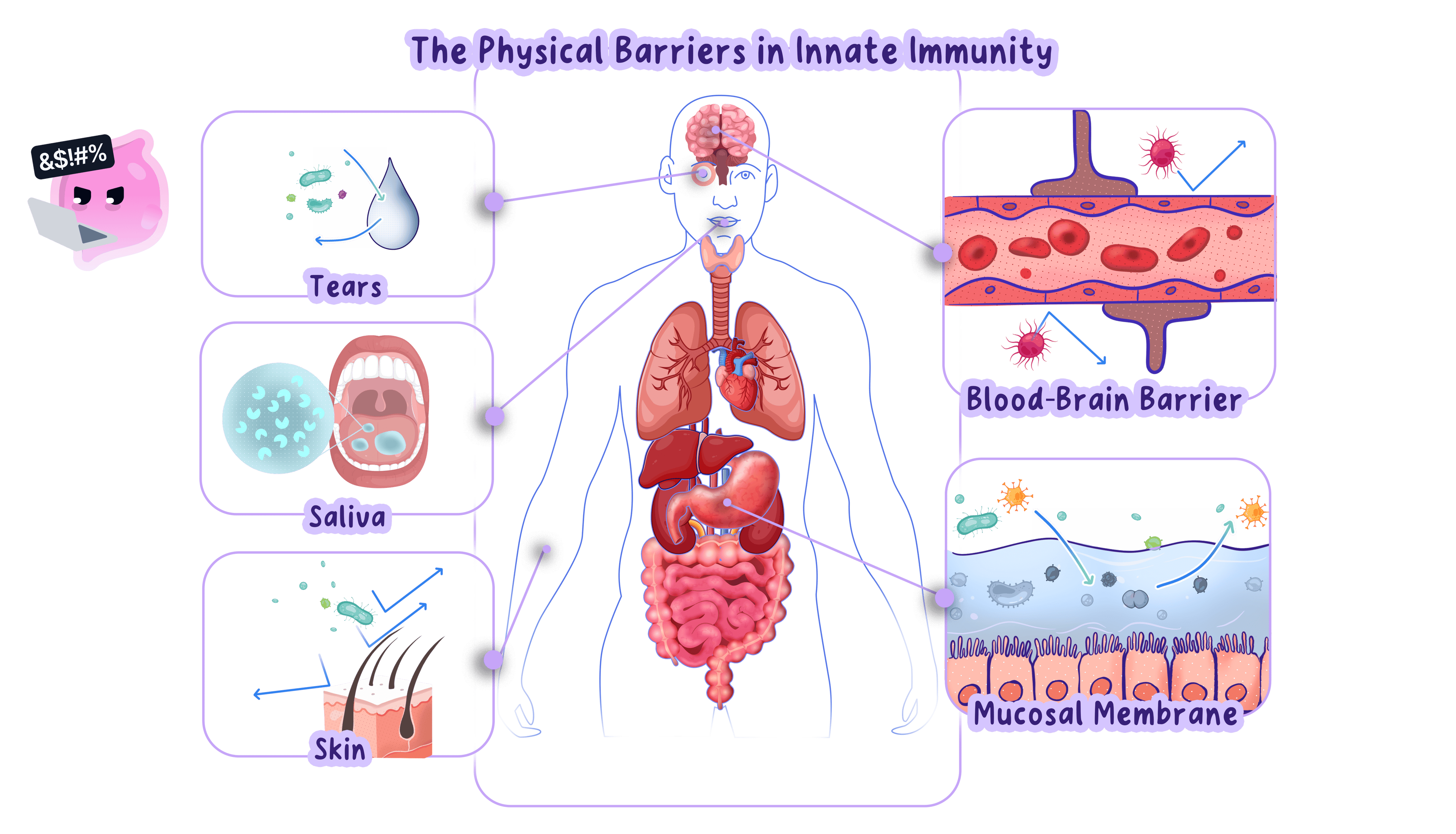
- Physical barriers block the entry of pathogens, and include the skin, the hairs and mucus of the nose, and the mucus and cilia of the airways.
- Chemical defences kill pathogens or stop them growing, and include stomach acid and the enzyme lysozyme in tears and saliva.
- Every place where the body is open to the outside, such as the nose, mouth, eyes and breaks in the skin, is protected by at least one of these defences.
The skin
Sebum
An oily substance secreted by glands in the skin that waterproofs the surface and slows the growth of microorganisms.
- The skin covers the whole outer surface of the body and is the largest barrier to pathogens.
- Its outer layer is made of many layers of dead cells packed with a tough protein, so pathogens cannot pass through intact skin and there are no living cells for viruses to infect.
- These dead cells are constantly worn away and replaced, so any pathogens settled on the surface are shed with them.
- Glands in the skin secrete an oily substance called sebum, which waterproofs the surface and contains chemicals that slow the growth of microorganisms.
- Sweat keeps the skin surface slightly acidic and salty, which many bacteria cannot grow in.
- Harmless microorganisms live naturally on healthy skin, and they compete with pathogens for space and nutrients so that pathogens find it harder to settle.
- When the skin is cut, the barrier is broken, and a blood clot quickly seals the wound so that pathogens cannot enter through the gap.
- Burns and large wounds are serious partly because they remove a wide area of this barrier, which is why patients with burns are at high risk of infection.
The nose and airways
Mucus
A sticky fluid secreted by goblet cells that traps dust and pathogens.
Goblet cell
A cell in the lining of the airways that secretes mucus.
Cilia
Tiny hair-like structures on the surface of some epithelial cells that beat together to move mucus.
- Every breath draws air containing dust, bacteria, viruses and fungal spores into the body.
- The nose is the first filter, because the hairs inside the nostrils trap large particles and the mucus lining the nasal cavity traps smaller ones.
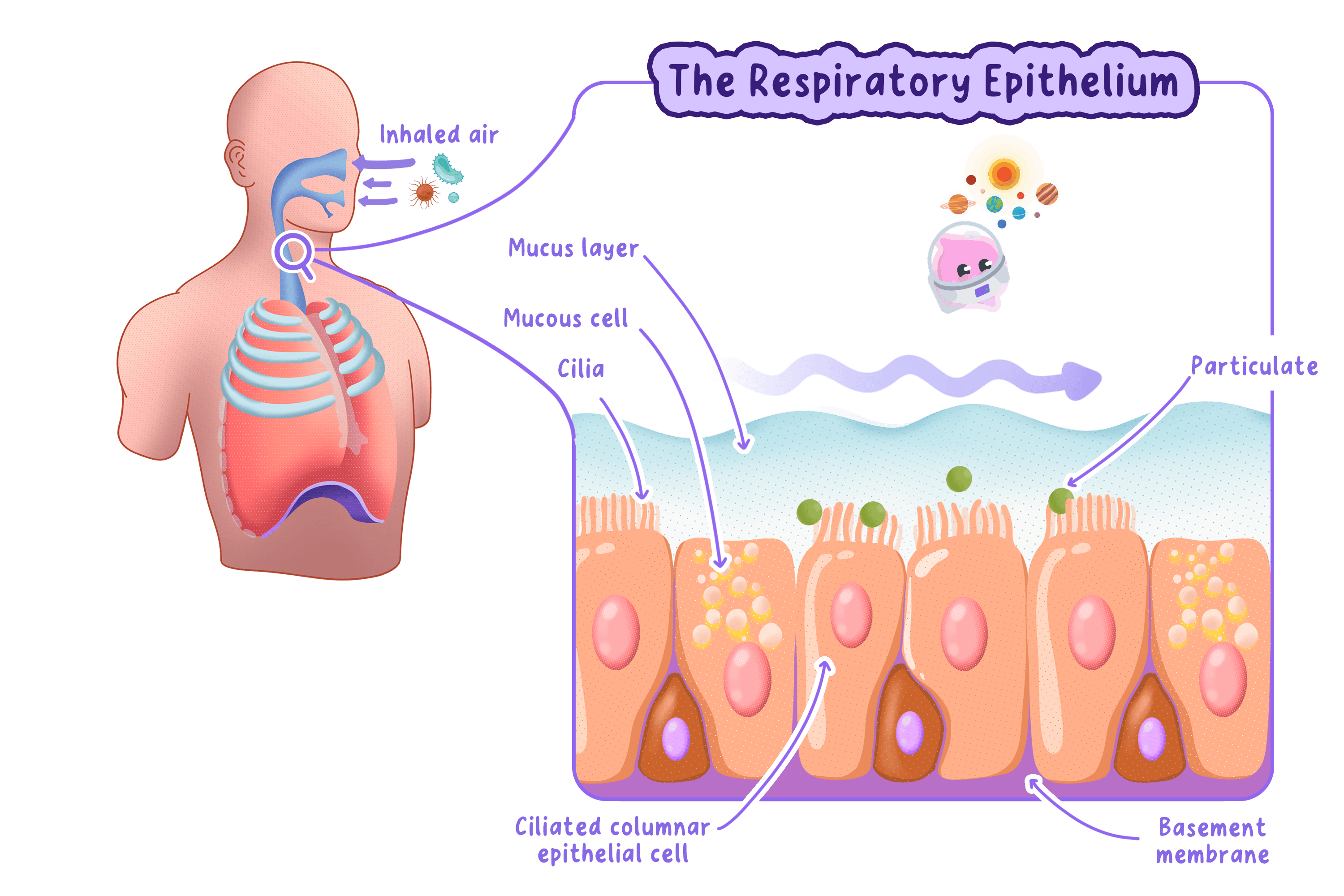
- The trachea and bronchi are lined with two types of cell that work together.
- Goblet cells secrete sticky mucus that coats the lining and traps pathogens and dust as air flows past.
- Ciliated epithelial cells carry cilia on their surface, which beat in a coordinated wave.
- The beating cilia sweep the mucus, carrying its trapped pathogens, upwards and away from the lungs towards the back of the throat.
- The mucus is then swallowed, so the pathogens reach the stomach, where the acid kills most of them.
- This system keeps the delicate alveoli almost free of pathogens, which matters because the thin walls of the alveoli would be easy for pathogens to cross.
- Smoking damages this defence, because chemicals in tobacco smoke stop the cilia beating and cause more mucus to be made.
- Mucus then collects in the airways, and smokers cough to move it, which is why smokers suffer more chest infections such as bronchitis.
- Do not write that cilia trap pathogens, because it is the mucus that traps them and the cilia that move the mucus.
- Do not write that cilia "kill" pathogens, because they only move the mucus to the throat.
- Do not confuse the cilia on airway cells with the hairs in the nose, which are a separate barrier.
Chemical defences
Stomach acid
Hydrochloric acid secreted by the stomach lining that kills most pathogens swallowed in food and drink.
Lysozyme
An enzyme in tears, saliva and mucus that kills bacteria by digesting their cell walls.
- Food and drink always carry some microorganisms, and the stomach is the main defence against those that are swallowed.
- Cells in the stomach lining secrete hydrochloric acid, which gives the stomach contents a pH of about 222.
- This acidity denatures the enzymes and other proteins of most pathogens, so they are killed before they reach the intestines.
- Some pathogens survive the acid, and this is how food poisoning bacteria such as Salmonella can still cause disease when a large number are eaten.
- Tears, saliva and mucus contain an enzyme called lysozyme.
- Lysozyme digests the cell walls of bacteria, so the bacterial cells burst and die.
- Tears wash over the surface of the eye every time you blink, so bacteria landing on the eye are both washed away and attacked by lysozyme.
One breath and one meal
- A student sitting on a crowded bus breathes in droplets containing cold viruses and bacteria.
- Hairs in the nose trap the largest droplets, and mucus in the nasal cavity traps many of the rest.
- The droplets that reach the trachea stick to the mucus there, and the cilia sweep this mucus up to the throat within minutes.
- The student swallows the mucus without noticing, and stomach acid at about pH 222 kills most of the trapped bacteria.
- Later, a sandwich carrying a few bacteria is eaten, and the same acid kills most of those bacteria before they leave the stomach.
Describing non-specific defences
- For each defence, name the structure and then say exactly how it stops the pathogen, such as "goblet cells make mucus that traps pathogens".
- Match the defence to the entry point in the question, so an answer about the airways should use mucus and cilia rather than skin.
- When the question says "non-specific", explain that the defence works against all pathogens and is always present.
- Keep white blood cells out of an answer about barriers unless the question asks about them, because the question is about stopping pathogens entering.
- Explain what is meant by a non-specific defence.
- Give two ways in which the skin prevents pathogens entering the body.
- Describe how goblet cells and ciliated epithelial cells work together to protect the lungs.
- Explain how stomach acid kills pathogens.
- State where lysozyme is found and describe how it kills bacteria.
