Antigens and the immune system
Immune system
The body system of white blood cells and the proteins they make that recognises and destroys pathogens inside the body.
Antigen
A molecule on the surface of a cell or pathogen that is recognised as foreign and has a shape unique to that organism.
Specific immune response
A response by lymphocytes that targets one particular pathogen by recognising its antigens.
- Pathogens that get past the skin, mucus and other barriers enter the tissues and the blood, where the immune system is the next line of defence.
- The immune system is made up of the white blood cells and the proteins they release, and its job is to find and destroy pathogens inside the body.
- Phagocytes give the first, non-specific part of this response by engulfing and digesting any pathogen they meet.
- Lymphocytes give the specific immune response, which targets one particular type of pathogen and destroys it far more effectively.
- To respond to a pathogen, the immune system must first recognise it as foreign.
- Every cell has molecules called antigens on its surface, and these are usually proteins with a particular three-dimensional shape.
- The antigens on your own cells are recognised as self, so lymphocytes do not attack them.
- The antigens on a pathogen have different shapes, so they are recognised as non-self, and this is what triggers the response.
- Each type of pathogen carries its own unique antigens, so the measles virus, the chickenpox virus and the bacterium that causes tuberculosis each trigger a different response.
How antibodies destroy pathogens
Antibody
A protein produced by lymphocytes that binds to a specific antigen with a complementary shape.
Agglutination
The clumping together of pathogens caused by antibodies binding to antigens on more than one pathogen at a time.
- The body contains millions of different lymphocytes, and each one carries receptors of one shape and can make antibodies of only that shape.
- When a pathogen enters the body, only the lymphocytes whose antibodies are complementary to its antigens can bind to it.
- The specific immune response then follows a sequence of steps.
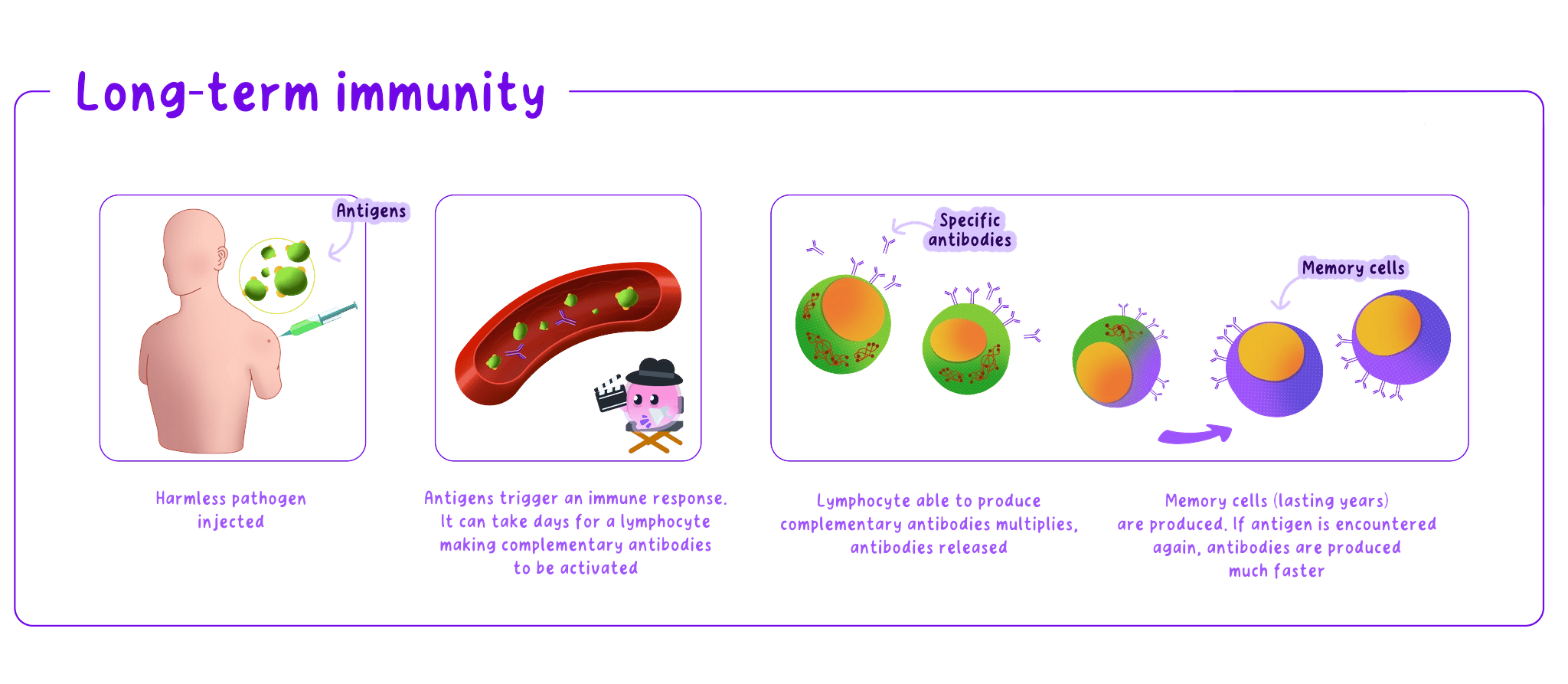
- The lymphocyte with the matching antibody binds to the antigen and is activated.
- The activated lymphocyte divides rapidly by mitosis, producing a clone of many genetically identical lymphocytes.
- The cloned lymphocytes release large numbers of antibodies into the blood, all with the same shape.
- The antibodies bind to the antigens on the surface of the pathogens.
- An antibody is a Y-shaped protein with two identical binding sites, one at the tip of each arm.
- Each binding site has a shape that is complementary to one antigen, so the antibody fits that antigen and no other.
- Once they have bound, antibodies destroy pathogens in several ways.
- Because each antibody has two binding sites, it can attach to two pathogens at once, and this causes agglutination, the clumping of many pathogens together.
- Clumped pathogens cannot spread through the body as easily, and a phagocyte can engulf a whole clump at once.
- Bound antibodies act as markers that tag the pathogen, so phagocytes recognise and engulf it more quickly.
- Antibodies that cover the antigens of a virus stop it attaching to and entering host cells, so it cannot reproduce.
- The phagocytes then engulf and digest the tagged and clumped pathogens, so the two types of white blood cell work together.
- Do not write that antibodies "kill" pathogens on their own, because they bind to them, clump them and mark them for phagocytes to destroy.
- Do not describe an antibody as a cell, because it is a protein made by a lymphocyte.
- Do not write that antibodies and antigens have "the same shape", because the correct word is complementary.
Antitoxins
Toxin
A poisonous substance released by a pathogen that damages host cells and produces the symptoms of the disease.
Antitoxin
A protein produced by lymphocytes that binds to a specific toxin and neutralises it.
- Some bacteria cause the symptoms of disease by releasing toxins, which are poisonous substances that damage body cells.
- The toxins released by the bacteria that cause tetanus and diphtheria are examples, and these toxins can be fatal even when the number of bacteria is small.
- Lymphocytes respond by producing antitoxins, which are proteins with a shape complementary to one particular toxin.
- An antitoxin binds to the toxin and neutralises it, so the toxin can no longer damage cells.
- Antitoxins deal with the toxin while antibodies and phagocytes deal with the bacteria that are releasing it.
Memory cells and immunity
Memory cell
A lymphocyte that stays in the blood after an infection and produces antibodies rapidly if the same antigen enters the body again.
Immunity
The ability to destroy a particular pathogen before it causes symptoms because memory cells for its antigens are already present.
- When a lymphocyte is activated and divides, some of the cells in the clone do not release antibodies straight away but become memory cells.
- Memory cells stay in the blood for many years, sometimes for life, after the infection has been cleared.
- If the same pathogen enters the body again, the memory cells recognise its antigens immediately.
- They divide rapidly and produce antibodies much faster and in much larger amounts than the first time.
- The pathogens are destroyed before they can reproduce enough to cause symptoms, so the person does not become ill.
- A person who has memory cells for a pathogen in this way has immunity to the disease that it causes.
- Immunity is specific to one pathogen, so having had chickenpox gives immunity to chickenpox but no protection against measles.
Some viruses, such as the viruses that cause colds and flu, change their antigens often, so memory cells made during one infection may not recognise the next strain.
Primary and secondary responses
Primary immune response
The slow production of a small amount of antibody that follows the first exposure to an antigen.
Secondary immune response
The rapid production of a large amount of antibody by memory cells that follows a later exposure to the same antigen.
- The response to the first exposure to a pathogen is called the primary immune response.
- It is slow, because only a few lymphocytes have the right antibody shape and they must divide many times before much antibody is made.
- There is a delay of several days before antibody appears in the blood, and during this time the pathogens reproduce and the person develops symptoms.
- The concentration of antibody peaks after about one to two weeks and then falls as the pathogen is cleared.
- The response to a later exposure to the same pathogen is called the secondary immune response.
- It is faster, because memory cells are already present and start producing antibody within a day or two.
- It is larger, because there are many more memory cells than there were matching lymphocytes at the start, so the peak concentration of antibody is often ten times higher or more.
- It lasts longer, so antibody stays in the blood at a high concentration for longer.
- On a graph of antibody concentration against time, the secondary response therefore appears as a curve that rises sooner, climbs more steeply and reaches a much higher peak than the primary response.
Comparing two responses from a graph
- A graph shows the antibody concentration in a person's blood after two exposures to the same pathogen, on day 000 and on day 404040.
- After the first exposure, antibody first appears on day 666 and reaches a peak of 888 arbitrary units on day 141414.
- After the second exposure, antibody appears on day 424242, which is only 222 days after exposure, and reaches a peak of 969696 arbitrary units on day 464646.
- The delay before antibody appears is 666 days in the primary response and 222 days in the secondary response, so the secondary response starts 444 days sooner.
- The ratio of the peaks is 968=12\dfrac{96}{8}=12896=12, so the secondary response produces 121212 times as much antibody.
- The person became ill after the first exposure but not after the second, because memory cells destroyed the pathogens before they could cause symptoms.
Explaining the immune response
- Write the steps in order, which are recognising the antigen, dividing to make a clone, releasing antibodies and binding to the antigen.
- Use the word complementary whenever you describe how an antibody fits an antigen.
- When comparing primary and secondary responses on a graph, give both the speed and the size of the response and quote values from the axes.
- Explain why a person does not become ill the second time by linking memory cells to the pathogen being destroyed before symptoms appear.
- Explain how the immune system recognises a pathogen as foreign.
- Describe what happens to a lymphocyte after it binds to a complementary antigen.
- Give three ways in which antibodies help to destroy pathogens.
- State the function of an antitoxin.
- Explain why the secondary immune response is faster and larger than the primary immune response.
