One set or two sets
Definition
Haploid
Haploid describes a nucleus containing one complete set of chromosomes.
Definition
Diploid
Diploid describes a nucleus containing two complete sets of chromosomes.
- A set of chromosomes contains one of each chromosome type for that species.
- A haploid nucleus contains one set, represented by nnn, while a diploid nucleus contains two sets, represented by 2n2n2n.
- The symbols nnn and 2n2n2n describe the number of chromosome sets rather than the size of a cell.
- Human gametes, sperm and eggs, are haploid and normally contain 232323 chromosomes.
- Most human nucleated body cells are diploid and normally contain 464646 chromosomes.
- The human diploid total can be organised as 232323 pairs, with one chromosome of each pair inherited from each parent.
Common Mistake
Haploid does not mean half a chromosome, because a haploid nucleus contains a complete single set of chromosomes.
Chromosome pairs
Definition
Homologous chromosomes
Homologous chromosomes are a pair of chromosomes carrying the same genes at the same positions, with one inherited from each parent.
- The chromosomes in an ordinary homologous pair have the same genes at the same positions.
- They need not have identical DNA sequences because they can carry different alleles of those genes.
- A haploid gamete has one member from each ordinary homologous pair and therefore one copy of each of those genes.
- The matching pair in a diploid nucleus contains two gene copies, even when their alleles differ.
Exam technique
State one set or two sets when defining haploid and diploid, then use the chromosome number appropriate to the species.
Fertilisation combines two sets
Definition
Fertilisation
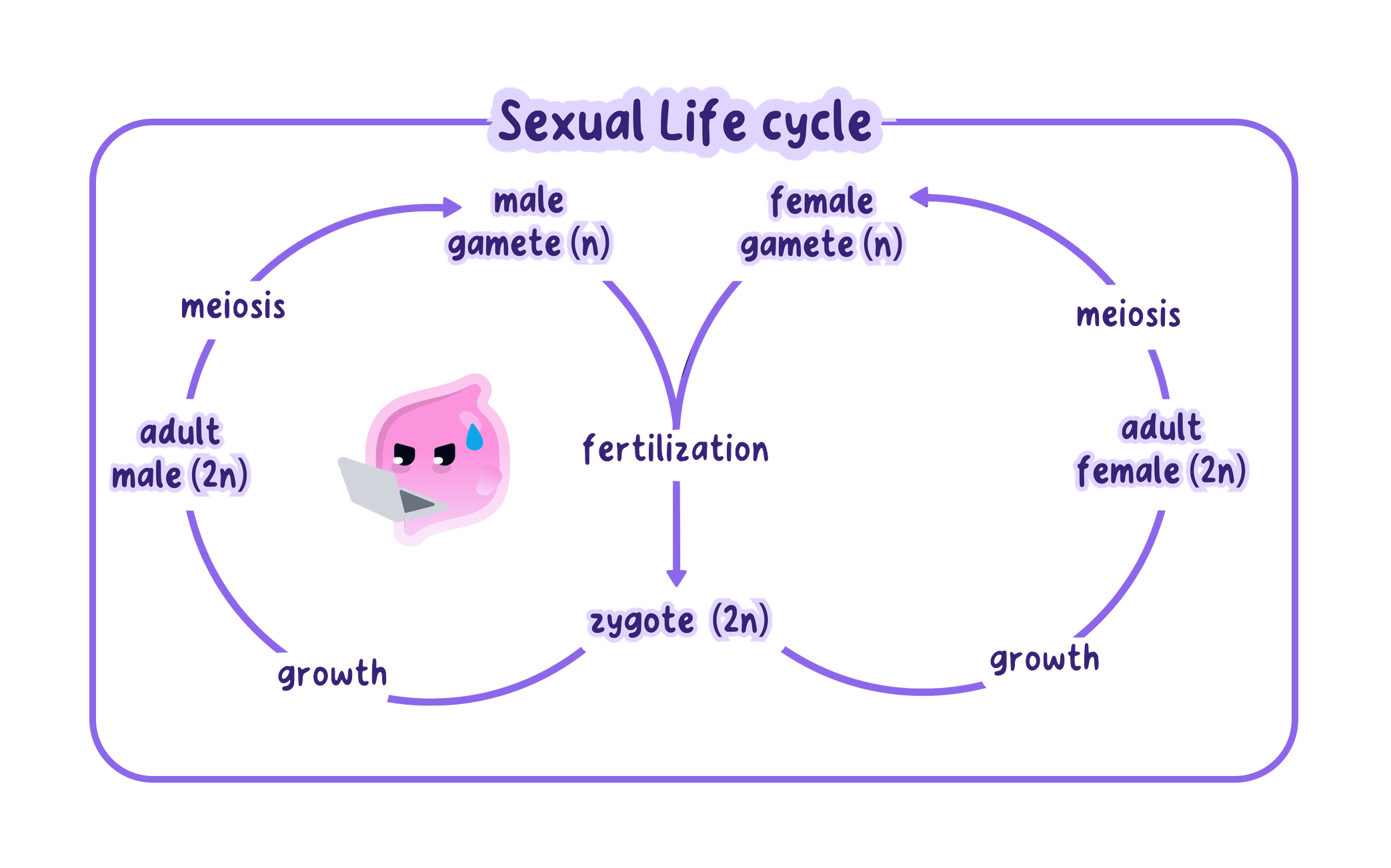
Fertilisation is the fusion of male and female gamete nuclei to form a zygote.
- At fertilisation, the nuclei of two haploid gametes fuse and combine their chromosome sets.
- The resulting zygote has two sets of chromosomes and is therefore diploid.
- The relationship is n+n→2nn+n\rightarrow2nn+n→2n.
- In humans, this is 23+23→4623+23\rightarrow4623+23→46, with 232323 chromosomes contributed by each parent.
- Subsequent normal mitotic divisions copy and distribute the chromosomes so that the developing organism's daughter cells retain the diploid number.
Common Mistake
A human gamete has 232323 individual chromosomes, not 232323 pairs.
Applying chromosome numbers
- Different species have different chromosome numbers, so use the number supplied rather than automatically using the human total.
- If the diploid number is known, calculate the haploid number using n=diploid chromosome number2n=\dfrac{\text{diploid chromosome number}}{2}n=2diploid chromosome number.
- If the haploid number is known, double it to find the diploid number: 2n=2×haploid chromosome number2n=2\times\text{haploid chromosome number}2n=2×haploid chromosome number.
- Count sets rather than assuming that any even chromosome number must be diploid, since a haploid number can also be even.
Example
- A species has 2n=242n=242n=24 chromosomes in a normal diploid nucleus.
- Each gamete has n=242=12n=\dfrac{24}{2}=12n=224=12 chromosomes.
- Fertilisation combines the two sets, giving 12+12=2412+12=2412+12=24 chromosomes in the zygote.
- The zygote contains 121212 chromosome pairs, rather than 242424 pairs.
Reading chromosome diagrams
- Identify matching chromosome types using their length, shape and gene positions when these are shown.
- Two copies of each ordinary chromosome type indicate two sets, whereas one copy of each type indicates one set.
- The two joined arms of an X-shaped replicated chromosome are sister chromatids, not a homologous pair.
- Copying DNA does not by itself change a diploid nucleus into a nucleus with four chromosome sets.
- Mature human red blood cells have no nucleus, so the usual diploid body-cell chromosome count does not apply to them.
Self review
- What does haploid mean?
- How many chromosomes are normally present in a human diploid nucleus?
- Why can homologous chromosomes carry different alleles?
- What chromosome sets combine during fertilisation?
- A species has 2n=182n=182n=18; how many chromosomes does a normal gamete contain?
