Enzymes are the biological catalysts of metabolism
Enzyme
A protein that acts as a biological catalyst, speeding up a reaction in a living organism without being used up.
Catalyst
A substance that increases the rate of a chemical reaction without being changed or used up itself.
Metabolism
The sum of all the chemical reactions that take place in a cell or organism.
- Every chemical reaction needs a certain amount of energy before it will start, and at body temperature most reactions in a cell would run far too slowly to keep the organism alive.
- A catalyst speeds a reaction up by lowering the energy needed to start it, and it is not used up, so the same molecule works over and over again.
- An enzyme is a protein that acts as a biological catalyst, which means it is a catalyst made by and working inside a living organism.
- Metabolism is the whole set of chemical reactions taking place in a cell, and almost every one of them is controlled by its own enzyme.
- Enzymes let a cell run those reactions quickly at about 37 ∘C37\,^\circ\mathrm{C}37∘C, instead of needing the high temperatures a chemist would use to force the same reaction along.
- Some enzymes catalyse breaking-down reactions, splitting one large molecule into smaller ones, as happens when a sugar such as maltose is broken into glucose.
- Others catalyse building-up reactions, joining small molecules into a larger one, as happens when glucose molecules are joined to make starch in a plant cell.
- Because enzymes are proteins, they are themselves built by protein synthesis, so the genes a cell uses decide which reactions that cell can carry out.
An enzyme is not used up and is not alive, so describe it as a catalyst rather than as something the reaction consumes.
The substrate binds to the active site
Active site
The region of an enzyme with a shape complementary to its substrate, where the substrate binds and the reaction takes place.
Substrate
The molecule that an enzyme acts on.
Enzyme-substrate complex
The structure formed when a substrate is bound to the active site of an enzyme.
- Every enzyme has a pocket in its surface called the active site, which is formed by the way its chain of amino acids folds up.
- The molecule an enzyme acts on is called its substrate.
- Enzyme and substrate molecules move about randomly in solution, so a reaction can only begin when the two collide.
- If the substrate hits the active site the right way round, it binds and forms an enzyme-substrate complex.
- Holding the substrate in the active site puts strain on its bonds, and in a building-up reaction it holds two substrate molecules side by side in exactly the right position.
- Either way, less energy is needed for the reaction to happen, which is how the enzyme speeds it up.
- The reaction takes place while the substrate is held, turning it into the products.
- The products have a different shape from the substrate, so they no longer fit the active site and are released into the solution.
- The enzyme itself is left completely unchanged, so its active site is free at once to bind another substrate molecule.
- This is why a cell needs only a small quantity of each enzyme, since one molecule can catalyse the same reaction thousands of times.
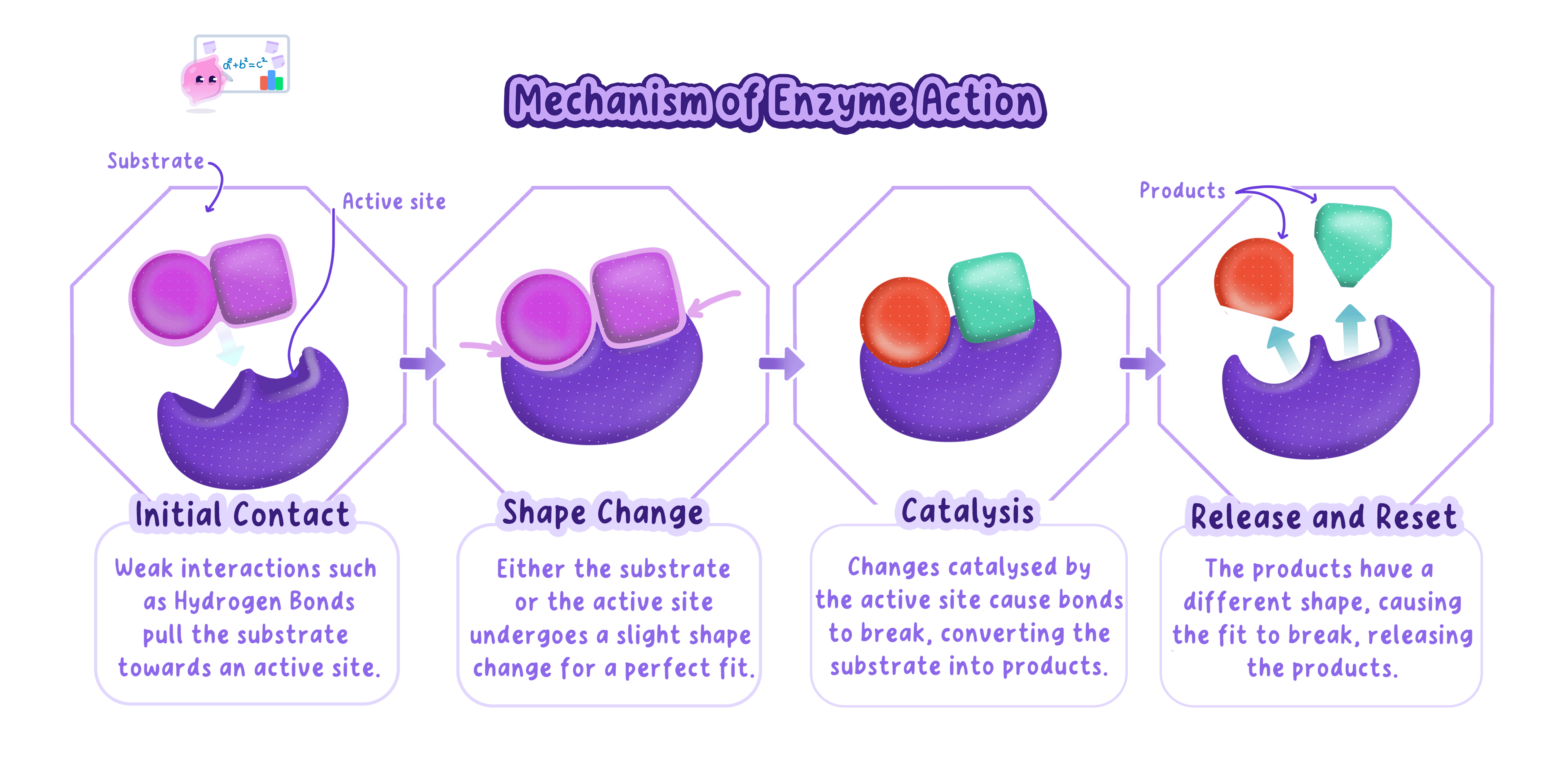
An enzyme works like a stapler, which holds the sheets in exactly the right position, does the job in one movement and is ready for the next pair straight away.
Specificity comes from the shape of the active site
Enzyme specificity
The property of an enzyme by which it catalyses only one reaction, because only its own substrate fits the active site.
- The lock and key hypothesis explains enzyme action by treating the active site as a lock and the substrate as the only key that fits it.
- The shape of the active site is complementary to the shape of the substrate, meaning the two match each other the way a hand matches a glove.
- Only a substrate with the matching shape can bind, so each enzyme catalyses just one reaction, and this is called specificity.
- A molecule of the wrong shape cannot enter the active site, so no complex forms and the enzyme has no effect on it.
- Amylase breaks starch down into sugars, and it has no effect on protein or fat.
- Protease breaks protein down into amino acids by splitting the bonds between them.
- Lipase breaks lipids down into fatty acids and glycerol.
- Because every reaction has its own enzyme, a cell controls which reactions run simply by controlling which enzymes it makes and where it puts them.
Write that the substrate is complementary to the active site, not that it is the same shape as the active site, because the two shapes fit together rather than match.
Temperature, pH and concentration change the rate
Optimum
The temperature or pH at which an enzyme catalyses its reaction at the fastest rate.
Denaturation
A change in the shape of an enzyme's active site, caused by a high temperature or an extreme pH, so that the substrate can no longer bind.
- Raising the temperature gives the enzyme and substrate molecules more kinetic energy, so they move faster, collide more often and collide harder.
- More successful collisions with the active site means more enzyme-substrate complexes form each second, so the rate rises.
- Above the optimum temperature the enzyme vibrates so strongly that the bonds holding its folded shape break, and the active site changes shape.
- The enzyme is then denatured, the substrate no longer fits, and the rate falls steeply and does not recover when the mixture is cooled again.
- Most human enzymes have an optimum close to 37 ∘C37\,^\circ\mathrm{C}37∘C and are denatured above roughly 505050 to 60 ∘C60\,^\circ\mathrm{C}60∘C.
- Moving the pH away from the optimum changes the charges on the amino acids that hold the active site in shape, so the site is distorted and eventually denatured.
- A pH graph therefore has a peak at the optimum with the rate falling away on both the acidic and the alkaline side.
- Different enzymes have different optimum pH values to suit where they work, so amylase in the mouth works best near pH 777 while pepsin in the acidic stomach works best at about pH 222.
- Increasing the substrate concentration increases the rate, because collisions between substrate molecules and active sites become more frequent.
- Once every active site is occupied the rate levels off, because the number of enzyme molecules has become the limiting factor and extra substrate has to wait.
- Increasing the enzyme concentration increases the rate, because there are more active sites available for the substrate to collide with.
- If the substrate then runs short the rate levels off again, because the substrate has become the limiting factor instead.
Explaining a levelling-off in the rate
- A tube contains a fixed mass of catalase and the concentration of hydrogen peroxide is doubled from 222 to 444 units.
- The rate of oxygen production roughly doubles, because twice as many substrate molecules are colliding with the active sites.
- Doubling the concentration again from 444 to 888 units produces almost no further increase.
- Every active site is already occupied, so the number of enzyme molecules is now the limiting factor and only adding more catalase would speed the reaction up.
Explaining a change in enzyme rate
- Take the answer all the way through to the active site, because most explain marks are for the effect on binding rather than for naming the factor.
- Use collisions and enzyme-substrate complexes for the rising part of a curve, and denaturation for the falling part.
- Say which factor is limiting whenever a graph levels off, since that is the mark students most often miss.
- Name the exact temperature or pH from the graph when the question gives you one, rather than describing it as high or low.
Do not write that heat kills an enzyme, because an enzyme is a molecule and is denatured rather than killed.
- What is a biological catalyst, and why does a cell need them at 37 ∘C37\,^\circ\mathrm{C}37∘C?
- Describe the four steps from collision to the release of the products.
- Use the lock and key hypothesis to explain why amylase cannot digest protein.
- Explain why the rate falls above the optimum temperature but rises below it.
- Why does increasing the substrate concentration eventually stop increasing the rate?
