What cellular respiration is
Definition
Cellular respiration
The series of enzyme-controlled reactions that goes on continuously in every living cell, breaking down glucose to supply the ATP the cell needs.
- Cellular respiration is the series of enzyme-controlled reactions that breaks glucose down inside a cell so the energy held in its bonds can be transferred to ATP.
- It is a universal process, which means it goes on in every living cell of every living organism, from a single bacterium to an oak tree to you.
- It also runs continuously, day and night, awake and asleep, from the moment a cell is formed until the moment it dies.
- A cell keeps no useful reserve of ready energy, so if respiration paused for even a short time the cell would have nothing left to power its reactions.
- The breakdown is not one single reaction but a chain of many small steps, and each step has its own enzyme controlling it.
- Splitting the job into small steps lets the energy leave the glucose in small, usable amounts instead of all at once, which would damage the cell.
- Because enzymes run every step, the rate of respiration rises with temperature up to an optimum and falls away if the enzymes are denatured.
- Glucose is the main respiratory substrate, which is the name for the molecule that gets broken down.
- An animal cell receives glucose from digested food carried to it in the blood, while a plant cell makes its own glucose by photosynthesis and then respires it.
- Respiration is a chemical process happening inside cells, so it is a different thing from breathing, which simply moves air in and out of the lungs.
Common Mistake
- Do not use the word respiration to mean breathing, because breathing moves air while respiration breaks down glucose inside cells.
- Do not write that respiration makes, creates or produces energy, because the energy already exists in the glucose and is only transferred to ATP.
- Do not restrict respiration to animals, because a plant cell respires every hour of the day and night just as yours do.
- Do not describe respiration as a single reaction, because it is a long sequence of steps, each one controlled by an enzyme.
How ATP stores and releases energy
Definition
ATP
Adenosine triphosphate, the molecule made during respiration that carries energy around a cell and releases it when it is broken down to ADP and phosphate.
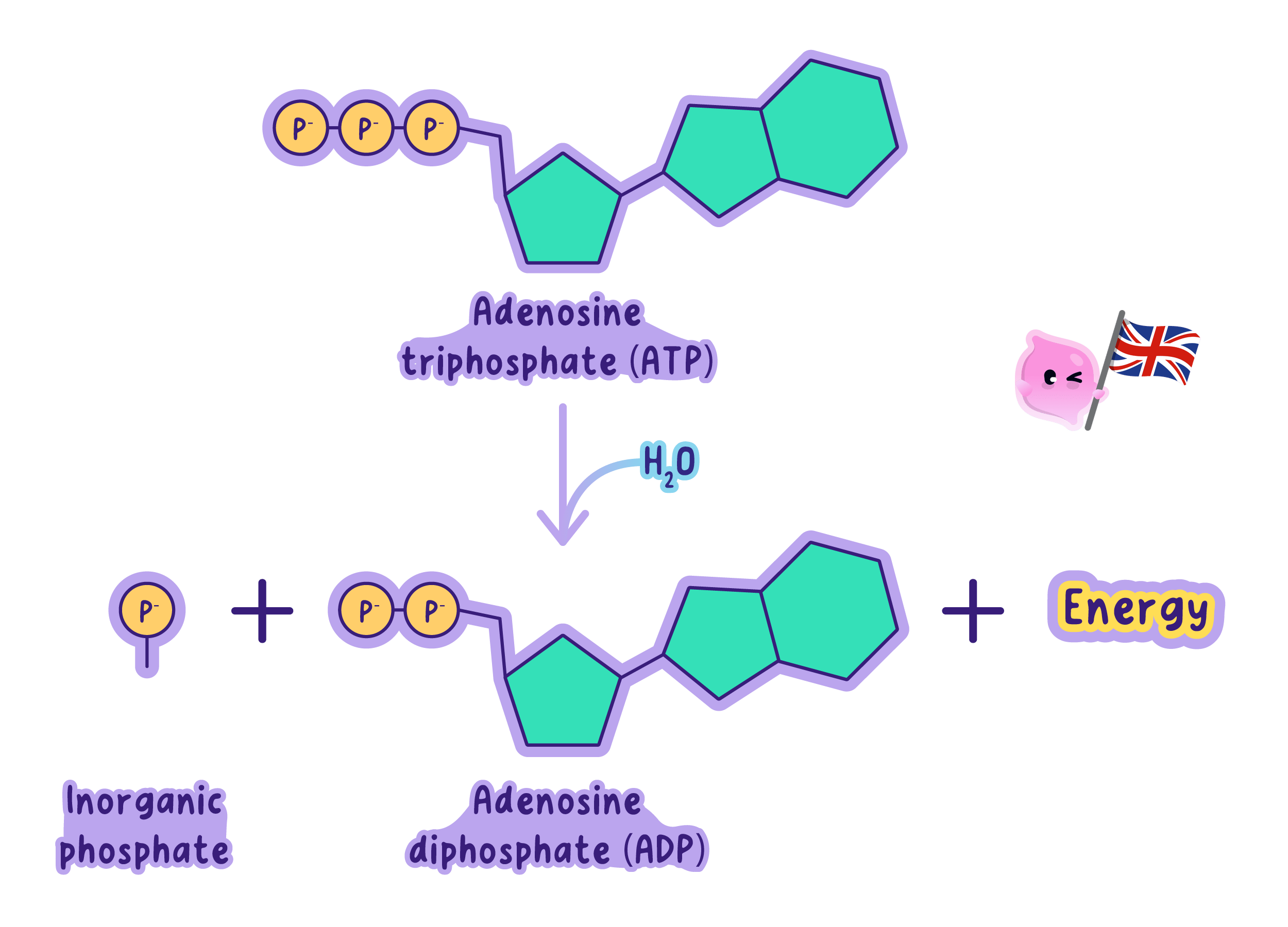
- ATP stands for adenosine triphosphate, and the name describes the molecule: an adenine base, a ribose sugar and a chain of three phosphate groups.
- Energy transferred by respiration is used to attach a third phosphate group onto ADP, which stands for adenosine diphosphate, and this builds a molecule of ATP.
- Building ATP can be written as ADP+Pi→ATP\text{ADP} + \text{P}_{\text{i}} \rightarrow \text{ATP}ADP+Pi→ATP, where Pi\text{P}_{\text{i}}Pi stands for an inorganic phosphate group.
- When a process in the cell needs energy, the bond holding that third phosphate group is broken instead, giving ATP→ADP+Pi\text{ATP} \rightarrow \text{ADP} + \text{P}_{\text{i}}ATP→ADP+Pi.
- Breaking that bond releases the stored energy at the exact place in the cell where the work is being done.
- The ADP and the phosphate group are not thrown away; they stay in the cell and are joined together again by the next round of respiration.
- A single ATP molecule is therefore spent and rebuilt over and over, so a cell needs a fast rate of respiration rather than a large store of ATP.
- ATP is called the cell's energy currency because every process that needs energy is paid for in ATP, whatever fuel the energy originally came from.
- Glucose cannot power a reaction directly, because one glucose molecule holds far more energy than any single reaction needs, and ATP breaks that store into small packets.
Example
Recharging ATP in a working muscle
- A muscle fibre holds only enough ATP to keep contracting for a second or two.
- As the fibre contracts, ATP is broken down to ADP and phosphate, and the energy released slides the muscle filaments past one another.
- The ADP and phosphate stay inside the fibre and are rebuilt into ATP straight away using energy from respiration.
- One ATP molecule can be spent and rebuilt many times a minute, so a muscle that works harder does not store more ATP; it respires faster.
What cells spend ATP on
- Muscle contraction is powered by ATP, so every movement an animal makes depends on a supply of it.
- Synthesis of large molecules from smaller ones needs ATP, because joining subunits together does not happen on its own.
- Amino acids are joined into proteins, glucose molecules are joined into starch or glycogen, and nucleotides are joined into DNA.
- Active transport needs ATP, because moving a substance against its concentration gradient can only happen if energy is supplied.
- Cell division needs ATP to copy the DNA and to pull the chromosomes to opposite ends of the cell.
- Transmission of nerve impulses needs ATP to pump ions back across the membrane after each impulse has passed.
- In mammals and birds, part of the energy transferred by respiration warms the body and helps hold the internal temperature steady.
Note
- The list of jobs is almost the same in a plant cell as in an animal cell, apart from holding a constant body temperature.
- A cell that carries out more of these jobs needs a faster supply of ATP, and so has to respire faster.
Respiration as an exothermic reaction
Definition
Exothermic reaction
A reaction that transfers energy out to its surroundings, so the surroundings become warmer.
- An exothermic reaction transfers energy out to its surroundings, so the surroundings end up warmer than they started.
- The bonds in glucose hold more energy than the bonds in the products of respiration, so there is a surplus every time a glucose molecule is broken down.
- Only part of that surplus is captured in ATP, and the rest leaves the cell as heat, which makes respiration exothermic.
- Because respiration never stops, this heat is being released all the time, in every cell of every organism.
- A tissue that respires quickly releases heat quickly, so it warms up more than a tissue that is resting.
- Contracting muscles respire faster during exercise, which is why you feel hot after sprinting for a bus.
- A large number of respiring organisms packed together warms its surroundings noticeably, which is why the middle of a compost heap or a bag of damp grass cuttings feels hot.
- In a mammal or bird, this steady release of heat is what makes a constant internal body temperature possible even when the air outside is cold.
- A plant releases heat from respiration too, but it has no way of holding its temperature steady, so that heat is simply lost to the air around it.
Practical
Heat released by germinating seeds
- Aim: to show that living, respiring tissue releases heat, and therefore that respiration is exothermic.
- Apparatus: two vacuum flasks, two thermometers or temperature probes with a data logger, cotton wool plugs, soaked mung bean or cress seeds, disinfectant solution, a boiling water bath, beakers, a measuring cylinder and a clamp stand.
- Variables: whether the seeds are alive or dead is the independent variable, the temperature inside the flask is the dependent variable, and the mass of seeds, the volume of disinfectant, the size of flask, the thickness of the cotton wool plug and the position in the room are all controlled.
- Method, preparing the seeds:
- Soak two equal masses of seeds in water for about a day so that they start to germinate and respire rapidly.
- Kill one batch by boiling it for roughly ten minutes, then leave it to cool until it is back at room temperature so both batches start from the same point.
- Rinse both batches in disinfectant for a few minutes and then in clean water, because microorganisms living on the seed coats would respire and release heat of their own.
- Method, setting up:
- Pack the living seeds into one vacuum flask and the boiled seeds into the second, filling both flasks to the same level.
- Push a loose plug of cotton wool into each neck so that air can still reach the seeds while heat is trapped inside.
- Push a thermometer through each plug until its bulb sits in the middle of the seeds, then clamp both flasks upright side by side.
- Method, taking readings:
- Record the starting temperature inside both flasks.
- Leave both flasks undisturbed in the same place and record both temperatures every few hours for four or five days.
- Plot temperature against time for both flasks on the same pair of axes so the two curves can be compared directly.
- Results: the flask holding the living seeds warms by several degrees over the following days, while the flask of boiled seeds stays close to room temperature throughout.
- Maths: find the temperature rise in each flask using ΔT=Tfinal−Tstart\Delta T = T_{\text{final}} - T_{\text{start}}ΔT=Tfinal−Tstart, and read the gradient of the steepest part of the living-seed curve to find when respiration was fastest.
- Watch out: the boiled seeds are the control, and without them any temperature rise could be blamed on a warm room rather than on respiration. Missing out the disinfectant lets bacteria and fungi respire on the seed coats, which warms both flasks and hides the real result. A tight stopper instead of cotton wool cuts off the oxygen supply and slows respiration in the living seeds.
- Safety: wear eye protection when handling disinfectant and boiling water, keep clear of the hot water bath, and wash your hands after touching the seeds.
Exam technique
Writing about respiration and ATP
- Say that respiration transfers energy from glucose to ATP, because answers claiming energy is made or produced are not credited.
- Name ATP instead of writing energy on its own when a question asks what respiration supplies to the cell.
- Give a named use of ATP, such as muscle contraction or active transport, whenever a question asks why a cell has to respire.
- Use the word exothermic and then add that energy is transferred to the surroundings, since the term on its own rarely earns the second mark.
- For the seed investigation, always mention the boiled seeds as the control and state that they show the rise is caused by living tissue.
Self review
- State what is meant by cellular respiration and name the molecule it supplies.
- Explain why respiration has to go on continuously in every living cell.
- Describe how ATP is built from ADP and how it releases its energy again.
- Explain why a cell relies on ATP rather than using glucose directly to power a reaction.
- Explain what the boiled seeds show in an investigation into the heat released by germinating seeds.
