Measuring the rate of an enzyme-controlled reaction
Definition
Enzyme
A protein that acts as a biological catalyst, speeding up a reaction in a living organism without being used up.
Definition
Optimum
The temperature or pH at which an enzyme catalyses its reaction at the fastest rate.
- An enzyme investigation is followed either by measuring how quickly the substrate disappears or by measuring how quickly a product appears.
- For amylase, the substrate is starch, and starch is detected with iodine solution, which turns blue-black when starch is present and stays orange-brown when it is not.
- The moment the iodine first stays orange-brown is the end point, because all the starch has by then been broken down into sugars.
- For catalase, the substrate is hydrogen peroxide and one product is oxygen gas, so the reaction is followed by collecting the gas given off: 2H2O2→2H2O+O22\mathrm{H_2O_2} \rightarrow 2\mathrm{H_2O} + \mathrm{O_2}2H2O2→2H2O+O2.
- When the measurement is a time taken for the reaction to finish, the rate is the reciprocal of that time, rate=1t\text{rate} = \dfrac{1}{t}rate=t1.
- Multiplying by a constant such as 100010001000 gives easier numbers to plot, rate=1000t\text{rate} = \dfrac{1000}{t}rate=t1000, and does not change the shape of the graph.
- When the measurement is a volume of gas, the rate is the volume divided by the time, rate=Vt\text{rate} = \dfrac{V}{t}rate=tV, in cm3 s−1\mathrm{cm^3\,s^{-1}}cm3s−1.
- A shorter time therefore means a faster rate, so a graph of time against temperature and a graph of rate against temperature are opposite shapes.
- The value of the independent variable that gives the highest rate is the optimum.
Example
Turning a reaction time into a rate
- At 30 ∘C30\,^\circ\mathrm{C}30∘C the starch disappears after 80 s80\ \mathrm{s}80 s, so the rate is 100080=12.5\dfrac{1000}{80} = 12.5801000=12.5.
- At 40 ∘C40\,^\circ\mathrm{C}40∘C it disappears after 40 s40\ \mathrm{s}40 s, so the rate is 100040=25\dfrac{1000}{40} = 25401000=25.
- Halving the time has doubled the rate, which is the relationship the reciprocal captures.
- The same constant of 100010001000 must be used for every temperature, or the values cannot be compared.
Practical
Effect of substrate concentration on catalase activity
- Aim: to find how the concentration of hydrogen peroxide affects the rate at which catalase from liver breaks it down.
- Apparatus: fresh liver or potato discs, cork borer, scalpel and white tile, hydrogen peroxide solution, distilled water, 10 cm310\ \mathrm{cm^3}10 cm3 and 25 cm325\ \mathrm{cm^3}25 cm3 measuring cylinders, boiling tube with a delivery tube and bung, trough of water, inverted measuring cylinder or gas syringe, stopclock, balance, forceps, goggles and gloves.
- Variables: the concentration of hydrogen peroxide is the independent variable, the volume of oxygen collected in a fixed time is the dependent variable, and temperature, pH, the mass and surface area of liver, the total volume of solution and the timing are all controlled.
- Method, preparing the solutions:
- Dilute the stock hydrogen peroxide with distilled water to make a set of at least five concentrations, for example 20%20\%20%, 40%40\%40%, 60%60\%60%, 80%80\%80% and 100%100\%100% of the stock.
- Keep the total volume the same in every tube, for example 20 cm320\ \mathrm{cm^3}20 cm3, so only the concentration differs.
- Cut liver discs of the same thickness with a cork borer so that every piece has the same surface area, and check their mass on a balance.
- Method, collecting the gas:
- Fill a measuring cylinder with water, invert it over the trough and feed the delivery tube up into it, or connect a gas syringe instead.
- Pour the first hydrogen peroxide solution into the boiling tube, drop in the liver with forceps, and push the bung in firmly as you start the stopclock.
- Record the volume of oxygen collected after a fixed time such as 60 s60\ \mathrm{s}60 s, reading the measuring cylinder at eye level.
- Rinse the apparatus, repeat each concentration three times with fresh liver, and calculate a mean volume.
- Results: the volume of oxygen collected in the fixed time increases as the concentration of hydrogen peroxide increases, and then levels off at the highest concentrations.
- Maths: calculate the rate as rate=Vt\text{rate} = \dfrac{V}{t}rate=tV in cm3 s−1\mathrm{cm^3\,s^{-1}}cm3s−1, plot rate on the vertical axis against concentration on the horizontal axis, and draw a smooth curve of best fit.
- Watch out: gas escapes if the bung is fitted late or loosely, liver left in air loses activity, and pieces of different thickness give different surface areas even at the same mass.
- Safety: hydrogen peroxide is an irritant, so wear goggles and gloves, cut on a tile away from your fingers, wash hands after handling liver and point the tube away from other people.
Setting up a fair test of temperature and pH
- The factor you deliberately change is the independent variable, and the thing you measure is the dependent variable.
- Everything else that could affect the rate is a control variable and must be kept the same, otherwise you cannot tell which factor caused the change.
- The control variables in an enzyme investigation are the concentration and volume of the enzyme, the concentration and volume of the substrate, and whichever of temperature and pH you are not changing.
- Temperature is controlled with a water bath, which holds the tubes steady at a set value far better than leaving them on the bench.
- pH is controlled with a buffer solution, which resists changes in pH as the reaction proceeds.
- The enzyme and the substrate are left in the water bath in separate tubes before they are mixed, so that the reaction starts at the temperature being tested.
- Each value of the independent variable is repeated at least three times and a mean is calculated, which reduces the effect of random error.
- A reading that sits well away from the others is an anomaly, and it is left out of the mean and, where possible, repeated rather than simply ignored.
Practical
Effect of temperature on amylase activity
- Aim: to find how temperature affects the rate at which amylase breaks down starch, and so to find the optimum temperature of the enzyme.
- Apparatus: amylase solution, starch solution, pH 777 buffer, iodine solution in a dropping bottle, white spotting tile, boiling tubes and rack, two syringes or graduated pipettes, water baths set to a range of temperatures, thermometer, stirring rod, dropping pipette, stopclock and goggles.
- Variables: temperature is the independent variable, the time for the starch to disappear is the dependent variable, and the volumes and concentrations of amylase and starch, the pH, the size of each drop and the sampling interval are controlled.
- Method, setting up:
- Place a single drop of iodine solution in each well of the spotting tile, enough for the whole run.
- Set the water baths to at least five temperatures across a wide range, for example 101010, 202020, 303030, 404040 and 50 ∘C50\,^\circ\mathrm{C}50∘C, and check each with a thermometer.
- Measure 5 cm35\ \mathrm{cm^3}5 cm3 of starch solution with 2 cm32\ \mathrm{cm^3}2 cm3 of pH 777 buffer into one tube and 2 cm32\ \mathrm{cm^3}2 cm3 of amylase into a second tube.
- Stand both tubes in the first water bath for five minutes so that their contents reach the set temperature before they meet.
- Method, running the reaction:
- Pour the amylase into the starch, stir once, start the stopclock and return the tube to the water bath.
- Every 30 s30\ \mathrm{s}30 s, remove one drop of the mixture with the pipette and add it to a fresh well of iodine.
- The iodine turns blue-black while starch is still present, and stays orange-brown once the starch has all been digested.
- Record the time at which the iodine first stays orange-brown, then repeat the whole run three times at that temperature.
- Move to the next water bath and repeat, using freshly measured solutions each time.
- Results: the time taken falls as the temperature rises towards the optimum, is shortest at the optimum, and then rises sharply at higher temperatures.
- Maths: calculate a mean time at each temperature, convert it with rate=1000t\text{rate} = \dfrac{1000}{t}rate=t1000, then plot rate against temperature and read the optimum from the peak of the curve.
- Watch out: mixing before the tubes have warmed up starts the reaction at the wrong temperature, sampling only every 30 s30\ \mathrm{s}30 s limits how precisely the end point can be found, and a dirty pipette carries starch between wells.
- Safety: iodine stains skin and clothing and is an irritant, so wear goggles, handle hot water baths with care and mop up spills at once.
Practical
Effect of pH on amylase activity
- Aim: to find how pH affects the rate at which amylase breaks down starch, and so to find the optimum pH of the enzyme.
- Apparatus: amylase solution, starch solution, buffer solutions at pH 333, 555, 777, 999 and 111111, iodine solution, white spotting tile, boiling tubes and rack, syringes, a water bath set to 35 ∘C35\,^\circ\mathrm{C}35∘C, thermometer, dropping pipette, stopclock and goggles.
- Variables: pH is the independent variable, the time for the starch to disappear is the dependent variable, and temperature, the volumes and concentrations of amylase and starch, the volume of buffer and the sampling interval are controlled.
- Method:
- Put a drop of iodine into each well of the spotting tile and label a tube for each pH value.
- Add 5 cm35\ \mathrm{cm^3}5 cm3 of starch and 2 cm32\ \mathrm{cm^3}2 cm3 of the first buffer to a tube, and 2 cm32\ \mathrm{cm^3}2 cm3 of amylase to a second tube.
- Stand both tubes in the 35 ∘C35\,^\circ\mathrm{C}35∘C water bath for five minutes, so that temperature stays constant throughout and only pH differs between runs.
- Mix the amylase into the starch and buffer, start the stopclock and sample a drop into fresh iodine every 30 s30\ \mathrm{s}30 s.
- Record the time at which the iodine first stays orange-brown, repeat three times, then work through the remaining buffers.
- Results: the reaction is fastest at one pH and slows on either side of it, and at the most acidic and most alkaline values the starch may not be digested at all within the time allowed.
- Maths: convert each mean time with rate=1000t\text{rate} = \dfrac{1000}{t}rate=t1000 and plot rate against pH, which gives a curve with a clear peak at the optimum pH.
- Watch out: use the same volume of buffer every time, because a different volume changes the concentration of the mixture as well as its pH, and check the pH with a meter rather than trusting the label alone.
- Safety: buffers at the extremes of the range are irritant, so wear goggles, avoid skin contact and rinse any splashes with plenty of water.
Reading the results and improving the method
Definition
Denaturation
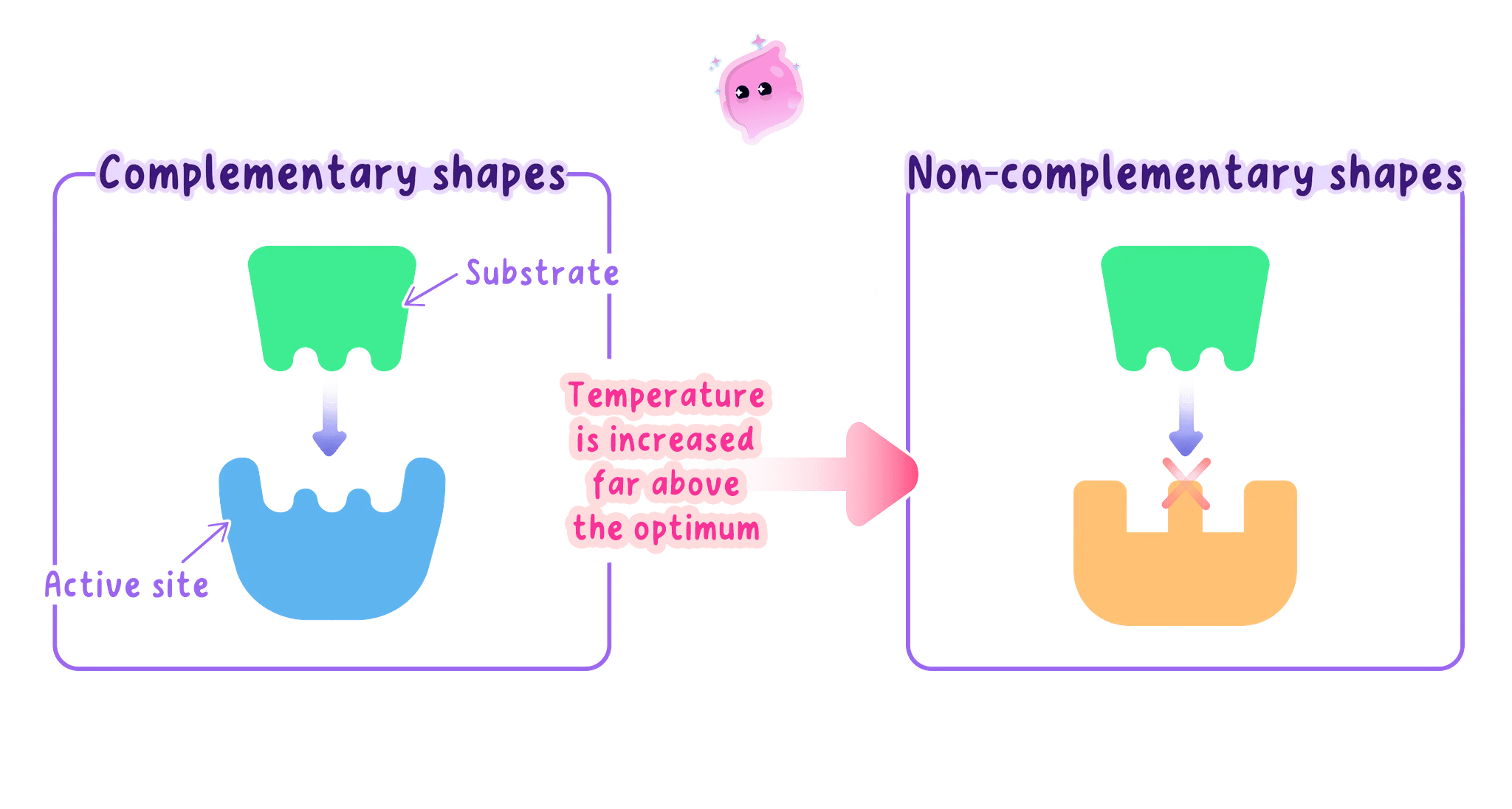
A change in the shape of an enzyme's active site, caused by a high temperature or an extreme pH, so that the substrate can no longer bind.
- A graph of rate against temperature rises to a peak at the optimum and then falls away steeply, so the curve is not symmetrical.
- The steep fall after the peak is caused by denaturation, in which the enzyme loses its folded shape and the substrate can no longer bind.
- Denaturation is not reversed by cooling the mixture down again, so a tube taken above the optimum stays slow for the rest of the run.
- Read the optimum from the peak of the curve rather than from the highest point you happened to test, because the true optimum can lie between two of your temperatures.
- Judging the colour change by eye is a source of error, because different people call the end point at slightly different moments.
- Sampling every 30 s30\ \mathrm{s}30 s means the true end point lies somewhere inside the last interval, so taking samples every 10 s10\ \mathrm{s}10 s improves the precision.
- A colorimeter removes the personal judgement altogether, because it measures the colour of the mixture as a number.
- Testing more values close to the peak gives a better estimate of the optimum than spreading the same number of readings across a wide range.
Common Mistake
An enzyme heated above its optimum is denatured, not killed, because an enzyme is a molecule and was never alive.
Exam technique
Answering on an enzyme investigation
- Name the control variables individually rather than writing that everything else was kept the same, since the marks are given for the named variables.
- Say why a variable is controlled, for example that pH is buffered because a change in pH would change the rate as well.
- State whether a shorter time means a faster or a slower reaction, because the mark is often for interpreting the direction correctly.
- When asked for an improvement, give a change to the method and the reason it helps, rather than writing only that you would repeat the experiment.
Self review
- What colour is iodine solution with starch present, and what colour once the starch has gone?
- Name the independent, dependent and three control variables for the temperature investigation.
- Why are the enzyme and substrate left in the water bath before they are mixed?
- The starch disappears after 25 s25\ \mathrm{s}25 s. Calculate the rate using rate=1000t\text{rate} = \dfrac{1000}{t}rate=t1000.
- Give one source of error in the iodine method and one change that would reduce it.
