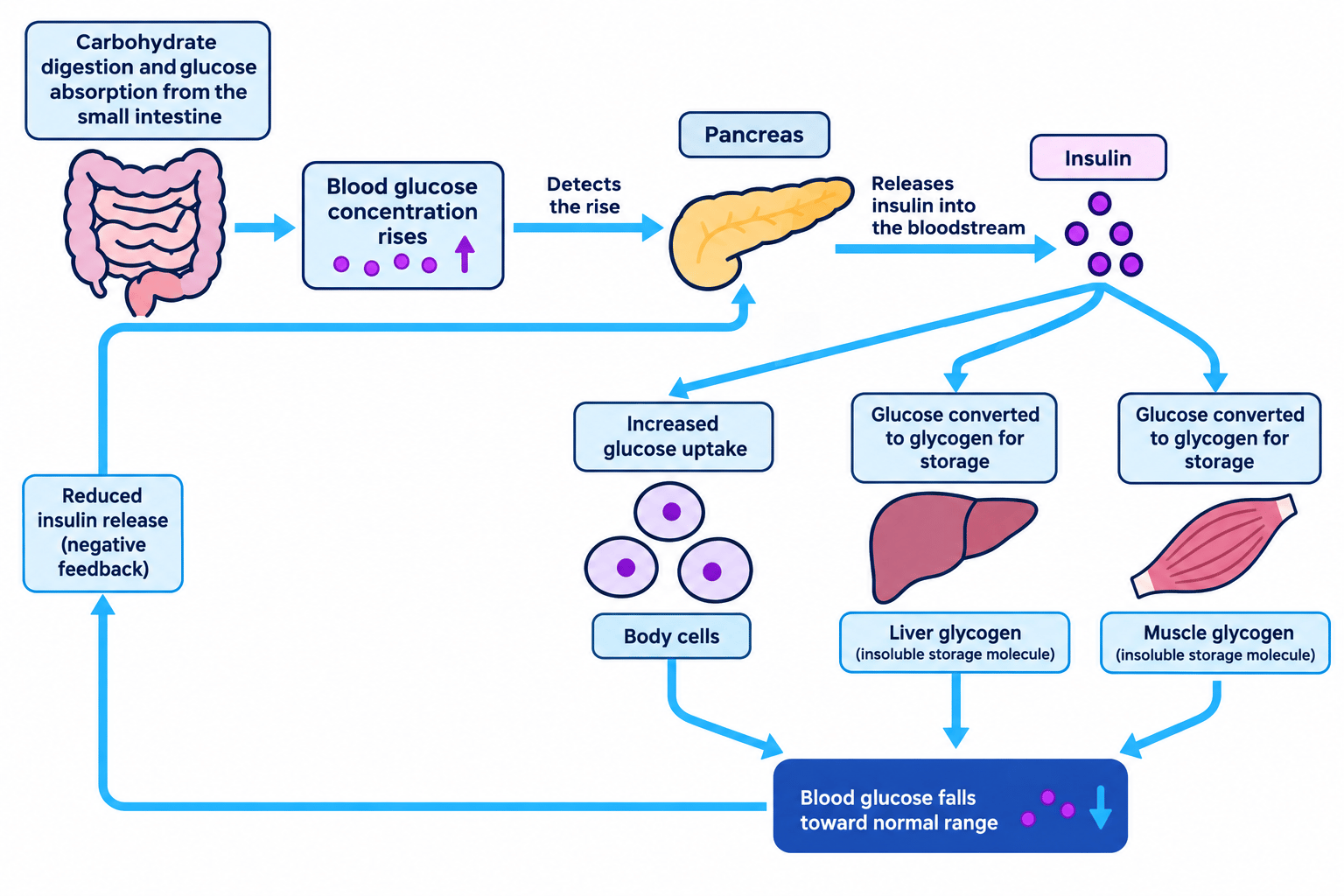
Insulin lowers a raised blood glucose concentration
Definition
Blood glucose
The concentration of glucose (sugar) dissolved in the blood, which the body keeps within narrow limits so cells always have a supply for respiration.
- Blood glucose concentration is the amount of glucose dissolved in a given volume of blood.
- It rises after carbohydrate is digested and glucose is absorbed from the small intestine into the blood.
- The pancreas detects the rise and releases the hormone insulin into the bloodstream.
Insulin increases glucose removal from the blood
Definition
Insulin
A hormone that lowers blood glucose concentration; people with type 1 diabetes must be given insulin.
- Insulin causes body cells to take up more glucose from the blood.
- Cells use some of this glucose in respiration to transfer energy.
- Insulin also causes liver and muscle cells to convert excess glucose into glycogen for storage.
- glucose→insulinglycogen\text{glucose} \xrightarrow{\text{insulin}} \text{glycogen}glucoseinsulinglycogen
- Glycogen is suitable for storage because it is insoluble and does not draw water into cells by osmosis.
- Liver glycogen can later help restore blood glucose, while muscle glycogen supplies glucose for respiration in muscle cells.
- Removing glucose from the blood lowers its concentration towards the normal range.
- Insulin secretion changes continuously with blood glucose rather than being fully on or fully off.
- As the concentration returns towards normal, less insulin is released, completing the negative feedback response.
Common Mistake
- Insulin is a hormone, not an enzyme.
- Do not state that insulin converts glucose into glycogen directly, because insulin causes liver and muscle cells to carry out the conversion.
Graphs show the effect of insulin
- On a graph of blood glucose against time, a meal is followed by a rise as glucose enters the blood.
- A later fall towards the starting range shows that glucose is being taken up and stored under the influence of insulin.
- The gradient shows the rate of change, so a steeper falling line represents a faster decrease in blood glucose.
- A curve that reaches a higher peak or remains raised for longer shows less effective removal of glucose from the blood.
- When comparing curves, use values from the axes and compare the height of the peak, the time taken to reach it and the time taken to return towards normal.
Example
- If blood glucose rises from 4.5 mmol dm−34.5\,\text{mmol dm}^{-3}4.5mmol dm−3 to 7.5 mmol dm−37.5\,\text{mmol dm}^{-3}7.5mmol dm−3, the increase is 7.5−4.5=3.0 mmol dm−37.5-4.5=3.0\,\text{mmol dm}^{-3}7.5−4.5=3.0mmol dm−3.
- The subsequent fall is explained by insulin causing glucose uptake by cells and conversion of glucose to glycogen.
Exam technique
Write the chain in order: high blood glucose, pancreas, insulin, greater glucose uptake, glycogen formation, then blood glucose falls.
Self review
- Which organ detects a rise in blood glucose?
- What hormone is released when blood glucose is too high?
- How does insulin affect glucose uptake by cells?
- Where is glycogen stored?
- What pattern should a healthy blood glucose graph show after a meal?