Glucagon raises a low blood glucose concentration
Definition
Glucagon
A hormone released by the pancreas when blood glucose is too low; it makes the liver break down glycogen into glucose and release it into the blood.
- Blood glucose falls between meals and during prolonged exercise because cells remove glucose for respiration.
- The pancreas detects the low concentration and releases the hormone glucagon into the blood.
- Glucagon targets the liver and causes stored glycogen to be converted into glucose.
- glycogen→glucagonglucose\text{glycogen} \xrightarrow{\text{glucagon}} \text{glucose}glycogenglucagonglucose
- The liver releases this glucose into the blood, raising the concentration towards its normal range.
- As blood glucose returns towards normal, glucagon release decreases.
Example
- During a long period without food, cells continue using glucose in respiration and blood glucose begins to fall.
- Glucagon causes the liver to mobilise its glycogen store, supplying glucose to the blood.
Insulin and glucagon act in opposite directions
Definition
Insulin
A hormone that lowers blood glucose concentration; people with type 1 diabetes must be given insulin.
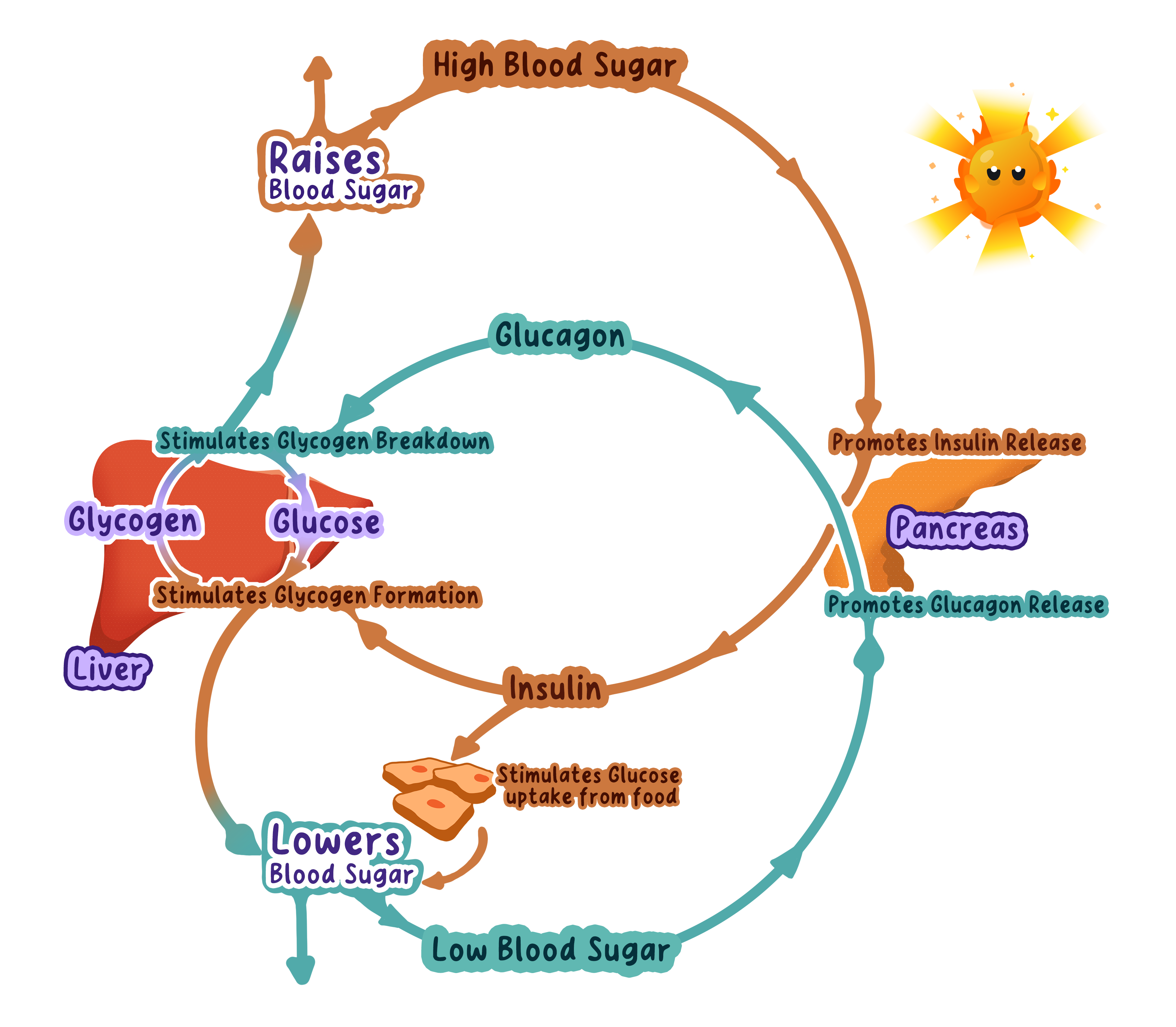
- When blood glucose is too high, insulin increases glucose uptake and glycogen formation, so blood glucose falls.
- When blood glucose is too low, glucagon increases glycogen breakdown and glucose release by the liver, so blood glucose rises.
- The two hormones are antagonistic because their effects oppose each other.
- After a meal, insulin secretion increases and glucagon secretion decreases, favouring glucose uptake and glycogen formation.
- Between meals, insulin secretion decreases and glucagon secretion increases, favouring glycogen breakdown and glucose release.
- The balance changes gradually, preventing large fluctuations as the body moves between fed and fasting conditions.
- Their interaction forms a negative feedback system that keeps blood glucose within narrow limits.
Common Mistake
- Do not swap the hormones: insulin lowers blood glucose and glucagon raises it.
- Glucagon acts mainly on the liver, not on glycogen stores in every body cell.
Data questions require comparison and explanation
- A healthy blood glucose curve rises after a meal and then returns towards its normal range.
- A fall below the normal range stimulates glucagon release, so the curve rises again.
- The gradient shows the rate of change, while the peak and trough show the highest and lowest measured concentrations.
- If two people are compared, use equivalent time points and consider whether they began at different concentrations.
- When interpreting data, identify the change, quote comparative values where possible and link the change to the correct hormone and organ.
Example
- A fall from 5.0 mmol dm−35.0\,\text{mmol dm}^{-3}5.0mmol dm−3 to 3.8 mmol dm−33.8\,\text{mmol dm}^{-3}3.8mmol dm−3 is a decrease of 1.2 mmol dm−31.2\,\text{mmol dm}^{-3}1.2mmol dm−3.
- The pancreas responds by releasing glucagon, which causes the liver to release glucose from glycogen.
Exam technique
For low blood glucose, write: pancreas detects the fall, glucagon is released, liver glycogen is converted to glucose, glucose enters the blood, and the concentration rises towards normal.
Self review
- When is glucagon released?
- Which organ responds to glucagon?
- What conversion does glucagon cause?
- Why are insulin and glucagon described as antagonistic?
- How does this hormonal interaction produce negative feedback?
