5.1.1 The genome
DNA, genes and chromosomes
Chromosome
A chromosome is a structure made of a long DNA molecule associated with proteins that carries many genes.
Gene
A gene is a section of DNA that contains the instructions for making a particular protein.
Genome
The genome is the complete genetic material of an organism.
- DNA stores genetic information in its base sequence, the order of its bases.
- In a plant or animal cell, most DNA is packaged with proteins into chromosomes in the nucleus.
- A chromosome contains many genes, each occupying a particular position along its DNA.
- The base sequence of a protein-coding gene determines the order of amino acids in a protein.
- Proteins include enzymes, structural components and some hormones, so their activities help produce an organism's characteristics.
- The genome includes both coding DNA and non-coding DNA, rather than only the genes that code for proteins.
- Mitochondria also contain a small amount of DNA, and plant chloroplasts have DNA, so an organism's genetic material is not confined to its nuclear chromosomes.
- Most nucleated body cells of an individual contain the same genetic information, although different cell types use different genes.
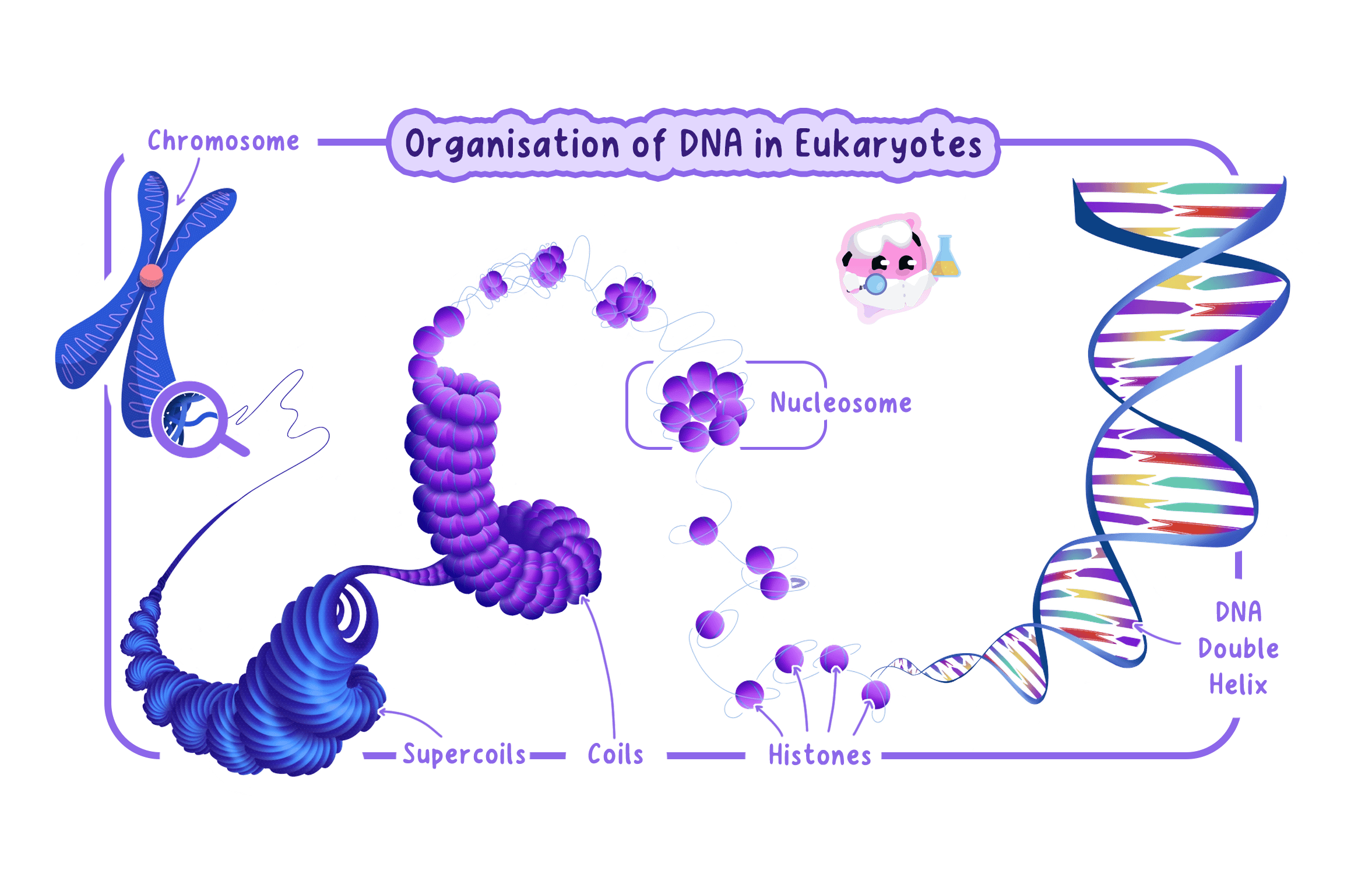
A genome is all of an organism's genetic material, a chromosome is a DNA-containing structure, and a gene is a section of DNA.
Alleles and characteristics
Allele
An allele is an alternative version of a gene.
Genotype
The genotype is the combination of alleles carried by an organism.
Phenotype
The phenotype is the observable or measurable characteristics of an organism produced by its genotype and its interaction with the environment.
- Individuals of the same species usually have the same types of genes but may carry different alleles of those genes.
- For a gene on an ordinary chromosome pair, an individual inherits one allele from each parent.
- A genotype describes the alleles present, whereas a phenotype describes the resulting observable or measurable characteristics.
- A phenotype can include a physical feature, such as flower colour, or a biochemical characteristic, such as a blood group.
- An organism's environment can also influence its phenotype, so knowing its genotype does not always predict its exact appearance or size.
Use gene for a section of DNA and allele for a version of that gene when explaining inherited differences.
Describing allele combinations
Dominant allele
A dominant allele determines the phenotype when present in a heterozygous genotype.
Recessive allele
A recessive allele determines the phenotype only when no dominant allele of the same gene is present.
Homozygous
Homozygous describes a genotype containing two identical alleles of a particular gene.
Heterozygous
Heterozygous describes a genotype containing two different alleles of a particular gene.
- For a simple gene with a dominant and a recessive allele, use the same letter in upper and lower case, such as AAA and aaa.
- The genotypes AAAAAA and aaaaaa are homozygous because each contains two copies of the same allele.
- The genotype AaAaAa is heterozygous because it contains two different alleles.
- With complete dominance, both AAAAAA and AaAaAa produce the dominant phenotype, whereas aaaaaa produces the recessive phenotype.
- A recessive allele is still present in a heterozygote and can be inherited even though it does not determine that individual's phenotype.
Dominant does not mean common, stronger or beneficial; it describes an allele's effect in a heterozygote.
Gametes carry inherited information
Gamete
A gamete is a haploid reproductive cell whose nucleus can fuse with another gamete nucleus during fertilisation.
- Animal gametes are sperm cells and egg cells, which carry genetic information from parents to offspring.
- The nucleus of each gamete carries one allele of each gene on an ordinary chromosome pair.
- When gamete nuclei fuse at fertilisation, their genetic information combines in the first cell of the offspring.
- This explains why an offspring inherits alleles from both parents while retaining its own combination of genetic information.
- How does a gene differ from a genome?
- What is an allele?
- How does genotype differ from phenotype?
- What makes a genotype heterozygous?
- What does a gamete carry from a parent?
5.1.2 Environment and phenotype
Genes and environment shape phenotype
Phenotype
The phenotype is the observable or measurable characteristics of an organism produced by its genotype and its interaction with the environment.
Variation
Variation is the differences in characteristics between individuals of the same species.
- An organism's phenotype develops through the interaction of its genome with its environment.
- Genetic differences arise because individuals inherit different alleles, while environmental differences arise from different conditions or experiences.
- Blood group is an example of a characteristic largely determined by inherited alleles.
- A scar is an acquired feature resulting from an injury and healing, rather than a new allele inherited from a parent.
- Height depends on inherited factors and on conditions during growth, including nutrition and illness.
- Body mass is influenced by inherited factors together with food intake, physical activity and other environmental conditions.
- Plant growth depends on inherited characteristics together with the supply of light, water and mineral ions.
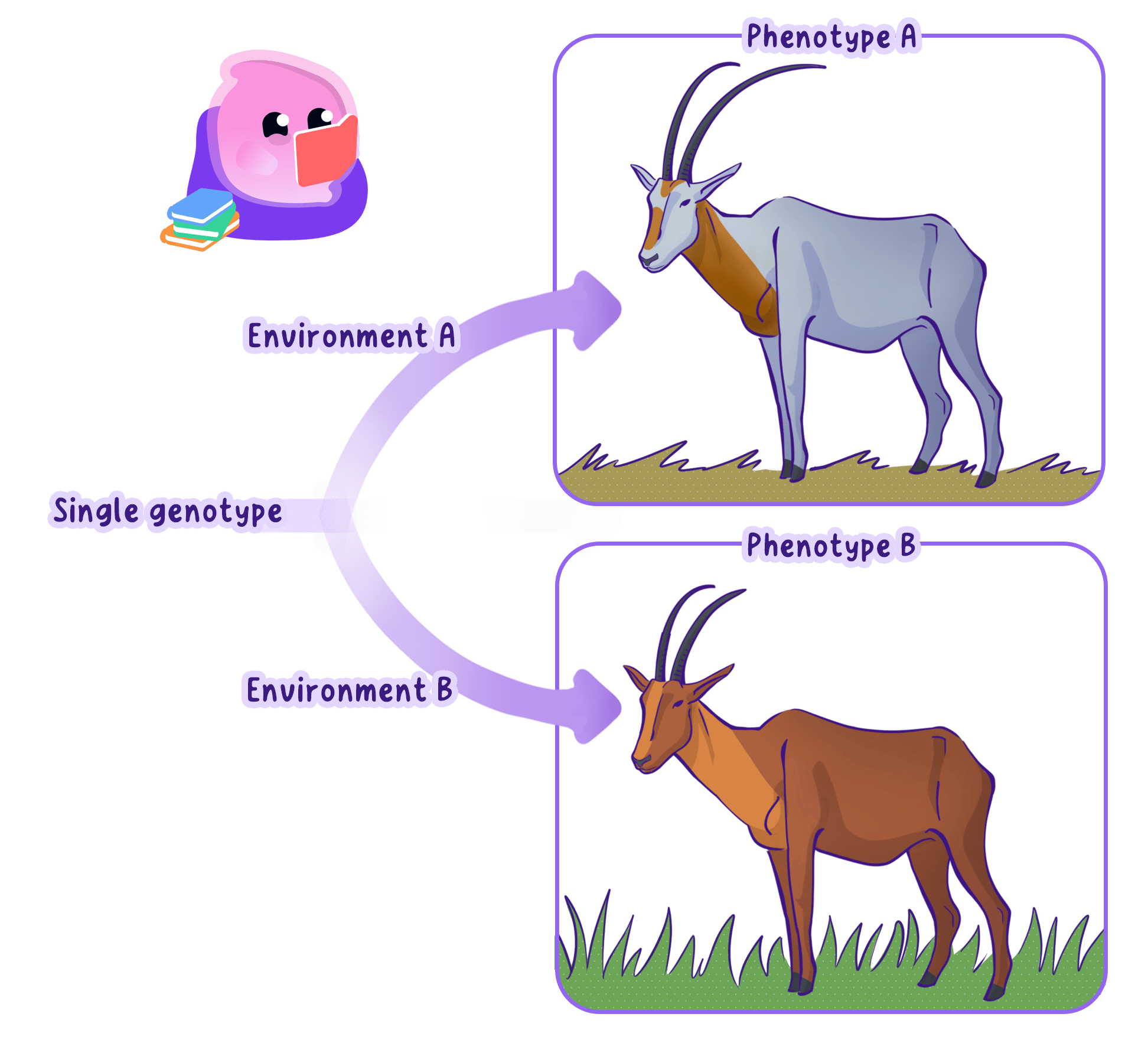
- Two genetically identical cuttings are grown with different supplies of mineral ions.
- The cutting with insufficient nitrate ions makes less protein for growth and may develop less biomass.
- A difference between their growth therefore need not indicate a difference in their inherited alleles.
Comparing environmental effects
- Identical twins have almost identical genomes but may develop different body masses or other characteristics when their experiences differ.
- Clones are useful for investigating environmental effects because their inherited genetic differences are greatly reduced.
- If genetically similar organisms develop different phenotypes under different conditions, this supports an environmental influence.
- A fair comparison changes the environmental factor of interest while keeping other relevant conditions the same.
- Simply finding a correlation between a condition and a characteristic does not prove that the condition caused the difference.
Investigating plant growth
- Aim: investigate how the supply of mineral ions affects the growth of genetically similar plants.
- Apparatus: use rooted cuttings from one parent plant, labelled pots, an inert growing medium, complete nutrient solution, a matching solution lacking nitrate ions, a measuring cylinder and a ruler.
- Method, setting up the plants:
- Select cuttings of similar initial height and root development, then randomly allocate several cuttings to each treatment.
- Provide one group with complete nutrient solution and the other with a solution lacking nitrate ions, keeping the other mineral concentrations the same.
- Use at least five cuttings in each treatment and grow them for a fixed period such as 212121 days.
- Give every pot the same volume of solution and keep pot size, growing medium, light exposure, temperature and growth period the same.
- Method, measuring and recording:
- Record initial shoot height from the growing-medium surface to the shoot tip and repeat the measurement at regular intervals using the same method.
- Measure shoot height at the start and every 333 days, recording each plant separately so its change can be followed.
- Record heights and height increases in mm\mathrm{mm}mm, together with observations such as leaf colour.
- Use several plants in each group and calculate each plant's increase in height before comparing the group means.
- Results: a consistent difference between the treatment means supports an effect of nitrate supply on phenotype.
- Watch out: compare the spread of results because a small difference between means may reflect variation among individual plants.
- Safety: handle solutions as instructed, avoid skin and eye contact, and wash hands after working with plants and growing media.
Continuous and discontinuous variation
Continuous variation
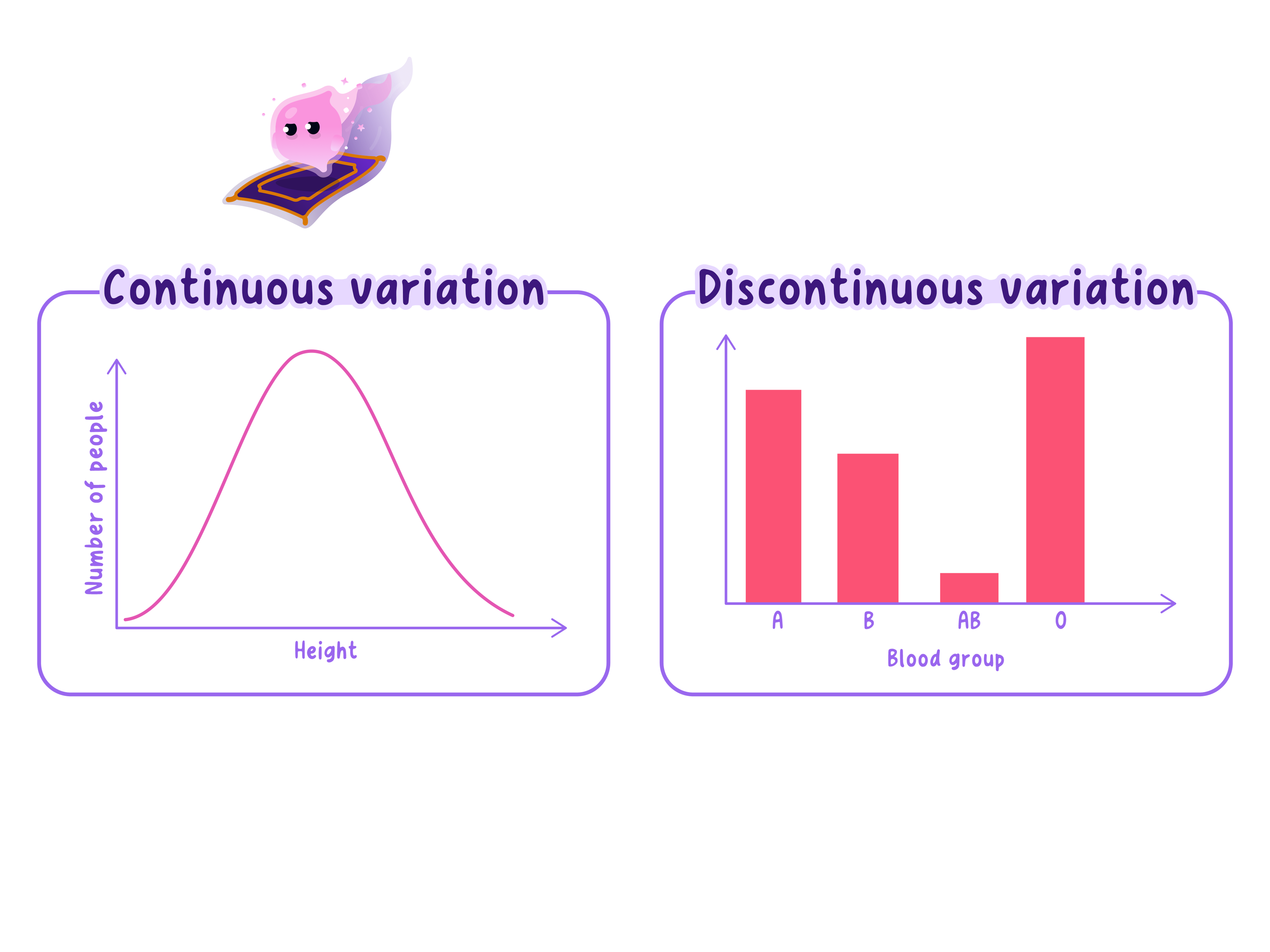
Continuous variation is variation in a characteristic across a range with intermediate values and no distinct categories.
Discontinuous variation
Discontinuous variation is variation in which a characteristic falls into distinct categories without intermediate values.
- Continuous variation produces a range of measurements with intermediate values, such as height, body mass or leaf length.
- Recording height to the nearest centimetre does not make height discontinuous, because the gaps arise from measurement precision.
- Discontinuous variation produces distinct categories, such as the blood groups A\mathrm{A}A, B\mathrm{B}B, AB\mathrm{AB}AB and O\mathrm{O}O.
- Eye colour can be recorded in categories for a survey, although real iris colour contains finer variation within those categories.
- The pattern of variation and the cause of variation are different questions, so continuous does not mean environmental and discontinuous does not mean unaffected by the environment.
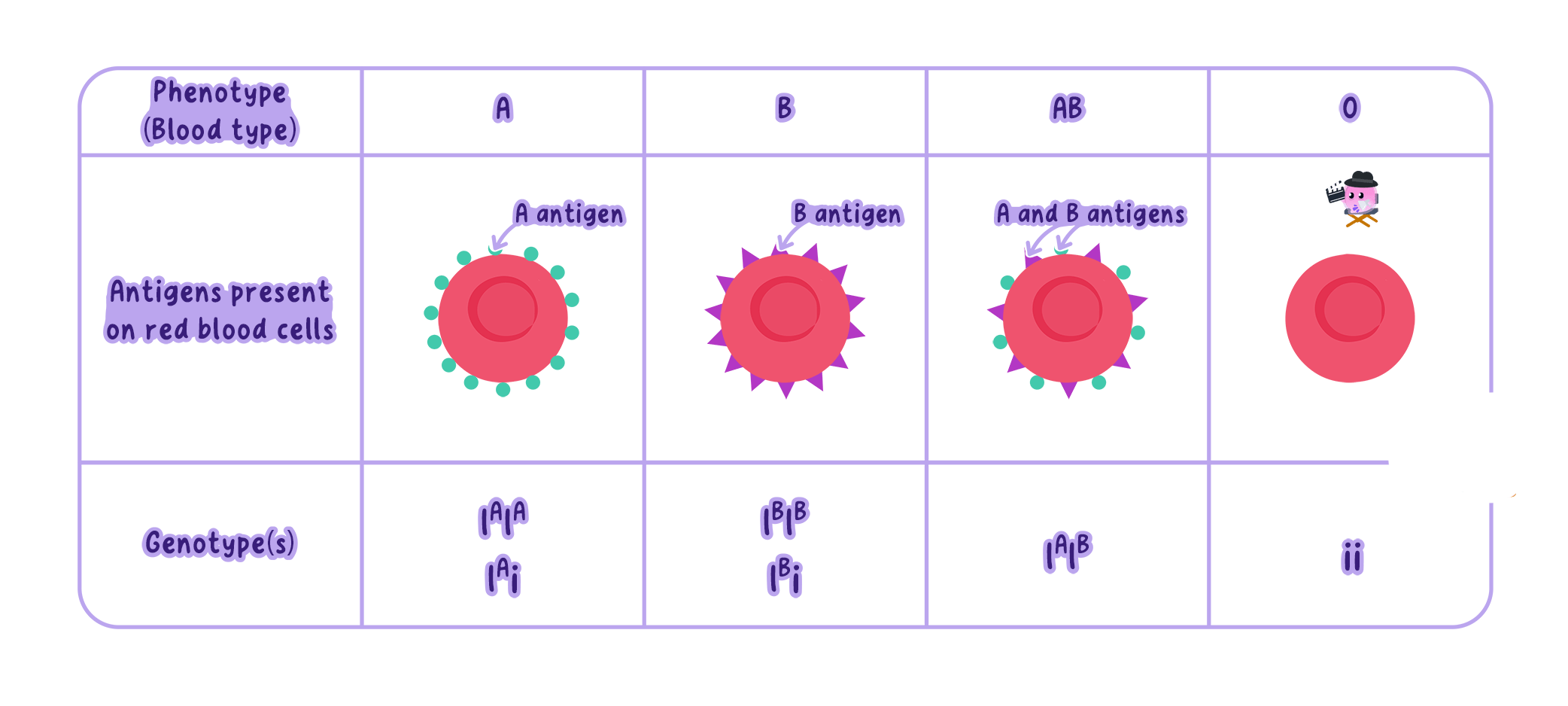
Justify continuous using the range and intermediate values, or discontinuous using distinct categories, rather than naming only an example.
Displaying variation
- For continuous measurements, group values into equal-width intervals and draw a histogram with touching bars.
- Many large samples show values clustered near the middle with fewer at the extremes, but continuous data do not have to form a perfectly symmetrical bell shape.
- For categorical data, draw a bar chart with a separate bar for each category and gaps between bars.
- Label the horizontal axis with the measured characteristic and units or the category names, and label the vertical axis with frequency.
Investigating variation
- Aim: compare continuous hand-span measurements with a discontinuous characteristic recorded from anonymous, supplied blood-group data.
- Apparatus: millimetre ruler, paper and anonymous supplied blood-group data.
- Method, selecting the sample:
- Choose volunteers randomly from the defined group and include a sufficiently large sample to reduce the effect of chance.
- Use anonymous codes, obtain consent and allow volunteers to withdraw without giving a reason.
- Method, measuring hand span:
- Ask each volunteer to place the same hand flat on paper and comfortably spread the fingers without straining.
- Measure the straight-line distance from the tip of the thumb to the tip of the little finger with a millimetre ruler.
- Use the same ruler, measuring method and hand throughout, and record relevant differences in age when comparing groups.
- Repeat each measurement using the same hand position and calculate a mean hand span for each volunteer.
- Results: group hand-span values into equal-width intervals for a histogram and count the supplied blood-group categories for a bar chart.
- Watch out: a class sample may not represent the wider population, even when every measurement is precise.
- Safety: use supplied blood-group records rather than collecting or testing blood.
Calculating a mean
- Calculate a mean by dividing the sum of the measurements by the number of measurements: mean=sum of measurementsnumber of measurements\text{mean}=\dfrac{\text{sum of measurements}}{\text{number of measurements}}mean=number of measurementssum of measurements.
- Retain the original measurement unit and inspect the spread as well as the mean when comparing samples.
- Hand spans in a small illustrative sample are 160160160, 170170170, 175175175, 180180180 and 190 mm190\,\mathrm{mm}190mm.
- Their total is 160+170+175+180+190=875 mm160+170+175+180+190=875\,\mathrm{mm}160+170+175+180+190=875mm.
- The mean is 8755=175 mm\dfrac{875}{5}=175\,\mathrm{mm}5875=175mm.
- The range is 190−160=30 mm190-160=30\,\mathrm{mm}190−160=30mm, which describes the difference between the largest and smallest measurements.
- Why can genetically identical plants develop different heights?
- What distinguishes continuous variation from discontinuous variation?
- Why does rounding a measurement not make the characteristic discontinuous?
- Why are clones useful in an environmental investigation?
- Which graph displays blood-group categories?
5.1.3 Variants and mutations
Mutations produce variants
Mutation
A mutation is a change in the base sequence of DNA.
Allele
An allele is an alternative version of a gene.
- A mutation changes the sequence of bases in DNA and can create a genetic variant.
- A variant within a gene may form a different allele of that gene.
- All genetic variants originate through mutations, although an individual may inherit a variant that first arose many generations earlier.
- Mutations can arise spontaneously, for example when DNA is copied, rather than occurring because an organism needs a useful characteristic.
- Some environmental agents, including ionising radiation and certain chemicals, increase the frequency of mutations.
- A substitution replaces a base, an insertion adds a base, and a deletion removes a base from a DNA sequence.
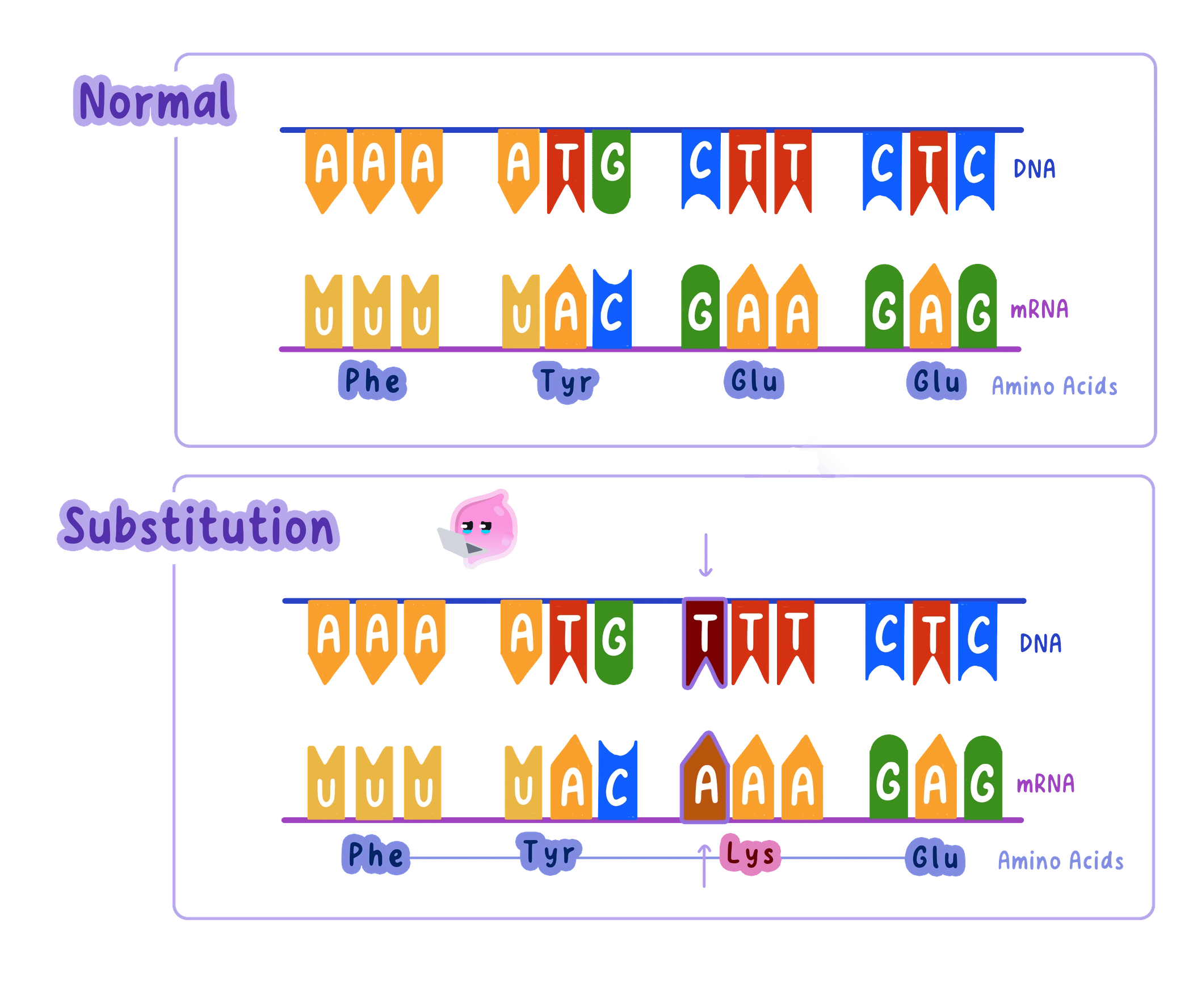
A mutation is a change in DNA, whereas a change in appearance caused by diet or exercise does not by itself demonstrate a mutation.
Variants have different effects
- Most variants produce no detectable change in phenotype, so a DNA difference does not necessarily produce a visible difference.
- Some variants influence a characteristic without deciding it completely, because other genetic and environmental factors also contribute.
- Very few variants have an effect large enough to determine a particular characteristic.
- A variant may be harmful, beneficial or neutral, depending on its effect and the environment in which the organism lives.
- A harmful effect can reduce survival or reproduction, whereas a beneficial effect can increase survival or reproduction in particular conditions.
- A DNA change with no detectable effect on growth or appearance illustrates a neutral variant.
- A variant that slightly changes growth illustrates an influence on phenotype.
- A variant that prevents a pigment from being produced can determine whether that pigment is present.
Passing a variant to offspring
- If a cell carrying a variant divides, its DNA can be copied into its descendant cells.
- In sexual reproduction, a variant can be inherited when it is present in a gamete that contributes to fertilisation.
- A mutation confined to an ordinary body cell is not normally passed to offspring through sexual reproduction.
- Sexual reproduction brings existing alleles into new combinations, while mutation is the original source of new variants.
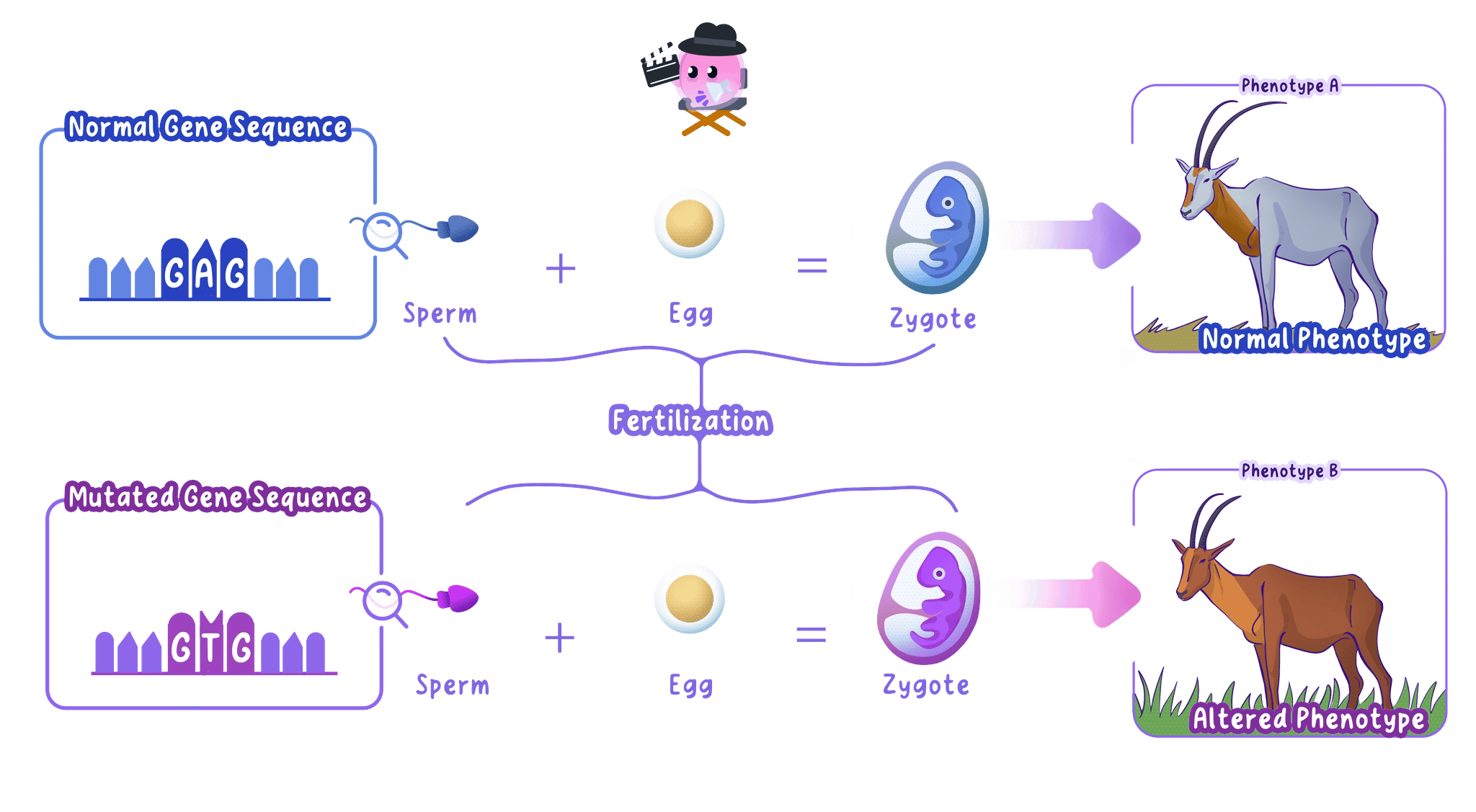
Distinguish the origin of a variant, a mutation, from its inheritance, the transmission of that variant from a parent.
Interpreting evidence
- When DNA sequences are supplied, compare corresponding positions to identify the changed base or an added or missing base.
- Use the reported characteristic to decide whether the variant has no detected effect, influences the phenotype or determines the feature being considered.
- A sequence difference alone is insufficient evidence that the organism will be harmed.
- What changes during a mutation?
- What is the original source of genetic variants?
- What effect do most variants have on phenotype?
- When can a variant be inherited through sexual reproduction?
- Why does a new variant not necessarily harm an organism?
5.1.4 How genetic variants influence phenotype
Coding variants affect proteins
Coding DNA
Coding DNA is a DNA sequence that specifies the amino acid sequence of a protein.
- A gene's base sequence determines the amino acid sequence of the protein it codes for.
- A variant in coding DNA may change the base sequence copied into messenger RNA, written mRNA\mathrm{mRNA}mRNA.
- When the message is translated at a ribosome, the changed sequence may cause a different amino acid to be added to the protein.
- The amino acid sequence affects how the chain folds into its specific three-dimensional shape.
- A change in folding can alter the protein's structure and therefore its activity.
- The resulting effect on a cell's processes may change the organism's phenotype.
Use may when describing the effect of a coding variant, because a changed DNA sequence does not always alter the protein's function.
Changes to an enzyme's active site
- An enzyme binds its substrate at an active site with a complementary shape.
- If a coding variant changes an amino acid important to folding, the enzyme's active site may change shape.
- The substrate may then bind less effectively or fail to bind, so fewer enzyme-substrate complexes form.
- The enzyme-controlled reaction may slow down or stop, changing the amount of product made.
- If that product is a pigment, a reduced supply can change the colour of a tissue.
- A plant has an enzyme that catalyses the formation of a purple pigment.
- A coding variant changes the enzyme's amino acid sequence and the shape of its active site.
- Its substrate no longer binds effectively, so less pigment is made and the flower is paler.
Protein changes can alter cells
- The same reasoning applies to proteins other than enzymes, including transport proteins and structural proteins.
- A variant affecting haemoglobin can alter how haemoglobin molecules behave and can cause red blood cells to become sickle-shaped under low-oxygen conditions.
- The example links a DNA difference to a protein difference and then to a change in cell properties.
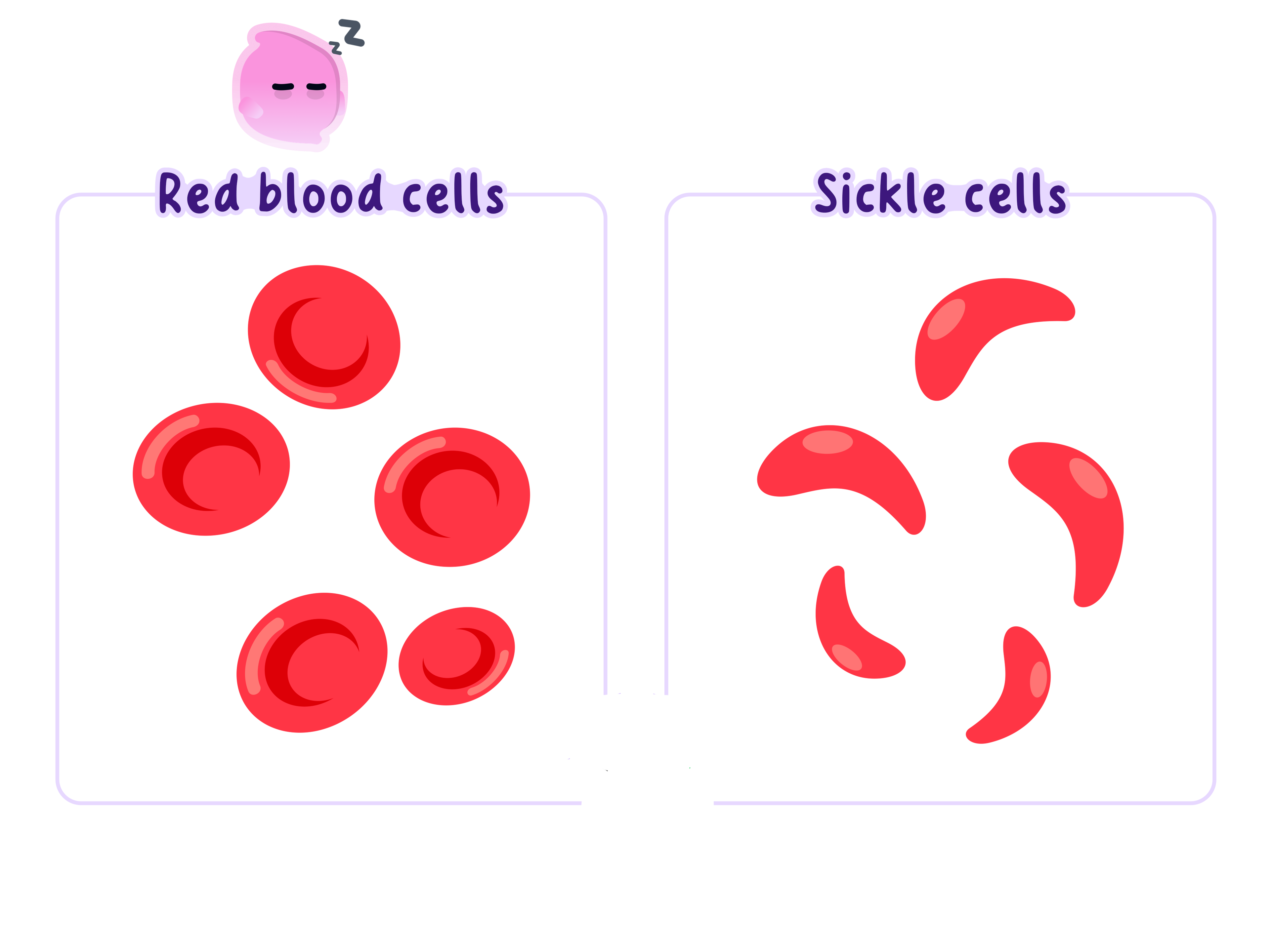
- For a coding variant, connect the base sequence, amino acid sequence, protein shape, protein activity and resulting characteristic.
- For an enzyme, name the active site and explain the effect on substrate binding rather than saying only that the enzyme changes.
Non-coding variants affect expression
Non-coding DNA
Non-coding DNA is DNA that does not specify the amino acid sequence of a protein.
Gene expression
Gene expression is the use of information in a gene to make its functional product, such as a protein.
- Some non-coding DNA regulates whether a gene is used and how much of its product is made.
- A variant in a regulatory region can prevent the gene from being transcribed.
- If transcription is prevented, no mRNA\mathrm{mRNA}mRNA copy of that gene is produced.
- Without the mRNA\mathrm{mRNA}mRNA message, ribosomes cannot make that protein from the affected copy of the gene.
- Other regulatory changes may increase or decrease transcription, altering the amount of protein produced.
- A non-coding variant can therefore change phenotype even when the protein-coding sequence itself has not changed.
- A flower-colour gene codes for an enzyme needed to make pigment.
- A variant in non-coding regulatory DNA prevents transcription of the gene, so its mRNA\mathrm{mRNA}mRNA is not made.
- The enzyme is not produced from that gene copy, reducing pigment production without needing to change the enzyme's amino acid sequence.
Distinguishing the two mechanisms
- A coding variant can change what the protein is like and how effectively it works.
- A non-coding regulatory variant can change whether, when or how much of a protein is made.
- Both routes can affect the same characteristic, but the explanation must identify the route supported by the information given.
- A variant outside an important coding or regulatory sequence may have no detectable phenotypic effect.
- How can a coding variant alter a protein's shape?
- Why can an altered active site reduce enzyme activity?
- How can non-coding DNA affect gene expression?
- What happens to protein production if transcription is prevented?
- How does changing protein activity differ from changing protein amount?
5.1.5 Asexual and sexual reproduction
Two ways to reproduce
Sexual reproduction
Sexual reproduction is reproduction involving the fusion of male and female gamete nuclei.
Asexual reproduction
Asexual reproduction is reproduction from one parent without the fusion of gametes, usually producing genetically identical offspring.
Fertilisation
Fertilisation is the fusion of male and female gamete nuclei to form a zygote.
Clone
A clone is a cell or organism that is genetically identical to the cell or organism from which it was produced.
- Sexual reproduction combines genetic information when male and female gamete nuclei fuse.
- The gametes usually come from two parents, although self-fertilisation can occur in some organisms.
- The first cell formed is a zygote, which divides and develops into an offspring.
- In animals, the gametes are sperm and eggs; in flowering plants, pollen delivers male gametes to an ovule containing an egg cell.
- Asexual reproduction involves one parent and no fusion of gametes, usually producing offspring genetically identical to that parent.
- In plants and animals, asexual reproduction involves mitosis, whereas bacteria reproduce by binary fission rather than mitosis.
The defining feature of sexual reproduction is the fusion of gamete nuclei, so parent number alone is not a sufficient distinction.
Asexual reproduction can be rapid
- One parent can reproduce without finding a mate, allowing an isolated organism to establish a population.
- Less time and energy are required for mate attraction and mating, so offspring can often be produced rapidly in favourable conditions.
- Repeated asexual reproduction can produce many offspring in a short period, allowing rapid use of available food or space.
- Successful combinations of alleles are retained in clones, which is useful when the environment remains suitable.
- Bacteria copy their DNA before binary fission, then divide to form two cells that can each reproduce again.
- Strawberry plants produce runners that root and grow into new plants, while potato tubers can develop into new plants from their buds.
- Yeast can reproduce asexually by budding, in which a small outgrowth receives a copied nucleus and separates from the parent cell.
- A Hydra can form a bud that grows and separates into a new animal.
- A strawberry plant already grows well in a sheltered garden bed.
- Its runners establish nearby without requiring pollination or seed production.
- The new plants retain the parent's useful genetic characteristics and can occupy suitable ground quickly.
Clones share vulnerabilities
- Asexual offspring usually have little genetic variation, apart from differences introduced by mutations.
- If a disease can infect the parent, many genetically similar offspring may also be susceptible.
- A change in temperature, food availability or other conditions may affect most members of a clone population in a similar way.
- Rapid production of offspring is therefore less helpful if few can survive the changed conditions.
- Clones can still develop different phenotypes when they experience different environments.
Genetically identical does not mean identical in every measured characteristic, because environmental conditions also affect phenotype.
Sexual reproduction increases variation
- Sexual reproduction usually produces offspring with different combinations of alleles.
- This genetic variation makes it more likely that at least some offspring can survive a new disease or an environmental change.
- Variation does not guarantee survival and does not mean that all sexually produced offspring are better suited to their surroundings.
- Finding a mate, producing gametes and transferring them can require time and energy.
- Fertilisation may fail, particularly when gametes are released into the environment or pollen does not reach a suitable flower.
- Reproduction may therefore be slower or less reliable when population density is low.
- Link an advantage to its consequence, such as no mate required, allowing reproduction by an isolated individual.
- When explaining variation, connect different inherited characteristics to the chance that some offspring survive the stated environmental change.
Offspring number and survival
- The number produced per reproductive event varies greatly among organisms and cannot be predicted from reproductive mode alone.
- Many mammals produce relatively few young and invest substantial resources in pregnancy and parental care.
- Many fish release large numbers of gametes, but only a fraction produce offspring that survive to adulthood.
- Many flowering plants produce numerous seeds sexually, while runners may produce fewer new plants per event but establish them rapidly.
- To compare reproductive success, consider offspring per event, frequency of reproduction, time to maturity and survival to reproductive age.
- An organism that produces fewer young per event can still produce more surviving offspring over time if it reproduces frequently or its young survive well.
- In a simplified comparison, one organism produces 444 offspring per event over 666 events, giving 4×6=244\times6=244×6=24 offspring.
- Another produces 101010 offspring per event over 222 events, giving 10×2=2010\times2=2010×2=20 offspring.
- If half of the first organism's offspring survive and three-quarters of the second organism's survive, the surviving totals are 24×0.5=1224\times0.5=1224×0.5=12 and 20×0.75=1520\times0.75=1520×0.75=15.
- The larger number born does not necessarily give the larger number surviving.
- What event defines sexual reproduction?
- Why can one isolated organism reproduce asexually?
- Why can a disease threaten a population of clones?
- How can genetic variation help when conditions change?
- Why is offspring number per birth insufficient to compare reproductive success?
5.1.6 Haploid and diploid
One set or two sets
Haploid
Haploid describes a nucleus containing one complete set of chromosomes.
Diploid
Diploid describes a nucleus containing two complete sets of chromosomes.
- A set of chromosomes contains one of each chromosome type for that species.
- A haploid nucleus contains one set, represented by nnn, while a diploid nucleus contains two sets, represented by 2n2n2n.
- The symbols nnn and 2n2n2n describe the number of chromosome sets rather than the size of a cell.
- Human gametes, sperm and eggs, are haploid and normally contain 232323 chromosomes.
- Most human nucleated body cells are diploid and normally contain 464646 chromosomes.
- The human diploid total can be organised as 232323 pairs, with one chromosome of each pair inherited from each parent.
Haploid does not mean half a chromosome, because a haploid nucleus contains a complete single set of chromosomes.
Chromosome pairs
Homologous chromosomes
Homologous chromosomes are a pair of chromosomes carrying the same genes at the same positions, with one inherited from each parent.
- The chromosomes in an ordinary homologous pair have the same genes at the same positions.
- They need not have identical DNA sequences because they can carry different alleles of those genes.
- A haploid gamete has one member from each ordinary homologous pair and therefore one copy of each of those genes.
- The matching pair in a diploid nucleus contains two gene copies, even when their alleles differ.
State one set or two sets when defining haploid and diploid, then use the chromosome number appropriate to the species.
Fertilisation combines two sets
Fertilisation
Fertilisation is the fusion of male and female gamete nuclei to form a zygote.
- At fertilisation, the nuclei of two haploid gametes fuse and combine their chromosome sets.
- The resulting zygote has two sets of chromosomes and is therefore diploid.
- The relationship is n+n→2nn+n\rightarrow2nn+n→2n.
- In humans, this is 23+23→4623+23\rightarrow4623+23→46, with 232323 chromosomes contributed by each parent.
- Subsequent normal mitotic divisions copy and distribute the chromosomes so that the developing organism's daughter cells retain the diploid number.
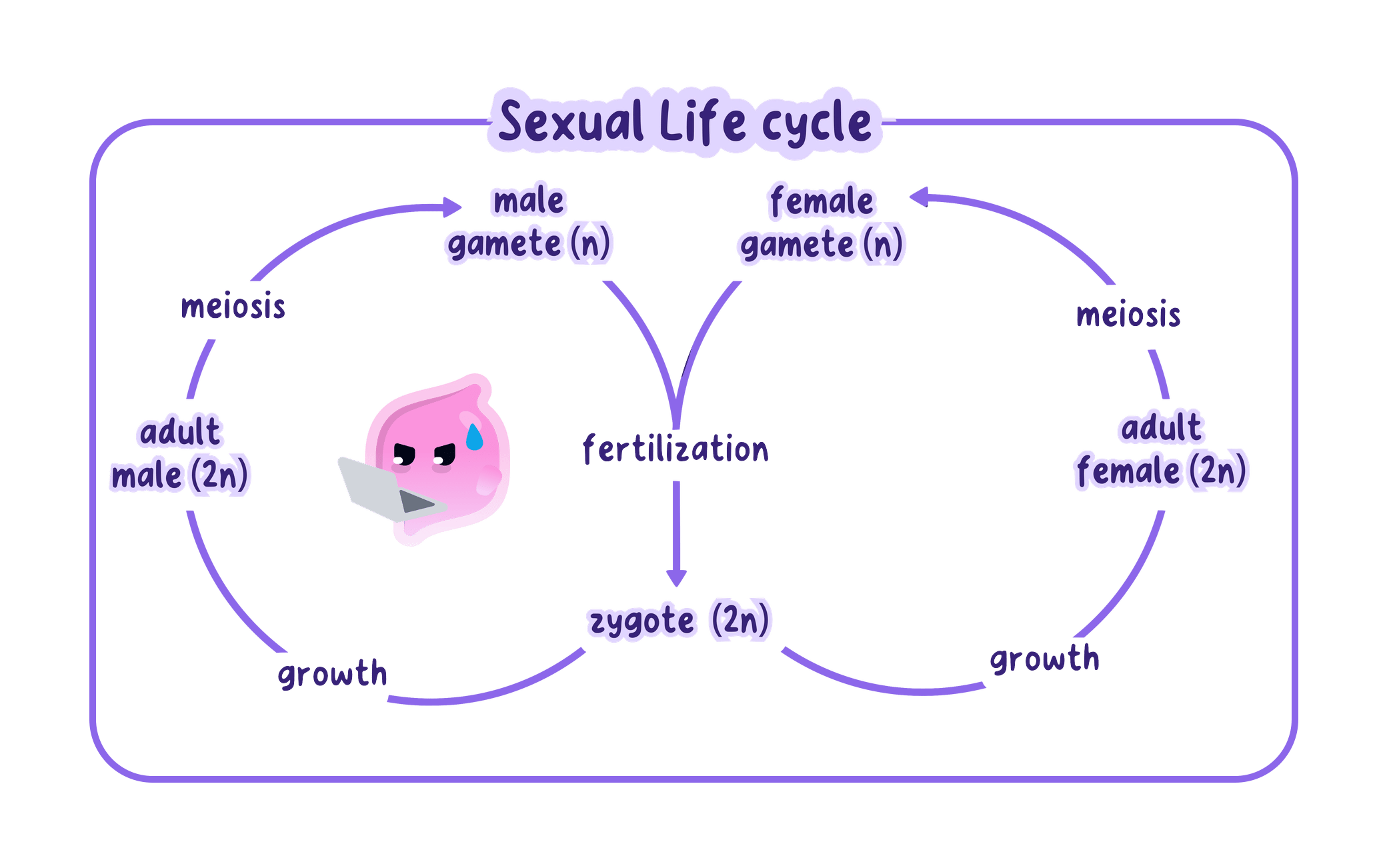
A human gamete has 232323 individual chromosomes, not 232323 pairs.
Applying chromosome numbers
- Different species have different chromosome numbers, so use the number supplied rather than automatically using the human total.
- If the diploid number is known, calculate the haploid number using n=diploid chromosome number2n=\dfrac{\text{diploid chromosome number}}{2}n=2diploid chromosome number.
- If the haploid number is known, double it to find the diploid number: 2n=2×haploid chromosome number2n=2\times\text{haploid chromosome number}2n=2×haploid chromosome number.
- Count sets rather than assuming that any even chromosome number must be diploid, since a haploid number can also be even.
- A species has 2n=242n=242n=24 chromosomes in a normal diploid nucleus.
- Each gamete has n=242=12n=\dfrac{24}{2}=12n=224=12 chromosomes.
- Fertilisation combines the two sets, giving 12+12=2412+12=2412+12=24 chromosomes in the zygote.
- The zygote contains 121212 chromosome pairs, rather than 242424 pairs.
Reading chromosome diagrams
- Identify matching chromosome types using their length, shape and gene positions when these are shown.
- Two copies of each ordinary chromosome type indicate two sets, whereas one copy of each type indicates one set.
- The two joined arms of an X-shaped replicated chromosome are sister chromatids, not a homologous pair.
- Copying DNA does not by itself change a diploid nucleus into a nucleus with four chromosome sets.
- Mature human red blood cells have no nucleus, so the usual diploid body-cell chromosome count does not apply to them.
- What does haploid mean?
- How many chromosomes are normally present in a human diploid nucleus?
- Why can homologous chromosomes carry different alleles?
- What chromosome sets combine during fertilisation?
- A species has 2n=182n=182n=18; how many chromosomes does a normal gamete contain?
5.1.7 Meiotic cell division
Meiosis and gametes
Meiosis
Meiosis is a form of cell division in which one diploid cell divides twice to produce four genetically different haploid gametes.
Gamete
A gamete is a haploid reproductive cell whose nucleus can fuse with another gamete nucleus during fertilisation.
- Meiosis is the form of cell division that produces gametes, and in humans it takes place only in the testes and the ovaries.
- In flowering plants the same division occurs in the anthers, which make pollen, and in the ovules, which make egg cells.
- One diploid parent cell that enters meiosis gives rise to four haploid daughter cells.
- A diploid human body cell holds 464646 chromosomes arranged as 232323 homologous pairs, one chromosome of each pair having come from each parent.
- Each gamete formed from that cell holds 232323 chromosomes, exactly one taken from every pair.
- The change is written 2n→n2n \rightarrow n2n→n, where nnn stands for one complete set of chromosomes.
- In humans n=23n = 23n=23, so a body cell is 2n=462n = 462n=46 and a sperm cell or egg cell is n=23n = 23n=23.
- Meiosis is the only division in the body that changes the chromosome number, which is why it is confined to the reproductive organs.
The gametes are sperm cells and egg cells in animals, and pollen nuclei and egg cells in flowering plants.
Why the number is halved
Fertilisation
Fertilisation is the fusion of male and female gamete nuclei to form a zygote.
Zygote
A zygote is the single diploid cell produced when the nuclei of two haploid gametes fuse at fertilisation.
- Fertilisation is the fusion of a male gamete nucleus with a female gamete nucleus.
- Two haploid nuclei fuse, so the zygote that forms carries 23+23=4623 + 23 = 4623+23=46 chromosomes.
- The diploid number is restored exactly, and the zygote then divides repeatedly by mitosis to build the whole organism.
- Every body cell of the new individual therefore carries the same 464646 chromosomes as the body cells of its parents.
- Because one full set arrives from each parent, every homologous pair holds one maternal chromosome and one paternal chromosome.
- If gametes were diploid, the chromosome number would double at every fertilisation, running 46→92→18446 \rightarrow 92 \rightarrow 18446→92→184 in three generations.
- A cell with the wrong chromosome number carries the wrong number of copies of every gene on the extra chromosomes, so it cannot develop normally.
- Meiosis is described as a reduction division because it is the step that takes one chromosome away from every pair.
Meiosis and fertilisation work as a pair: meiosis takes the chromosome number down to nnn and fertilisation returns it to 2n2n2n, so the diploid number of the species stays the same generation after generation.
Fertilisation is not a type of cell division. No cell divides when two gamete nuclei fuse, so a cross that describes fertilisation as halving or copying chromosomes has the two processes the wrong way round.
The two divisions of meiosis
Homologous chromosomes
Homologous chromosomes are a pair of chromosomes carrying the same genes at the same positions, with one inherited from each parent.
- Before meiosis starts, every chromosome is copied during interphase, so it becomes two identical sister chromatids joined at a centromere.
- Meiosis I separates the homologous pairs, and it is this division that halves the chromosome number.
- Prophase I: the chromosomes condense and each one pairs up alongside its homologous partner.
- Metaphase I: the pairs line up along the equator of the cell, each pair positioned independently of the others.
- Anaphase I: spindle fibres pull one whole chromosome of each pair to each pole, so the sister chromatids stay joined together.
- Telophase I: two nuclei form and the cell divides, producing two cells that are already haploid.
- Meiosis II separates the sister chromatids and runs in the same way as mitosis.
- Prophase II: the chromosomes condense again inside each of the two new cells.
- Metaphase II: the chromosomes line up singly along the equator.
- Anaphase II: each centromere divides and the sister chromatids are pulled to opposite poles.
- Telophase II: four nuclei form and both cells divide, giving four haploid cells in total.
- The overall result is one diploid cell becoming four haploid cells, each carrying one chromosome from every original pair.
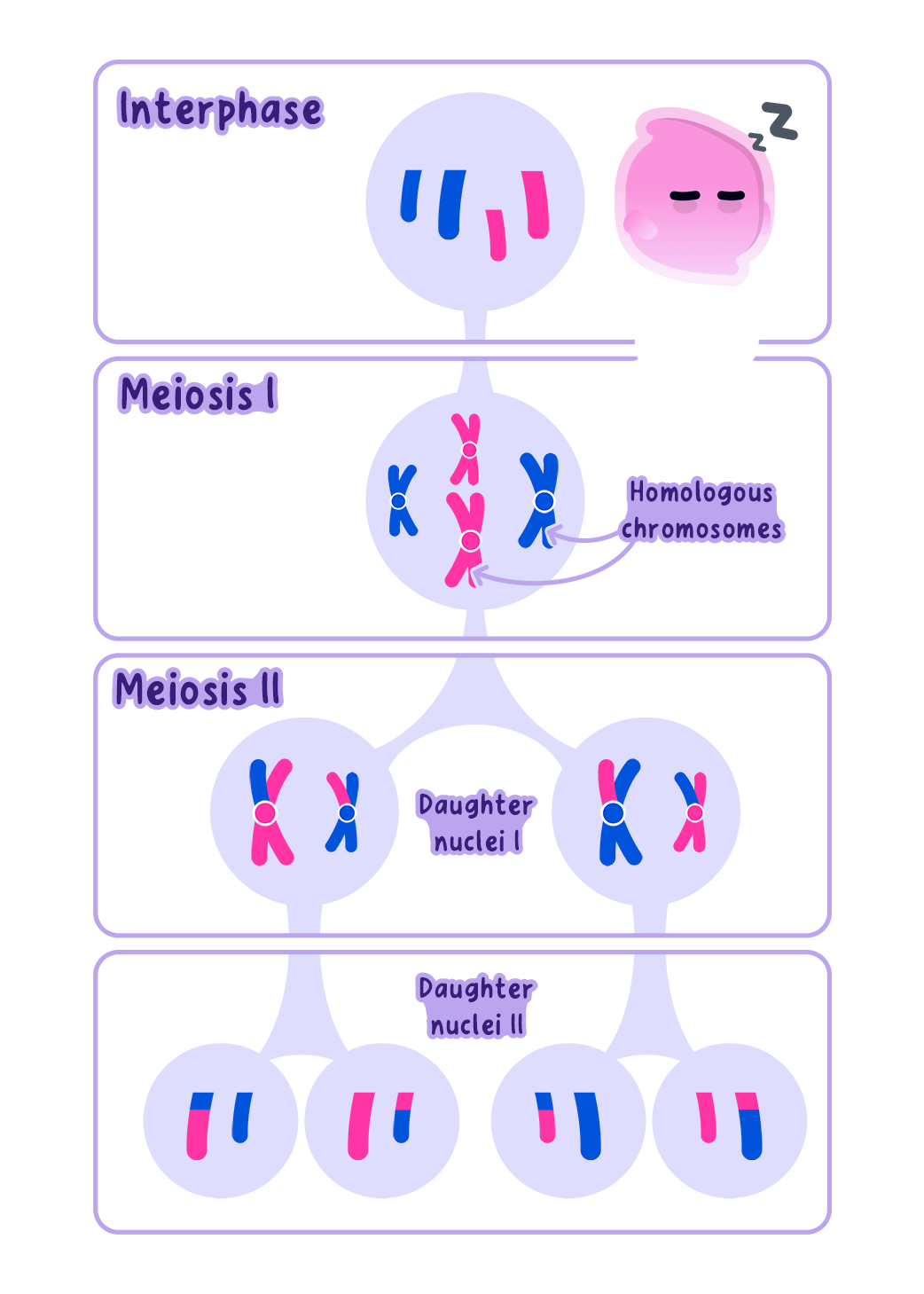
Both divisions run through the same four stages in the same order, so only the Roman numeral changes: prophase, metaphase, anaphase, telophase.
How meiosis creates variation
- Crossing over happens in prophase I, when the chromatids of a homologous pair lie against each other and swap matching sections of DNA.
- The point at which they join and exchange material is called a chiasma, and every chromatid that leaves it carries a new combination of alleles.
- Independent assortment happens at metaphase I, because the way one pair lines up at the equator has no effect on the way any other pair lines up.
- Either chromosome of a pair can end up facing either pole, so each pair contributes one of two possible outcomes to the gamete.
- For nnn homologous pairs the number of possible chromosome combinations in a gamete is 2n2^{n}2n.
- With n=23n = 23n=23 in humans this gives 223=8 388 6082^{23} = 8\,388\,608223=8388608 combinations from independent assortment alone, before crossing over is counted.
- Random fertilisation adds a further step, because any one of those sperm cells can fuse with any one of those egg cells.
- The four gametes produced by one meiosis are therefore genetically different from one another, and offspring differ from their parents and from each other.
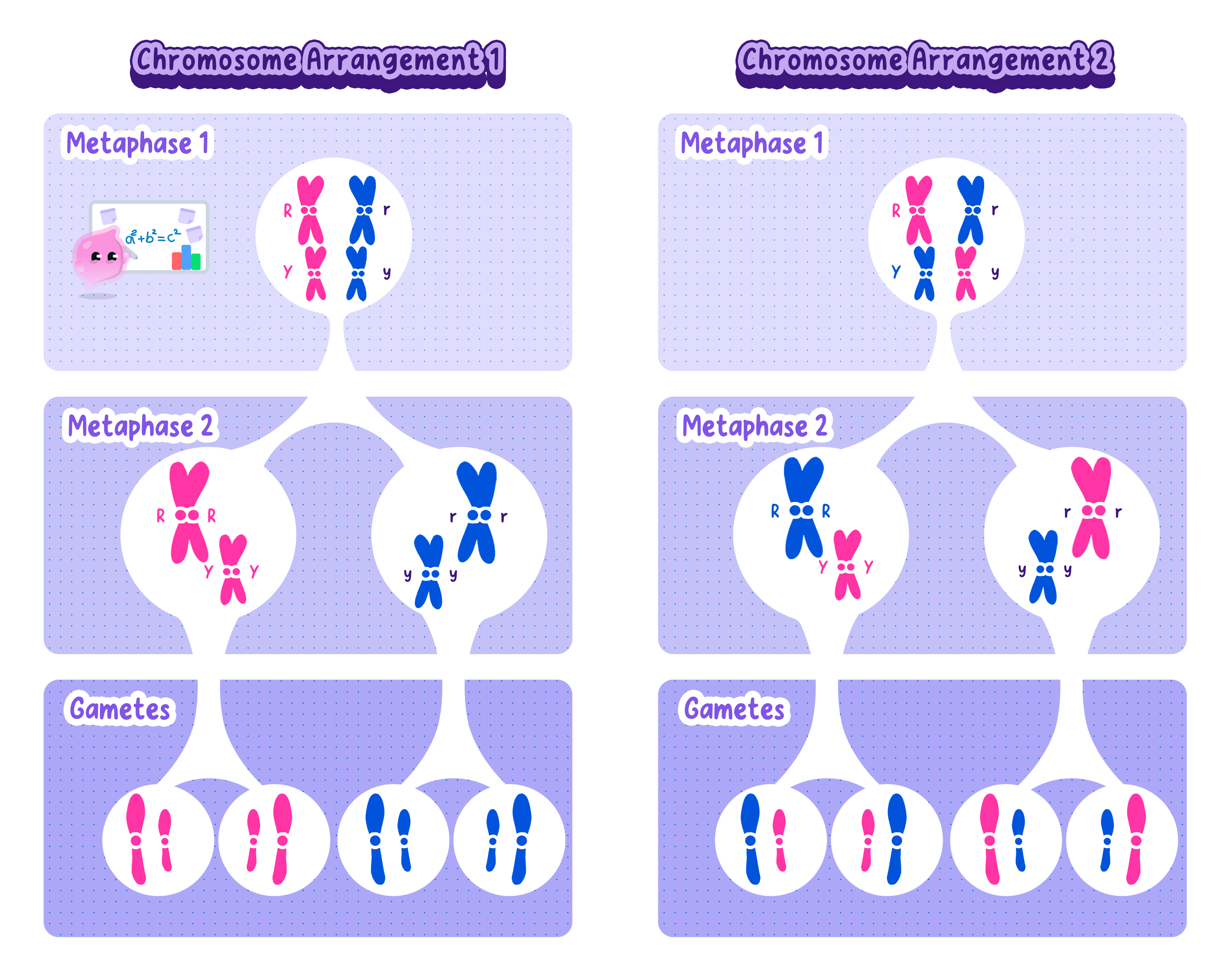
- A parent cell holds two homologous pairs, one pair carrying the alleles RRR and rrr and the other carrying YYY and yyy.
- At metaphase I the pairs can line up so that RRR faces the same pole as YYY, which sends RYRYRY into one gamete and ryryry into the other.
- They can equally line up so that RRR faces the same pole as yyy, which sends RyRyRy into one gamete and rYrYrY into the other.
- Four different gamete types are therefore possible from one parent cell, matching 2n2^{n}2n with n=2n = 2n=2 pairs, so 22=42^{2} = 422=4.
- A question asking how meiosis produces genetic variation is looking for a named process placed at a named stage.
- Name crossing over and put it in prophase I, then say that sections of DNA are exchanged between the chromatids of a homologous pair.
- Name independent assortment and put it at metaphase I, then say that each pair lines up at random with respect to the others.
- Finish with the outcome, that the four gametes are genetically different from one another.
Meiosis compared with mitosis
Mitosis
Mitosis is the stage of the cell cycle in which the nucleus divides to produce two nuclei with identical sets of chromosomes.
- Mitosis produces two daughter cells, whereas meiosis produces four.
- Mitosis keeps the chromosome number at 2n2n2n, whereas meiosis reduces it to nnn.
- Mitosis involves a single division, whereas meiosis involves two divisions one straight after the other.
- The cells made by mitosis are genetically identical to the parent cell, whereas the cells made by meiosis are all genetically different.
- Mitosis occurs throughout the body for growth, repair and asexual reproduction, whereas meiosis occurs only in the reproductive organs.
- Neither crossing over nor independent assortment occurs in mitosis, which is why mitosis produces no genetic variation.
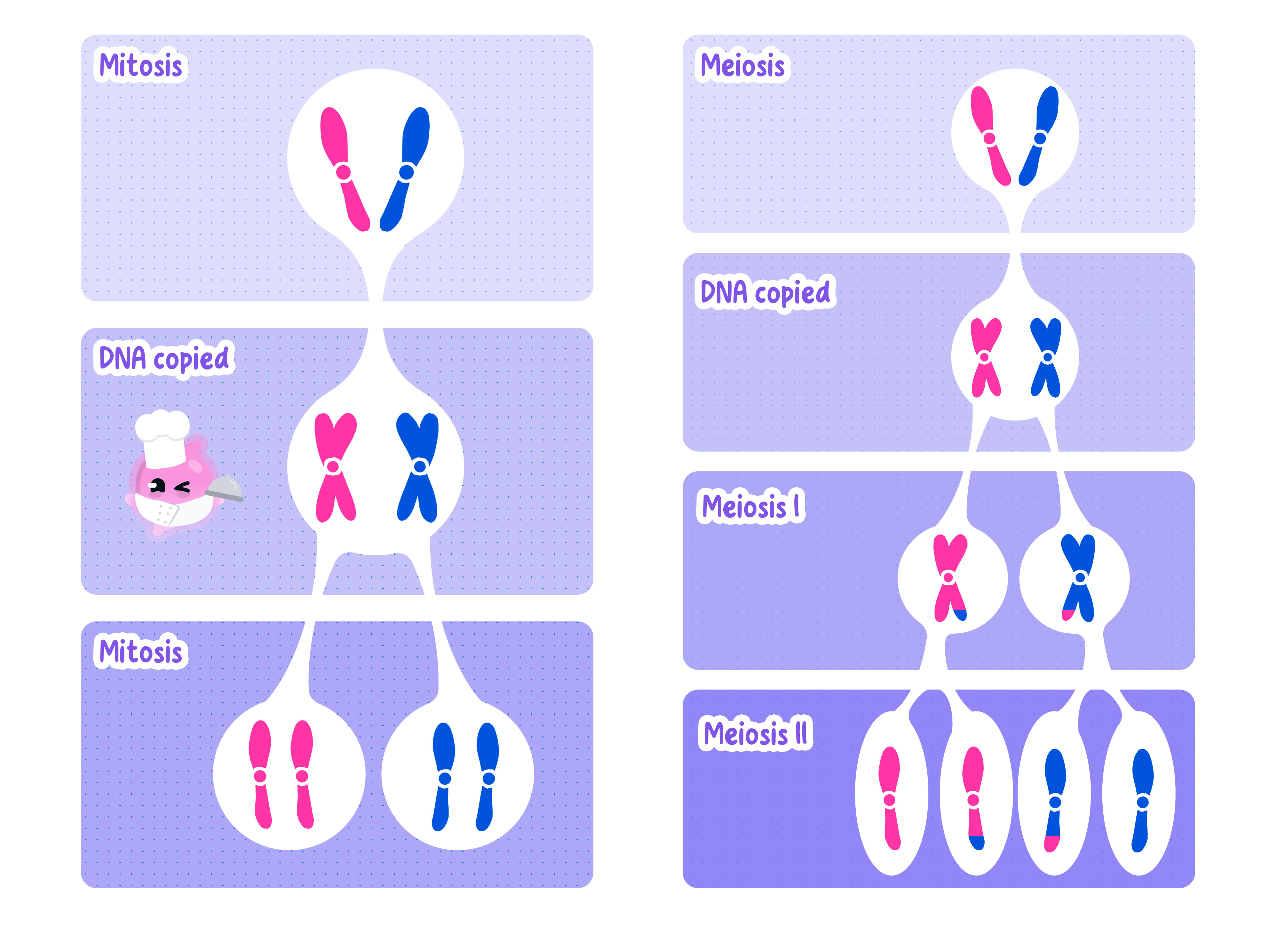
Do not write that meiosis gives two cells or that mitosis gives gametes. The number of daughter cells and the type of cell produced are the two details mixed up most often.
- Where in the human body does meiosis take place?
- How many daughter cells does one meiosis produce, and how many chromosomes does each one carry?
- Explain why gametes must be haploid rather than diploid.
- Name the two processes in meiosis I that produce genetic variation, and state the stage at which each occurs.
- Give three differences between mitosis and meiosis.
5.1.8 Single gene inheritance
Genes and alleles
Gene
A gene is a section of DNA that contains the instructions for making a particular protein.
Allele
An allele is an alternative version of a gene.
- A gene is a section of DNA carrying the instructions for one protein, and it sits at a fixed position on a chromosome called its locus.
- Because chromosomes come in homologous pairs, a body cell carries two copies of every gene, one on each chromosome of the pair.
- The two copies may be the same version or two different versions, and each version is called an allele.
- New alleles arise when a mutation changes the base sequence of a gene, which changes the instruction and often changes the protein made from it.
- A gene may have many alleles across a whole population, but any one diploid individual carries only two of them.
- Alleles are written as letters, and both alleles of the same gene are written with the same letter, for example TTT and ttt.
Gene and allele are not interchangeable words: the gene is the instruction for a characteristic, and an allele is one particular version of that instruction.
Dominant and recessive alleles
Dominant allele
A dominant allele determines the phenotype when present in a heterozygous genotype.
Recessive allele
A recessive allele determines the phenotype only when no dominant allele of the same gene is present.
- A dominant allele determines the phenotype whenever it is present, so one copy is enough for its effect to show.
- A recessive allele determines the phenotype only when no dominant allele of that gene is present, so two copies are needed.
- Dominant alleles are written as capital letters and recessive alleles as the matching lower case letter, so TTT and ttt are two alleles of one gene.
- Writing TTT alongside sss would suggest two separate genes rather than two versions of the same gene, so the letters must always match.
- When a dominant and a recessive allele are present together, the protein coded by the dominant allele is enough to produce the dominant characteristic.
- A recessive characteristic can therefore disappear for a generation and reappear later, whenever two recessive alleles meet in the same individual.
- In pea plants the allele TTT codes for a tall stem and the allele ttt codes for a short stem.
- A plant with the alleles TTT and ttt makes enough of the protein coded by TTT to grow tall, so it has a tall stem.
- Only a plant with the alleles ttt and ttt grows short, because it has no dominant allele at all.
Genotype and phenotype
Genotype
The genotype is the combination of alleles carried by an organism.
Phenotype
The phenotype is the observable or measurable characteristics of an organism produced by its genotype and its interaction with the environment.
- The genotype is the pair of alleles an individual carries for a gene, written as two letters such as TTTTTT, TtTtTt or tttttt.
- The phenotype is the characteristic that can be seen or measured, such as a tall stem or a short stem.
- The genotype decides which proteins the cell can make, and those proteins, together with the conditions the organism grows in, produce the phenotype.
- Two individuals with different genotypes can share one phenotype, because TTTTTT and TtTtTt both give a tall stem.
- The recessive phenotype has only one possible genotype, because a short stem can only come from tttttt.
Do not answer with a phenotype when a question asks for a genotype. A genotype is always written as two allele letters and a phenotype is always described in words.
Homozygous and heterozygous
Homozygous
Homozygous describes a genotype containing two identical alleles of a particular gene.
Heterozygous
Heterozygous describes a genotype containing two different alleles of a particular gene.
Carrier
A carrier is a heterozygous individual that carries one recessive allele but does not show the recessive characteristic.
- An individual is homozygous for a gene when its two alleles are identical, written TTTTTT for homozygous dominant and tttttt for homozygous recessive.
- An individual is heterozygous when its two alleles are different, written TtTtTt.
- A homozygous individual can pass on only one kind of allele, so it is described as pure-breeding for that characteristic.
- A heterozygous individual can pass on either of its two alleles, so its offspring are not all alike.
- A heterozygous individual that shows the dominant characteristic while carrying a recessive allele is a carrier of that allele.
- A carrier passes the recessive allele on unseen, which is how a recessive characteristic can appear in offspring whose parents do not show it.
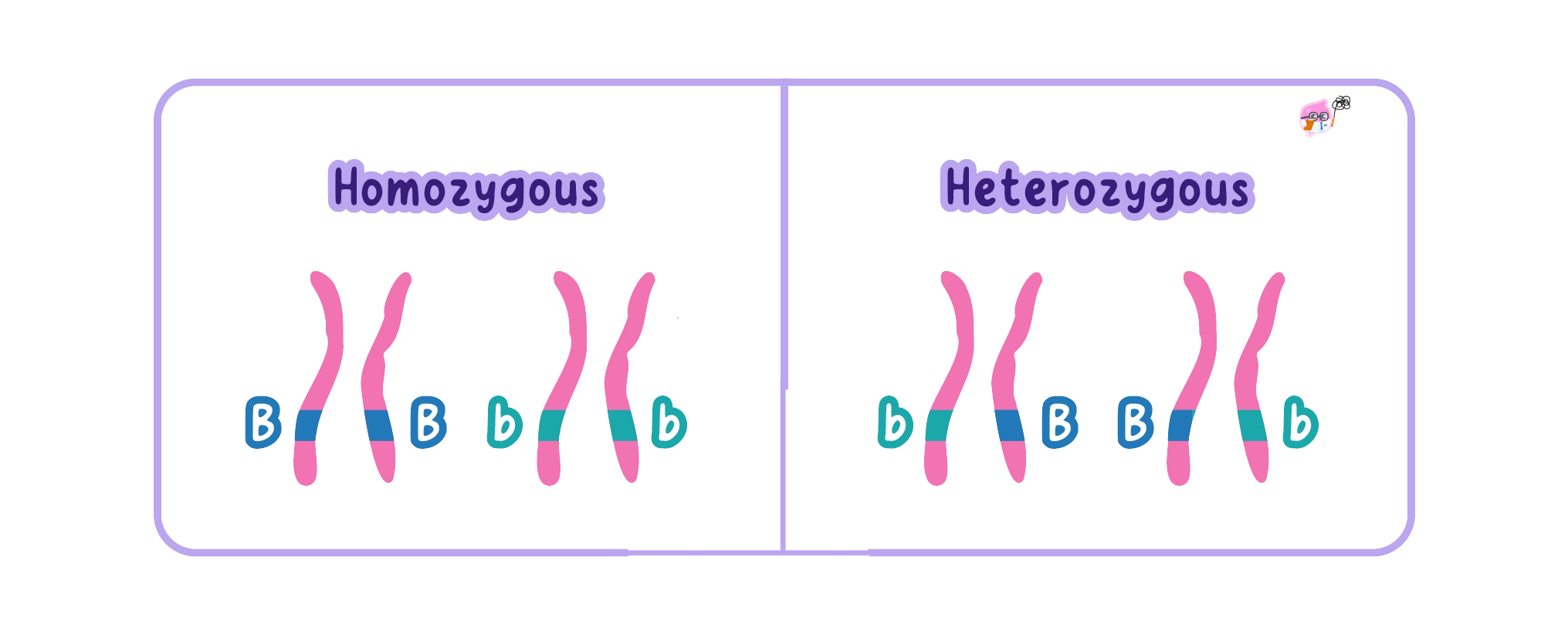
The prefixes carry the meaning: homo- means the same, so a homozygote has two identical alleles, and hetero- means different, so a heterozygote has two different alleles.
A tall plant is not automatically pure-breeding. Its genotype could be TTTTTT or TtTtTt, and nothing about its appearance separates the two.
How alleles pass to offspring
Monohybrid cross
A monohybrid cross is a genetic cross that follows the inheritance of a single gene from two parents to their offspring.
- Meiosis separates the two alleles of a gene, because the homologous chromosomes carrying them are pulled into different gametes.
- Every gamete therefore carries one allele of the gene and never both.
- A homozygous TTTTTT parent makes only TTT gametes, and a homozygous tttttt parent makes only ttt gametes.
- A heterozygous TtTtTt parent makes TTT gametes and ttt gametes in equal numbers.
- At fertilisation one allele carried by the male gamete joins one allele carried by the female gamete, which rebuilds the pair in the zygote.
- A cross that follows one gene through this route is a monohybrid cross, and it is set out as a genetic diagram.
- A genetic diagram is written in a fixed order, and every line of it earns credit.
- Line 1: the phenotypes of the two parents, described in words.
- Line 2: the genotypes of the two parents, written as pairs of allele letters.
- Line 3: the gametes each parent can make, written as single alleles.
- Line 4: the offspring genotypes produced by combining those gametes.
- Line 5: the offspring phenotypes that follow from those genotypes.
Gametes are normally drawn inside circles in a genetic diagram, which makes clear that each one holds a single allele rather than a whole genotype.
Crosses between the genotypes
- A cross between two homozygous parents, TT×ttTT \times ttTT×tt, gives every offspring the genotype TtTtTt, so all of them show the dominant characteristic.
- A cross between two heterozygous parents, Tt×TtTt \times TtTt×Tt, gives offspring of genotype TTTTTT, TtTtTt, TtTtTt and tttttt.
- Three of those four offspring carry at least one TTT and show the dominant characteristic, while the fourth is tttttt and shows the recessive characteristic.
- A cross between a heterozygote and a homozygous recessive parent, Tt×ttTt \times ttTt×tt, gives offspring of genotype TtTtTt, TtTtTt, tttttt and tttttt.
- Half of those offspring show the dominant characteristic and half show the recessive characteristic.
- Any cross involving a homozygous dominant parent, such as TT×TtTT \times TtTT×Tt, gives no recessive offspring at all, because every offspring receives at least one TTT.
- The recessive characteristic appears only in an offspring that receives a recessive allele from both parents at once.
- Two pea plants of genotype TtTtTt are crossed, where TTT codes for a tall stem and ttt codes for a short stem.
- Both parents are tall, because each carries one dominant allele.
- Each parent makes two kinds of gamete in equal numbers, TTT and ttt.
- Combining the gametes gives the offspring genotypes TTTTTT, TtTtTt, TtTtTt and tttttt.
- The offspring phenotypes are tall, tall, tall and short, so two tall parents can produce a short plant whenever both pass on ttt.
- Say what each allele letter stands for before using it, because an unexplained letter cannot be credited.
- Lay the genetic diagram out in the same order every time, since the gamete line carries marks of its own.
- Write gametes as single alleles, never as pairs, because a gamete carrying TtTtTt would be diploid.
- Keep the same letters from the parent line to the offspring line, as switching from TTT to LLL partway through breaks the link between them.
- What is the difference between a gene and an allele?
- How many alleles of one gene does a gamete carry, and why?
- Write the three possible genotypes for a gene with alleles TTT and ttt, and give the phenotype of each.
- Explain what a carrier is and how a carrier can have offspring showing a recessive characteristic.
- Which offspring genotypes come from the cross Tt×ttTt \times ttTt×tt?
5.1.9 Predicting single gene crosses
Building a Punnett square
Punnett square
A Punnett square is a grid that combines the alleles carried by the gametes of two parents to show every possible genotype of their offspring.
Monohybrid cross
A monohybrid cross is a genetic cross that follows the inheritance of a single gene from two parents to their offspring.
- A Punnett square is a grid that combines the gametes of two parents so that every possible offspring genotype appears in the table.
- The grid is built in the same six steps every time.
- Write the genotype of each parent, for example BbBbBb for the father and BbBbBb for the mother.
- Work out the gametes each parent can make, writing single alleles only, so a BbBbBb parent makes BBB and bbb.
- Draw a 2×22 \times 22×2 grid, place one parent's gametes above the two columns and the other parent's gametes beside the two rows.
- Fill each box by combining the allele at the head of its column with the allele at the start of its row.
- Write the dominant allele first inside each box, so a box holding bbb and BBB is written BbBbBb.
- Read off the phenotype of each box, remembering that one dominant allele is enough to give the dominant characteristic.
- Two gamete types from each parent give 2×2=42 \times 2 = 42×2=4 boxes, and each box is one equally likely outcome of fertilisation.
- A parent that is homozygous makes only one kind of gamete, so its allele is simply repeated along its side of the grid.
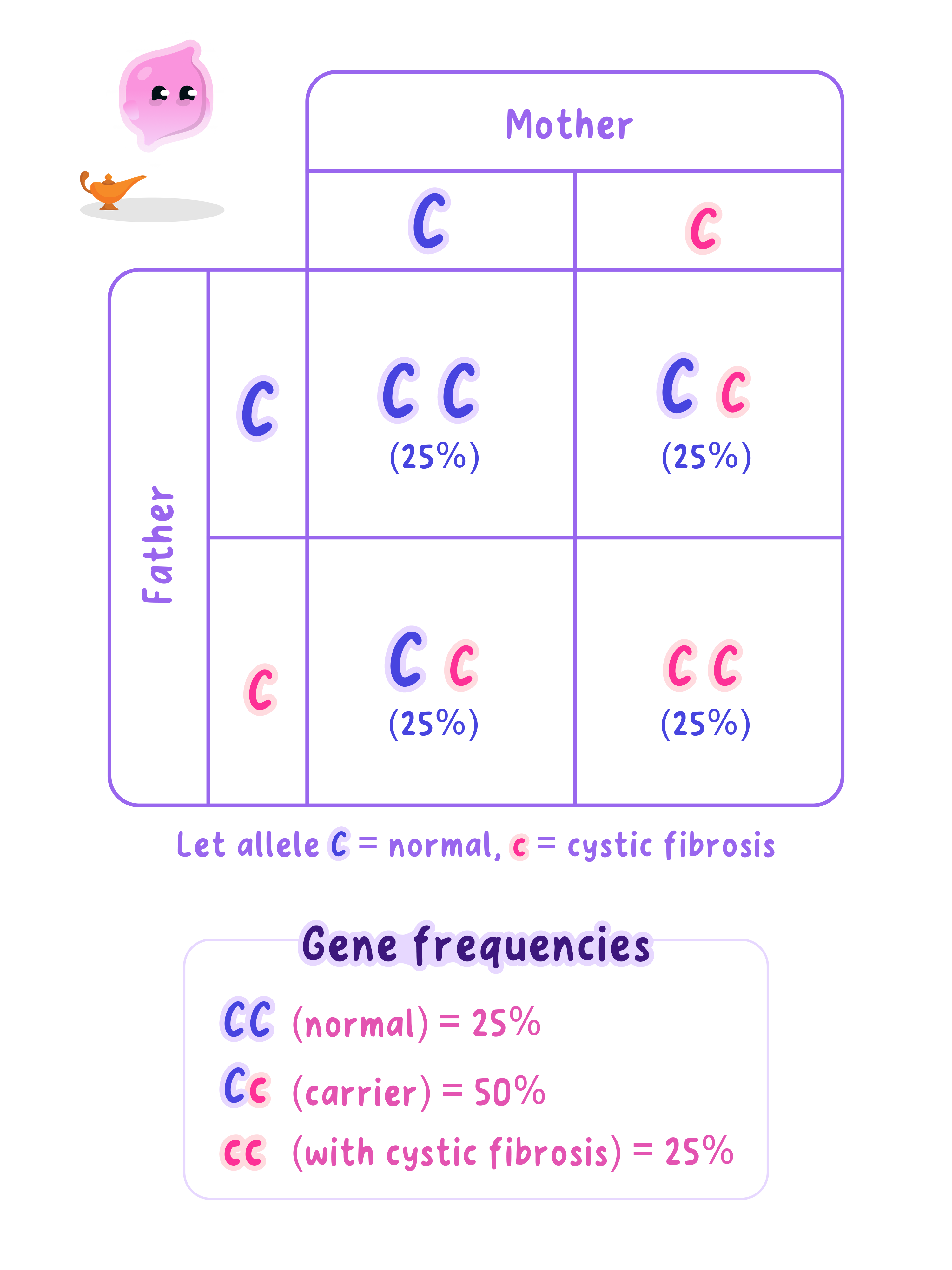
Put single alleles on the edges of the grid and never whole genotypes, because a gamete carries one allele of the gene and not both.
Do not read the four boxes as four children. Each box is one possible outcome, and the same four outcomes apply afresh to every offspring.
Reading ratios from the grid
- The genotype ratio counts the boxes by genotype, so Bb×BbBb \times BbBb×Bb gives 1 BB:2 Bb:1 bb1\,BB : 2\,Bb : 1\,bb1BB:2Bb:1bb.
- The phenotype ratio counts the boxes by appearance, so the same cross gives 3:13 : 13:1 dominant to recessive.
- The cross Bb×bbBb \times bbBb×bb gives BbBbBb, BbBbBb, bbbbbb and bbbbbb, which is 1:11:11:1 by genotype and 1:11:11:1 by phenotype.
- The cross BB×bbBB \times bbBB×bb fills all four boxes with BbBbBb, so every offspring shows the dominant characteristic.
- The cross BB×BbBB \times BbBB×Bb gives BBBBBB, BBBBBB, BbBbBb and BbBbBb, which is 1:11:11:1 by genotype but gives no recessive offspring at all.
- A ratio is converted to a fraction using fraction=parts of interesttotal parts\text{fraction} = \dfrac{\text{parts of interest}}{\text{total parts}}fraction=total partsparts of interest.
- A ratio of 3:13:13:1 therefore means 333 parts out of 444, which is 34\frac{3}{4}43, and 34×100=75%\frac{3}{4} \times 100 = 75\%43×100=75%.
- A ratio of 1:11:11:1 means 111 part out of 222, which is 12\frac{1}{2}21 and therefore 50%50\%50%.
- A ratio is simplified by dividing both parts by their highest common factor, so 27:927:927:9 becomes 3:13:13:1.
- A brown eyed father of genotype BbBbBb and a brown eyed mother of genotype BbBbBb have children, where BBB codes for brown eyes and bbb codes for blue eyes.
- Each parent makes BBB gametes and bbb gametes in equal numbers.
- Filling the grid gives the offspring genotypes BBBBBB, BbBbBb, BbBbBb and bbbbbb.
- Three of the four boxes hold at least one BBB, so the phenotype ratio is 333 brown to 111 blue.
- Written the other two ways, that is 34\frac{3}{4}43 brown and 14\frac{1}{4}41 blue, or 75%75\%75% brown and 25%25\%25% blue.
Do not give a genotype ratio when the question asks for a phenotype ratio. The cross Bb×BbBb \times BbBb×Bb is 1:2:11:2:11:2:1 by genotype and 3:13:13:1 by appearance, and only one of those answers fits each question.
Probability for one offspring
- Each box of a completed grid is one equally likely outcome, so a single box carries a probability of 14\frac{1}{4}41.
- The probability of any genotype is the number of boxes showing it divided by the total number of boxes.
- From Bb×BbBb \times BbBb×Bb the probability of bbbbbb is 14\frac{1}{4}41, of BbBbBb is 24=12\frac{2}{4} = \frac{1}{2}42=21 and of BBBBBB is 14\frac{1}{4}41.
- The probability of the dominant phenotype from that cross is 34\frac{3}{4}43, which is 0.750.750.75 as a decimal and 75%75\%75% as a percentage.
- Every probability lies between 000 and 111, and the probabilities of all possible outcomes of a cross add up to 111.
- Each fertilisation is an independent event, so the outcome of one offspring has no effect on the next.
- Parents who already have three children showing the dominant characteristic still face a probability of 14\frac{1}{4}41 that the fourth shows the recessive one.
A probability can be written as a fraction, a decimal or a percentage, and a question will usually name the form the answer should take.
Expected and observed numbers
- The expected number of offspring of one type is found from expected number=probability×total number of offspring\text{expected number} = \text{probability} \times \text{total number of offspring}expected number=probability×total number of offspring.
- From Bb×BbBb \times BbBb×Bb with 404040 offspring, the expected number showing the recessive characteristic is 14×40=10\frac{1}{4} \times 40 = 1041×40=10.
- The expected number showing the dominant characteristic is 34×40=30\frac{3}{4} \times 40 = 3043×40=30.
- Observed numbers rarely match expected numbers exactly, because which gamete fuses with which is a matter of chance.
- The more offspring are counted, the closer the observed proportions usually come to the expected ones.
- Observed results close to the expected ratio support the genotypes proposed for the parents.
- Observed results a long way from the expected ratio suggest that one of the parent genotypes was wrong, or that too few offspring were counted.
Modelling a monohybrid cross with beads
- Aim: to model the cross Bb×BbBb \times BbBb×Bb using beads drawn at random, and to compare the offspring ratio actually obtained with the 3:13:13:1 ratio predicted by a Punnett square.
- Apparatus: two opaque containers such as beakers covered with card, 505050 red beads, 505050 white beads, a marker pen, a tally chart on paper, a pencil and a calculator.
- Method:
- Label one container as the male parent and the other as the female parent, since each container will supply one gamete for every offspring.
- Place 252525 red beads, standing for the allele BBB, and 252525 white beads, standing for the allele bbb, into each container.
- Check that both containers hold equal numbers of the two colours, because a heterozygous parent makes its two gamete types in equal numbers.
- Shake each container for several seconds so the beads are thoroughly mixed and no colour is left sitting on top.
- Look away from the containers and draw one bead from each with the other hand, so that neither draw is influenced by what can be seen.
- Record the pair as a genotype with the dominant allele written first, so one red bead and one white bead is recorded as BbBbBb.
- Return each bead to the container it came from and shake again before the next draw, because taking beads out would change the proportion of alleles left behind.
- Repeat the draw until 100100100 offspring have been recorded, tallying in groups of five so the totals can be counted quickly.
- Add up the tallies to give the observed numbers of BBBBBB, BbBbBb and bbbbbb, then group BBBBBB and BbBbBb together as the dominant phenotype.
- Results: a typical run gives roughly 252525 BBBBBB, 505050 BbBbBb and 252525 bbbbbb, which is about 757575 offspring with the dominant phenotype and 252525 with the recessive one.
- Maths: the expected numbers are 34×100=75\frac{3}{4} \times 100 = 7543×100=75 dominant and 14×100=25\frac{1}{4} \times 100 = 2541×100=25 recessive, and dividing the observed 75:2575:2575:25 by 252525 simplifies it to 3:13:13:1.
- Watch out: failing to replace the beads changes the allele proportions and drags the ratio away from 3:13:13:1, glancing into the container makes the draw non-random, and stopping after only 202020 draws can give a ratio as far out as 2:12:12:1 purely by chance.
- Safety: the hazard is low, but keep spilled beads off the floor because they are a slipping hazard, and never put beads near the mouth.
- What goes along the two edges of a Punnett square, and why?
- Give the genotype ratio and the phenotype ratio produced by the cross Bb×BbBb \times BbBb×Bb.
- What is the probability that a single offspring of the cross Bb×bbBb \times bbBb×bb shows the recessive characteristic?
- Calculate the expected number of recessive offspring when 606060 offspring come from the cross Bb×BbBb \times BbBb×Bb.
- Explain why observed offspring numbers do not always match the expected ratio.
5.1.10 Sex determination
The sex chromosomes
Sex chromosomes
The sex chromosomes are the pair of chromosomes that determine the sex of an individual, which in humans are XX in a female and XY in a male.
- A human body cell holds 232323 pairs of chromosomes, and 222222 of those pairs are autosomes, which look the same in both sexes.
- The twenty third pair is the pair of sex chromosomes, and this pair decides whether an individual develops as female or male.
- A female has two X chromosomes, written XXXXXX, so this pair is fully matched like any other pair.
- A male has one X chromosome and one Y chromosome, written XYXYXY, and the Y is much shorter than the X.
- The Y chromosome carries a gene that switches on the development of testes in the early embryo.
- An embryo with no Y chromosome has no copy of that gene, so it develops ovaries instead.
- The X chromosome also carries many genes with nothing to do with sex, so every individual needs at least one copy of it.
The X chromosome is far larger than the Y and carries many more genes, so the two members of this pair are not matched in the way an autosomal pair is.
Gametes and a child's sex
Gamete
A gamete is a haploid reproductive cell whose nucleus can fuse with another gamete nucleus during fertilisation.
- Meiosis separates the two sex chromosomes, so every gamete receives exactly one of them.
- A female is XXXXXX, so every egg cell she makes carries an X chromosome.
- A male is XYXYXY, so half the sperm cells he makes carry an X chromosome and half carry a Y chromosome.
- The egg cell always supplies an X, so the sex of the child depends entirely on which kind of sperm reaches it first.
- An X sperm fusing with the egg gives a zygote of genotype XXXXXX, which develops as a female.
- A Y sperm fusing with the egg gives a zygote of genotype XYXYXY, which develops as a male.
- Equal numbers of X sperm and Y sperm are made, which is why the two outcomes are equally likely.
The mother does not decide the sex of the child. Every egg cell carries an X, so it is the sperm cell that brings either the X or the Y that settles it.
The genetic cross for sex
Punnett square
A Punnett square is a grid that combines the alleles carried by the gametes of two parents to show every possible genotype of their offspring.
- Sex determination is set out as a genetic cross in exactly the same way as any other single gene cross.
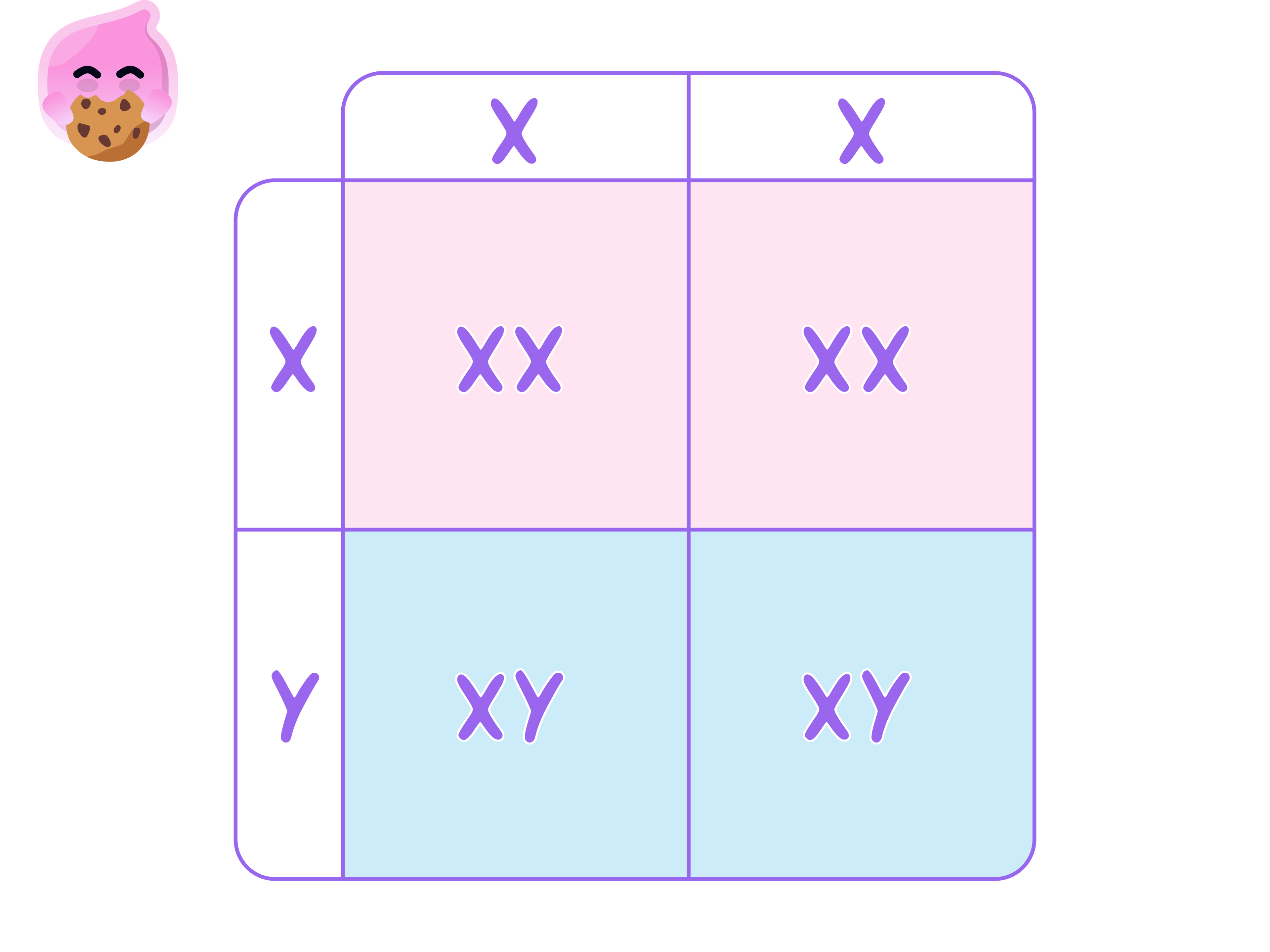
- Parent genotypes: the mother is XXXXXX and the father is XYXYXY.
- Gametes: the mother produces XXX and XXX, while the father produces XXX and YYY.
- Grid: the mother's gametes go along the top of a 2×22 \times 22×2 Punnett square and the father's gametes go down the side.
- Offspring genotypes: the four boxes give XXXXXX, XXXXXX, XYXYXY and XYXYXY.
- Offspring phenotypes: two female and two male.
- The phenotype ratio is therefore 1:11:11:1 female to male.
- The probability that any one child is male is 24=12\frac{2}{4} = \frac{1}{2}42=21, which is 50%50\%50%.
- That prediction applies afresh to every pregnancy, because each fertilisation is an independent event.
- Birth records show slightly more boys than girls born each year, which is close to but not exactly the predicted 1:11:11:1.
- A couple who already have three daughters are expecting a fourth child.
- The cross is still XX×XYXX \times XYXX×XY, because the genotypes of the parents have not changed.
- The completed grid still gives XXXXXX, XXXXXX, XYXYXY and XYXYXY, so two of the four outcomes are male.
- The probability that the fourth child is a boy is 24=12\frac{2}{4} = \frac{1}{2}42=21, or 50%50\%50%.
- The three daughters make no difference to that figure, because the sperm that fertilises each egg is selected independently of every earlier fertilisation.
- Label the chromosomes as XXX and YYY in the genetic diagram rather than as male and female, because the credit is for the chromosomes.
- Show the gamete line, since a mark is often given for two kinds of sperm alongside one kind of egg.
- Give the answer in the form asked for, whether that is a ratio of 1:11:11:1, a probability of 12\frac{1}{2}21 or a percentage of 50%50\%50%.
- Say that each fertilisation is independent whenever a question mentions the children a family already has.
- Which sex chromosomes does a human female have, and which does a human male have?
- Which sex chromosome does every egg cell carry?
- Explain why the sperm cell determines the sex of a child.
- Give the four offspring genotypes produced by the cross XX×XYXX \times XYXX×XY.
- What is the probability that a couple's next child is a girl, and why does it not change with each pregnancy?
5.1.11 Multiple gene inheritance
Most features involve many genes
Polygenic inheritance
Polygenic inheritance is the control of one characteristic by several genes, each contributing part of the phenotype.
- Single gene inheritance, with two clear alleles and a predictable ratio, is the exception among characteristics rather than the rule.
- Polygenic inheritance means that one characteristic is controlled by several genes, which are often carried on different chromosomes.
- Each of those genes has its own alleles, and each one contributes a small part of the finished characteristic.
- The small contributions add together, so an individual carrying more of the alleles that increase the characteristic ends up further along the range.
- Human height, body mass, skin colour and eye colour are all controlled in this way.
- Skin colour depends on several genes that between them control how much melanin the skin cells produce.
- Eye colour was once taught as a single gene with brown dominant over blue, but several genes are now known to contribute to it.
- The link runs the other way as well, because one gene can affect more than one characteristic at the same time.
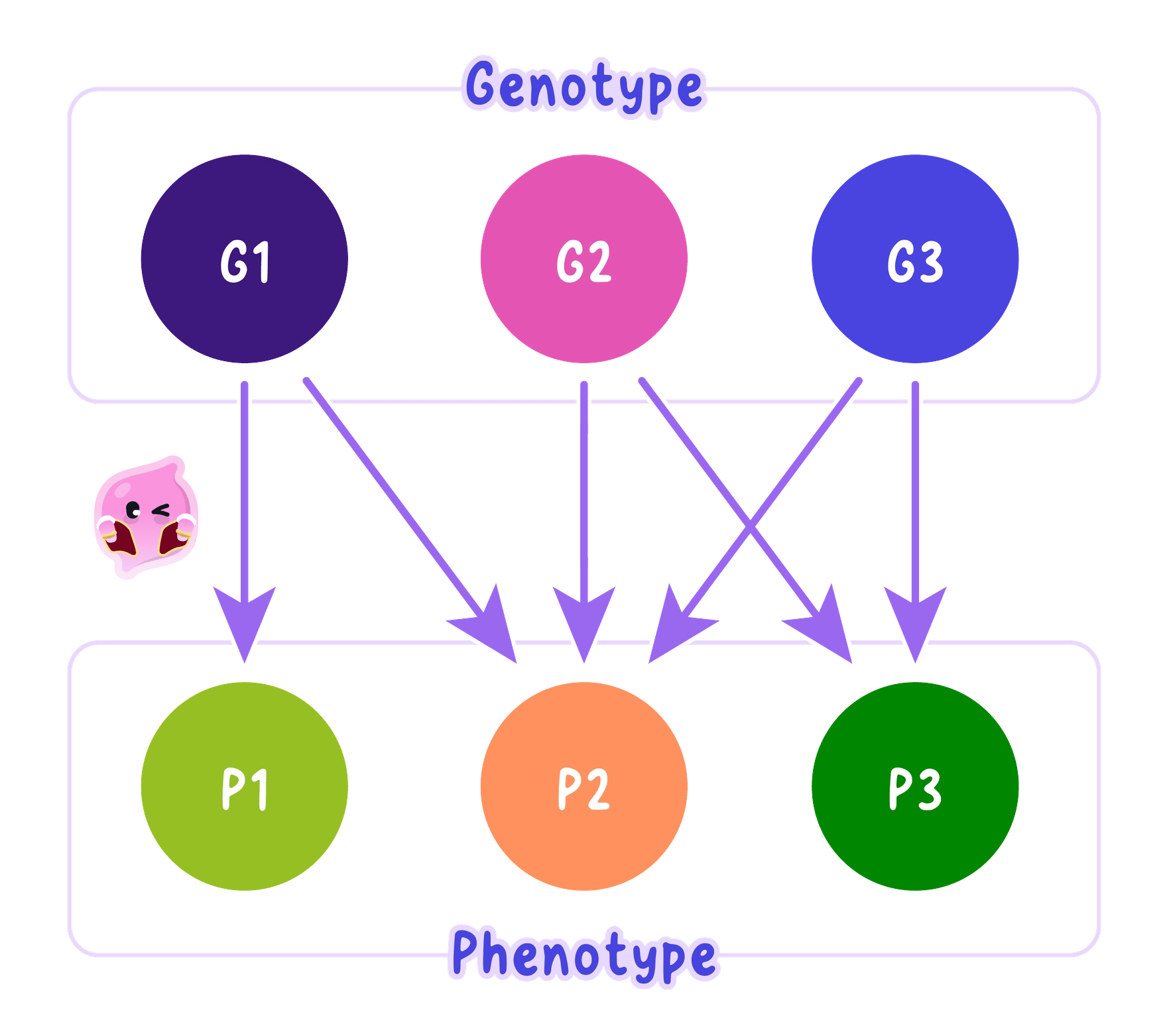
One gene affecting several characteristics and several genes affecting one characteristic are both common, which is why a single gene rarely maps neatly onto a single feature.
Why the range is continuous
Continuous variation
Continuous variation is variation in a characteristic across a range with intermediate values and no distinct categories.
Discontinuous variation
Discontinuous variation is variation in which a characteristic falls into distinct categories without intermediate values.
- A characteristic controlled by one gene with two alleles has only a few possible outcomes, so individuals fall into separate groups with nothing in between.
- That pattern is discontinuous variation, and the data are displayed as a bar chart with a gap between each bar.
- A characteristic controlled by many genes has a very large number of possible allele combinations.
- For nnn genes each having two alleles, the number of possible genotypes is 3n3^{n}3n, so even five genes give 35=2433^{5} = 24335=243 different genotypes.
- Those many combinations produce values that overlap and run smoothly from one extreme to the other with no gaps.
- That pattern is continuous variation, and the data are displayed as a histogram whose bars touch.
- The histogram of a polygenic characteristic usually forms a bell shaped curve, with most individuals near the middle and few at either extreme.
- The environment widens the range still further, because factors such as diet and sunlight change the value an individual actually reaches.
- Human height shows both effects at once, since many genes set the potential height and nutrition during childhood decides how much of it is reached.
Do not treat a continuous characteristic such as height as though it had one tall allele and one short allele. Many genes contribute to it, so there is no single pair of alleles to write down.
Working with polygenic features
- A Punnett square cannot be drawn for a polygenic characteristic, because each parent produces far more gamete types than a 2×22 \times 22×2 grid can hold.
- Polygenic characteristics are therefore studied by measuring and plotting distributions rather than by predicting ratios.
- Data are collected by measuring a large sample, grouping the values into equal classes and plotting the frequency of each class.
- A large sample matters, because a small one leaves gaps that make continuous variation look discontinuous.
- Offspring of a polygenic characteristic tend to fall somewhere between their two parents rather than matching either one exactly.
- Two tall parents usually have tall children, but no genetic diagram can predict the exact height of any one child.
- A characteristic that clearly runs in families yet never gives clean 3:13:13:1 or 1:11:11:1 ratios is a strong sign that several genes are involved.
- The heights of 303030 students are measured to the nearest centimetre and grouped into classes 5 cm5\ \text{cm}5 cm wide.
- The tallest student is 184 cm184\ \text{cm}184 cm and the shortest is 152 cm152\ \text{cm}152 cm, so the range is 184−152=32 cm184 - 152 = 32\ \text{cm}184−152=32 cm.
- Every class between those two values contains at least one student, so the distribution has no empty gaps.
- The largest numbers fall in the middle classes and the smallest numbers at the two ends, giving the bell shaped pattern expected of a polygenic characteristic.
- Repeating the measurements on 300300300 students instead of 303030 smooths the curve further, because more values fill each class.
- Decide first whether the characteristic falls into distinct groups or runs across a range, because that decision sets the type of chart required.
- Draw a bar chart with gaps between the bars for discontinuous data, and a histogram with touching bars for continuous data.
- Write that several genes contribute rather than simply that the characteristic is controlled by genes, because the number of genes is the point being tested.
- Add the environment as a second cause whenever the characteristic is one such as height or body mass.
- What is polygenic inheritance?
- Name three human characteristics that are controlled by several genes.
- Explain why a polygenic characteristic produces a continuous range of values.
- Which type of chart is used for continuous data, and which for discontinuous data?
- Explain why a Punnett square cannot be used to predict a child's height.
5.1.12 Development of our understanding of genetics
Mendel and his pea plants
- Gregor Mendel was a monk who studied inheritance in the garden of his monastery at Brno during the 185018501850s and 186018601860s.
- He chose the garden pea because it grows quickly, produces large numbers of offspring and shows characteristics that fall into two clear forms.
- He followed seven characteristics, among them stem height, flower colour, seed shape and pod colour.
- He began with pure-breeding lines, checking over several generations that each line always produced offspring like itself.
- He controlled pollination by hand, and the method mattered as much as the counting.
- The anthers were cut out of a flower before its own pollen ripened, so the plant could not pollinate itself.
- Pollen from a chosen plant was then brushed onto the stigma of that flower with a fine brush.
- The treated flower was covered with a small bag so that no stray pollen from other plants could reach it.
- Every cross therefore had a known male parent and a known female parent, which is what made the results interpretable.
- He counted every offspring rather than judging by eye, working with thousands of plants so that chance had little effect on the proportions he found.
Counting large numbers is what separated Mendel's work from the breeding studies before it, because small samples had given results too irregular for any pattern to show.
What the crosses showed
- Crossing a pure-breeding tall plant with a pure-breeding short plant gave a first generation in which every plant was tall.
- The short form had not been lost, because crossing those tall offspring with one another brought short plants back in the following generation.
- In that second generation the plants appeared in a ratio close to three tall to one short.
- One of his crosses gave 787787787 tall plants and 277277277 short plants, which is a ratio of 2.84:12.84 : 12.84:1.
- The same pattern of one form vanishing and then returning at about 3:13:13:1 appeared in all seven characteristics he followed.
- From these counts Mendel drew three conclusions, none of which needed any knowledge of what was inside the cell.
- Each characteristic is controlled by a pair of separate units of inheritance, one received from each parent.
- One unit of a pair can mask the other, which explains why the short form disappeared in the first generation.
- The two units of a pair separate when gametes are formed, so each gamete carries only one of them.
- Those three conclusions are recognised today as alleles, dominance, and the separation of alleles during meiosis.
- Mendel's pure-breeding tall line can be written TTTTTT and his pure-breeding short line tttttt.
- The cross TT×ttTT \times ttTT×tt gives every offspring the genotype TtTtTt, which accounts for a first generation that was entirely tall.
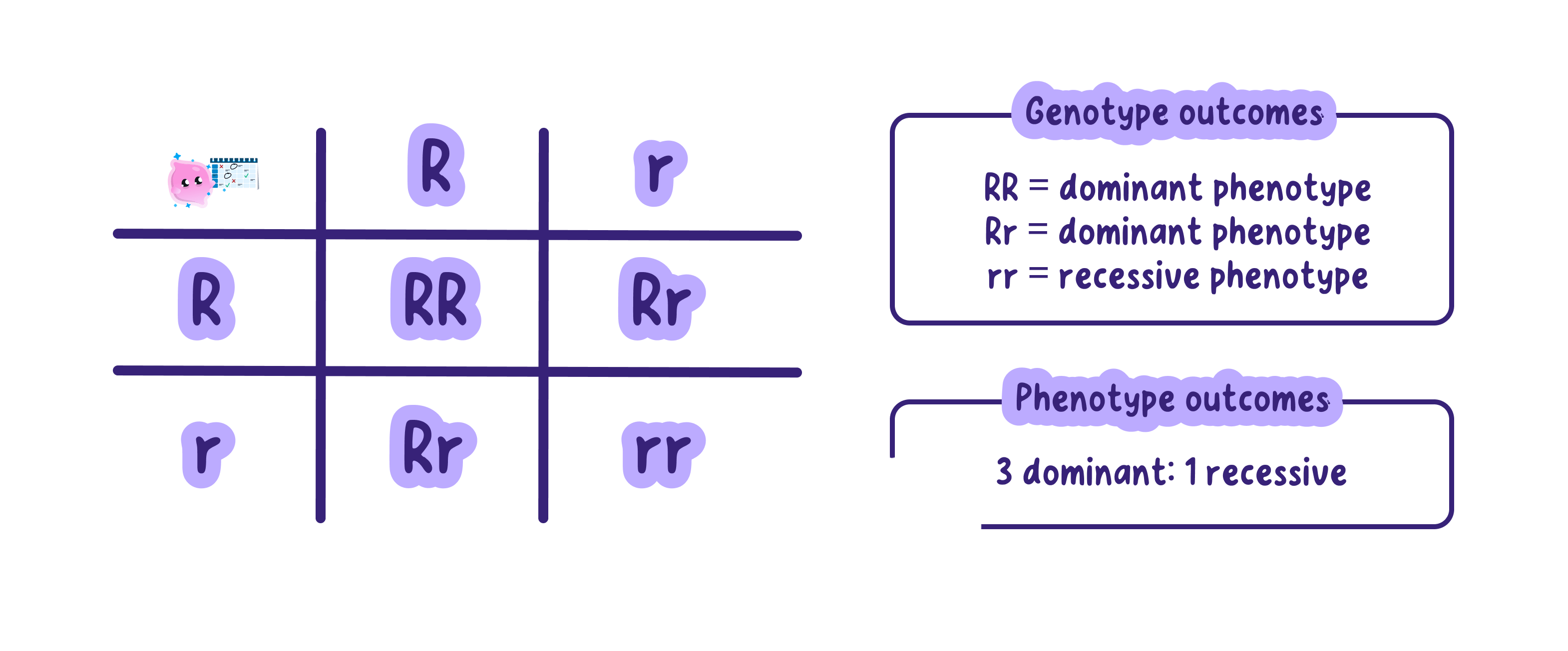
- Crossing those offspring with each other, Tt×TtTt \times TtTt×Tt, gives TTTTTT, TtTtTt, TtTtTt and tttttt.
- Three of the four carry a TTT and are tall while the fourth is tttttt and is short, which is the 3:13:13:1 pattern Mendel counted.
- His figures of 787787787 and 277277277 sit close to the 798798798 and 266266266 that a perfect 3:13:13:1 ratio would give for 106410641064 plants.
Why his work was ignored
- Mendel published his results in 186618661866 in the journal of a local natural history society, which few biologists elsewhere read.
- His argument rested on ratios and counting, an approach unfamiliar to naturalists who described organisms rather than measured them.
- Most biologists of the time accepted blending inheritance, in which the characteristics of the two parents mixed to give an intermediate offspring.
- Mendel's units stayed separate and could reappear unchanged in a later generation, which contradicted blending directly.
- Nothing was known of chromosomes, genes or DNA, so there was no structure inside the cell that his units could be matched to.
- Mendel became abbot of his monastery in 186818681868, and the administrative work that followed left him little time for breeding experiments.
- He died in 188418841884 without his explanation having been taken up by other biologists.
Do not write that Mendel's work was rejected because it was wrong. His results were sound and repeatable, and the difficulty was that no known structure in the cell could be identified with his units of inheritance.
From units to genes
Chromosome
A chromosome is a structure made of a long DNA molecule associated with proteins that carries many genes.
Gene
A gene is a section of DNA that contains the instructions for making a particular protein.
Allele
An allele is an alternative version of a gene.
- During the 188018801880s better microscopes and new stains allowed biologists to watch chromosomes move during cell division.
- Chromosomes were seen to occur in pairs, to separate during the division that forms gametes, and to be restored to pairs at fertilisation.
- That behaviour matched Mendel's units of inheritance point for point, which is why his paper was rediscovered and confirmed around 190019001900.
- By 191519151915 genes had been shown to lie in a fixed order along chromosomes, which gave Mendel's units a physical position in the cell.
- In 195319531953 the double helix structure of DNA was described, showing how a gene can be copied exactly and how it stores a coded instruction.
- Mendel's units of inheritance are now called genes, and the alternative forms he described as masking one another are now called alleles.
- The development therefore runs in a clear order: Mendel's counted ratios, then the observed behaviour of chromosomes, then genes, then the structure of DNA.
Mendel worked out the rules of inheritance decades before anyone knew that chromosomes carried genes or that genes were made of DNA, and each later discovery explained the pattern he had already measured.
- Give a reason rooted in the science of the time when asked why Mendel's work was not accepted, such as chromosomes and genes being unknown.
- Name the discoveries in order, because questions often ask which came first.
- Call what Mendel proposed units of inheritance rather than genes, since the word gene did not exist in his lifetime.
- Quote the 3:13:13:1 ratio when explaining his conclusions, because that figure is the evidence they rest on.
- Which plant did Mendel study, and why was it a good choice?
- Describe how Mendel controlled which plant pollinated which.
- What ratio did Mendel find in the second generation of his crosses?
- State the three conclusions Mendel drew from his results.
- Give two reasons why his work was not accepted during his lifetime.
- What discovery in the 188018801880s eventually led to his work being accepted?
