4.1.1 Cycling of materials in ecosystems
Materials move between living and non-living parts
Nutrient cycle
A nutrient cycle is the repeated transfer and reuse of a nutrient between organisms and the non-living environment.
- Carbon, nitrogen, water and mineral ions are used repeatedly as they move between organisms and their surroundings.
- The biotic components of an ecosystem are its living organisms, including plants, animals and microorganisms.
- The abiotic components are its non-living surroundings, including the atmosphere, water and soil.
- A material can be stored in one component before a biological or physical process transfers it to another.
- For example, nitrogen can be present in dissolved soil minerals, become part of a plant protein and later enter an animal that eats the plant.
- The atoms are rearranged into different substances during these transfers, rather than being created or destroyed.
Organisms take in and return materials
- Plants take in carbon dioxide from the air and absorb water and dissolved mineral ions through their roots.
- They use these raw materials to make the substances needed for growth, including carbohydrates and proteins.
- Animals obtain carbon-containing and nitrogen-containing substances in food, and obtain water by drinking or feeding.
- When one organism eats another, some of the materials in the food become part of the feeding organism.
- Excretion returns metabolic waste to the surroundings, while egestion returns undigested food.
- When an organism dies, its body still contains materials that were taken from the environment during its life.
- Decomposition returns materials from dead organisms and waste to forms that can be taken up again.
- These transfers connect the living organisms with material stores in the air, soil and water.
- A nitrogen atom in a dissolved soil mineral is absorbed by a grass plant and becomes part of a protein.
- A rabbit eats the grass and uses some of this nitrogen to make its own proteins.
- After waste is released or the rabbit dies, decomposition helps return the nitrogen to the surroundings where it can be used again.
Recycling maintains available supplies
- Earth has a finite supply of each element, so continued growth depends on making existing materials available repeatedly.
- Without recycling, more materials would remain locked in dead bodies and waste, leaving fewer available for new growth.
- Recycling maintains a supply of usable raw materials, rather than increasing the total number of atoms.
- Materials can also enter or leave a particular ecosystem, for example when water carries dissolved minerals into or away from a pond.
When describing a material transfer, identify the material, the component it leaves, the component it enters and the process responsible.
Energy flows through ecosystems
- Light energy from the Sun supplies most ecosystems and is transferred to chemical energy stores by photosynthesis.
- Organisms transfer energy to the surroundings as heat, which becomes dispersed and is unavailable for repeated use by the food chain.
- A continuing energy input is therefore needed, even though the materials used by organisms can circulate repeatedly.
- The arrows showing matter returning to plants represent recycled materials, not energy returning from decomposers.
Do not describe energy as being recycled: materials cycle, while energy is transferred through an ecosystem and dissipated to the surroundings.
- Which non-living stores supply raw materials to plants?
- How can nitrogen move from soil into an animal?
- Why would a lack of recycling eventually restrict growth?
- Why does an ecosystem need a continuing energy input?
4.1.2 Microorganisms in cycling materials
Microorganisms break down organic material
Decomposition
Decomposition is the breakdown of dead organic material and organic waste into simpler substances by decomposers.
Decomposer
A decomposer is an organism, such as a bacterium or fungus, that obtains nutrients by breaking down dead organisms or organic waste.
- Many bacteria and fungi obtain nutrients from dead organisms and organic waste, including fallen leaves, dead roots and animal faeces.
- Their activity breaks complex biological material into simpler substances that can move back into the environment.
- A dead organism contains large molecules, such as proteins and carbohydrates, that cannot all be absorbed directly by microbial cells.
- Decomposers secrete digestive enzymes onto the material, so digestion occurs outside their cells.
- The enzymes break large, insoluble molecules into smaller, soluble molecules, such as amino acids and simple sugars.
- The small molecules dissolve in water and can then be absorbed by the microorganisms.
- Absorbed molecules provide materials for growth and substances that can be broken down in respiration.
- An explanation of microbial feeding needs both enzyme secretion onto the material and absorption of the soluble products.
- Use named organisms such as bacteria and fungi when explaining which decomposers carry out the process.
Decomposition returns usable materials
- Some absorbed carbon becomes part of the decomposers’ own cells, so carbon can be temporarily stored in microbial biomass.
- During aerobic respiration, decomposers break down carbon-containing substances and release carbon dioxide into the surroundings.
- That carbon dioxide can subsequently be taken up by photosynthesising organisms.
- The breakdown of nitrogen-containing substances returns nitrogen to the surroundings in mineral forms, with further microbial activity making nitrogen available in forms plants can absorb.
- Other mineral nutrients are also returned to the soil or water as dead material is broken down.
- Plant roots absorb dissolved mineral ions and use them to make new biological molecules, including the proteins needed for growth.
- Without decomposition, dead material and waste would accumulate and a larger proportion of nutrients would remain unavailable to plants.
Plants absorb mineral ions through their roots and take in carbon dioxide for photosynthesis; they do not obtain their food by absorbing pieces of decaying organisms.
Detritivores help microorganisms
Detritivore
A detritivore is an animal that feeds on dead organic material and breaks it into smaller pieces.
- Woodlice and earthworms feed on dead organic matter and fragment it into smaller pieces.
- Smaller pieces expose a larger total surface area for microbial colonisation and enzyme action.
- This makes more of the material accessible to bacteria and fungi and can increase the rate at which it is decomposed.
- Detritivores also mix organic matter with soil, bringing it into contact with microorganisms.
- The animal fragments and digests material within its digestive system, whereas microbial decomposers can secrete enzymes onto material outside their cells.
- Both activities contribute to recycling, but an earthworm is an animal, not a microorganism.
- A fallen leaf is chewed into fragments by a woodlouse, exposing more surface for fungi and bacteria.
- Microbial enzymes digest substances in the fragments, and the microorganisms absorb the soluble products.
- As the microorganisms respire and the material is broken down further, carbon dioxide and mineral nutrients return to the surroundings.
- Which two groups contain the main microbial decomposers?
- Why must large insoluble food molecules be digested before absorption?
- Which process releases carbon dioxide from decomposers?
- How does fragmentation by detritivores help decomposition?
- Why does decomposition support plant growth?
4.1.3 The carbon and water cycles
Carbon moves between stores
Carbon cycle
The carbon cycle is the transfer of carbon between organisms and stores in the atmosphere, water, soil and rocks through biological, chemical and physical processes.
- Carbon atoms are needed to build carbohydrates, lipids, proteins and other molecules in living organisms.
- Carbon is stored in the atmosphere, dissolved substances in oceans, living organisms, dead organic material and fossil fuels.
- A store holds carbon, while a process such as photosynthesis or respiration transfers carbon between stores.
- The carbon cycle keeps carbon moving into forms that organisms can use to build new biological material.
Photosynthesis brings carbon into organisms
- Plants and algae take in carbon dioxide from their surroundings and use its carbon to make glucose during photosynthesis.
- Light provides the energy for the reaction: 6CO2+6H2O→lightC6H12O6+6O26\mathrm{CO_2}+6\mathrm{H_2O}\xrightarrow{\text{light}}\mathrm{C_6H_{12}O_6}+6\mathrm{O_2}6CO2+6H2OlightC6H12O6+6O2.
- Carbon in glucose can be used to make other carbohydrates and lipids, or combined with nitrogen-containing substances to make amino acids and proteins.
- When animals eat plants or other animals, carbon-containing molecules pass from the food into the feeding organism.
- Some of the absorbed carbon is incorporated into new cells, so feeding transfers carbon between living organisms.
- Plants obtain the carbon for photosynthesis from carbon dioxide, not from mineral ions absorbed by their roots.
- A carbon atom in atmospheric carbon dioxide is taken into a grass leaf and incorporated into glucose by photosynthesis.
- The grass uses that carbon to build a substance that is eaten by a rabbit.
- If the rabbit uses the carbon-containing substance in aerobic respiration, the carbon can return to the atmosphere in carbon dioxide.
Respiration returns carbon dioxide
- Plants, animals and decomposer microorganisms carry out aerobic respiration, which returns carbon dioxide to the air or surrounding water.
- The overall reaction is C6H12O6+6O2→6CO2+6H2O\mathrm{C_6H_{12}O_6}+6\mathrm{O_2}\rightarrow6\mathrm{CO_2}+6\mathrm{H_2O}C6H12O6+6O2→6CO2+6H2O, with energy released for cellular processes.
- Plants respire during the day and at night, although photosynthesis requires light.
- Dead organisms, fallen leaves and waste transfer carbon into dead organic material.
- Decomposers absorb substances from this material and release carbon dioxide as they respire.
- Some carbon becomes part of decomposer cells or remains in slowly decaying material, so carbon does not all return to the atmosphere immediately.
- For an arrow from the atmosphere to a plant, identify photosynthesis and explain that carbon dioxide is used to make glucose.
- For an arrow from a living organism to the atmosphere, identify respiration and specify that carbon returns as carbon dioxide.
- When explaining carbon release from dead material, connect it to respiration by decomposers rather than stating only that the material disappears.
Combustion releases stored carbon
Combustion
Combustion is a reaction in which a substance burns in oxygen and releases energy.
- When wood burns, carbon stored in the plant material is released mainly as carbon dioxide during complete combustion.
- Some dead organic material avoids complete decay and, after burial and changes over millions of years, can form fossil fuels.
- Coal, oil and natural gas therefore contain carbon that has been stored for a very long time.
- Burning these fuels transfers their carbon into the atmosphere much faster than new fossil fuels form.
- Carbon dioxide also dissolves in oceans, so photosynthesis is not the only process that removes it from the atmosphere.
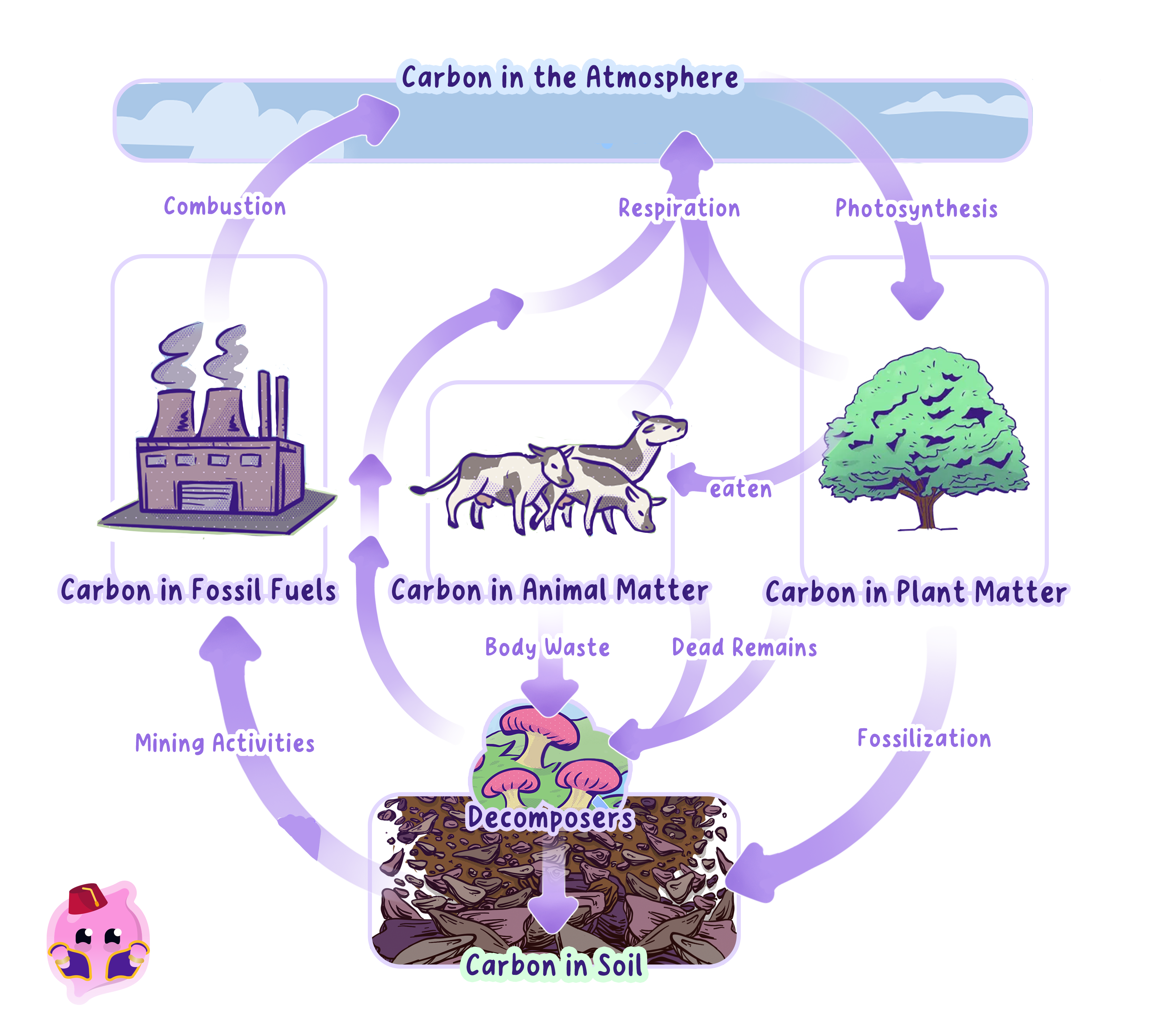
Carbon stores can change
- A carbon store grows when transfers into it are greater than transfers out, and shrinks when transfers out exceed transfers in.
- A growing forest can accumulate carbon in tree biomass, while its litter and soil also hold carbon.
- The amount of carbon in the atmosphere can increase when combustion and respiration add it faster than photosynthesis and other transfers remove it.
- Removing trees reduces carbon uptake by photosynthesis, and subsequent burning or decay can release carbon stored in the trees.
- On a carbon dioxide graph, distinguish a long-term trend from smaller seasonal fluctuations rather than treating every short-term fall as a reversal of the overall trend.
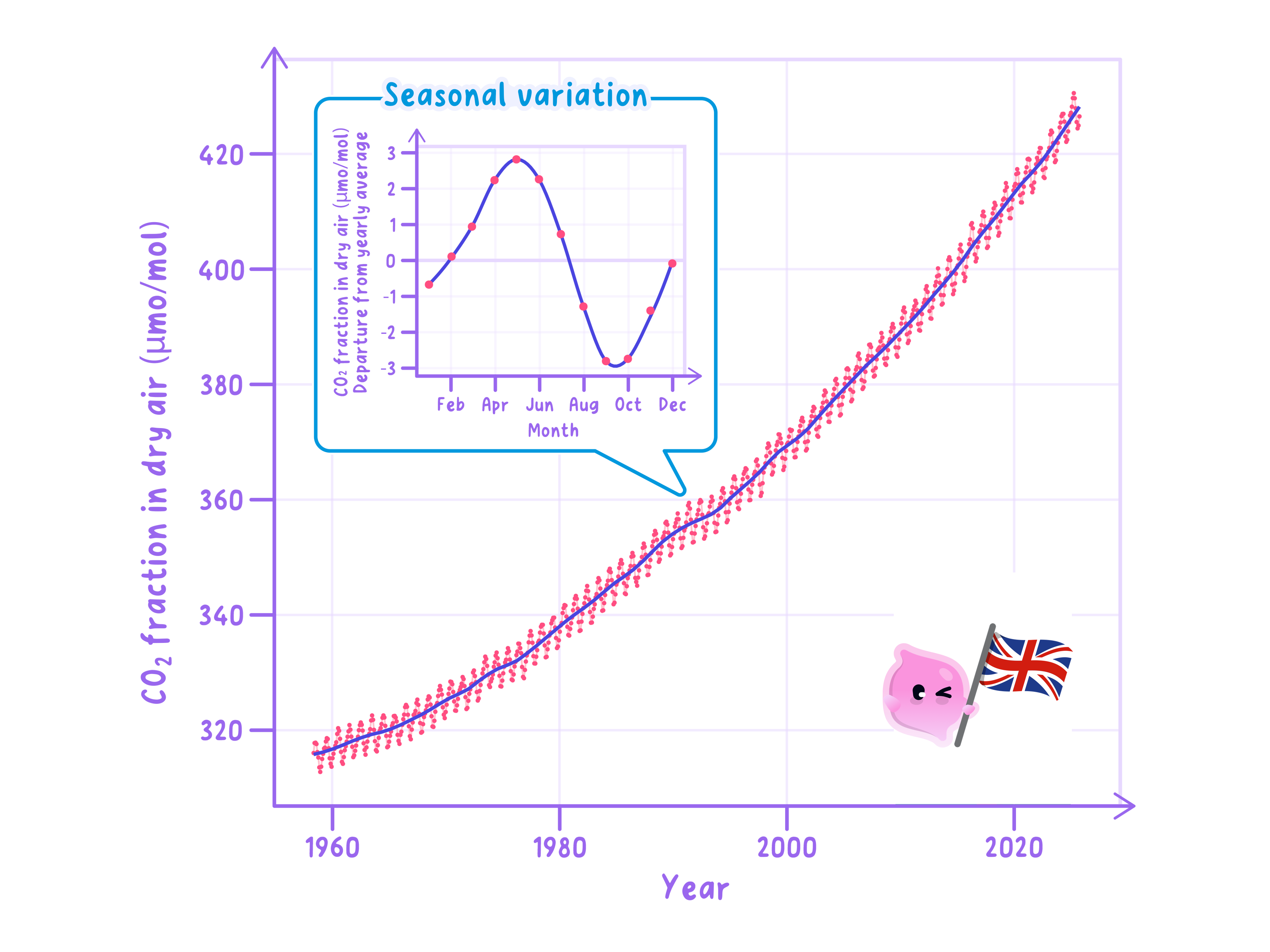
Water circulates through the environment
Water cycle
The water cycle is the continuous movement of water between the atmosphere, land, bodies of water and living organisms.
Evaporation
Evaporation is the change of a liquid into a gas at the liquid’s surface.
Condensation
Condensation is the change of a gas into a liquid.
Precipitation
Precipitation is water that falls from the atmosphere to Earth’s surface as rain, snow, sleet or hail.
- Energy from the Sun causes water to evaporate from oceans, lakes, rivers and moist surfaces.
- Water vapour is carried through the atmosphere, and cooling allows it to condense into tiny liquid droplets that form clouds.
- Cloud droplets join together, or ice crystals grow, until water falls as precipitation, including rain or snow.
- Some precipitation flows over the land as surface run-off, enters streams and rivers, and returns to lakes or oceans.
- Some enters the soil by infiltration and moves deeper into the ground, where it can be stored as groundwater.
- Groundwater can later flow into streams, lakes or the sea, so water follows several possible routes through the cycle.
- Evaporation leaves dissolved salts behind, helping supply fresh water through condensation and precipitation.
- Water vapour is an invisible gas; the visible droplets in a cloud are liquid water, not water vapour.
Organisms depend on water cycling
Transpiration
Transpiration is the loss of water vapour from the leaves and stems of a plant, mainly through the stomata.
- Plants absorb water through their roots and transport it to leaves, where some is used in photosynthesis and most is eventually lost as water vapour.
- Water evaporates from leaf cell surfaces and diffuses out through stomata, returning water to the atmosphere by transpiration.
- Animals take in water by drinking and feeding, and return it through processes including urination, breathing and sweating.
- Water acts as a solvent for reactions and transport, so a continuing supply allows substances to dissolve and move within organisms.
- Water in soil carries dissolved mineral ions to roots, and flowing water transports nutrients through habitats.
- The cycle replenishes rivers, ponds and other freshwater habitats, while rainfall and soil water support organisms on land.
- A prolonged lack of rainfall can reduce available water and shrink aquatic habitats, even though water continues to exist elsewhere in the global cycle.
Evaporation changes liquid water into a gas, while condensation changes water vapour into liquid droplets; neither process changes water into a different chemical substance.
- How does photosynthesis transfer carbon from the atmosphere into living material?
- Why does decomposing material release carbon dioxide?
- How does burning fossil fuels change the atmospheric carbon store?
- What happens to water during condensation?
- How does the water cycle maintain freshwater habitats?
4.1.4 Factors affecting decomposition
Temperature changes decomposition rate
Decomposition
Decomposition is the breakdown of dead organic material and organic waste into simpler substances by decomposers.
- Decomposition depends on enzyme-controlled reactions in bacteria and fungi, so environmental conditions affect how quickly dead material is broken down.
- At low temperatures, enzyme and substrate molecules have less kinetic energy and fewer successful collisions occur each second.
- Digestion, respiration and microbial growth are slower, so decomposition proceeds slowly.
- As temperature increases towards a suitable optimum, molecules move faster and successful collisions become more frequent.
- More enzyme-substrate complexes form per second, increasing the rate of reactions involved in decomposition.
- Above a suitable temperature range, enzymes can denature, changing the shape of their active sites so substrates no longer fit effectively.
- High temperatures can also kill microbial cells, reducing the number of decomposers able to act on the material.
- Different microorganisms have different temperature tolerances, so a mixed decomposer community does not have one universal optimum.
Enzymes are denatured, not killed; low temperature usually reduces their activity without denaturing them.
Moisture and oxygen support decay
Aerobic conditions
Aerobic conditions are conditions in which oxygen is available.
Anaerobic conditions
Anaerobic conditions are conditions in which oxygen is absent.
- Microorganisms need water for cellular reactions and for dissolved substances to move to and from their cells.
- In dry material, fewer substances can dissolve and microbial growth is restricted, so decomposition is slower.
- Adding water to dry material can therefore increase decomposition when other conditions are suitable.
- Aerobic conditions contain oxygen, allowing decomposers to release energy through aerobic respiration.
- This energy supports cellular processes and growth, allowing a larger active microbial population to break down material.
- When material becomes waterlogged, water fills the air spaces and the supply of oxygen can become limited.
- Oxygen moves through water much more slowly than through air, so it may be used faster than it is replaced.
- Anaerobic conditions lack oxygen, although microorganisms capable of functioning without oxygen may still decompose material.
- Decomposition is often slower in oxygen-poor conditions, so partially decomposed material can accumulate.
- Increasing moisture therefore does not always increase decay: very dry conditions restrict activity, but waterlogging can restrict oxygen.
- Link each condition to its mechanism: temperature changes enzyme activity, water enables reactions and transport, and oxygen supports aerobic respiration.
- Use the range shown in the data when explaining a temperature trend rather than adding denaturation if the results never reach temperatures where it occurs.
Decay can be encouraged or slowed
- A compost heap decomposes plant material efficiently when it remains moist, has a suitable temperature and receives enough oxygen.
- Turning or mixing compost admits air, while avoiding excessive watering helps keep air spaces open.
- Respiration by decomposers releases energy that warms the heap, although excessive heating can reduce the activity of some microorganisms.
- Compost supplies organic material and mineral nutrients to soil as decomposition continues.
- Refrigeration slows microbial reactions, while freezing also reduces the availability of liquid water.
- Freezing does not reliably kill every microorganism, so microbial activity can increase again when food thaws.
- Drying reduces available water and therefore slows the reactions and growth needed for decay.
- Removing oxygen slows aerobic decay, but does not prevent every form of decomposition because some microorganisms can function anaerobically.
- In canning, heating kills microorganisms and subsequent sealing prevents new microorganisms entering; sealing alone does not make contaminated food safe.
Investigating leaf decomposition
- Aim: compare the loss of leaf material at different moisture levels while keeping temperature and access to air as similar as possible.
- Apparatus: use identical ventilated containers, fine-mesh bags, leaves of one species and similar age, soil from one mixed sample, a balance, measuring cylinders, labels, gloves and a teacher-controlled drying oven.
- Preparation: dry the leaves gently to constant mass, allow them to cool and weigh equal starting masses into labelled mesh bags.
- Constant mass: dry, cool and reweigh until consecutive measurements agree within the resolution of the balance, so changes in water content do not dominate the measurements.
- Set-up: place equal masses of well-mixed soil in identical containers and add measured water volumes to create low, medium and high moisture treatments without submerging the soil.
- Replication: prepare at least three separate containers for each moisture treatment and put the same number of identical leaf bags at the same depth in each container.
- Controls: keep leaf species, initial dry mass, leaf fragment size, soil source, temperature, mesh size, ventilation and duration the same.
- Moisture control: record the starting mass of each container and check regularly, replacing evaporated water to keep each treatment close to its intended moisture level.
- Sampling: retrieve a different bag from each container at each planned interval, such as after one, two and three weeks, so drying a sample does not interrupt decomposition of the remaining samples.
- Measurement: gently remove adhering soil without losing leaf fragments, dry the remaining leaf material to constant mass, cool it and record its dry mass.
- Processing: calculate dry mass lost and percentage mass lost for each bag, then calculate a mean for each treatment at each time.
- Presentation: plot time on the horizontal axis and mean percentage mass lost on the vertical axis, with separate labelled lines for the moisture treatments.
- Interpretation: compare mass loss over the same time interval, because greater loss during an equal interval indicates faster breakdown.
- Evaluation: some loss may result from soluble substances being washed out or fragments escaping through the mesh, so dry mass loss is an estimate rather than a direct measurement of microbial activity alone.
- Safety: wear gloves when handling soil or decaying material, wash hands afterwards, avoid inhaling dust and let the teacher handle heated equipment and disposal.
Microbial activity can change milk acidity
- Some bacteria use the sugar in milk and produce lactic acid, causing the milk’s pH\mathrm{pH}pH to decrease.
- A faster decrease in pH\mathrm{pH}pH over a fixed interval can indicate faster microbial activity when the starting conditions are controlled.
- This is an indirect indicator of decomposition and does not measure dry mass loss.
- Because pH\mathrm{pH}pH is a logarithmic scale, equal changes in pH\mathrm{pH}pH do not represent equal amounts of acid produced.
Investigating milk decomposition
- Aim: investigate how temperature affects the change in milk acidity caused by a teacher-approved, non-pathogenic lactic acid bacterial culture.
- Apparatus: use milk from one batch, the same food-grade bacterial starter, sterile tubes and caps, measuring pipettes, controlled-temperature water baths or incubators, thermometers and a calibrated pH\mathrm{pH}pH probe.
- Set-up: place equal milk volumes, such as 10 cm310\,\mathrm{cm^3}10cm3, in labelled tubes and allow them to reach the chosen temperatures before adding the starter.
- Temperature range: use teacher-approved school conditions, for example 10 ∘C10\,^{\circ}\mathrm{C}10∘C, 20 ∘C20\,^{\circ}\mathrm{C}20∘C and 25 ∘C25\,^{\circ}\mathrm{C}25∘C, and check the actual temperatures with thermometers.
- Starting the investigation: add the same measured volume and concentration of starter to each tube, mix in the same way and record the starting time.
- Controls: keep the milk source, milk volume, starting pH\mathrm{pH}pH, bacterial inoculum, vessel size, mixing and exposure to air the same.
- Control treatment: include uninoculated milk at each temperature to check whether changes also occur without the added starter.
- Replication: prepare at least three independent tubes for each temperature and each sampling time, using separate tubes so repeated opening does not alter later samples.
- Measurement: at fixed intervals selected in a pilot study, measure pH\mathrm{pH}pH using the same calibrated probe, rinsing it between samples to prevent carry-over.
- Recording: use a table with time and the individual pH\mathrm{pH}pH readings for each temperature, then calculate the mean of the repeats.
- Graph: plot time on the horizontal axis and mean pH\mathrm{pH}pH on the vertical axis, drawing a separate labelled line for each temperature.
- Interpretation: within a suitable temperature range, a steeper initial fall indicates faster acidification, which can be linked to faster enzyme-controlled activity.
- Evaluation: judge the measured trend within the temperature range tested and do not assume that the trend would continue indefinitely at higher temperatures.
- Safety: use only the approved starter, never taste the milk, minimise opening of cultures, disinfect the work area and leave culture disposal to the teacher.
Calculate rates and percentage loss
- Use the same time interval when comparing decomposition rates, and use dry mass when changing water content could affect the result.
- Calculate the loss using mass lost=initial dry mass−final dry mass\text{mass lost}=\text{initial dry mass}-\text{final dry mass}mass lost=initial dry mass−final dry mass.
- The mean rate is mean rate of mass loss=mass losttime taken\text{mean rate of mass loss}=\dfrac{\text{mass lost}}{\text{time taken}}mean rate of mass loss=time takenmass lost.
- If mass is measured in grams and time in days, report the rate in g day−1\mathrm{g\,day^{-1}}gday−1.
- To compare samples with different starting masses, calculate percentage mass lost=mass lostinitial dry mass×100%\text{percentage mass lost}=\dfrac{\text{mass lost}}{\text{initial dry mass}}\times100\%percentage mass lost=initial dry massmass lost×100%.
- A mean rate over a whole investigation may hide changes during that period, so compare shorter intervals when the data allow this.
- A leaf sample decreases from 12.0 g12.0\,\mathrm{g}12.0g to 7.2 g7.2\,\mathrm{g}7.2g dry mass during 24 days24\,\text{days}24days.
- The dry mass lost is 12.0−7.2=4.8 g12.0-7.2=4.8\,\mathrm{g}12.0−7.2=4.8g.
- The mean rate of mass loss is 4.824=0.20 g day−1\dfrac{4.8}{24}=0.20\,\mathrm{g\,day^{-1}}244.8=0.20gday−1.
- The percentage mass lost is 4.812.0×100%=40%\dfrac{4.8}{12.0}\times100\%=40\%12.04.8×100%=40%.
- A second sample losing the same mass in half the time has twice the mean rate, not twice the percentage mass loss.
Interpret decomposition results
- On a graph of mass remaining against time, a more steeply falling line indicates faster mass loss.
- On a graph of mass lost against time, a more steeply rising line indicates faster mass loss.
- A curve that becomes less steep shows that the rate is slowing, which may happen as the more easily decomposed material is used up.
- Use repeat measurements to calculate a mean and inspect their spread before deciding that a small difference between treatments is convincing.
- Check unusual results against the method and repeat the measurement where possible rather than deleting them simply because they do not match the expected pattern.
- A conclusion should identify the observed relationship and support it with comparable values, followed by the biological explanation that fits the tested conditions.
- Why does increasing temperature initially speed up decomposition?
- Why can waterlogging slow decay?
- What does anaerobic mean?
- Why should leaf samples be dried to constant mass?
- Why does a fall in milk pH\mathrm{pH}pH provide evidence of microbial activity?
4.1.5 Levels of organisation in an ecosystem
Individuals form populations
Individual
An individual is one living organism.
Population
A population is all the organisms of one species living in a defined area at the same time.
- One oak tree, one fox or one bacterial cell can each be described as an individual organism.
- A population includes all the individuals of one species within a stated area at the same time.
- For example, all the common frogs in one pond form a population, whereas one frog is an individual.
- A population must refer to a particular species, so all the animals in the pond do not form a single population.
- The area and time must be clear because the same species can occur in several places and its numbers can change.
- Population size is the number of individuals in that population, rather than the number of species present.
A large group is not automatically a population: its organisms must belong to the same species and occur in the same defined area at the same time.
Populations form a community
Community
A community is all the populations of different species living and interacting in the same area.
- A pond can contain separate populations of common frogs, great pond snails, duckweed and many other species.
- These populations together make up its community.
- A community includes plants, animals, fungi and microorganisms, including organisms that are too small to see without a microscope.
- The word community refers to the living organisms, so the pond water, rocks and light are not themselves members of the community.
- A species represented by only one individual in the area still contributes to the community.
- When naming a community, use the different populations together, rather than listing only the most visible animals.
- One common frog in a pond represents the individual level.
- All the common frogs in that pond represent one population.
- The frogs, snails, duckweed, algae, bacteria and all other populations together represent the pond community.
- Adding the pond’s water, light, temperature, dissolved gases and other non-living surroundings, together with their interactions with organisms, describes the ecosystem.
An ecosystem includes the environment
Ecosystem
An ecosystem is a community of organisms interacting with one another and with the non-living components of their environment.
- An ecosystem contains a community and the non-living environment with which that community interacts.
- The living organisms are its biotic components, while water, air, soil and physical conditions are its abiotic components.
- Including interactions matters because an ecosystem is more than a list of organisms and objects in the same place.
- For example, pond plants take in dissolved substances from the water, and their activity changes the substances present in that water.
- The levels of organisation progress from individual to population to community to ecosystem.
- An ecosystem can be relatively small, such as a rock pool, or much larger, such as a woodland.
- Its defining feature is the living community interacting with its surroundings, rather than a fixed size.
- To distinguish a population from a community, state whether one species or all the different species are included.
- To distinguish a community from an ecosystem, add the abiotic environment and the interactions with it.
Habitats are places within ecosystems
Habitat
A habitat is the place in which an organism lives.
Niche
A niche is the role of an organism in its ecosystem, including its use of resources and its interactions with other organisms.
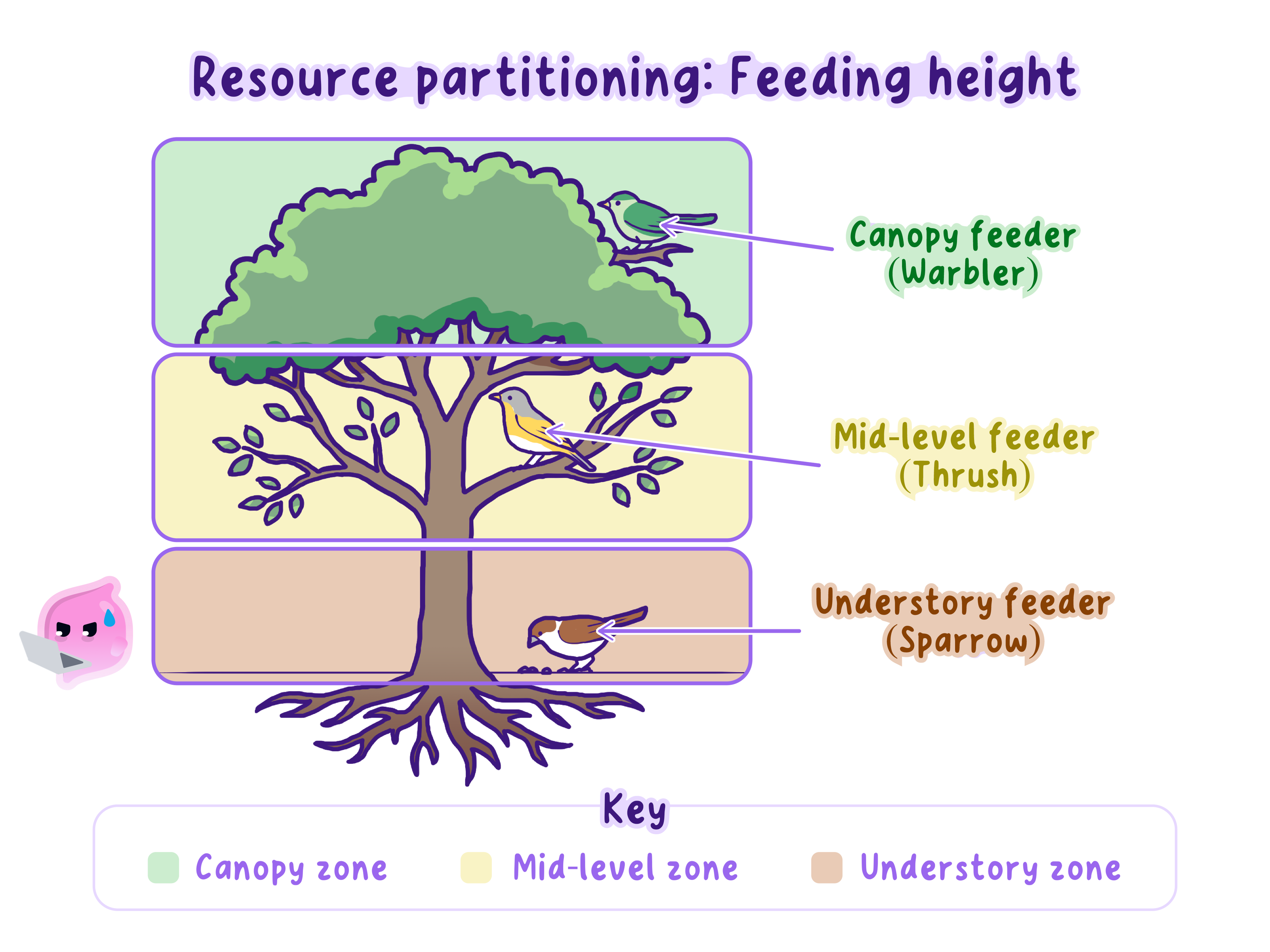
- A woodland contains several habitats, including leaf litter, tree bark and the canopy, even though they belong to the same wider ecosystem.
- Different organisms can share a habitat, so a habitat does not correspond to only one population.
- A microhabitat is a small, localised part of a habitat, such as the damp space beneath a log.
- The same tree can provide living space for several bird species, as shown in the retained illustration.
- The birds occupy different parts of the tree and use its resources differently, illustrating that a habitat describes a place while a niche describes an organism’s role there.
- When identifying organisational levels, keep where an organism lives separate from whether the description concerns an individual, population, community or ecosystem.
- What makes a group of organisms a population?
- Which organisms are included in a community?
- What must be added to a community to describe an ecosystem?
- What is the order of the four levels of organisation?
- How does a habitat differ from a niche?
4.1.6 Abiotic and biotic factors affecting communities
Abiotic conditions affect survival
Abiotic factor
An abiotic factor is a non-living physical or chemical feature of the environment that affects organisms.
- The organisms found in a habitat depend on whether its physical and chemical conditions allow them to survive, grow and reproduce.
- Different species have different tolerances, so a condition favourable to one species may restrict another.
- Temperature affects enzyme-controlled reactions, including photosynthesis, respiration and growth.
- At low temperatures these reactions are often slower, while temperatures above an organism’s tolerance can disrupt enzyme activity and survival.
- Temperature can also change the availability of liquid water and the amount of oxygen dissolved in water.
- Light intensity affects the rate of photosynthesis and therefore the amount of material plants can make for growth.
- Where light is limited, fewer plants may grow or shade-tolerant species may become more common.
- Many woodland plants flower before the trees develop a full leaf canopy, allowing them to use the stronger light that reaches the ground in early spring.
- Moisture supplies water for photosynthesis, transport and maintaining cell turgor.
- A shortage of water can cause wilting and stomatal closure, reducing carbon dioxide uptake and photosynthesis.
- Waterlogged soil can restrict oxygen around roots and therefore limit aerobic respiration.
- Soil acidity, measured using pH\mathrm{pH}pH, affects the availability of mineral ions and the activity of roots and soil microorganisms.
- Some species grow better in acidic soils and others in more alkaline soils, so differences in soil pH\mathrm{pH}pH can change the plant community.
- Mineral ion availability affects growth because plants need substances such as nitrates to make amino acids and proteins.
- Dissolved oxygen affects aquatic organisms that need oxygen for aerobic respiration, so a fall in oxygen concentration can reduce their survival.
- For an environmental change, connect the named factor to a biological process, then explain its effect on survival, growth or reproduction.
- For example, reduced light can lower photosynthesis, leaving less material for plant growth and potentially less food for herbivores.
Biotic factors involve other organisms
Biotic factor
A biotic factor is an influence of living organisms on other organisms in a community.
- Food availability affects how much energy and raw material consumers can obtain.
- With less food, some organisms grow more slowly, produce fewer offspring or die, so the population may decrease.
- An increase in food may allow more individuals to survive and reproduce, provided another resource does not become limiting.
- Predators reduce prey numbers by killing and eating individuals.
- Introducing a predator can reduce a prey population, whereas removing a predator may allow that population to increase.
- Pathogens can cause disease that reduces survival or reproduction, changing the abundance of affected species.
- Competitors reduce the share of a limited resource available to each organism.
- A newly arriving species may use the same food or growing space as an existing species and reduce its abundance.
- The effect of a biotic change depends on the other organisms present, so the response should be explained using the relationships given.
A biotic factor is an influence involving organisms, such as predation or food availability; temperature and light intensity are abiotic factors.
Factors change abundance and distribution
- Abundance describes how many organisms of a species occur in an area, whereas distribution describes where they occur.
- A plant may be abundant in damp ground but absent from a nearby dry patch because the patches offer different conditions.
- Several factors act together, so a site with suitable light may still lack a species if its soil is too dry or the species has not reached it.
- A limiting factor restricts population growth when a required resource or suitable condition is insufficient.
- As a population grows, food or space may become harder to obtain, so its growth can slow and its size may fluctuate around the level the habitat can support.
- The levelling-off shown in these diagrams represents restricted net population growth, not the complete stopping of births and deaths.
- A change in resources or conditions can change the population size that the habitat can support.
- Across larger regions, temperature and rainfall help determine which broad communities of plants and animals can occur.
Investigating a habitat gradient
- Aim: investigate whether the abundance of one plant species changes with light intensity from open grassland towards a shaded area.
- Apparatus: use a tape measure, a quadrat of fixed area, a light meter, a plant identification guide, a recording sheet and instruments for checking soil moisture and temperature.
- Method, field sampling:
- Identify the plant reliably and choose a transect that crosses the change in shade without crossing a major change in soil type or management.
- Lay the tape in a straight line from the open area into shade and mark fixed sampling distances, for example every 2 m2\,\mathrm{m}2m.
- Place the quadrat on the same side of the tape at each distance and count the rooted individuals of the chosen species.
- Use the same quadrat area and the same boundary rule, such as including plants rooted on the top and left edges but excluding those on the bottom and right edges.
- For a plant that is difficult to separate into individuals, estimate percentage cover using a gridded quadrat and use that measure consistently throughout.
- Record light intensity at the same height and orientation in each quadrat, keeping your body from shading the sensor.
- Record soil moisture and temperature at the sampling points so that alternative explanations can be considered.
- Repeat the transect along several parallel lines across the same habitat transition, using the same sampling intervals.
- Take measurements within a short period under similar weather conditions, because changing cloud cover can alter light readings.
- Results and processing:
- Retain the paired light and abundance measurements and plot a scatter graph with light intensity on the horizontal axis and abundance on the vertical axis.
- Describe whether abundance tends to rise, fall or show no consistent change with light intensity, and support the statement with values from the results.
- Sampling design:
- A transect is useful for finding changes along an environmental gradient because its sampling positions follow that gradient.
- To compare the overall abundance of a species in two areas, use random quadrat positions within each defined area to reduce selection bias.
- Choose positions from random coordinates rather than placing quadrats where the chosen plant is easiest to see.
- Use the same quadrat area, identification method and counting rules in both habitats, and take enough samples to represent variation within each area.
- Evaluation:
- A field correlation does not establish that light is the only cause, because moisture, soil conditions and other factors may change along the transect as well.
- An association between a factor and abundance supports an explanation, but a controlled investigation is needed to isolate the effect of that factor more securely.
- Safety and care: check for uneven ground and harmful plants, minimise trampling, avoid uprooting plants and wash hands after fieldwork.
- How can low light intensity reduce plant growth?
- Why can waterlogging reduce the survival of roots?
- How can an increase in food change a consumer population?
- How does distribution differ from abundance?
- Why does a correlation between light and abundance not prove that light is the only cause?
4.1.7 Interdependence and competition
Organisms depend on one another
Interdependence
Interdependence is the reliance of organisms on other organisms in their community for resources or processes needed for survival and reproduction.
- Organisms in a community obtain food, shelter and other resources through relationships with other species.
- Flowering plants may depend on animals for pollination, while some animals depend on those plants for nectar or pollen.
- Fruit-eating animals can disperse seeds, allowing plants to establish away from the parent plant.
- Trees can provide nesting sites and shelter, so removing a tree can affect organisms that do not eat the tree itself.
- A change in one population can therefore affect other populations both directly and through a sequence of linked changes.
- Interdependence does not mean that every interaction benefits both organisms: some relationships benefit one organism while harming another.
- A decline in insect pollinators can reduce the transfer of pollen between flowers.
- Fewer flowers may then be fertilised, reducing the production of seeds and fruits.
- Animals that rely on those fruits may have less food, even if they do not interact directly with the pollinators.
Competition occurs for limited resources
Competition
Competition is an interaction in which organisms use the same limited resource, reducing the amount available to each.
- Organisms compete when they need the same resource and there is not enough for all of them.
- Plants compete for light, water, mineral ions and space.
- A taller plant may shade a shorter plant, reducing the light available for photosynthesis in the shorter plant.
- Roots from neighbouring plants can draw water and mineral ions from the same part of the soil.
- Animals compete for food, water, mates and space that provides food, shelter or breeding sites.
- Competition can occur between members of the same species or between members of different species.
- Individuals of the same species often have very similar needs and can compete for mates as well as other resources.
- Members of different species may compete for a shared food source or nesting site, but they do not normally compete for the same mates.
- Competition can reduce growth, survival or reproductive success because an organism obtains less of a resource it needs.
- Competition does not require fighting or direct contact, as one plant can remove water before another plant’s roots absorb it.
- To explain competition, identify the two organisms and the specific resource they both use.
- Use the feeding links shown in a food web rather than assuming that two predators eat all the same prey.
Predators and prey affect each other
Predation
Predation is an interaction in which one animal kills and eats another animal.
- A predator kills and eats another animal, which is its prey.
- The predator gains food, while the prey individual is killed.
- If prey become more abundant, predators may obtain more food, allowing more predators to survive and reproduce.
- Predator numbers usually respond after a time delay, because growth and reproduction take time.
- A larger predator population may remove more prey, contributing to a later decrease in prey numbers.
- As prey become scarce, predators may have less food and their population can subsequently decrease.
- Reduced predation can then allow prey numbers to recover, producing linked fluctuations under suitable conditions.
- Real populations do not always follow neat repeating cycles because food supplies, disease, weather and other predators also affect them.
A peak in predator abundance often follows a peak in prey abundance; do not assume their population peaks must occur at the same time.
Mutualism benefits both partners
Mutualism
Mutualism is an interaction between organisms of different species in which both benefit.
- In a mutualistic relationship, each species gains a benefit from its association with the other.
- A bee obtains nectar as a food source from a flower, and pollen carried on the bee can be transferred to another flower of the same species.
- The plant benefits because pollen transfer can enable fertilisation, leading to seed production.
- The two benefits must be identified separately: the bee receives food and the plant gains assistance with reproduction.
- Another example is the association between some plant roots and fungi, where the plant supplies sugars and the fungus helps the plant obtain water and mineral ions.
- If one partner declines, the other may lose that benefit, although the effect depends on whether alternative partners are available.
Parasitism benefits one partner
Parasitism
Parasitism is an interaction in which one organism gains resources from a living host and harms the host.
- A parasite lives on or in another organism, called its host, and gains resources while harming the host.
- A tapeworm living in an animal’s intestine absorbs nutrients from digested food, leaving less available to the host.
- A flea feeds on a mammal’s blood, gaining nutrients while the host loses blood and may suffer irritation.
- The host may grow more slowly, reproduce less successfully or become more vulnerable to disease because of the parasite’s effects.
- A parasite usually exploits a living host over a period of time rather than immediately killing and eating it as a predator does.
- A parasite can still cause severe illness or death, so parasitism should not be described as harmless to the host.
- For mutualism, explain what each partner gains.
- For parasitism, identify the resource gained by the parasite and the resulting harm to the host.
- For predation, identify which organism kills and eats the other.
Linked populations can remain stable
- A relatively stable community can retain its range of species while population sizes fluctuate within limits.
- Stability does not require the number of every species to remain exactly constant.
- Changes in predation, competition or beneficial partnerships can alter survival and reproduction, so a disturbance can spread through the community.
- Predictions should follow the relationships given and recognise that an organism may have several food sources or several interacting partners.
- How can a loss of pollinators affect fruit-eating animals?
- Why must a resource be limited for competition to occur?
- Why can predator numbers rise after prey numbers rise?
- What does each partner gain in bee-flower mutualism?
- How does parasitism differ from predation?
4.1.8 Trophic levels
Trophic levels describe feeding positions
Trophic level
A trophic level is the feeding position of an organism along a particular food chain.
- A food chain shows one route by which material and energy pass between organisms through feeding.
- A food web combines several food chains and shows that many organisms have more than one food source.
- An arrow points from the organism being eaten to the organism that eats it, showing the direction of transfer.
- A trophic level is assigned by following a particular feeding route, rather than by the size or appearance of the organism.
Food-chain arrows point from food to feeder, not in the direction in which a predator moves to catch its prey.
Producers start food chains
Producer
An organism that makes its own food by photosynthesis and so supplies the food and biomass that begins a food chain.
- Green plants and algae act as producers because they make organic substances using carbon dioxide and water in photosynthesis.
- They use light energy to build these substances, forming the biological material on which the rest of the chain depends.
- Producers occupy the first trophic level, written as level 111.
- Grass, pondweed and microscopic algae can therefore all occupy the same trophic level despite their different sizes and habitats.
- A producer still needs water, mineral ions and suitable conditions, but it does not obtain its organic food by eating another organism.
Consumers feed on other organisms
Consumer
A consumer is an organism that obtains organic food by feeding on other organisms or their material.
- Consumers obtain organic substances by feeding on organisms or their material rather than making all their organic food from inorganic raw materials.
- A primary consumer eats a producer and occupies trophic level 222.
- A secondary consumer eats a primary consumer and occupies trophic level 333.
- A tertiary consumer eats a secondary consumer and occupies trophic level 444.
- If a further consumer eats the tertiary consumer, it is a quaternary consumer at trophic level 555.
- The consumer name counts the feeding steps after the producer, while the trophic-level number includes the producer.
- In the chain grass→grasshopper→frog→heron\text{grass}\rightarrow\text{grasshopper}\rightarrow\text{frog}\rightarrow\text{heron}grass→grasshopper→frog→heron, grass is the producer at level 111.
- The grasshopper eats the producer, so it is the primary consumer at level 222.
- The frog eats the primary consumer, so it is the secondary consumer at level 333.
- The heron eats the secondary consumer, so it is the tertiary consumer at level 444.
Diet and feeding position
Herbivore
A herbivore is an animal that feeds on plant or algal material.
Carnivore
A carnivore is an animal that feeds on other animals.
Omnivore
An omnivore is an animal that feeds on both plant and animal material.
- A herbivore feeding directly on a producer is a primary consumer.
- A carnivore can be a secondary, tertiary or higher consumer depending on the feeding route being followed.
- An apex predator has no regular predators in the food web being considered, but its trophic-level number depends on the length of that feeding route.
- Diet labels alone are not enough to assign every organism one fixed numbered level.
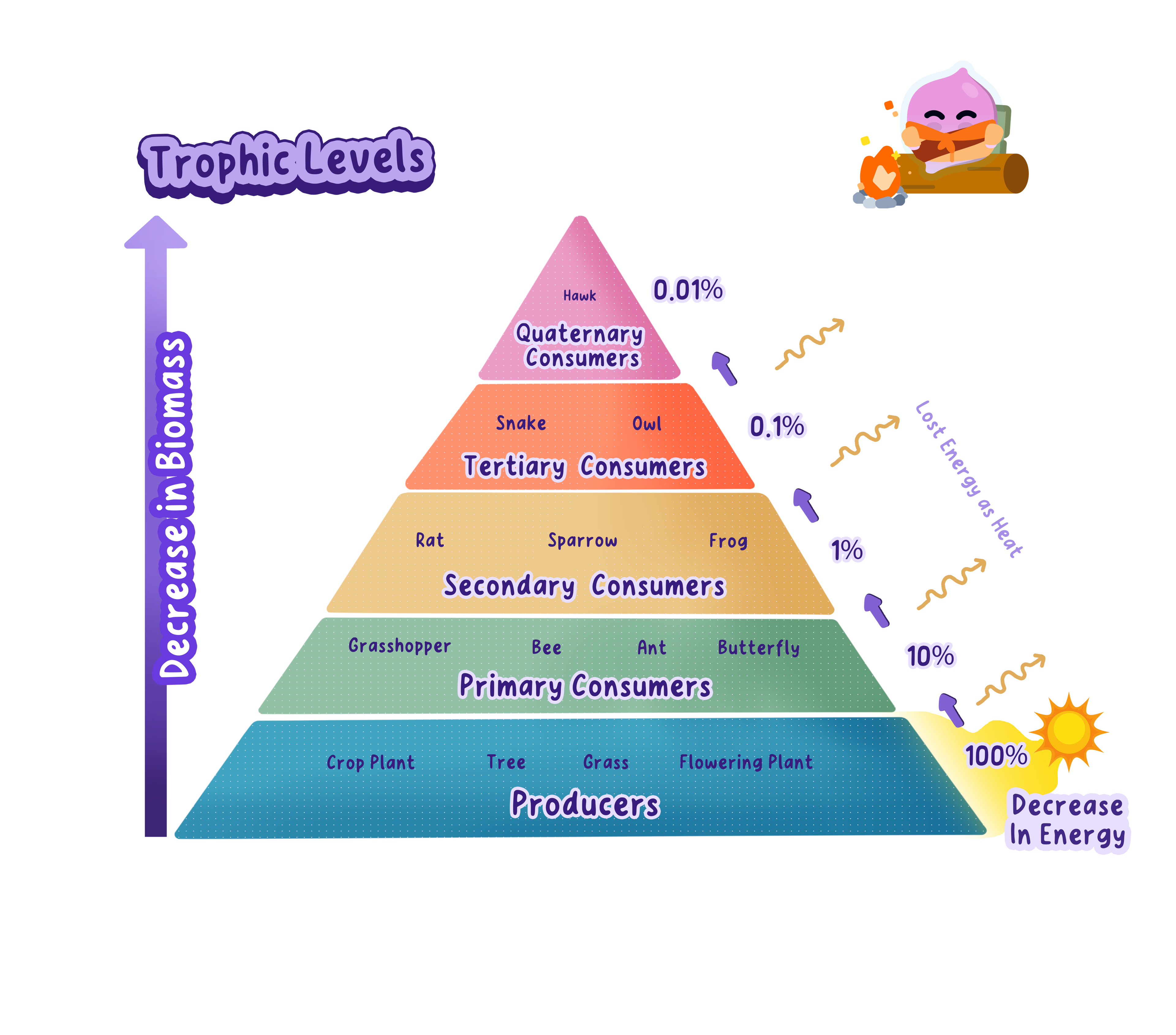
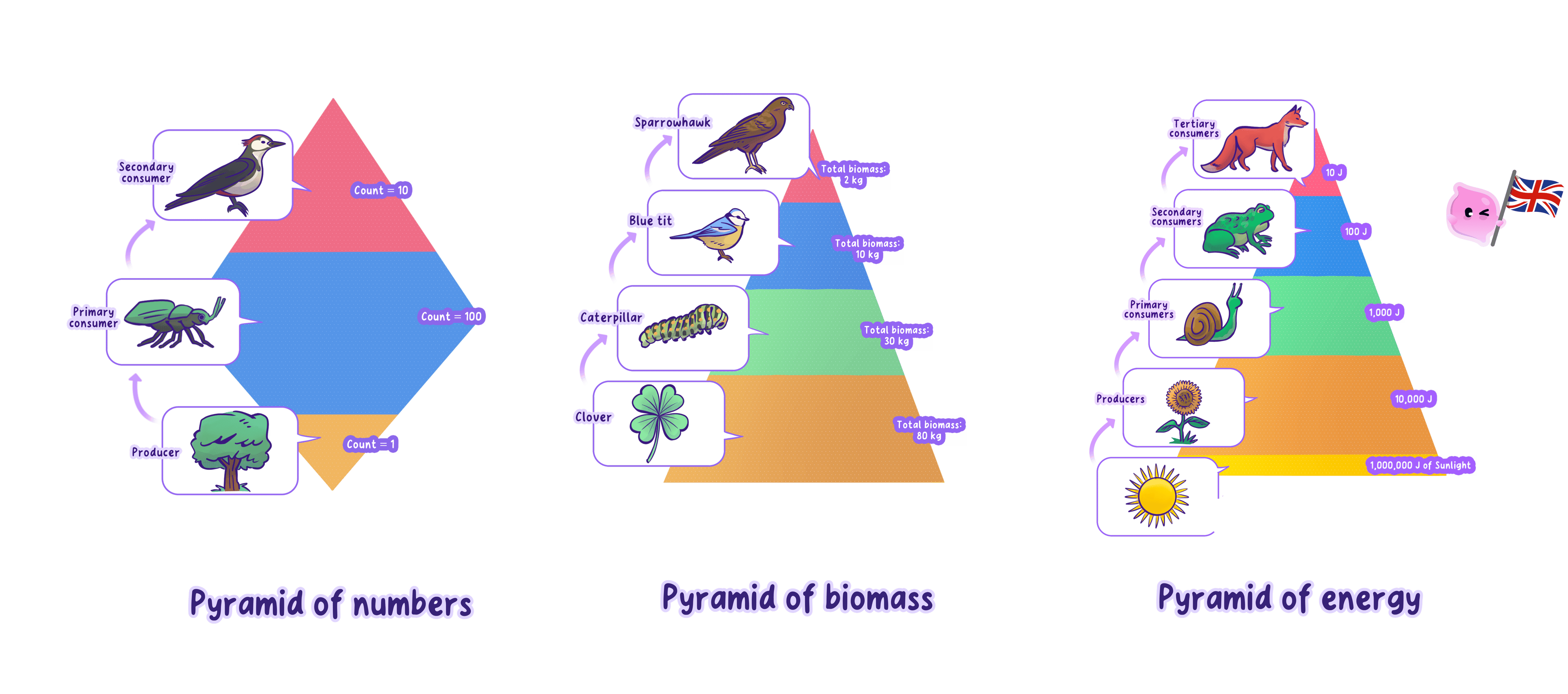
- The retained pyramid illustrates feeding positions; its transfer percentages are illustrative rather than a rule for every food chain.
Start at a producer and count feeding links along the route shown, giving both the consumer name and its numbered trophic level when requested.
One species can occupy several levels
- An omnivore may feed directly on a producer in one chain and eat a consumer in another.
- A blackbird eating berries acts as a primary consumer, while a blackbird eating a leaf-eating caterpillar acts as a secondary consumer.
- A predator that eats both herbivores and other predators can also feed at more than one trophic level, even if it is not an omnivore.
- Use each stated feeding route to assign its level and do not invent links that are absent from the food web.
- Along berry plant→blackbird\text{berry plant}\rightarrow\text{blackbird}berry plant→blackbird, the blackbird occupies trophic level 222.
- Along leafy plant→caterpillar→blackbird\text{leafy plant}\rightarrow\text{caterpillar}\rightarrow\text{blackbird}leafy plant→caterpillar→blackbird, the blackbird occupies trophic level 333.
- These are two feeding positions of the same species, so a single fixed level would not describe the whole food web.
Decomposers receive material from many levels
- Dead organisms and organic waste can originate from producers and from every consumer level.
- Decomposer bacteria and fungi use this material, so they are not restricted to material from the top predator.
- They are often shown linked to several levels or outside the numbered chain because their feeding cannot be represented by one fixed step after the final consumer.
- A top predator can itself be decomposed after death even though it has no regular predators in the living food web.
- What direction does an arrow point in a food chain?
- Why is a producer assigned trophic level one?
- Which trophic level contains a secondary consumer?
- How can one bird species occupy two trophic levels?
- Why are decomposers not placed only above the top predator?
4.1.9 Pyramids of biomass
Biomass measures biological material
Biomass
The mass of living material in an organism, usually measured as dry mass because water content varies.
Pyramid of biomass
A pyramid of biomass is a diagram whose bar widths represent the total biomass at successive trophic levels.
- Biomass compares the amount of biological material in organisms rather than simply counting the organisms.
- It is usually measured as dry mass, so differences in water content do not dominate the comparison.
- For example, two samples with the same fresh mass may contain different amounts of dry biological material if one contains more water.
- A biomass value must identify the organisms, the area sampled and the time of measurement for a fair comparison.
- Values may be expressed as total dry mass, such as g\mathrm{g}g or kg\mathrm{kg}kg, or as dry mass per unit area, such as g m−2\mathrm{g\,m^{-2}}gm−2.
- To find the biomass of a trophic level, combine the biomass of all the organisms assigned to that level in the area being compared.
Measuring dry biomass
- Aim: measure the dry biomass of a small representative plant sample while removing variation due to its water content.
- Apparatus: use a balance, labelled heat-resistant weighing containers, a teacher-controlled drying oven, forceps and a suitable place for samples to cool without taking up moisture.
- Method, drying and weighing:
- Use a small teacher-provided plant sample, or collect a permitted representative sample from a measured area without damaging protected plants or habitats.
- Weigh the empty, dry container and record its mass before adding the sample.
- Remove adhering soil carefully, keep all the plant material being measured and record the mass of the container with the fresh sample.
- Place the container and sample in a drying oven at a suitable low drying temperature, such as 80 ∘C80\,^{\circ}\mathrm{C}80∘C under the teacher’s method, until much of the water has evaporated.
- Allow the container to cool in a dry place before weighing, then return it to the oven for a further drying period.
- Repeat drying, cooling and weighing until successive masses agree within the balance’s resolution, indicating that further drying causes no measurable loss.
- Results and processing:
- Subtract the empty-container mass from the final constant mass of the container and dried sample to obtain the sample’s dry biomass.
- If samples came from different measured areas, divide each dry mass by its sampled area before comparing the results.
- Dry several representative samples separately and calculate a mean, because one sample may not represent variation within the habitat.
- Limitations: drying is destructive and only measures the sampled material, so estimate wider biomass cautiously and minimise the number of organisms collected.
- Safety: use heat-resistant handling equipment for hot containers, follow the teacher’s oven instructions and avoid inhaling dust from dried material.
Draw bars using one scale
- Place producers at the base, followed by primary consumers and then any higher consumers in feeding order.
- Draw horizontal rectangular bars of equal height, with each bar centred on the same vertical line.
- Make the bar width proportional to total biomass, using the same scale at every trophic level.
- Label each bar with its trophic level or organisms and give the biomass values and units.
- For a chosen scale, calculate bar width=biomass valuebiomass represented by one unit of width\text{bar width}=\dfrac{\text{biomass value}}{\text{biomass represented by one unit of width}}bar width=biomass represented by one unit of widthbiomass value.
- The width represents the biomass of the whole level, not the size or biomass of one average organism.
- Suppose the biomass values are 1200 g m−21200\,\mathrm{g\,m^{-2}}1200gm−2 for producers, 240 g m−2240\,\mathrm{g\,m^{-2}}240gm−2 for primary consumers and 60 g m−260\,\mathrm{g\,m^{-2}}60gm−2 for secondary consumers.
- Using a scale of 1 cm1\,\mathrm{cm}1cm for each 120 g m−2120\,\mathrm{g\,m^{-2}}120gm−2, the producer bar is 1200120=10 cm\dfrac{1200}{120}=10\,\mathrm{cm}1201200=10cm wide.
- The primary-consumer bar is 240120=2 cm\dfrac{240}{120}=2\,\mathrm{cm}120240=2cm wide.
- The secondary-consumer bar is 60120=0.5 cm\dfrac{60}{120}=0.5\,\mathrm{cm}12060=0.5cm wide.
- Centre all three bars and keep their heights equal so that their widths show the differences in biomass.
Only part of food becomes new biomass
- A consumer must eat, digest and absorb food before some of its molecules can become part of new cells.
- Uneaten material never enters that consumer, for example roots left behind when a rabbit eats a plant’s leaves.
- Undigested material passes through the gut and is removed in faeces by egestion, so it is not absorbed and incorporated into the consumer’s tissues.
- For example, some tough plant material in an animal’s diet may be egested rather than digested.
- Some absorbed substances are broken down to make metabolic waste, which is removed by excretion.
- For example, removing urea in urine transfers nitrogen-containing material out of a mammal’s body.
- During respiration, organic molecules are broken down and their atoms can leave the body in substances such as carbon dioxide and water.
- The energy released by respiration supports processes including movement and maintenance, with energy eventually dissipated as heat.
- Only the material retained in growth and reproduction adds to the consumer biomass that can be passed on when it is eaten.
- Egestion removes undigested food from the gut, whereas excretion removes waste produced by metabolism.
- Biomass is not converted into heat: respiration transfers atoms into products while releasing energy, which can be dissipated as heat.
Biomass usually decreases up the chain
- Because much material is not retained as new consumer tissue, less biomass is usually supported at each successive trophic level.
- This produces the familiar upright pyramid, with a wide producer bar and narrower bars above it.
- Material leaving one food-chain pathway has not vanished: uneaten remains and waste can supply decomposers and enter material cycles.
- A pyramid of biomass is a snapshot, so the values can change with season, growth, reproduction and death.
- In some aquatic systems, small producers reproduce and are eaten so rapidly that their biomass at one instant can be lower than the biomass of the consumers they support.
- Such a snapshot does not show more biomass being created at each transfer; the producer biomass is being continually replaced.
- When explaining a smaller biomass at the next level, identify a specific route such as uneaten tissue, egested material, excreted waste or respiration.
- Link that route to material not retained in new consumer tissue, rather than saying only that biomass is lost.
Read the quantity each diagram shows
- A pyramid of numbers counts organisms, so one large tree can have a narrower bar than the many small insects feeding on it.
- A biomass pyramid takes their different sizes into account by comparing their total mass.
- A diagram showing energy transferred over an area and time measures a different quantity from a snapshot of biomass.
- Read the labels and units before interpreting the retained comparison diagram, and do not treat organism number, dry mass and energy as interchangeable.
- Why is biomass usually measured as dry mass?
- What does the width of a biomass-pyramid bar represent?
- Why does egested material not become new consumer biomass?
- How does respiration reduce the organic material retained in a consumer?
- Why can a snapshot of an aquatic biomass pyramid have a small producer bar?
4.1.10 Efficiency of biomass transfers
Efficiency measures biomass transfer
Biomass transfer efficiency
Biomass transfer efficiency is the percentage of biomass available at one trophic level that becomes new biomass at the next trophic level.
- Only part of the biomass available at one trophic level is converted into new biomass at the next level.
- Transfer efficiency describes how large that transferred part is compared with the starting amount.
- For a biomass transfer, use efficiency=biomass transferred to the next levelbiomass available at the previous level×100%\text{efficiency}=\dfrac{\text{biomass transferred to the next level}}{\text{biomass available at the previous level}}\times100\%efficiency=biomass available at the previous levelbiomass transferred to the next level×100%.
- Place the amount transferred in the numerator and the starting amount in the denominator.
- Use quantities measured on a comparable basis, including the same area and time period where those are specified.
- The masses must have the same units before division, so convert units first if necessary.
- Because identical units cancel in the ratio, an efficiency is given as a percentage, not in grams or kilograms.
- Of 800 kg800\,\mathrm{kg}800kg of producer biomass available over a stated period, 120 kg120\,\mathrm{kg}120kg becomes new primary-consumer biomass.
- The transferred fraction is 120800=0.15\dfrac{120}{800}=0.15800120=0.15.
- The percentage transfer efficiency is 0.15×100%=15%0.15\times100\%=15\%0.15×100%=15%.
- The amount not transferred into that consumer biomass is 800−120=680 kg800-120=680\,\mathrm{kg}800−120=680kg.
- The percentage not transferred is 100%−15%=85%100\%-15\%=85\%100%−15%=85%.
Use the supplied values
- The often-used figure of about 10%10\%10% is an illustration, not a fixed value that applies to every ecosystem or feeding step.
- Differences in food digestibility, the proportion eaten and the amount used in respiration can produce different transfer efficiencies.
- An efficiency for one step cannot automatically be used for another step unless the question states that they are equal.
- Use the relevant data to calculate each transfer rather than replacing the data with an assumed percentage.
Do not invert the fraction: dividing the larger starting biomass by the smaller transferred biomass gives a result above 100%100\%100% and does not calculate the transfer efficiency.
Convert units before dividing
- A mass stated in kilograms can be converted to grams using 1 kg=1000 g1\,\mathrm{kg}=1000\,\mathrm{g}1kg=1000g.
- Writing the conversion before the substitution makes it clear which quantities are being compared.
- Keep unrounded values during intermediate steps, then round the final result to the precision requested.
- A transfer produces 450 g450\,\mathrm{g}450g of new consumer biomass from 3.0 kg3.0\,\mathrm{kg}3.0kg of available food biomass.
- Convert the starting mass: 3.0 kg=3000 g3.0\,\mathrm{kg}=3000\,\mathrm{g}3.0kg=3000g.
- Substitute comparable masses: efficiency=4503000×100%=15%\text{efficiency}=\dfrac{450}{3000}\times100\%=15\%efficiency=3000450×100%=15%.
- The same result follows from converting 450 g450\,\mathrm{g}450g to 0.450 kg0.450\,\mathrm{kg}0.450kg and calculating 0.4503.0×100%\dfrac{0.450}{3.0}\times100\%3.00.450×100%.
Calculate an unknown biomass
- To calculate the biomass transferred, multiply the starting biomass by the efficiency expressed as a decimal fraction.
- Use biomass transferred=starting biomass×percentage efficiency100\text{biomass transferred}=\text{starting biomass}\times\dfrac{\text{percentage efficiency}}{100}biomass transferred=starting biomass×100percentage efficiency.
- To calculate the starting biomass required, rearrange to starting biomass=biomass transferredpercentage efficiency/100\text{starting biomass}=\dfrac{\text{biomass transferred}}{\text{percentage efficiency}/100}starting biomass=percentage efficiency/100biomass transferred.
- A percentage must be divided by 100100100 before it is used as a multiplier, so 12%12\%12% becomes 0.120.120.12.
- With a starting biomass of 250 kg250\,\mathrm{kg}250kg and an efficiency of 12%12\%12%, the transferred biomass is 250×0.12=30 kg250\times0.12=30\,\mathrm{kg}250×0.12=30kg.
- If 30 kg30\,\mathrm{kg}30kg is the transferred biomass and the efficiency is 12%12\%12%, the starting biomass is 300.12=250 kg\dfrac{30}{0.12}=250\,\mathrm{kg}0.1230=250kg.
- The reverse calculation gives a larger starting mass because only part of it was transferred.
Repeated transfers reduce available biomass
- Each additional feeding step retains only a fraction of the biomass available at the previous level.
- For successive transfers, multiply the fractional efficiencies rather than adding the percentage efficiencies.
- This means that the overall efficiency across several steps is smaller than the efficiency of an individual step.
- Suppose 2000 kg2000\,\mathrm{kg}2000kg of producer biomass supplies a first transfer with efficiency 20%20\%20% and a second transfer with efficiency 15%15\%15%.
- The new primary-consumer biomass is 2000×0.20=400 kg2000\times0.20=400\,\mathrm{kg}2000×0.20=400kg.
- The new secondary-consumer biomass is 400×0.15=60 kg400\times0.15=60\,\mathrm{kg}400×0.15=60kg.
- The overall transfer from producers to secondary consumers is 602000×100%=3%\dfrac{60}{2000}\times100\%=3\%200060×100%=3%.
- Equivalently, 0.20×0.15=0.030.20\times0.15=0.030.20×0.15=0.03, which is 3%3\%3%, not 35%35\%35%.
Energy and biomass data
- An energy-transfer efficiency uses the same ratio method, but both quantities must be energy values, such as values measured in kJ\mathrm{kJ}kJ.
- Do not divide a biomass value in g\mathrm{g}g by an energy value in kJ\mathrm{kJ}kJ and label the result a percentage transfer efficiency.
- The retained energy-pyramid diagram shows the declining energy supply through feeding levels and supports the explanation for limited food-chain length.
- A snapshot of biomass and a measured transfer over time describe different things, so interpret the quantities exactly as the data labels specify.
- When efficiencies are positive but below 100%100\%100%, energy and biomass available through that feeding route become progressively smaller, rather than suddenly disappearing at a fixed level.
Transfer losses limit food-chain length
- Biomass contains chemical energy that consumers need for maintenance, movement, growth and reproduction.
- At each feeding step, material fails to become new consumer biomass through the routes explained previously, leaving less biomass and associated energy for another level.
- Eventually the supply reaching a further level may be too small to maintain a viable population of consumers.
- This helps explain why food chains usually contain only a few trophic levels, rather than extending indefinitely.
- There is no single compulsory maximum number of levels: the amount produced at the base and the efficiencies of the transfers both affect what can be supported.
- Large top predators often occur at low densities and range over large areas to obtain enough prey.
- The percentages in this illustration show one possible sequence of transfers and should not replace measured values in a calculation.
- To explain a limit on food-chain length, link repeated inefficient transfers to too little biomass and energy reaching a further level to support a population.
- For a calculation, identify the two levels being compared, show the substituted values and state the final percentage.
- Which biomass belongs in the denominator of a transfer-efficiency calculation?
- Why must the two masses use the same units?
- How is a percentage converted into a multiplier?
- Why are successive transfer efficiencies multiplied rather than added?
- How do inefficient transfers limit the length of a food chain?
