Variation within populations
Definition
Genetic variation
Genetic variation is the difference in DNA sequences between individuals of the same species.
Definition
Population
A population is all the organisms of one species living in the same area at the same time.
Definition
Allele
An allele is an alternative version of a gene.
- Individuals of the same species share many features, but a population usually contains a wide range of inherited differences.
- Members of a population usually have the same kinds of genes, while the alleles they carry and the combinations of those alleles can differ.
- A gene can have several alleles across a population, even though a diploid individual normally carries only two copies of that gene, one inherited from each parent.
- Genetic variation therefore includes both differences between DNA base sequences and differences in the combinations of alleles present in individuals.
- Two organisms can look very similar while differing at many positions in their DNA, so visible appearance alone underestimates genetic variation.
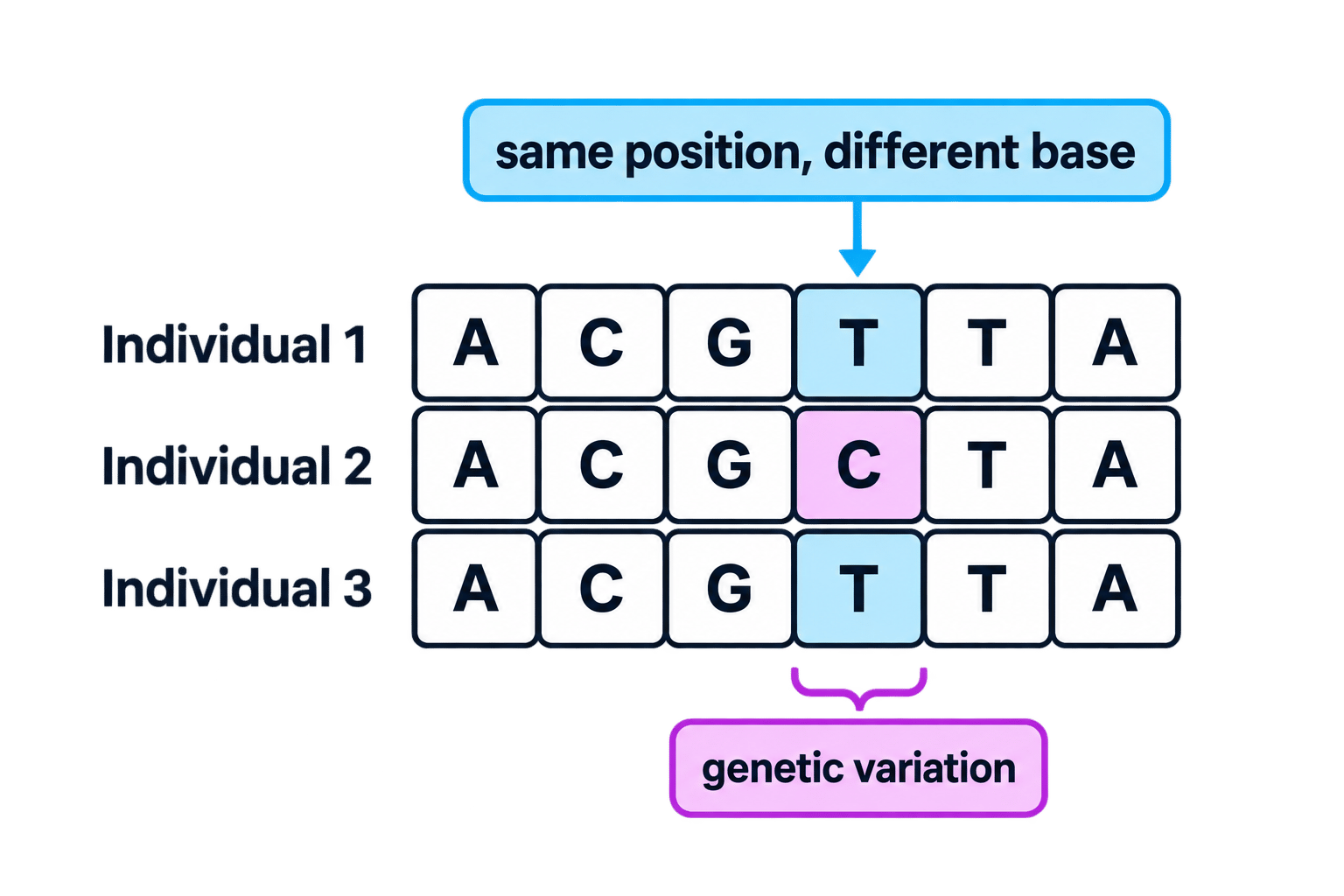
- The illustration shows different bases at the same position in a DNA sequence, which is one possible form of genetic variation.
Example
- Three individuals of the same species have corresponding DNA fragments written as ACGTTA\mathrm{ACGTTA}ACGTTA, ACGCTA\mathrm{ACGCTA}ACGCTA and ACGTTA\mathrm{ACGTTA}ACGTTA.
- Comparing the same position in each fragment shows that the second individual has C\mathrm{C}C where the other two have T\mathrm{T}T.
- This difference is evidence of genetic variation, but it does not by itself show whether any visible characteristic is affected.
- The matching short fragments in the first and third individuals do not show that their entire genomes are identical.
Sources of genetic differences
Definition
Mutation
A mutation is a change in the base sequence of DNA.
- Mutations are the original source of new genetic variants, including new alleles.
- They occur without being directed towards a particular useful outcome, so an organism does not produce a specific mutation because it needs that characteristic.
- A mutation can be passed to offspring only if the altered genetic material is included in the cells that produce the offspring.
- In sexually reproducing animals, a mutation confined to an ordinary body cell is generally not passed to the next generation.
- Sexual reproduction brings existing alleles together in new combinations, which explains why offspring usually differ from both their parents and their siblings.
- Meiosis produces genetically different gametes, and the random meeting of gametes during fertilisation adds further combinations.
- The chromosome combinations in the diagram illustrate this mixing of inherited material; the mixing rearranges existing alleles rather than creating new versions of them.
Common Mistake
Mutation can create a new allele, whereas meiosis and fertilisation produce new combinations of alleles.
Genetic and visible variation
- Genotype is the combination of alleles an organism has.
- Phenotype is the observable characteristics of an organism, produced by its genotype and its interactions with the environment.
- A difference in phenotype can result from genetic differences, environmental differences or both, so visible variation is not automatically evidence of different alleles.
- For example, a plant may be short because it carries alleles associated with short growth, because it receives too few mineral ions, or because both factors affect it.
- Most genetic variants do not change the phenotype, while some alter a characteristic and a small number can have a large effect.
- A variant with no obvious effect is still a DNA difference and therefore still contributes to genetic variation.
- When comparing individuals, use evidence about their inherited material to distinguish genetic variation from changes caused only by their surroundings.
Exam technique
- Explain genetic differences using different alleles or different DNA sequences, rather than saying that members of a species simply have completely different genes.
- If the evidence gives only a visible characteristic, consider whether the environment could also explain the difference.
Self review
- What does genetic variation mean?
- How can a population contain more alleles of a gene than one diploid individual carries?
- Which process creates new alleles?
- How does sexual reproduction produce new allele combinations?
- Why does a difference in appearance not always demonstrate genetic variation?