Mendel and his pea plants
- Gregor Mendel was a monk who studied inheritance in the garden of his monastery at Brno during the 185018501850s and 186018601860s.
- He chose the garden pea because it grows quickly, produces large numbers of offspring and shows characteristics that fall into two clear forms.
- He followed seven characteristics, among them stem height, flower colour, seed shape and pod colour.
- He began with pure-breeding lines, checking over several generations that each line always produced offspring like itself.
- He controlled pollination by hand, and the method mattered as much as the counting.
- The anthers were cut out of a flower before its own pollen ripened, so the plant could not pollinate itself.
- Pollen from a chosen plant was then brushed onto the stigma of that flower with a fine brush.
- The treated flower was covered with a small bag so that no stray pollen from other plants could reach it.
- Every cross therefore had a known male parent and a known female parent, which is what made the results interpretable.
- He counted every offspring rather than judging by eye, working with thousands of plants so that chance had little effect on the proportions he found.
Counting large numbers is what separated Mendel's work from the breeding studies before it, because small samples had given results too irregular for any pattern to show.
What the crosses showed
- Crossing a pure-breeding tall plant with a pure-breeding short plant gave a first generation in which every plant was tall.
- The short form had not been lost, because crossing those tall offspring with one another brought short plants back in the following generation.
- In that second generation the plants appeared in a ratio close to three tall to one short.
- One of his crosses gave 787787787 tall plants and 277277277 short plants, which is a ratio of 2.84:12.84 : 12.84:1.
- The same pattern of one form vanishing and then returning at about 3:13:13:1 appeared in all seven characteristics he followed.
- From these counts Mendel drew three conclusions, none of which needed any knowledge of what was inside the cell.
- Each characteristic is controlled by a pair of separate units of inheritance, one received from each parent.
- One unit of a pair can mask the other, which explains why the short form disappeared in the first generation.
- The two units of a pair separate when gametes are formed, so each gamete carries only one of them.
- Those three conclusions are recognised today as alleles, dominance, and the separation of alleles during meiosis.
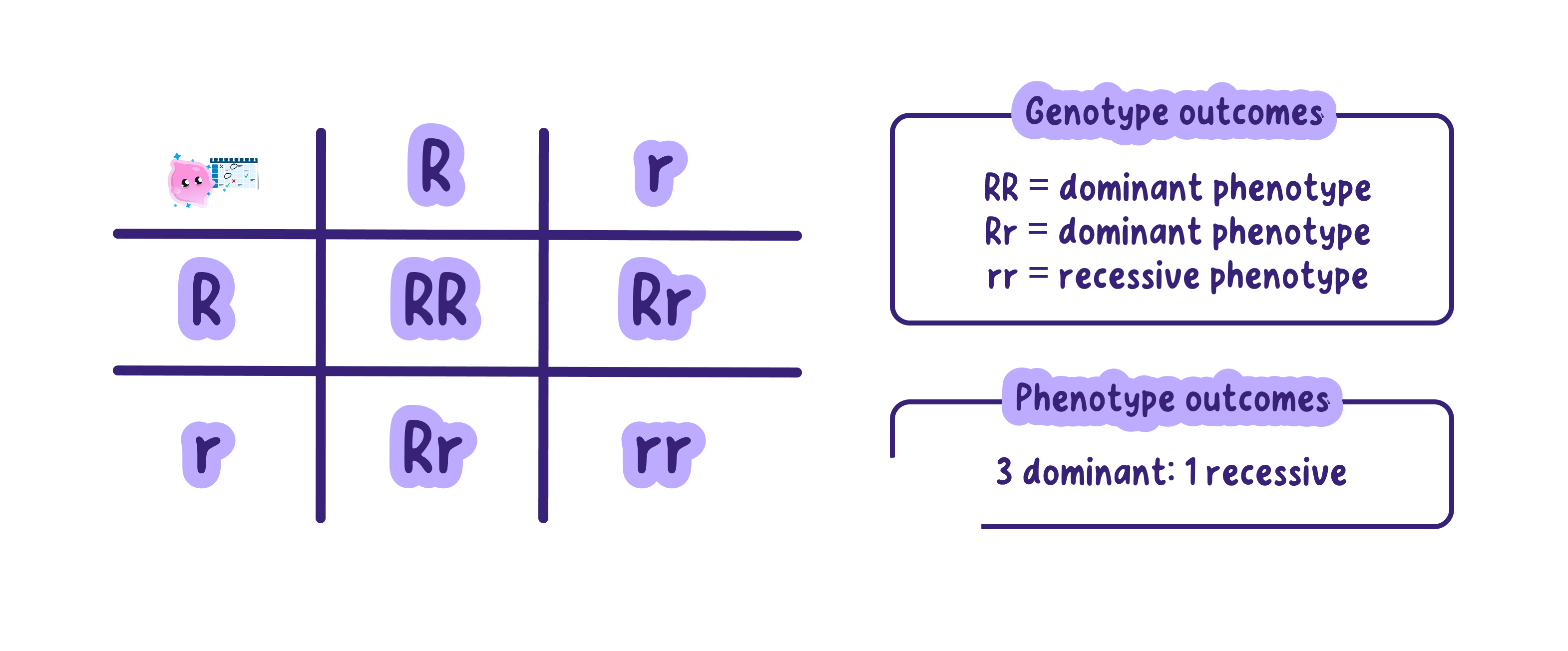
- Mendel's pure-breeding tall line can be written TTTTTT and his pure-breeding short line tttttt.
- The cross TT×ttTT \times ttTT×tt gives every offspring the genotype TtTtTt, which accounts for a first generation that was entirely tall.
- Crossing those offspring with each other, Tt×TtTt \times TtTt×Tt, gives TTTTTT, TtTtTt, TtTtTt and tttttt.
- Three of the four carry a TTT and are tall while the fourth is tttttt and is short, which is the 3:13:13:1 pattern Mendel counted.
- His figures of 787787787 and 277277277 sit close to the 798798798 and 266266266 that a perfect 3:13:13:1 ratio would give for 106410641064 plants.
Why his work was ignored
- Mendel published his results in 186618661866 in the journal of a local natural history society, which few biologists elsewhere read.
- His argument rested on ratios and counting, an approach unfamiliar to naturalists who described organisms rather than measured them.
- Most biologists of the time accepted blending inheritance, in which the characteristics of the two parents mixed to give an intermediate offspring.
- Mendel's units stayed separate and could reappear unchanged in a later generation, which contradicted blending directly.
- Nothing was known of chromosomes, genes or DNA, so there was no structure inside the cell that his units could be matched to.
- Mendel became abbot of his monastery in 186818681868, and the administrative work that followed left him little time for breeding experiments.
- He died in 188418841884 without his explanation having been taken up by other biologists.
Do not write that Mendel's work was rejected because it was wrong. His results were sound and repeatable, and the difficulty was that no known structure in the cell could be identified with his units of inheritance.
From units to genes
Chromosome
A chromosome is a structure made of a long DNA molecule associated with proteins that carries many genes.
Gene
A gene is a section of DNA that contains the instructions for making a particular protein.
Allele
An allele is an alternative version of a gene.
- During the 188018801880s better microscopes and new stains allowed biologists to watch chromosomes move during cell division.
- Chromosomes were seen to occur in pairs, to separate during the division that forms gametes, and to be restored to pairs at fertilisation.
- That behaviour matched Mendel's units of inheritance point for point, which is why his paper was rediscovered and confirmed around 190019001900.
- By 191519151915 genes had been shown to lie in a fixed order along chromosomes, which gave Mendel's units a physical position in the cell.
- In 195319531953 the double helix structure of DNA was described, showing how a gene can be copied exactly and how it stores a coded instruction.
- Mendel's units of inheritance are now called genes, and the alternative forms he described as masking one another are now called alleles.
- The development therefore runs in a clear order: Mendel's counted ratios, then the observed behaviour of chromosomes, then genes, then the structure of DNA.
Mendel worked out the rules of inheritance decades before anyone knew that chromosomes carried genes or that genes were made of DNA, and each later discovery explained the pattern he had already measured.
- Give a reason rooted in the science of the time when asked why Mendel's work was not accepted, such as chromosomes and genes being unknown.
- Name the discoveries in order, because questions often ask which came first.
- Call what Mendel proposed units of inheritance rather than genes, since the word gene did not exist in his lifetime.
- Quote the 3:13:13:1 ratio when explaining his conclusions, because that figure is the evidence they rest on.
- Which plant did Mendel study, and why was it a good choice?
- Describe how Mendel controlled which plant pollinated which.
- What ratio did Mendel find in the second generation of his crosses?
- State the three conclusions Mendel drew from his results.
- Give two reasons why his work was not accepted during his lifetime.
- What discovery in the 188018801880s eventually led to his work being accepted?
