Grouping organisms
Definition
Classification
Classification is the organisation of organisms into groups according to shared characteristics.
- A classification system organises the variety of living organisms so that their features can be compared and information about them can be shared.
- Classifications can use external appearance, internal structure, cell organisation and molecular information.
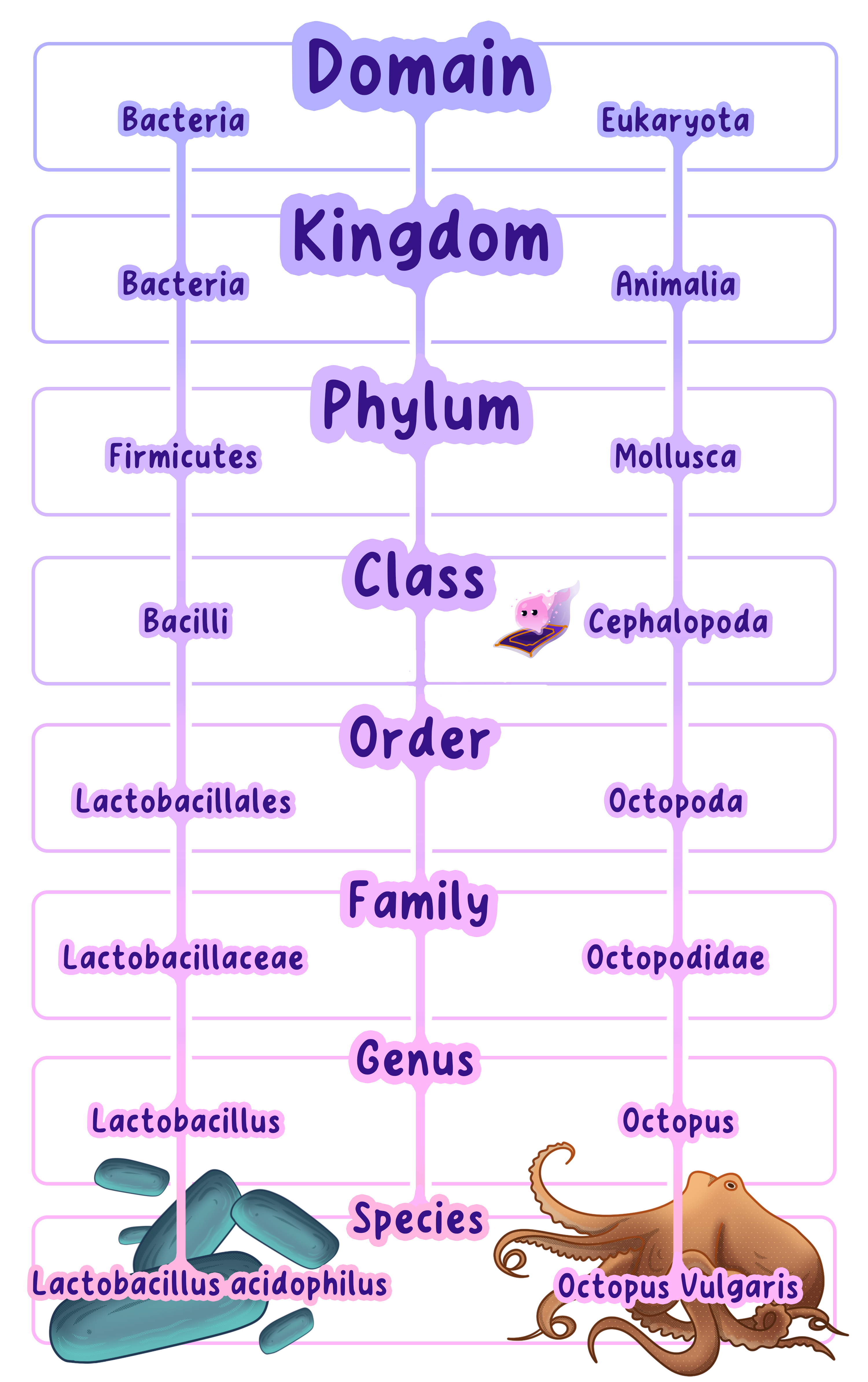
- The traditional hierarchy contains kingdom, phylum, class, order, family, genus and species, with domain placed above kingdom in a domain-based system.
- Each smaller group lies within a larger group, so species in the same genus also share a family.
- A natural classification aims to place more closely related organisms together in the smaller groups.
Artificial and natural systems
Definition
Artificial classification
Artificial classification groups organisms using selected convenient features rather than their evolutionary relationships.
Definition
Natural classification
Natural classification groups organisms according to their evolutionary relationships and common ancestry.
- An artificial system may use a few easily observed features, such as where organisms live or whether they have wings, because these make sorting convenient.
- Grouping all swimming animals together would combine fish with mammals such as dolphins, even though those animals do not share a recent common ancestor.
- A natural system uses evidence from many characteristics to represent common ancestry, rather than relying only on a convenient resemblance.
- Shared internal structures can reveal relationships that a similar outward shape hides, so both the number and biological significance of shared features matter.
- A shark, penguin and dolphin all have structures that help them swim, but similarity in function alone does not establish a close evolutionary relationship.
- The penguin and dolphin have corresponding forelimb bones inherited from a shared vertebrate ancestor, while their streamlined swimming forms do not place either within the fish.
Example
- A sorting rule that groups bats with birds because both can fly is an artificial classification.
- Considering hair, milk production and other mammalian features places bats with mammals in a natural classification.
- The shared ability to fly is therefore insufficient evidence that bats and birds belong in the same small natural group.
DNA reveals relationships
Definition
Molecular phylogenetics
Molecular phylogenetics is the study of evolutionary relationships by comparing biological molecules such as DNA.
- Phylogeny is the evolutionary history and relationships of organisms.
- DNA sequencing determines the order of bases in DNA, allowing scientists to compare corresponding sequences from different organisms.
- For comparable DNA regions, a greater similarity in base sequence generally indicates a closer evolutionary relationship and a more recent common ancestor.
- Differences build up as lineages diverge, so comparing many corresponding sequences provides stronger evidence than comparing one short fragment.
- Scientists can also compare amino acid sequences in proteins and combine molecular findings with structural evidence.
- Molecular comparisons provide evidence about organisms that look very different as well as organisms whose appearance is misleadingly similar.
- If this evidence conflicts with an existing grouping, scientists can revise the classification to reflect the better-supported relationships.
- Improved microscopy also revealed differences in cell structures, helping scientists distinguish groups that earlier methods could not separate.
Exam technique
- Link similar DNA base sequences to a more recent common ancestor when explaining a close relationship.
- Explain reclassification as a response to new evidence, naming the evidence rather than simply saying that technology improved.
Reading evolutionary trees
- A phylogenetic tree is a branching diagram representing a proposed pattern of evolutionary relationships.
- A branch point represents a common ancestor, and the descendants connected through that point share that ancestor.
- To compare two species, trace their branches backwards to the first common branch point, then compare this with the branch points shared with other species.
- Species whose branches meet at a more recent common ancestor are more closely related, regardless of how close their names appear on the page.
- A labelled characteristic on a branch indicates a feature shared by descendants of that branch in the simplified tree.
- Evidence can change the groups shown on a tree, as illustrated by the grouping of birds with other descendants within the reptile lineage.
- The three-domain system separates Bacteria, Archaea and Eukaryota, reflecting molecular and cellular differences that older classifications did not fully recognise.
- Bacteria and archaea both lack a membrane-bound nucleus, but molecular differences support their placement in distinct domains.
- Eukaryota includes organisms whose cells contain nuclei, including animals, plants, fungi and protists.
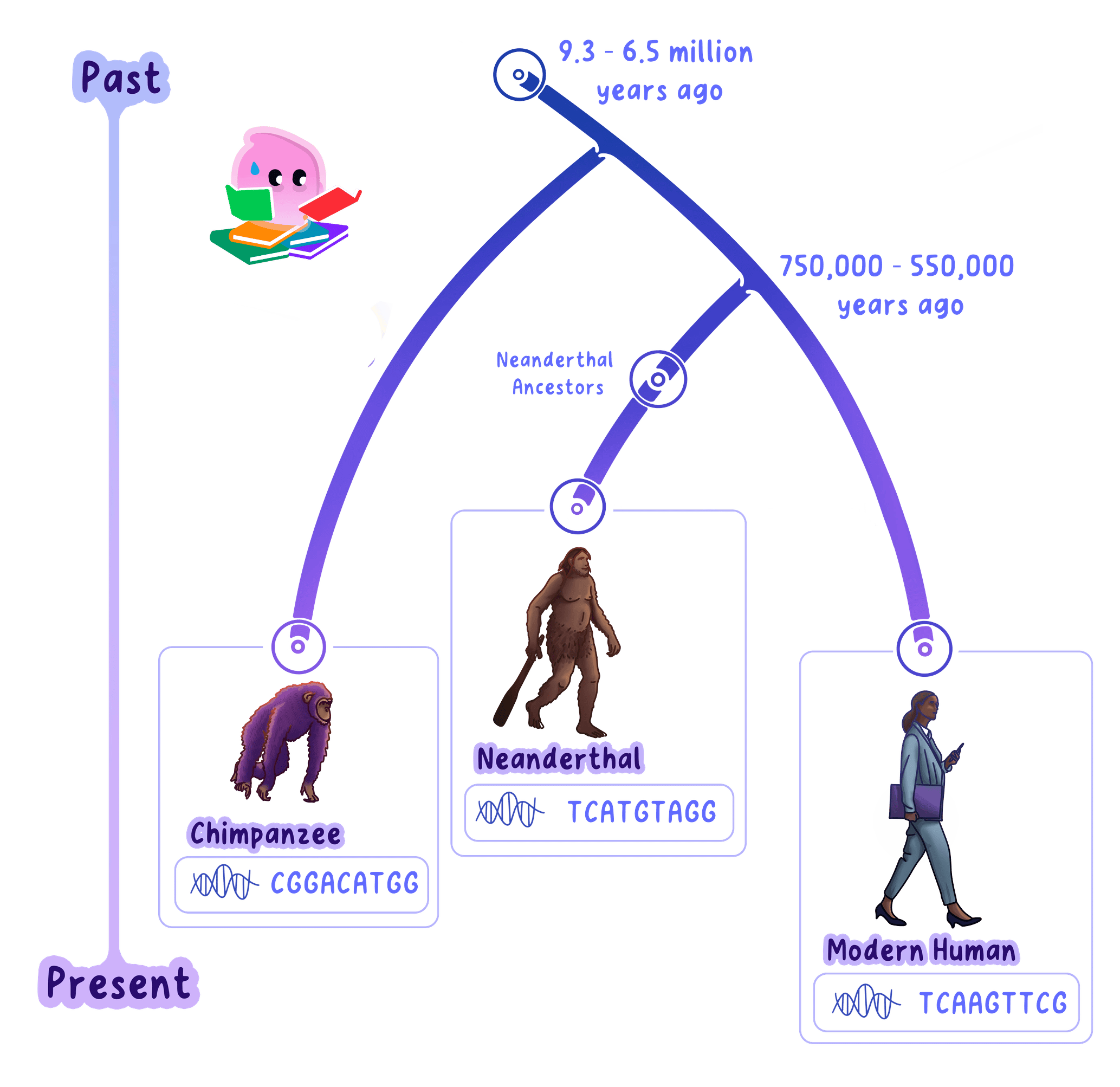
- The broad ancestry diagram shows how present-day groups can be traced back towards shared ancestors; the branching relationships are the feature to interpret here.
- Some trees include a time scale, but branch length indicates time only when the diagram explicitly provides that information.
- The DNA comparison diagram illustrates how molecular differences can inform estimates of divergence, although exact dates cannot be read from an unscaled tree.
Names and identification
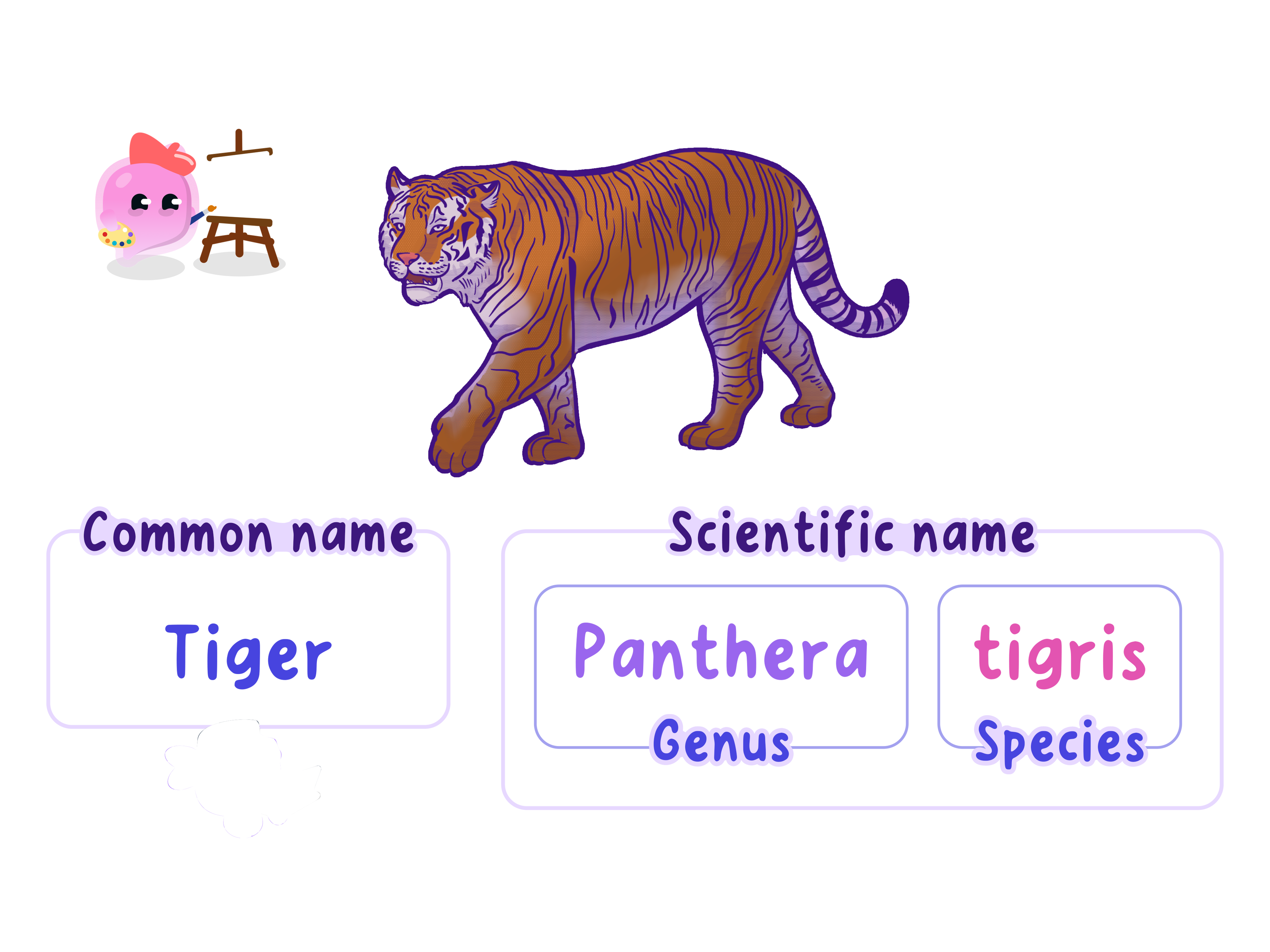
- A binomial name is the two-part scientific name of a species, consisting of its genus name and specific name.
- The genus starts with a capital letter and the specific name uses a lower-case initial, with both words italicised in print or underlined separately by hand.
- For example, the tiger belongs to the genus Panthera and has the specific name tigris, as the naming illustration shows.
- Scientific names allow people using different languages to identify the same species, avoiding ambiguity caused by shared common names.
- An identification key guides the identification of a specimen using observable features, whereas a natural classification describes how organisms are related.
- The leaf key illustrates a sequence of paired choices, but the order of those choices does not itself represent evolutionary ancestry.
Common Mistake
The position of a species at the top, bottom or far right of a tree does not mean it is more advanced than the other species.
Self review
- What is the difference between artificial and natural classification?
- Why can similar functions give a misleading impression of relatedness?
- How can DNA sequencing change a classification?
- What does a branch point on a phylogenetic tree represent?
- Why is an identification key not necessarily an evolutionary tree?
