The two building blocks of a lipid
Lipid
A biological molecule made of one glycerol molecule joined to three fatty acids, used as a concentrated energy store and as insulation.
Glycerol
The small three-carbon molecule that forms the backbone of every lipid, holding three fatty acids.
Fatty acid
A molecule with a long chain of carbon and hydrogen atoms that joins to glycerol to build a lipid.
- A lipid is built from two different kinds of subunit, which makes it unlike a carbohydrate or a protein.
- Glycerol is the small three-carbon molecule that acts as the backbone, and there is exactly one of it in every lipid molecule.
- A fatty acid is a long chain of carbon and hydrogen atoms with an acid group at one end, and three of them are attached to each glycerol.
- The ratio of subunits is therefore 1:31:31:3, one glycerol to three fatty acids, and a lipid built this way is called a triglyceride.
- Because there are two kinds of subunit rather than one repeating monomer, a lipid is not a polymer in the way that starch and a protein are.
- A lipid molecule is also a fixed size, since it always contains four subunits, whereas a polymer chain can be any length.
- Lipids contain carbon, hydrogen and oxygen like carbohydrates, but the long fatty acid chains hold a far smaller proportion of oxygen.
- Less oxygen means more carbon to hydrogen bonds per molecule, and that is exactly why a lipid releases so much more energy per gram than a carbohydrate.
- The three fatty acids attached to one glycerol do not have to be identical, which is one reason different lipids have different properties.
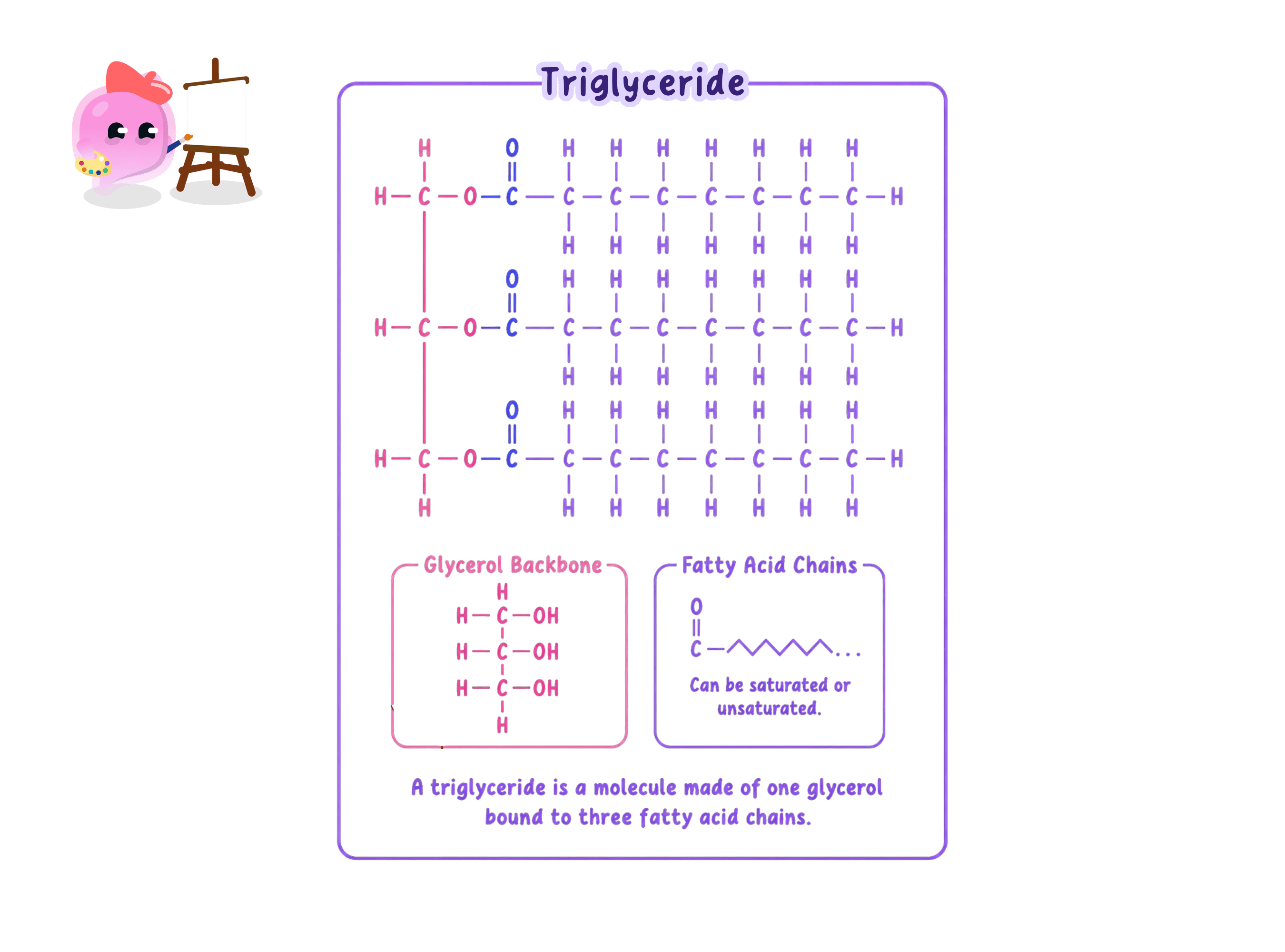
- Fatty acids and glycerol are the subunits a lipid is built from and also the products released when it is broken down.
- Any lipid that is solid at room temperature is called a fat, and any lipid that is liquid is called an oil.
Building and breaking lipids
Condensation reaction
A reaction in which two smaller molecules join together and one molecule of water is released.
Hydrolysis
A reaction in which a large molecule is split into smaller ones by adding a molecule of water at each bond broken.
- Each fatty acid is attached to the glycerol by a condensation reaction, and each of those reactions releases one molecule of water.
- Since three fatty acids are attached to each glycerol, building one lipid molecule releases three molecules of water.
- The reactions are controlled by enzymes and need energy from ATP, in the same way that building any large molecule does.
- Hydrolysis reverses the process, adding one molecule of water at each of the three bonds to release the glycerol and the three fatty acids.
- Lipase is the enzyme that hydrolyses lipids, and it does this in the small intestine so that the products are small enough to be absorbed.
- Once absorbed, the fatty acids and glycerol are rejoined to build the particular lipids that body needs, including the lipids of its cell membranes.
- A cell also hydrolyses its own stored lipid whenever it needs the energy, releasing fatty acids that can be respired.
- This is why a body that has used up its stored carbohydrate begins to lose stored fat instead.
Counting the water released when lipids are built
- A cell builds 202020 lipid molecules from glycerol and fatty acids.
- Every lipid molecule needs three fatty acids attached, so three condensation reactions are needed for each one.
- The number of water molecules released is 20×3=6020 \times 3 = 6020×3=60.
- Hydrolysing those 202020 lipid molecules back to their subunits would use up the same 606060 molecules of water.
What cells use lipids for
- A lipid is a concentrated energy store, releasing roughly twice as much energy per gram as a carbohydrate does.
- That matters for an animal that has to carry its store around, because the same amount of energy can be stored in half the mass.
- Lipids are also insoluble in water, so a large store can sit in a cell without dragging water in by osmosis.
- A layer of fat under the skin gives thermal insulation, because fat conducts heat poorly and so slows the rate at which heat is lost.
- Fat packed around organs such as the kidneys and the heart acts as protection, cushioning them against knocks.
- Lipids form part of every cell membrane, which is why even a cell that stores no fat at all still has to make them.
- Plant seeds store lipid rather than starch when they need a compact energy reserve, which is why sunflower and rapeseed are pressed for oil.
- Carbohydrate is the store a cell reaches for first because it can be hydrolysed quickly, while lipid is the longer-term reserve.
- A lipid store therefore does two jobs at once in a mammal, holding energy and reducing heat loss.
Saturated and unsaturated fatty acids
Saturated fatty acid
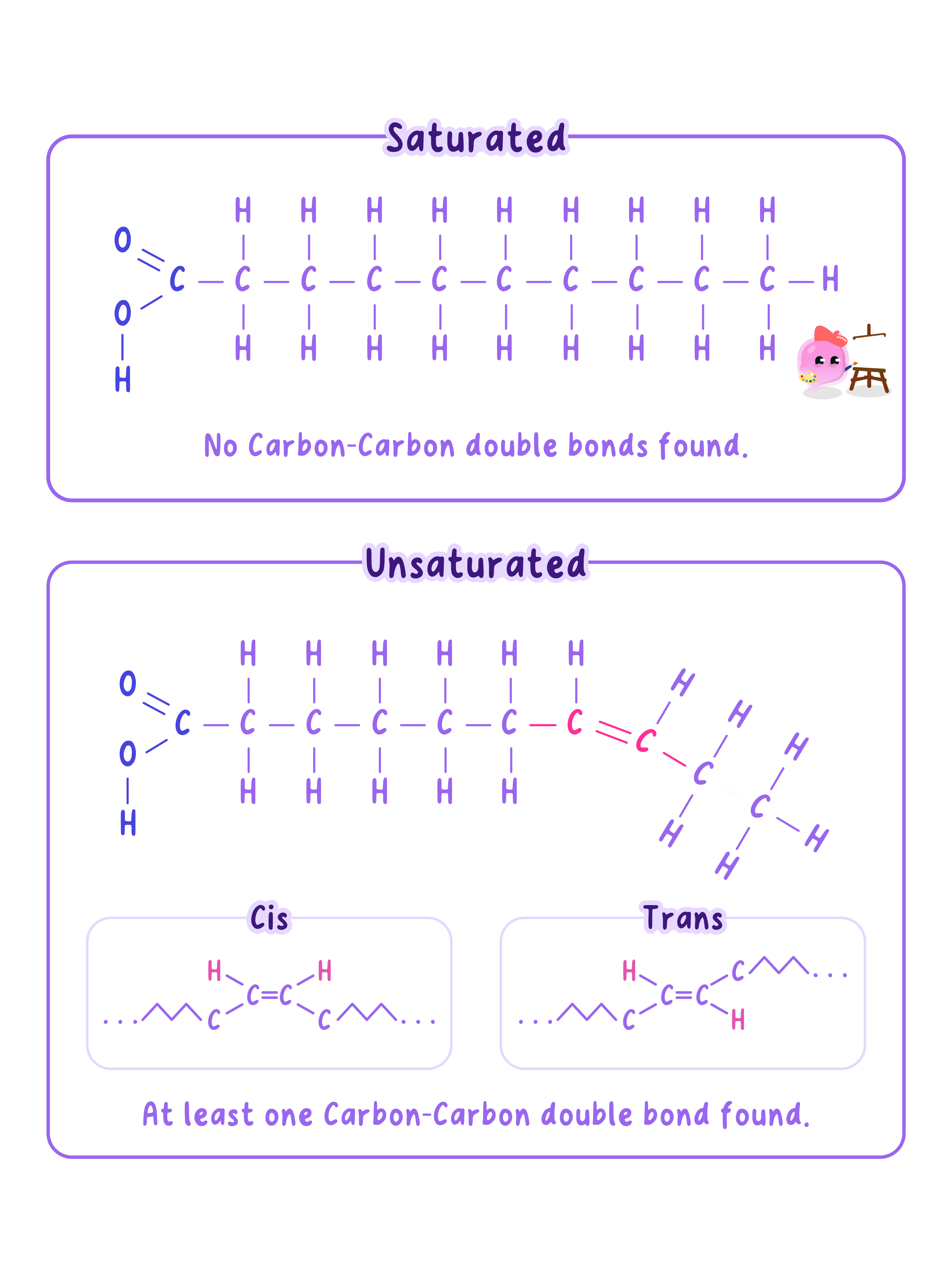
A fatty acid whose carbon chain contains no carbon to carbon double bonds, so the chain is straight and packs together closely.
Unsaturated fatty acid
A fatty acid whose carbon chain contains one or more carbon to carbon double bonds, which put a kink in the chain and keep the molecules further apart.
- The three fatty acids attached to the glycerol can be saturated or unsaturated, and this changes the properties of the whole lipid.
- A saturated fatty acid has no carbon to carbon double bonds in its chain, so every carbon holds as many hydrogen atoms as it can.
- With no double bonds the chain stays straight, so neighbouring molecules pack closely together and attract one another strongly.
- Close packing means more energy is needed to separate the molecules, so lipids rich in saturated fatty acids are usually solid fats at room temperature.
- An unsaturated fatty acid has one or more carbon to carbon double bonds, written as C=C\text{C=C}C=C.
- Each double bond puts a kink in the chain, which stops the molecules packing neatly and weakens the attraction between them.
- Loose packing means less energy is needed to separate them, so lipids rich in unsaturated fatty acids are usually liquid oils at room temperature.
- Saturated fatty acids come mainly from animal sources such as butter, cheese, lard and fatty meat.
- Unsaturated fatty acids come mainly from plant and fish sources such as olive oil, sunflower oil, nuts and oily fish.
- Both kinds are still lipids, so both release about the same amount of energy per gram when they are respired.
- Do not treat unsaturated as meaning low in energy, because an oil holds just as much energy per gram as a solid fat.
- Do not say a lipid is a polymer of fatty acids, because it contains only three of them joined to one glycerol.
- Do not write that two molecules of water are released per lipid, since there are three bonds to form and therefore three molecules of water.
Writing about lipids and their subunits
- Name both subunits every time, because an answer that gives only fatty acids misses the glycerol mark.
- Quote the ratio as one glycerol to three fatty acids when a question asks about the structure of a lipid.
- Say condensation and three molecules of water for building, and hydrolysis for breaking down, rather than describing the change in general terms.
- Link a use to a property, for example that lipids are insoluble so a large store can be held without water being drawn in.
- Explain a difference in melting behaviour through the shape of the chains and how closely they pack, not just by naming the double bond.
- Name the two kinds of subunit in a lipid and state how many of each there are in one molecule.
- State how many molecules of water are released when a single lipid molecule is built.
- Name the enzyme that hydrolyses lipids and give the two products it releases.
- Give three uses of lipids in the body apart from storing energy.
- Explain why a lipid rich in unsaturated fatty acids is a liquid at room temperature.
