Selection favours inherited variants
Definition
Natural selection
Natural selection is the process in which individuals with advantageous inherited characteristics leave more offspring, making the responsible alleles more common over generations.
Definition
Selection pressure
A selection pressure is an environmental factor that affects the survival or reproductive success of organisms with different phenotypes.
- Individuals within a population have different alleles, and some of these genetic differences produce different phenotypes.
- Mutations are the original source of the variants on which natural selection acts, but they do not occur in response to an organism needing a particular advantage.
- A selection pressure, such as predation, disease or shortage of food, affects the reproductive success of individuals with different characteristics.
- A phenotype is advantageous only in relation to the conditions in which the organism lives, so a characteristic that helps in one environment may be less useful in another.
- Organisms often produce more offspring than the available resources can support, which creates competition for resources such as food, light, space and water.
- Individuals with a favourable inherited phenotype are more likely to survive long enough to reproduce successfully.
- Their offspring may inherit the alleles responsible for that phenotype, so those alleles are represented more frequently in the next generation.
- When this difference in reproductive success continues across generations, the advantageous alleles and associated phenotypes usually become more common.
- The result depends on inheritance as well as survival, because surviving without producing offspring does not pass an allele to the next generation.
Exam technique
- Connect the named phenotype to the actual pressure in the situation, such as darker fur making an animal harder for a predator to see.
- Carry the explanation through survival, reproduction, inheritance of alleles and an increased proportion in later generations.
- Use more likely when comparing survival, because a favourable characteristic does not guarantee that every individual survives.
Camouflage and predation
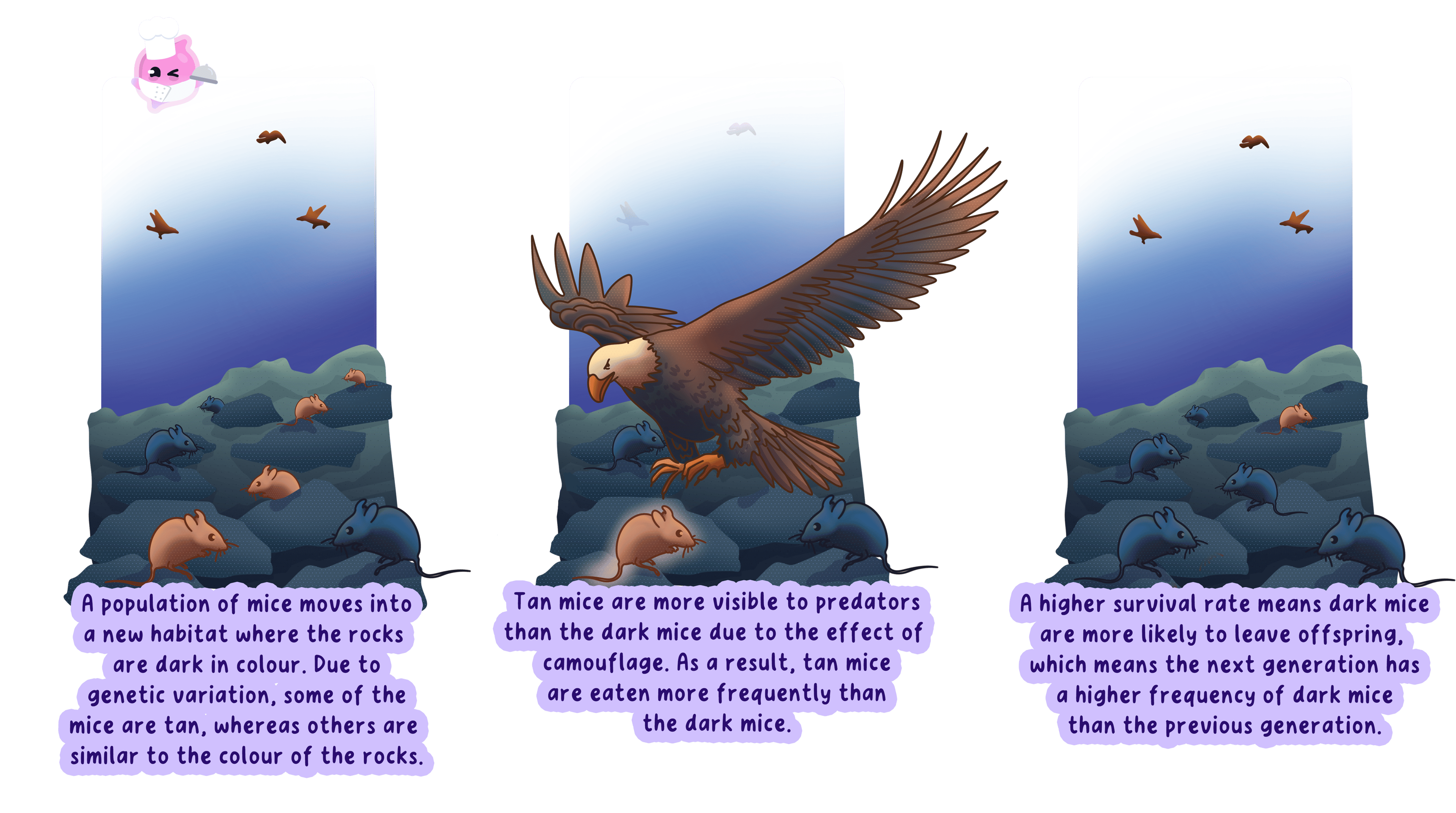
- In the illustrated mouse population, fur colour varies and the background is dark.
- Dark fur provides better camouflage, making dark mice less conspicuous to visual predators than pale mice.
Example
- Suppose that fur colour is inherited and both pale and dark mice live on dark rocks.
- Predators more easily detect pale mice against this background, so pale mice are more likely to be eaten.
- More dark mice survive to reproduce, increasing their contribution of alleles to the offspring population.
- Offspring that inherit alleles for dark fur also have better camouflage on the dark rocks.
- Across generations, the proportion of dark mice can increase without any pale individual deliberately changing its fur colour.
Changing selection pressures
- Reproductive success means the contribution an organism makes to future generations through its offspring.
- Biological fitness concerns reproductive success in a particular environment, so it does not simply mean being the strongest or largest organism.
- If the surroundings change from dark rock to pale sand, pale fur may become advantageous because the relationship between colour and visibility has changed.
- A change in conditions can therefore favour a different phenotype without directing a useful mutation to occur.
- A trait may also involve a trade-off, helping with one pressure while making another activity more difficult.
- A full explanation identifies the relevant pressure and weighs the effect of the characteristic in that specific setting.
Common Mistake
- Organisms do not develop a useful inherited characteristic because they decide to adapt.
- An advantageous allele need not be dominant, because dominance describes expression in a heterozygote rather than usefulness in an environment.
Practical
Modelling camouflage and selection
- Aim: investigate whether background colour affects the survival of differently coloured model prey.
- Apparatus: equal-sized paper discs in two colours, two contrasting background sheets, a stopwatch, containers for collected discs and a results table.
- Variables: change the background colour, measure the number or proportion of each prey colour remaining, and keep disc size, starting numbers, searching time, lighting and searching area constant.
- Method:
- Place 202020 pale discs and 202020 dark discs at randomly chosen positions on a dark background, with no discs overlapping.
- Ask a participant who did not arrange the discs to collect the first visible discs, one at a time, for 10 s10\ \mathrm{s}10 s.
- Count the surviving discs of each colour and record both the number removed and the number remaining.
- Reset to the same starting numbers and repeat at least three times with new random positions.
- Repeat on a pale background, alternating which background is tested first to reduce effects of practice or fatigue.
- If different participants are used, have each participant test both backgrounds so differences in searching ability can be considered.
- Processing: calculate survival for each colour using percentage surviving=number remainingnumber at the start×100\text{percentage surviving}=\dfrac{\text{number remaining}}{\text{number at the start}}\times100percentage surviving=number at the startnumber remaining×100.
- Extending the model:
- To represent reproduction, create a new population with the same colour proportions as the survivors, keeping the total number of discs constant.
- Randomly redistribute this new population on the same background and repeat the search to represent another generation.
- Record the proportion of each colour after every round, making any necessary rounding consistent when whole discs are required.
- Expected pattern: the less conspicuous colour will often have a higher survival percentage, and its proportion may increase when survival is followed by model reproduction.
- Reliability: compare repeated trials because chance positions, search order and participant behaviour can alter individual results.
- Limitations: paper discs do not move, reproduce or mutate, and copying the survivors' colour proportions represents inheritance rather than demonstrating real genetic transmission.
- Safety: prepare discs carefully with scissors, keep small pieces away from mouths and clear loose discs from the floor.
Self review
- Why must a favourable characteristic be inherited for natural selection to increase its frequency?
- How does predation select between differently camouflaged mice?
- Why is survival alone insufficient to pass an allele to the next generation?
- How can a change of background reverse which fur colour is advantageous?
- What does the reproduction stage add to a paper-disc model of selection?
