Natural selection changes populations
Natural selection
The process by which organisms with alleles best suited to their environment are more likely to survive and reproduce, so those alleles become more common in the population over generations.
- Natural selection is the process in which individuals with inherited features that suit their environment survive and reproduce more successfully than other individuals.
- Individuals within a population show genetic variation because they carry different alleles, and new alleles can arise through random mutation.
- Organisms produce more offspring than the environment can support, so there is competition for food, space, shelter and mates.
- A selection pressure, such as predation, disease or a change in climate, makes some inherited features more useful than others.
- Individuals with advantageous alleles are more likely to survive, reproduce and pass those alleles to their offspring.
- Across many generations, advantageous alleles increase in frequency and the population becomes better adapted to its environment.
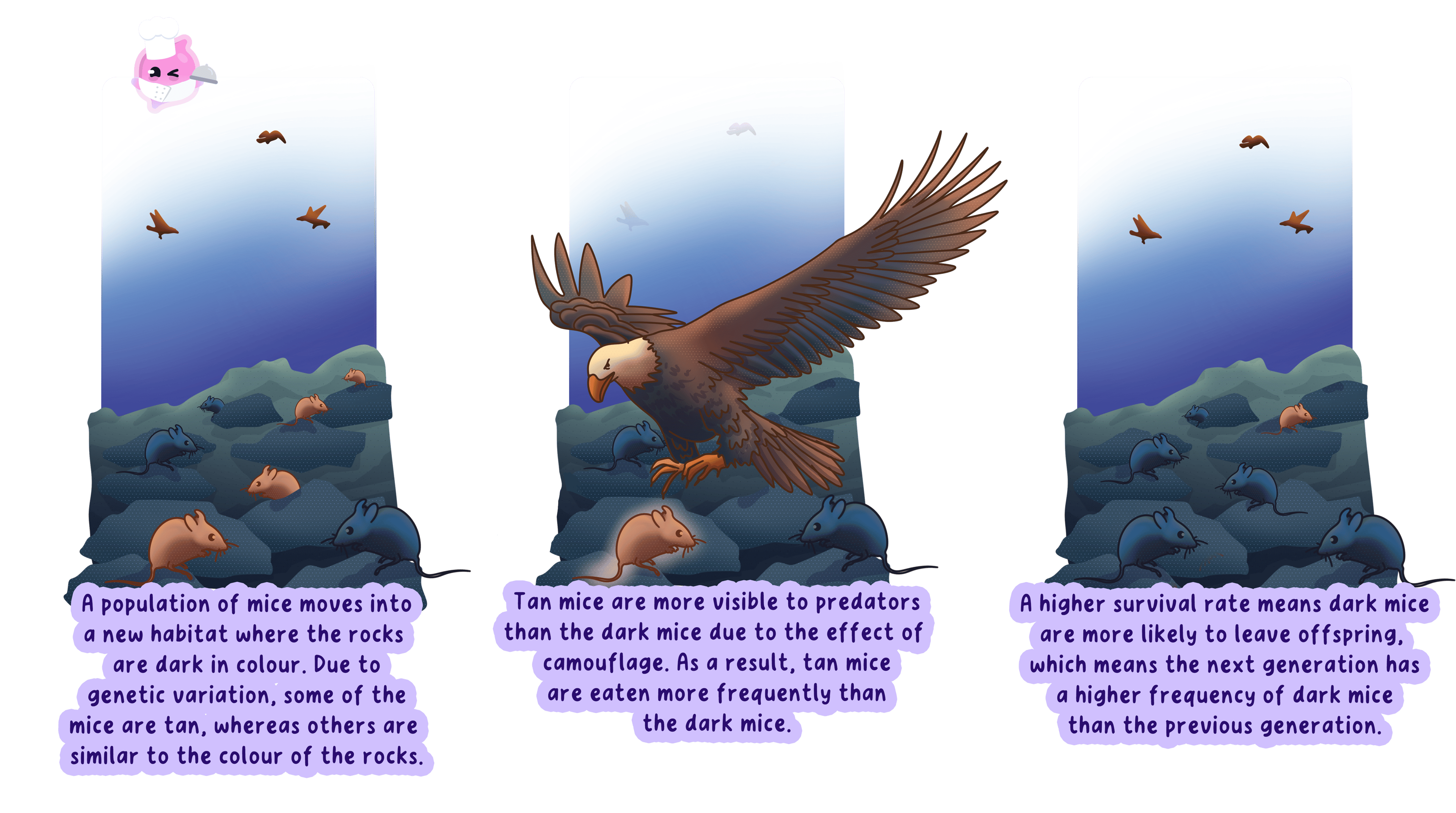
Do not write that an organism changes because it needs to; random inherited variation exists before the selection pressure acts.
For a natural-selection explanation, link variation, competition or selection pressure, survival and reproduction, inheritance, and the increase in allele frequency over generations.
Darwin and Wallace reached the same idea
Evolution
The gradual change in the inherited characteristics of a population over many generations, brought about by natural selection acting on variation.
- Evolution is the gradual change in the inherited characteristics of a population over many generations.
- Charles Darwin gathered evidence during his voyage on HMS Beagle and used observations of variation, fossils and geographical distribution to develop his explanation.
- Alfred Russel Wallace studied organisms in the Malay Archipelago and independently concluded that environmental pressures favour some inherited variations.
- Wallace sent his ideas to Darwin in 1858, and their accounts of natural selection were presented together before Darwin later published a detailed body of evidence.
- Their work provided a testable mechanism for evolution and helped biology explain adaptation, common ancestry and the formation of new species.
If darker mice are harder for predators to see on dark rock, more dark mice survive and reproduce, so alleles for dark fur become more common in later generations.
Evidence led to gradual acceptance
- Natural selection was not accepted immediately because it challenged widely held beliefs that species were fixed and had been created separately.
- Darwin and Wallace could not explain how inherited characteristics passed from parents to offspring because genes and DNA were not yet understood.
- The fossil record was incomplete, so many expected intermediate forms had not been discovered.
- Later discoveries in genetics, DNA, fossils and observed evolution supported the mechanism and strengthened scientific acceptance.
- Lamarck had proposed that features acquired during life could be inherited, but changes to body cells through use or disuse do not normally alter the alleles passed in gametes.
A giraffe stretching its neck does not create a longer-neck allele in its gametes, whereas a giraffe born with an inherited longer neck may leave more offspring if food is high in trees.
- What sequence of events causes natural selection?
- How did Wallace contribute to the theory?
- Why was natural selection accepted slowly?
- Why does a population evolve rather than an individual?
