Resistance evolves through selection
Definition
Antibiotic resistance
The ability of a bacterium to survive an antibiotic that would normally kill it, caused by a chance mutation and spread through the population by natural selection.
- Antibiotic resistance is the inherited ability of a bacterium to survive exposure to an antibiotic that would normally kill it or stop it reproducing.
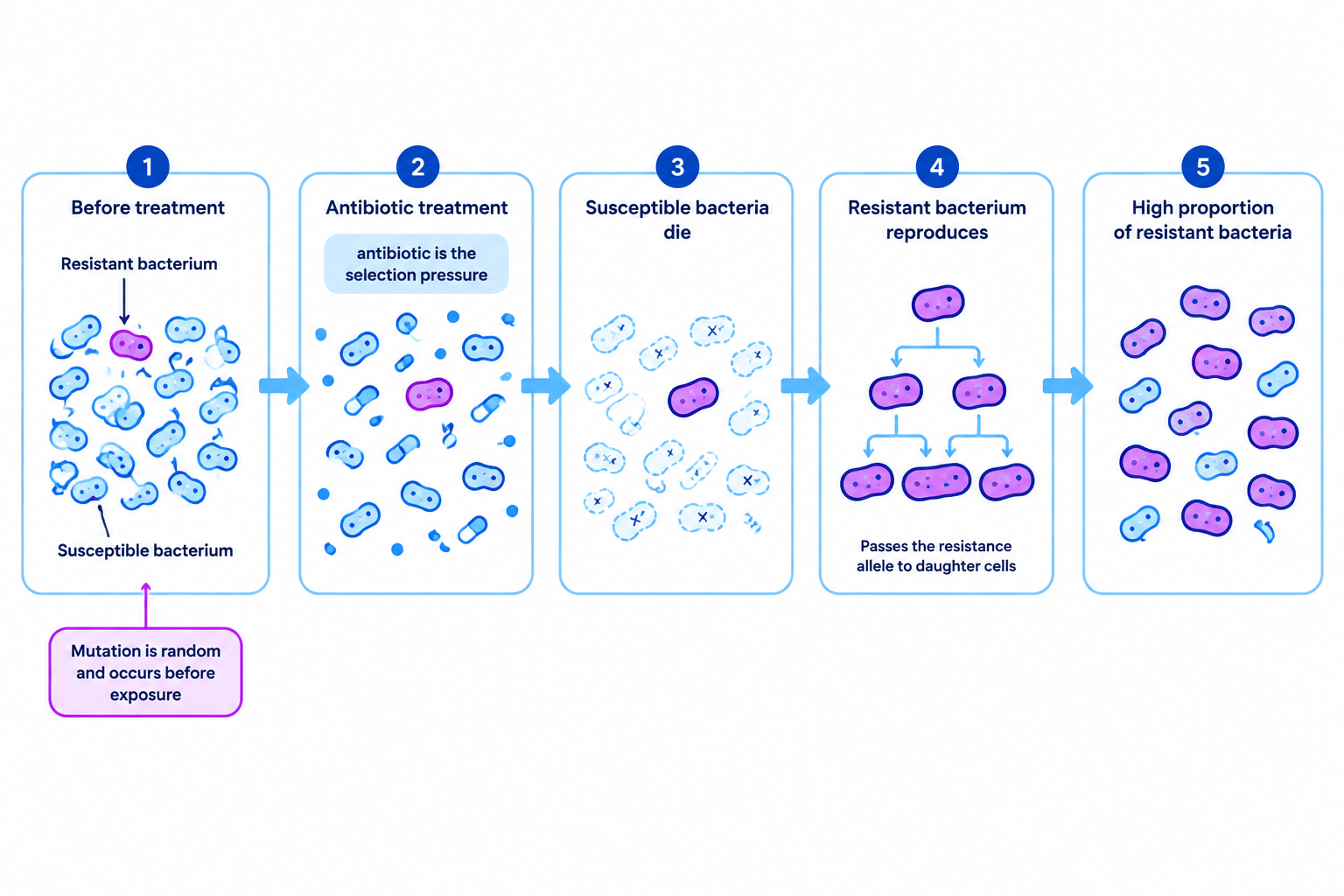
- A random mutation can give one bacterium an allele that provides resistance before the antibiotic is used.
- The antibiotic acts as a selection pressure by killing susceptible bacteria while resistant bacteria survive.
- The survivors reproduce rapidly by binary fission and pass copies of the resistance allele to their daughter cells.
- After repeated exposure, the proportion of resistant bacteria rises and a resistant strain can dominate the population.
- This observed change in an inherited characteristic across generations supports evolution by natural selection.
Common Mistake
Do not say that bacteria become resistant because they try to adapt, or that the antibiotic causes the useful mutation.
Example
In an MRSA population, bacteria with resistance survive treatment and reproduce, making the infection harder to control with the same antibiotics.
Antibiotic use changes selection pressure
- Using an antibiotic when it is not needed exposes bacteria to selection without giving a useful treatment benefit.
- Antibiotics cannot treat viral infections because viruses do not have the bacterial structures or processes that antibiotics target.
- Prescribing only when needed and using the correct dose reduce unnecessary selection for resistant bacteria.
- Good hygiene, isolation procedures and infection control reduce transmission of resistant strains between people.
- Reducing routine antibiotic use in livestock lowers selection pressure in agricultural bacterial populations.
- New antibiotics are difficult and expensive to develop, so resistance can spread faster than replacement treatments become available.
Exam technique
When asked how resistance develops, begin with a random mutation, then explain selection by the antibiotic, survival, reproduction, and the rising frequency of the resistance allele.
Self review
- How can antibiotic resistance first arise?
- Why does an antibiotic increase the proportion of resistant bacteria?
- How does resistance support natural selection?
- Give two ways to slow the spread of resistant strains.