Translocation: moving dissolved food
Translocation
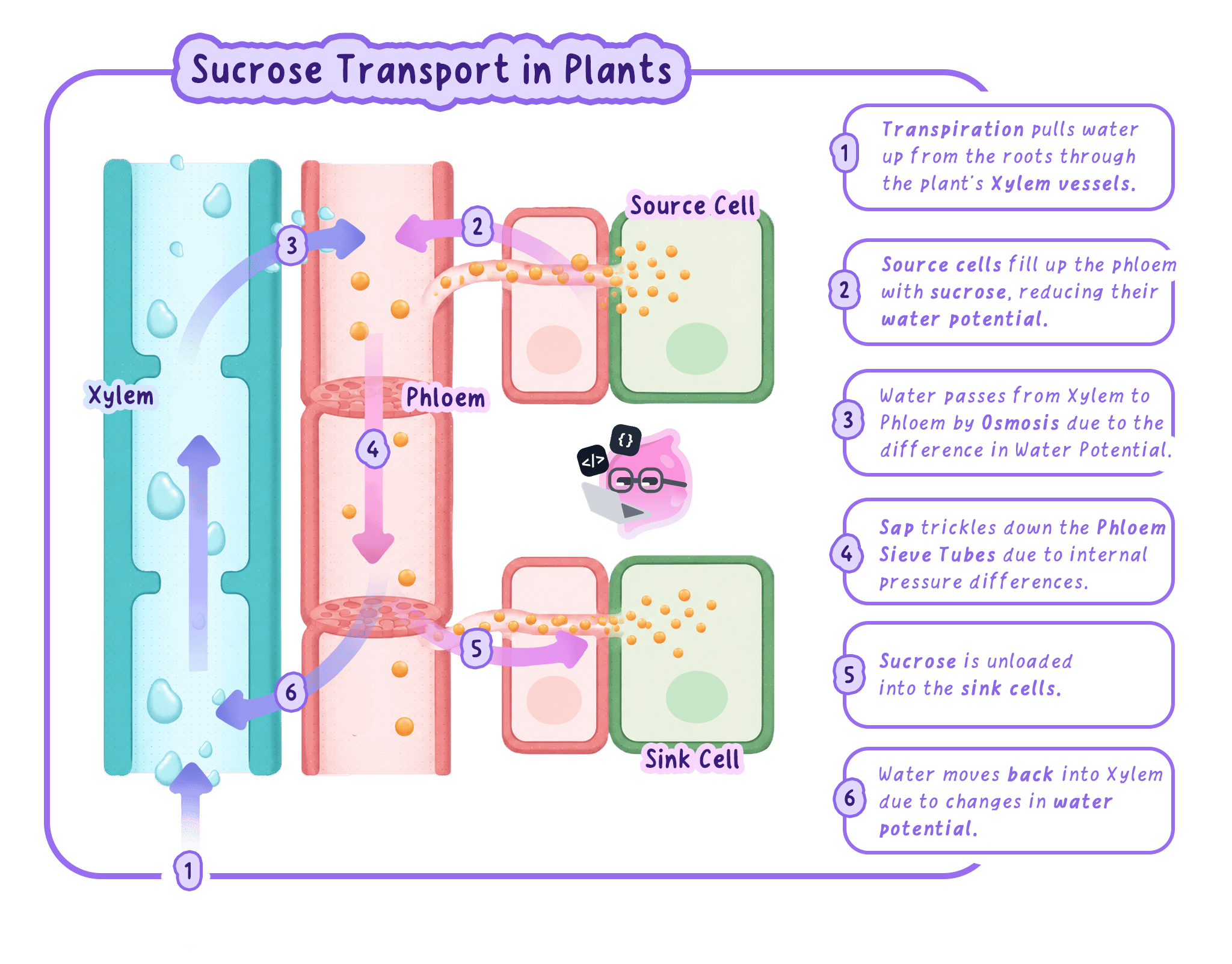
The movement of dissolved food, mainly sucrose and amino acids, through the phloem from sources to sinks.
- Translocation is the movement of dissolved food, mainly sucrose and amino acids, through phloem from sources to sinks.
- Glucose made by photosynthesis is often converted to sucrose because sucrose is soluble and suitable for transport.
- Translocation requires energy for loading and unloading substances, supplied by respiration in companion cells.
- It is separate from the transpiration stream, which moves water and mineral ions through xylem.
Sources load food into phloem
Source (translocation)
A part of a plant that loads dissolved food into the phloem, such as a photosynthesising leaf or a storage organ releasing its store.
- Source means a plant region that releases or produces more sucrose than it uses, so sucrose enters the phloem.
- A mature photosynthesising leaf is usually a source because it makes sugars faster than it uses them.
- A storage organ can become a source when stored carbohydrate is converted into soluble sugar and exported.
Sinks remove food from phloem
Sink (translocation)
A part of a plant that removes dissolved food from the phloem to use or store it, such as a growing root or developing fruit.
- Sink means a plant region that removes sucrose from phloem for respiration, growth or storage.
- Growing roots, shoot tips, flowers, fruits and seeds are common sinks because their cells need energy and new biological molecules.
- A sink can later become a source, so phloem transport can occur upwards or downwards according to the plant's needs.
Example: during summer a leaf is a source and a developing fruit is a sink; during spring a storage root can become a source for a growing shoot.
Phloem structure supports transport
Phloem
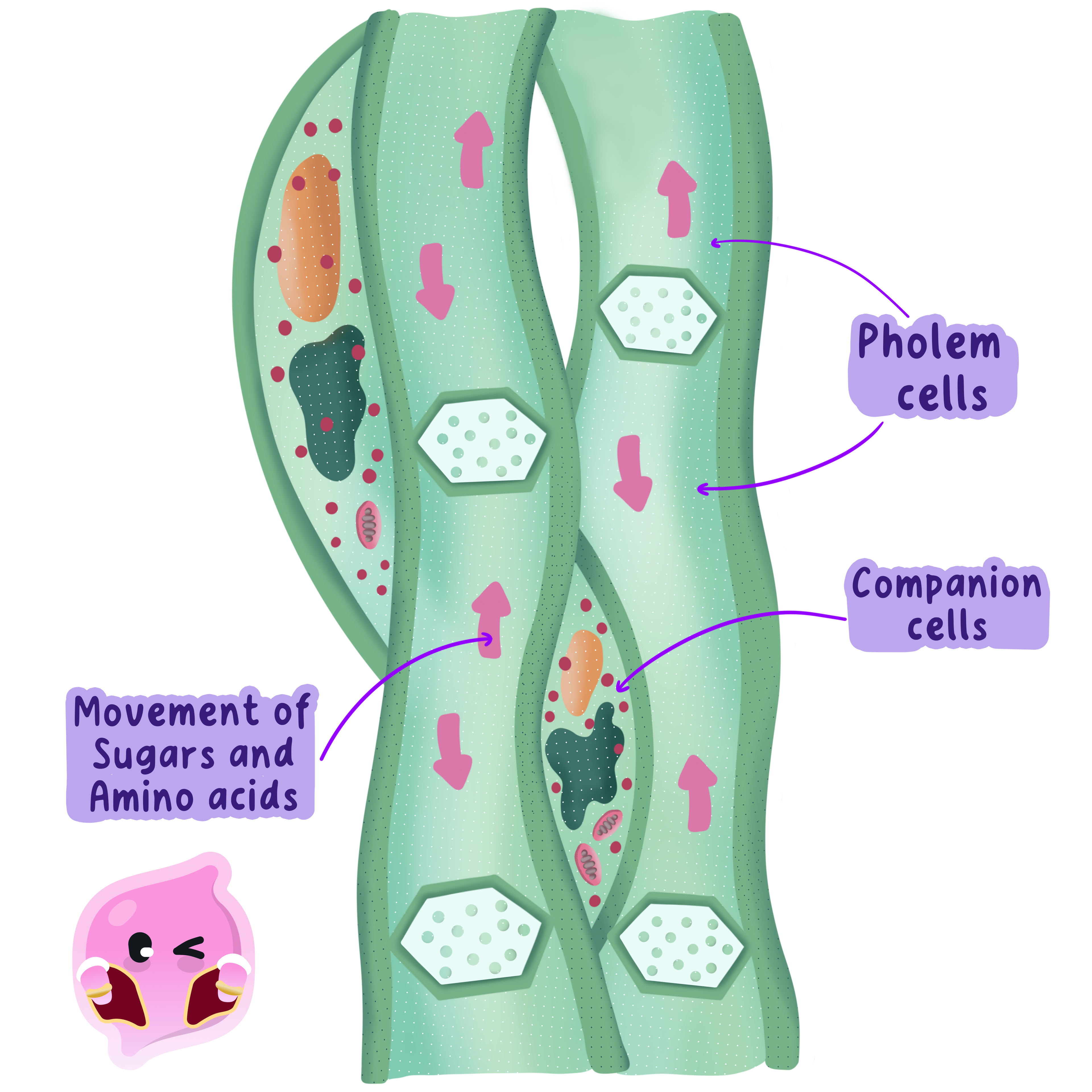
A living plant tissue made of sieve tubes and companion cells that carries dissolved food such as sucrose and amino acids around the plant.
- Sieve tube elements join end to end, and pores in their sieve plates allow phloem sap to pass between cells.
- Companion cells have many mitochondria, so they can release energy for active loading and unloading of sucrose.
- Different sieve tubes can carry sap in different directions at the same time, but movement within one tube is from its source towards its sink.
Do not write that phloem carries glucose only downwards or that translocation happens in xylem.
Answering source-and-sink questions
- Use the context: decide which organ is producing or releasing sucrose and which is using or storing it.
- Explain the direction: name the source, name the sink and state that sucrose moves through phloem between them.
- What is translocation?
- What makes a leaf a source?
- What makes a growing root a sink?
- Why can phloem transport occur in either direction?
- How do companion cells support translocation?
