Leaf structure: maximising photosynthesis
Definition
Photosynthesis
The process in which plants and algae use light energy, absorbed by chlorophyll in the chloroplasts, to make glucose from carbon dioxide and water, releasing oxygen as a by-product.
- Photosynthesis is the process in which light energy absorbed by chlorophyll is used to make glucose from carbon dioxide and water, releasing oxygen.
- The word equation is carbon dioxide+water→glucose+oxygen\text{carbon dioxide}+\text{water}\rightarrow\text{glucose}+\text{oxygen}carbon dioxide+water→glucose+oxygen.
- The balanced symbol equation is 6CO2+6H2O→C6H12O6+6O26\mathrm{CO_2}+6\mathrm{H_2O}\rightarrow\mathrm{C_6H_{12}O_6}+6\mathrm{O_2}6CO2+6H2O→C6H12O6+6O2.
- A broad leaf provides a large surface area for light absorption, while a thin leaf gives carbon dioxide a short diffusion distance.
Upper layers let light reach chloroplasts
Definition
Palisade mesophyll
The layer of tall cells near the top of a leaf, packed with chloroplasts to absorb the most light for photosynthesis.
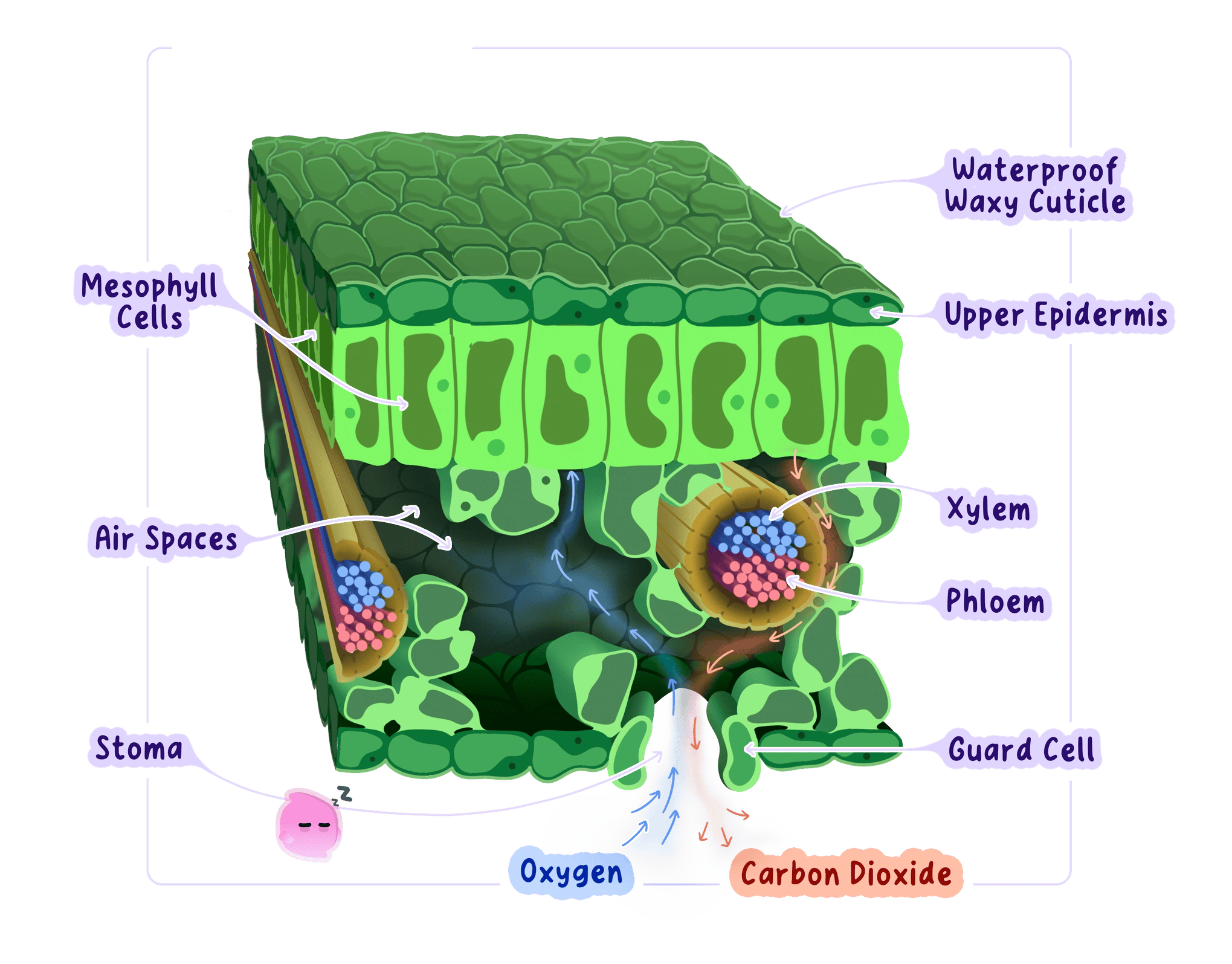
- The waxy cuticle is transparent so light passes through, and waterproof so it reduces evaporation from the surface.
- The upper epidermis is thin and transparent, allowing light to reach the palisade mesophyll.
- Palisade mesophyll is a layer of tall, closely packed cells near the upper leaf surface containing many chloroplasts.
- Its position and chloroplast density allow it to absorb a high proportion of the incoming light.
Common Mistake
Do not state that epidermal cells contain many chloroplasts; guard cells are the main epidermal exception.
Spongy mesophyll speeds gas exchange
Definition
Spongy mesophyll
A layer of loosely packed leaf cells with large air spaces that give a big surface area for water to evaporate and gases to move.
- Spongy mesophyll is a loosely packed layer with many interconnecting air spaces and moist cell surfaces.
- The air spaces provide a large internal surface area and let carbon dioxide diffuse rapidly from stomata to photosynthesising cells.
- Oxygen made in photosynthesis diffuses through the same spaces and out of the leaf.
- The lower epidermis contains many stomata, which allow gas exchange while reducing exposure to direct sunlight and air movement.
Veins supply and remove materials
- Xylem in each vascular bundle supplies water and mineral ions to leaf cells.
- Phloem carries sucrose and amino acids away from photosynthesising cells to sources and sinks elsewhere in the plant.
- A network of veins keeps cells close to transport tissue and also helps support the leaf blade.
Example
Example: palisade cells contain many chloroplasts, so they absorb more light and can photosynthesise at a higher rate.
Exam technique
Explaining adaptations in exams
- Required link: state the feature and then explain how it increases light absorption, gas diffusion, water supply or sugar removal.
- Diagram labels: use waxy cuticle, upper epidermis, palisade mesophyll, spongy mesophyll, air space, lower epidermis, guard cells, stoma, xylem and phloem.
Self review
- Why is a leaf broad and thin?
- How is palisade mesophyll adapted for photosynthesis?
- How do spongy mesophyll air spaces aid gas exchange?
- What do xylem and phloem do in a leaf vein?
- Why is the upper epidermis transparent?
