Thyroxine sets metabolic rate
Thyroxine
A hormone secreted by the thyroid gland that controls metabolic rate.
- The thyroid gland is an endocrine gland in the neck that produces and secretes thyroxine.
- Thyroxine enters the blood and is carried to cells throughout the body.
- Thyroxine changes how quickly cells carry out chemical reactions, so it controls the body's metabolic rate.
- The body needs thyroxine to remain near its normal concentration because reactions that run too slowly or too quickly disrupt normal cell function.
Metabolic rate changes energy use
Metabolic rate
The overall rate of the chemical reactions in the body.
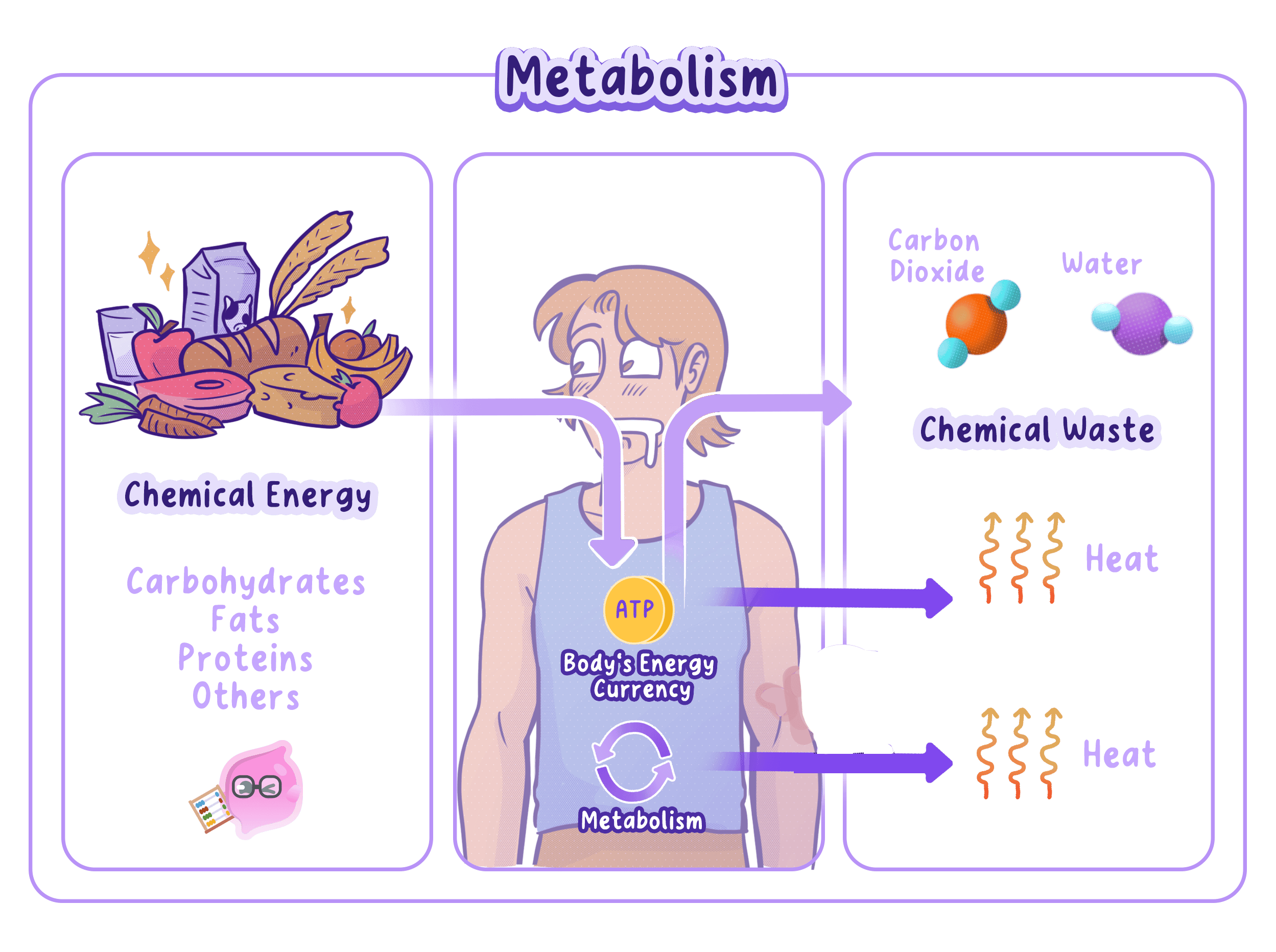
- Metabolic rate is the overall rate of the chemical reactions in the body.
- A higher thyroxine concentration increases the rate of many cellular reactions, including reactions involved in respiration and energy transfer.
- A lower thyroxine concentration slows these reactions, so the body releases and uses less energy in a given time.
- The effect is not instant because thyroxine must be secreted, transported in the blood and act on its target cells.
Write a complete feedback chain
Keep the order low thyroxine→TRH→TSH→more thyroxine\mathrm{low\ thyroxine} \rightarrow \mathrm{TRH} \rightarrow \mathrm{TSH} \rightarrow \mathrm{more\ thyroxine}low thyroxine→TRH→TSH→more thyroxine, then state how normal thyroxine inhibits both TRH\mathrm{TRH}TRH and TSH\mathrm{TSH}TSH.
The hypothalamus detects low thyroxine
Hypothalamus
A region of the brain that monitors internal conditions and controls the pituitary gland by releasing hormones such as TRH\mathrm{TRH}TRH.
- The hypothalamus is a region of the brain that monitors internal conditions and controls hormone release from the pituitary gland.
- When the blood thyroxine concentration falls below normal, the hypothalamus responds by producing and releasing more TRH\mathrm{TRH}TRH.
- A low thyroxine concentration therefore begins a response that will increase thyroxine secretion and oppose the original fall.
TRH activates the pituitary
TRH (thyrotropin-releasing hormone)
A hormone released by the hypothalamus when the thyroxine level is low that stimulates the pituitary gland to release TSH\mathrm{TSH}TSH.
- TRH\mathrm{TRH}TRH is thyrotropin-releasing hormone produced by the hypothalamus.
- TRH\mathrm{TRH}TRH travels to the pituitary gland and stimulates it to produce and release TSH\mathrm{TSH}TSH.
- More TRH\mathrm{TRH}TRH therefore causes more TSH\mathrm{TSH}TSH to enter the blood.
The pituitary releases TSH
Pituitary gland
An endocrine gland at the base of the brain that releases hormones, including TSH\mathrm{TSH}TSH, which control other endocrine glands.
- The pituitary gland is an endocrine gland at the base of the brain that releases hormones which control other endocrine glands.
- In this pathway, the pituitary is the source of TSH\mathrm{TSH}TSH and the thyroid gland is its target.
- The pituitary does not release thyroxine, because thyroxine is produced by the thyroid gland.
TSH stimulates the thyroid
TSH (thyroid-stimulating hormone)
A hormone released by the pituitary gland that stimulates the thyroid gland to secrete thyroxine.
- TSH\mathrm{TSH}TSH is thyroid-stimulating hormone released by the pituitary gland.
- TSH\mathrm{TSH}TSH travels in the blood to the thyroid gland and stimulates it to produce and secrete more thyroxine.
- As the thyroid releases more thyroxine, the blood thyroxine concentration rises towards its normal level.
- The higher thyroxine concentration raises metabolic rate towards its normal value.
Negative feedback reduces stimulation
Negative feedback
A control mechanism in which a change away from the normal level causes responses that reverse the change and restore the normal level.
- Negative feedback is a control mechanism in which a change away from the normal level causes responses that reverse the change and restore the normal level.
- As thyroxine returns to its normal concentration, thyroxine inhibits the hypothalamus from producing and releasing more TRH\mathrm{TRH}TRH.
- Thyroxine also inhibits the pituitary gland from producing and releasing more TSH\mathrm{TSH}TSH.
- Less TSH\mathrm{TSH}TSH reaches the thyroid gland, so the thyroid receives less stimulation and secretes less thyroxine.
- This response prevents the thyroxine concentration and metabolic rate from continuing to rise above the normal level.
- If thyroxine later falls below normal, inhibition of the hypothalamus and pituitary weakens, so TRH\mathrm{TRH}TRH and TSH\mathrm{TSH}TSH secretion increase again.
- If thyroxine rises above normal, stronger inhibition reduces TRH\mathrm{TRH}TRH and TSH\mathrm{TSH}TSH secretion until thyroxine falls towards normal.
Explaining an underactive thyroid
- An underactive thyroid secretes too little thyroxine, so blood thyroxine remains below normal.
- The low thyroxine concentration stimulates the hypothalamus to release more TRH\mathrm{TRH}TRH.
- More TRH\mathrm{TRH}TRH causes the pituitary gland to release more TSH\mathrm{TSH}TSH, which stimulates the thyroid.
- If the thyroid still cannot release enough thyroxine, metabolic rate remains low and the body uses less energy.
- A continuing energy surplus can be stored as fat, so body mass may increase.
- Do not swap the sources of the hormones: the hypothalamus releases TRH\mathrm{TRH}TRH, the pituitary releases TSH\mathrm{TSH}TSH and the thyroid releases thyroxine.
- Do not say that TSH\mathrm{TSH}TSH inhibits the thyroid, because TSH\mathrm{TSH}TSH stimulates the thyroid to secrete thyroxine.
- Do not describe negative feedback as stopping all hormone release, because it adjusts secretion to keep thyroxine close to its normal level.
- For a developed explanation, link each named hormone to the gland that releases it and the gland or process it affects.
- How does thyroxine affect metabolic rate?
- What causes the hypothalamus to release more TRH\mathrm{TRH}TRH?
- Which gland releases TSH\mathrm{TSH}TSH, and which gland does it stimulate?
- How does normal thyroxine reduce further thyroxine secretion?
- Why can an underactive thyroid lead to an increase in body mass?
