The cycle prepares the uterus for pregnancy
Definition
Menstrual cycle
The roughly monthly cycle of hormone-controlled changes in the female reproductive system that releases an egg and prepares the uterus lining for pregnancy.
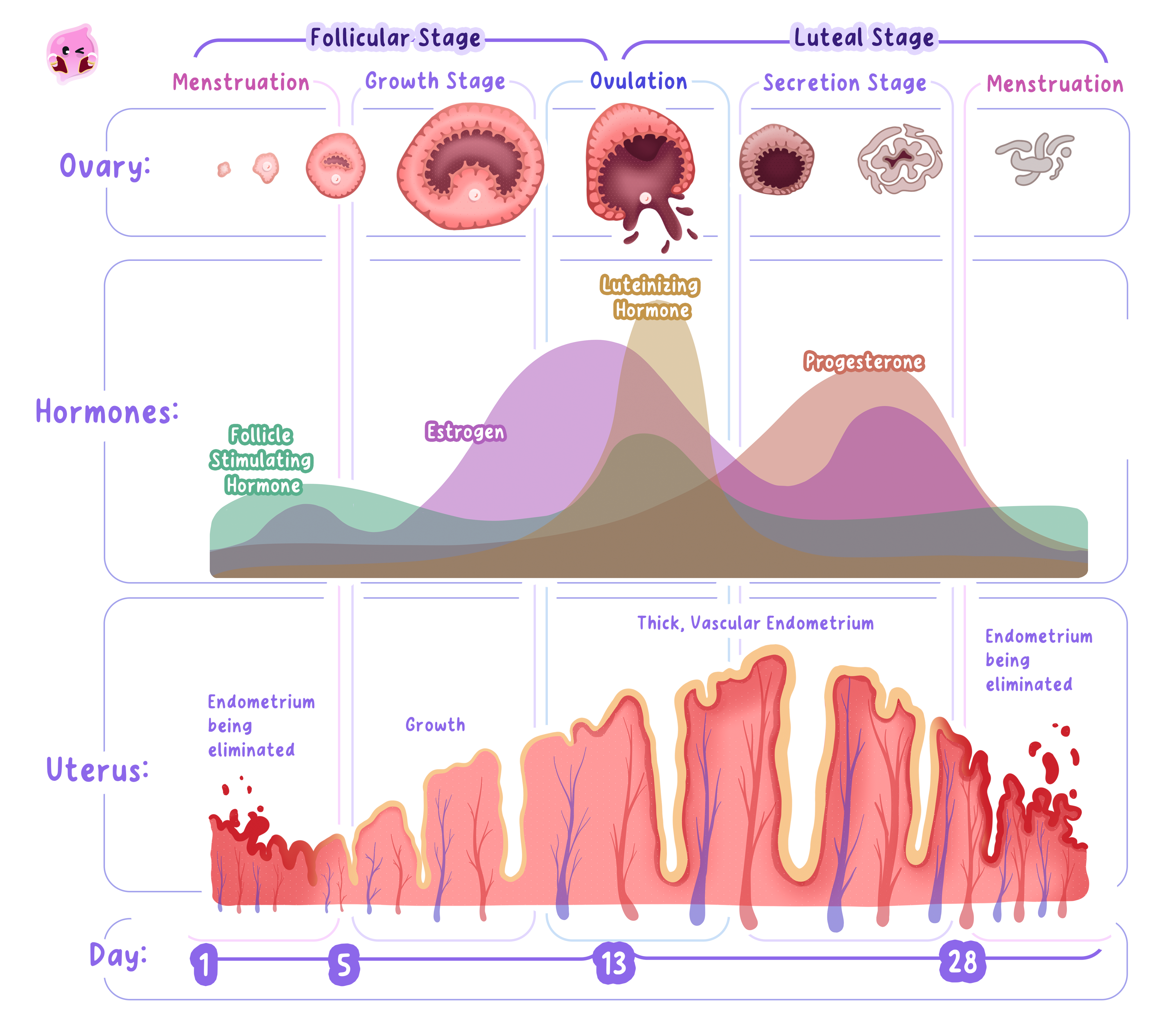
- The menstrual cycle is a repeating sequence of changes in the ovaries and uterus that releases an egg and prepares the uterus lining for possible implantation.
- Day 111 is the first day of menstruation, when the uterus lining breaks down and leaves the body through the vagina.
- A cycle is often modelled as about 282828 days, but the length varies between individuals and between cycles.
- During the first half of the cycle, an egg matures in a follicle in an ovary while the uterus lining repairs and becomes thicker.
- Around the middle of the cycle, a mature egg is released from an ovary.
- During the second half, the uterus lining is maintained so it can support an embryo if fertilisation and implantation occur.
Key Idea
- Sequence: menstruation is followed by repair of the uterus lining, ovulation, maintenance of the lining and then either implantation or another menstruation.
- Timing: day numbers are approximate, so use the pattern of events as well as the value shown on a graph.
Ovulation separates the two halves
Definition
Ovulation
The release of a mature egg cell from an ovary, about halfway through the menstrual cycle.
- Ovulation is the release of a mature egg from an ovary.
- In a model 282828-day cycle, ovulation occurs at about day 141414, after the egg has matured inside a follicle.
- The released egg enters an oviduct, where fertilisation may occur if a sperm cell reaches it.
- If fertilisation does not occur, the egg breaks down and the hormone changes later in the cycle lead to menstruation.
Example
- A graph shows ovulation on day 151515 rather than day 141414.
- This is still consistent with a menstrual cycle because day 141414 is an approximate value, not a fixed date for every cycle.
Oestrogen rebuilds the uterus lining
Definition
Oestrogen
The main female sex hormone, made in the ovaries, which controls female secondary sexual characteristics and helps regulate the menstrual cycle.
- Oestrogen is a hormone made mainly by the ovaries that repairs and thickens the uterus lining after menstruation.
- Its concentration rises during the first half of the cycle as the follicle develops.
- A thicker, well-supplied lining creates suitable conditions for an embryo to implant if the egg is fertilised.
Exam technique
- When a question asks for the role of oestrogen, write the biological effect: it repairs and thickens the uterus lining.
- Do not write only that oestrogen controls the cycle, because that does not identify the change it causes.
Progesterone maintains the uterus lining
Definition
Progesterone
A female sex hormone that maintains the lining of the uterus during the second half of the menstrual cycle and during pregnancy.
- Progesterone is a hormone made by the ovary after ovulation that maintains the thick uterus lining.
- If pregnancy does not occur, progesterone and oestrogen concentrations fall near the end of the cycle.
- The fall in these hormones means the lining is no longer maintained, so it breaks down and a new menstruation begins.
- If pregnancy begins, progesterone remains high and helps keep the uterus lining in place.
Self review
- What event defines day 111 of the menstrual cycle?
- What is ovulation, and when does it occur in a model 282828-day cycle?
- How does oestrogen change the uterus lining?
- Why does menstruation occur when progesterone and oestrogen concentrations fall?
