Adrenaline starts fight or flight
Definition
Adrenaline
A hormone secreted by the adrenal glands that prepares the body for the fight or flight response.
- The adrenal glands secrete adrenaline when the brain detects fear, stress or danger.
- The fight or flight response is a rapid set of body changes that prepares a person to confront danger or escape from it.
- Adrenaline travels in the blood and changes the activity of several target organs at the same time.
Exam technique
Link each change to respiration
Explain how each effect increases the delivery of oxygen or glucose to muscles, then link this to a higher rate of respiration and faster energy release.
Four effects supply active muscles
Definition
Fight or flight response
A rapid set of body changes that prepares a person to confront danger or escape from it.
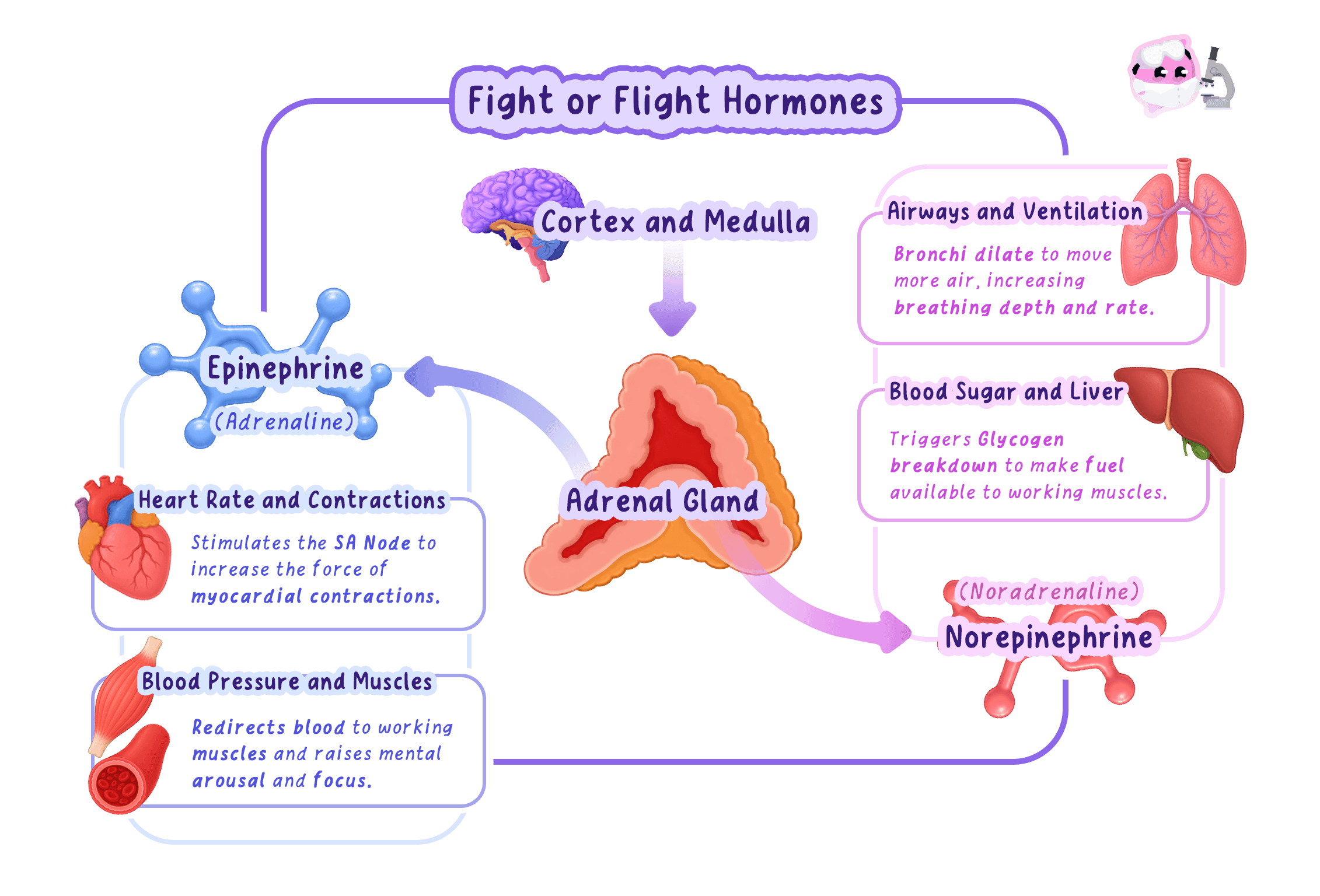
- Adrenaline increases heart rate, so the heart pumps blood to the muscles more quickly.
- Adrenaline increases blood pressure, which helps blood reach the muscles rapidly.
- Adrenaline increases blood flow to the muscles, so muscle cells receive more oxygen and glucose.
- Adrenaline stimulates the liver to convert glycogen→glucose\mathrm{glycogen} \rightarrow \mathrm{glucose}glycogen→glucose, which raises the blood glucose concentration.
- The extra oxygen and glucose increase the rate of aerobic respiration in muscle cells, releasing energy more quickly for contraction.
Example
Explaining the start of a sprint
- A runner becomes tense before the start, so the adrenal glands release adrenaline.
- Heart rate, blood pressure and blood flow to the leg muscles increase.
- The liver converts glycogen to glucose, so blood glucose rises.
- More oxygen and glucose reach the leg muscles, increasing respiration and releasing energy for rapid contraction.
Exam technique
Avoid incomplete explanations
- Do not stop after listing a change such as increased heart rate, because an explanation must state how the change helps the muscles respond.
- Do not say that adrenaline contains or supplies energy, because it causes changes that let muscle cells release energy by respiration.
- Do not replace the four assessed effects with pupil dilation or faster breathing, because those details do not cover the required causal chain.
Self review
- Which glands secrete adrenaline?
- What is the fight or flight response?
- How does adrenaline raise blood glucose?
- Why does increased blood flow to muscles help a rapid response?
- What error is made by saying that adrenaline supplies energy?
