Thermoregulation controls body temperature
Definition
Thermoregulation
The control of core body temperature within narrow limits around approximately 37 ∘C37\,^\circ\mathrm{C}37∘C.
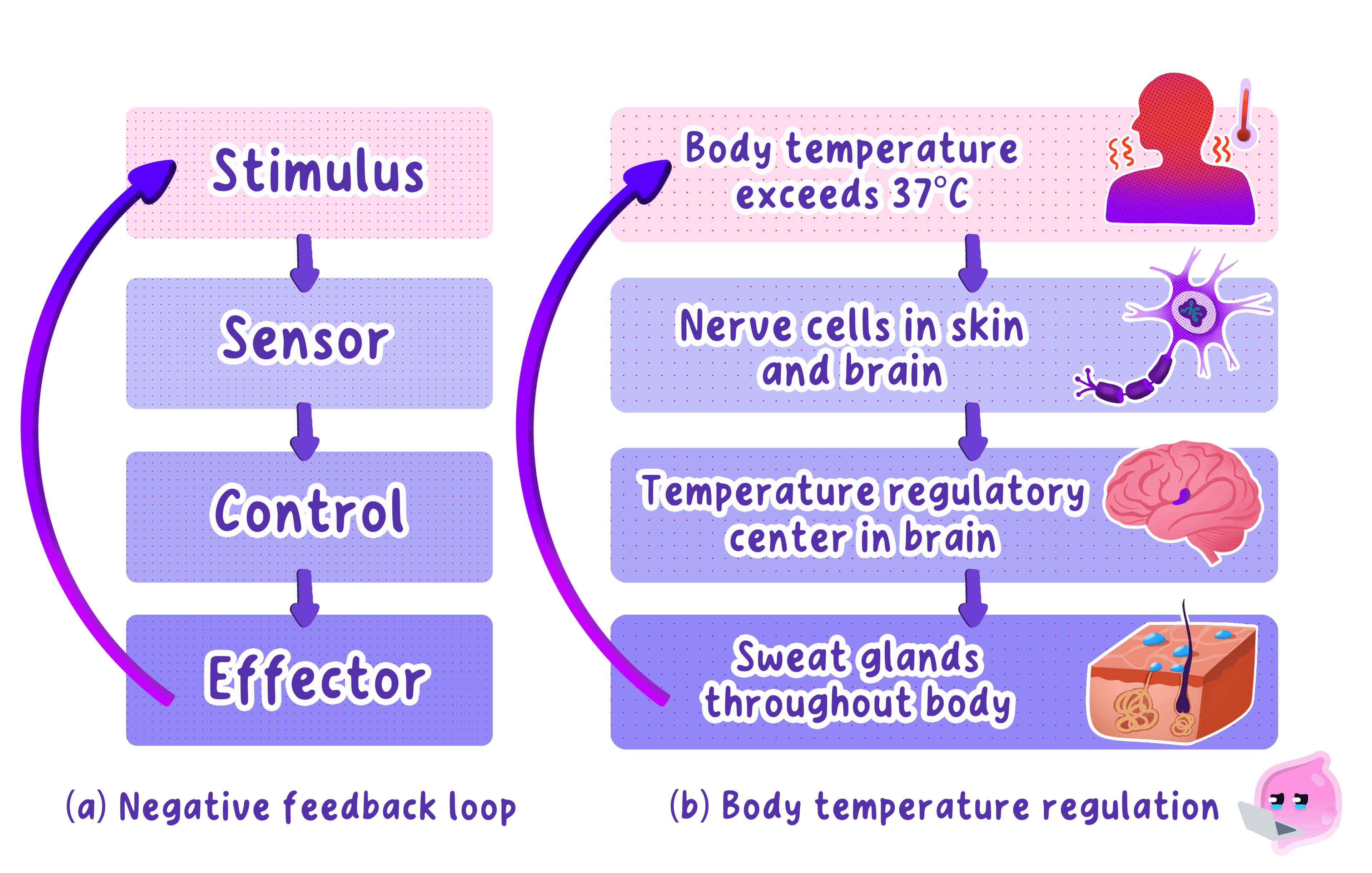
- Thermoregulation keeps core body temperature within narrow limits around approximately 37 ∘C37\,^\circ\mathrm{C}37∘C.
- Respiration releases heat inside the body, while heat is transferred to and from the surroundings through the skin.
- A rise above the normal range activates responses that increase heat loss.
- A fall below the normal range activates responses that reduce heat loss or generate more heat.
- As temperature returns towards normal, the corrective response becomes smaller.
The epidermis forms the surface
Definition
Epidermis
The thin outer layer of the skin that forms a protective, waterproof barrier and contains no blood vessels.
- The epidermis is the thin outer layer of the skin and contains no blood vessels.
- It forms a protective, waterproof barrier that reduces uncontrolled water loss from the body.
- Sweat released by ducts reaches the epidermal surface and evaporates from it.
- Heat transferred from the dermis must pass through the epidermis before reaching the surroundings.
Common Mistake
- Do not place sweat glands, blood vessels or most temperature receptors in the epidermis.
- These structures lie in the dermis, although sweat passes through ducts to the epidermal surface.
The dermis changes heat transfer
Definition
Dermis
The layer of skin beneath the epidermis that contains blood vessels, sweat glands, sensory receptors, hair follicles and hair erector muscles.
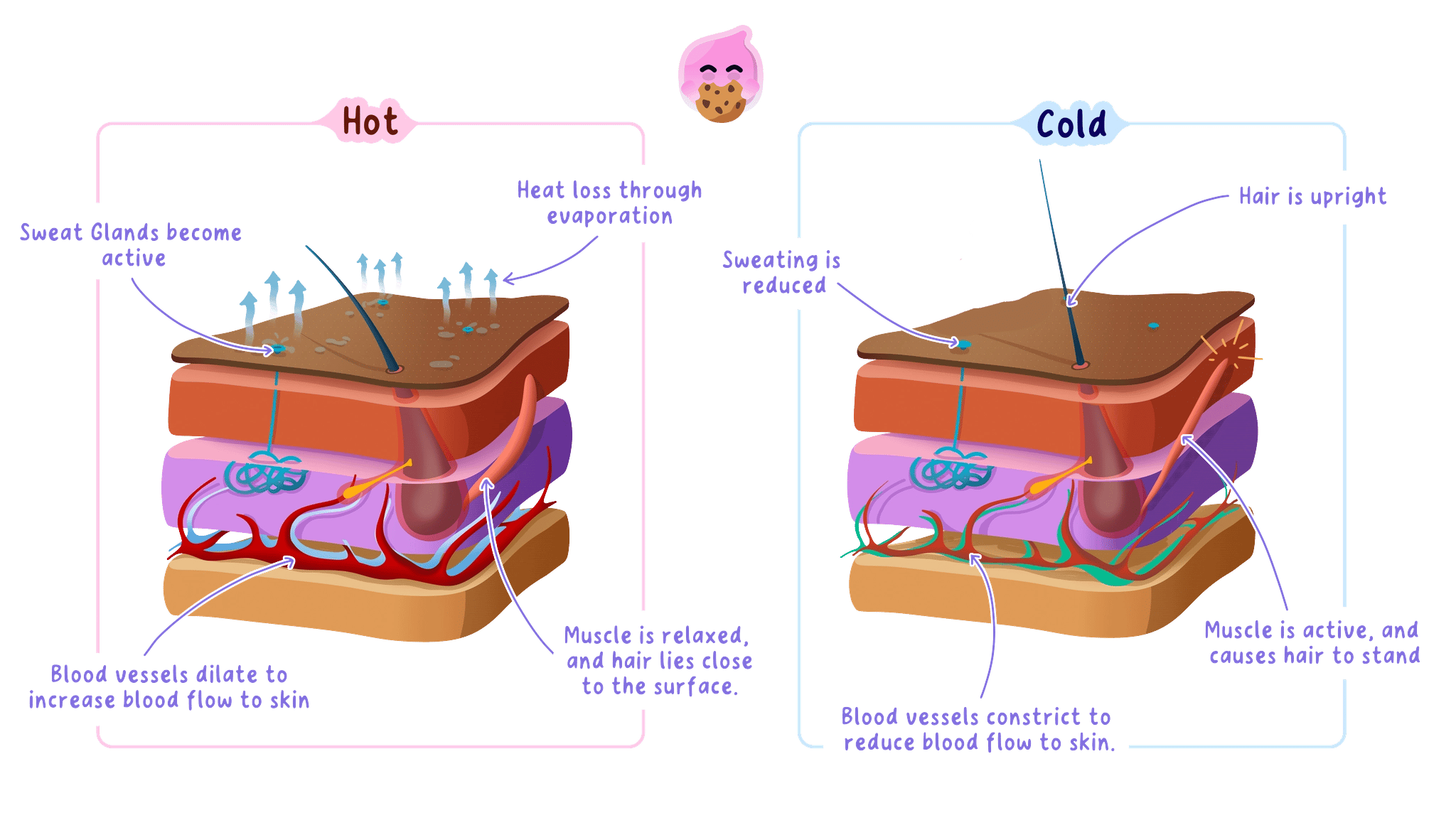
- The dermis contains the structures that detect temperature and alter heat loss through the skin.
- Sweat glands release more sweat when the body is too hot.
- Evaporation requires energy, so energy is transferred from the skin to the surroundings and the skin cools.
- Blood vessels supply capillary networks close to the surface, allowing the amount of warm blood near the surface to be adjusted.
- Temperature receptors detect changes in skin temperature and send electrical impulses towards the brain.
- Hair erector muscles contract in cold conditions and pull the hairs upright.
- Upright hairs trap a layer of still air, which reduces heat transfer by convection, although this response has a small effect in humans.
- Fatty tissue beneath the dermis insulates the body because fat conducts heat poorly.
The hypothalamus coordinates responses
Definition
Hypothalamus
A region of the brain that monitors internal conditions and controls the pituitary gland by releasing hormones such as TRH\mathrm{TRH}TRH.
- The hypothalamus contains the thermoregulatory centre in the brain.
- Temperature receptors in the hypothalamus detect the temperature of the blood flowing through it.
- Temperature receptors in the skin detect changes in the external environment and send electrical impulses to the hypothalamus.
- The hypothalamus processes both sources of information and compares body temperature with the normal range.
- It sends nerve impulses to effectors such as sweat glands, hair erector muscles and skeletal muscles.
- The effectors produce responses that oppose the temperature change, and the hypothalamus reduces the response as normal temperature is restored.
Exam technique
- In a skin question, name each labelled structure before explaining its response.
- For every structure, link structure to action, action to heat transfer, and heat transfer to the change in body temperature.
- A long list of structures without explaining how they cool or warm the body cannot reach the highest level in an extended response.
Shivering generates more heat
Definition
Shivering
Rapid, involuntary contractions of skeletal muscles that increase respiration and transfer energy as heat.
- When core body temperature falls, the hypothalamus sends impulses that trigger rapid, involuntary contractions of skeletal muscles.
- The contracting muscle cells need more energy, so their rate of respiration increases.
- Respiration transfers energy from glucose, and some of this energy is transferred as heat.
- The heat warms the blood and surrounding tissues, raising core body temperature towards normal.
- Shivering therefore increases heat production rather than reducing heat loss.
Self review
- What are the roles of the epidermis in thermoregulation?
- Which thermoregulatory structures are found in the dermis?
- What temperature information reaches the hypothalamus?
- How does sweat evaporation cool the skin?
- How does shivering raise core body temperature?
