Vasodilation increases heat loss
Definition
Vasodilation
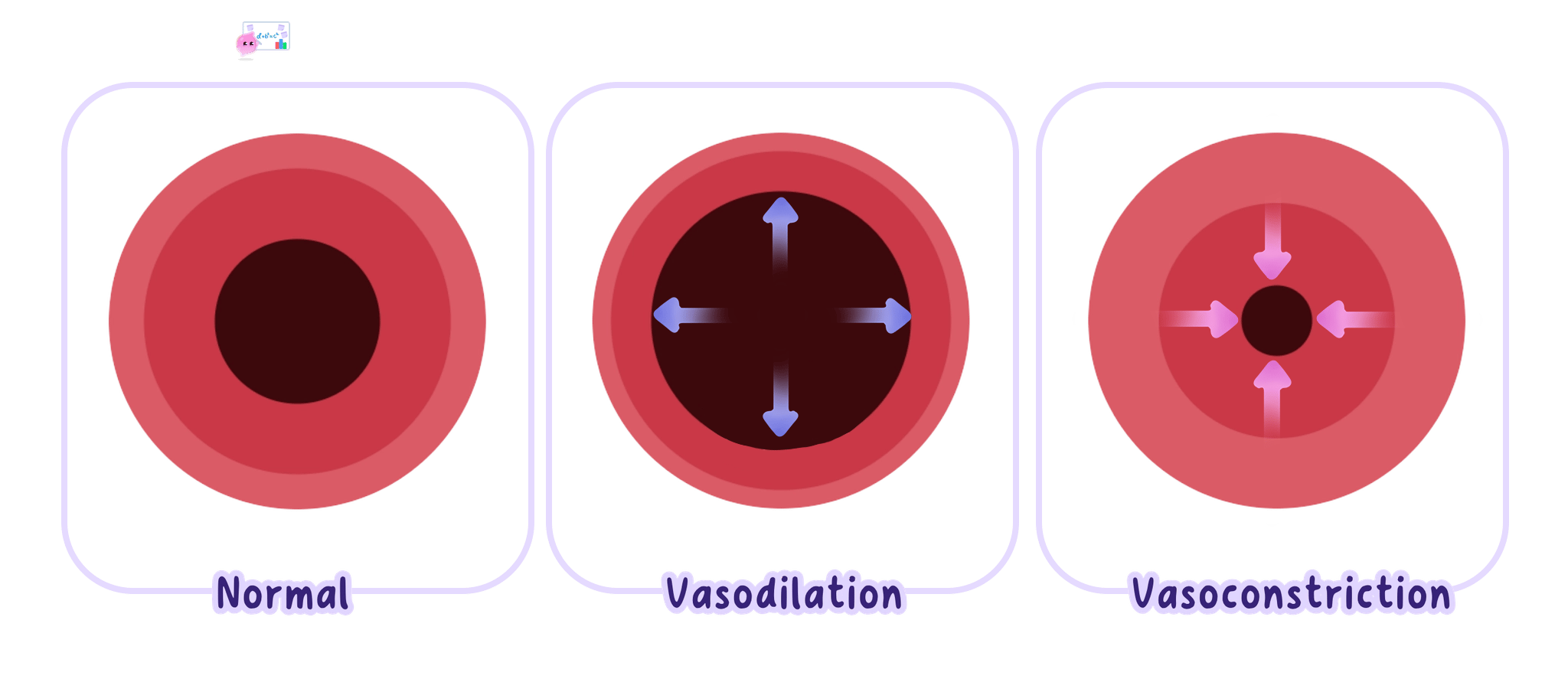
The widening of arterioles supplying the skin capillaries, which increases blood flow near the skin surface and increases heat loss.
- When body temperature rises above the normal range, the hypothalamus sends impulses to the blood vessels supplying skin capillaries.
- Smooth muscle in the arteriole walls relaxes, so the arterioles widen by vasodilation.
- More blood flows through capillaries close to the skin surface.
- The warm blood raises the temperature of the skin and increases the temperature gradient between the skin and the surroundings.
- More energy is transferred from the skin by radiation and convection, so core body temperature falls towards normal.
- The skin may look redder because a larger volume of blood is flowing near the surface.
Vasoconstriction reduces heat loss
Definition
Vasoconstriction
The narrowing of arterioles supplying the skin capillaries, which reduces blood flow near the skin surface and reduces heat loss.
- When body temperature falls below the normal range, smooth muscle in the arteriole walls contracts.
- The arterioles supplying skin capillaries narrow by vasoconstriction.
- Less blood flows through capillaries near the skin surface, while more blood remains in deeper tissues.
- The skin surface becomes cooler and the temperature gradient between the skin and the surroundings becomes smaller.
- Less energy is transferred from the skin by radiation and convection, so heat is conserved and core body temperature rises towards normal.
- Vasoconstriction reduces surface blood flow but does not stop it completely because skin cells still need oxygen and glucose.
Common Mistake
- Do not write that blood vessels move closer to or farther from the skin surface.
- The vessels stay in place and change diameter, which changes the volume of blood flowing through surface capillaries.
The responses work in opposite directions
- Vasodilation widens the arterioles, increases surface blood flow and increases heat loss when the body is too hot.
- Vasoconstriction narrows the arterioles, reduces surface blood flow and reduces heat loss when the body is too cold.
- Both responses change heat transfer through the skin without changing the position of the blood vessels.
- As core temperature returns towards normal, the hypothalamus reduces the corrective response.
Exam technique
- A complete explanation must continue beyond widen or narrow to surface blood flow, heat transfer and the resulting change in core temperature.
- Use the correct response name and write the direction of every change.
- For a comparison, describe both responses using matching stages so the contrast is explicit.
Heat transfer completes the explanation
- In hot conditions, more warm blood near the surface produces more heat transfer to cooler surroundings.
- In cold conditions, less warm blood near the surface produces less heat transfer to the surroundings.
- These causal links explain why changing blood flow helps restore body temperature.
Self review
- What happens to arterioles during vasodilation?
- Why does vasodilation increase heat loss?
- What happens to surface blood flow during vasoconstriction?
- Why does vasoconstriction conserve heat?
- Why is it incorrect to say that skin blood vessels move towards the surface?
