Homeostasis keeps cells working
Definition
Homeostasis
The maintenance of a stable internal environment within narrow limits despite internal and external changes.
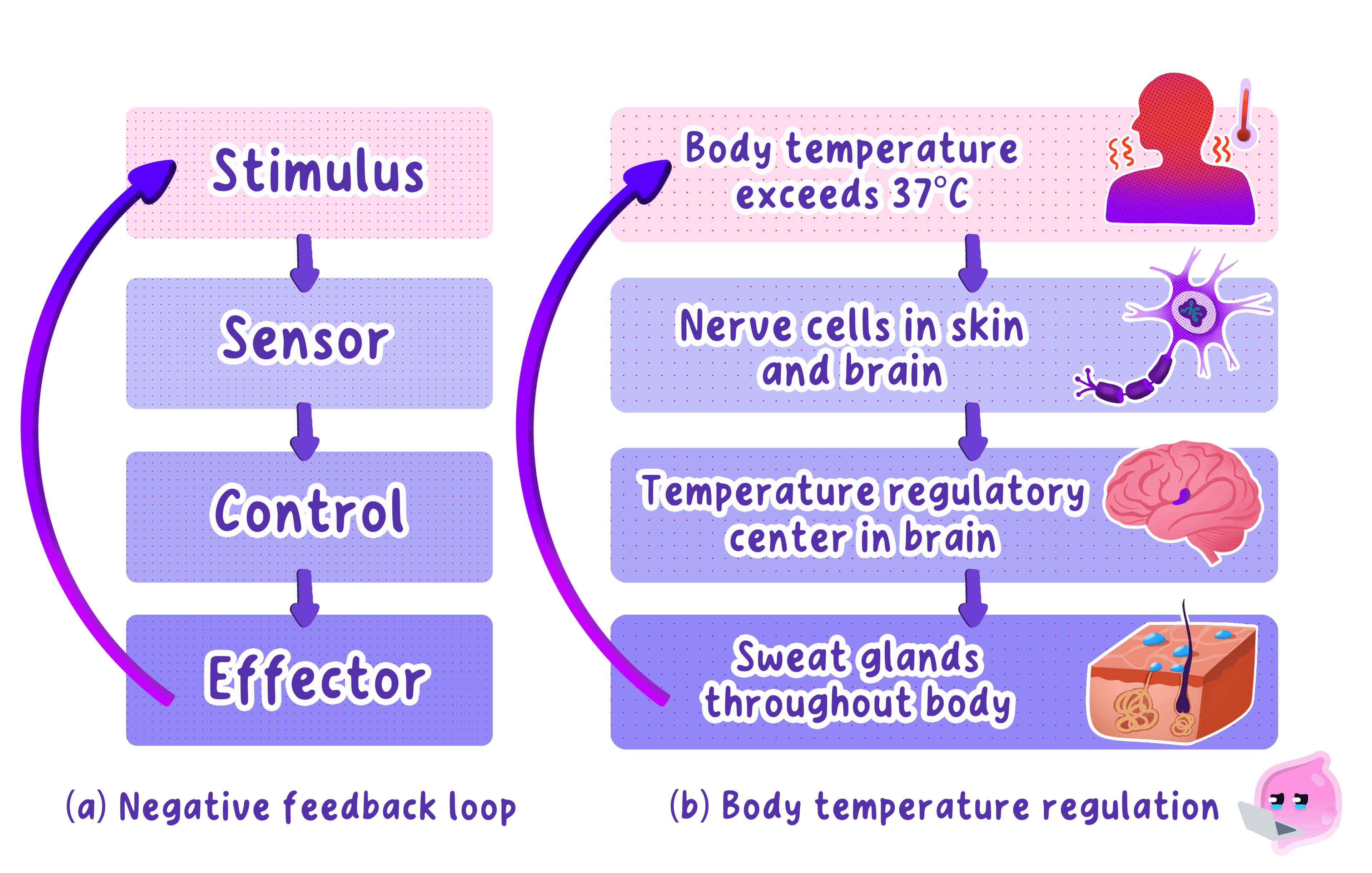
- Homeostasis holds internal conditions within narrow limits while the body and its surroundings change.
- The controlled value moves slightly above and below its normal range because detection and correction take time.
- A change is detected, effectors produce an opposing response, and the response reduces as the condition returns towards normal.
- This two-direction control prevents a small disturbance from becoming a damaging change.
Temperature affects enzyme activity
Definition
Thermoregulation
The control of core body temperature within narrow limits around approximately 37 ∘C37\,^\circ\mathrm{C}37∘C.
- Thermoregulation keeps core body temperature close to about 37 ∘C37\,^\circ\mathrm{C}37∘C, where many human enzymes work efficiently.
- Below an enzyme’s optimum temperature, particles have less kinetic energy and collide less often.
- Fewer successful collisions form enzyme-substrate complexes, so enzyme-controlled reactions proceed more slowly.
- Above the optimum, bonds maintaining the enzyme’s three-dimensional shape can be disrupted.
- The active site changes shape, the substrate is no longer complementary, and the reaction rate falls because fewer enzyme-substrate complexes form.
- If enough of the enzyme changes shape, the enzyme is denatured and can no longer catalyse its reaction.
- Thermoregulation limits both slow reactions in the cold and denaturation when body temperature becomes too high.
Common Mistake
- Low temperature does not usually denature an enzyme because the active site keeps its shape.
- High temperature can denature an enzyme, so do not describe the effect as the enzyme being killed.
Water balance protects animal cells
Definition
Osmoregulation
The control of the water and ion content of the body within narrow limits.
- Osmoregulation controls the water and ion content of the body fluids surrounding cells.
- The cell membrane is partially permeable, so water can move across it by osmosis.
- Water moves from a more dilute solution to a more concentrated solution through the partially permeable membrane.
- If body fluids become too dilute, water enters animal cells by osmosis and the cells swell.
- An animal cell may burst if too much water enters because it has no rigid cell wall.
- If body fluids become too concentrated, water leaves animal cells by osmosis and the cells shrink.
- A swollen or shrunken cell cannot maintain normal concentrations of reactants, ions and enzymes, so its reactions and membrane processes are disrupted.
- Osmoregulation prevents excessive net movement of water and keeps animal cells at a suitable volume.
Exam technique
- When asked about osmoregulation, state the direction of water movement and name osmosis.
- Then link the movement to swelling or shrinking and explain why the lack of a cell wall makes animal cells vulnerable.
- For thermoregulation, connect temperature to collision frequency or active-site shape before stating the effect on reaction rate.
The two controls prevent damage
- Thermoregulation protects enzyme shape and keeps enzyme-controlled reactions close to suitable rates.
- Osmoregulation protects animal-cell volume and keeps the concentrations inside cells suitable for their reactions.
- Both controls keep the conditions around cells within limits that allow metabolism and membrane transport to continue.
Self review
- What is homeostasis?
- Why do enzyme-controlled reactions slow when body temperature is too low?
- How can a high temperature reduce enzyme activity?
- What happens to an animal cell in a solution that is too dilute?
- Why can an animal cell shrink when body fluids become too concentrated?
