Arteries Carry Blood at High Pressure
Definition
Artery
A blood vessel that carries blood away from the heart.
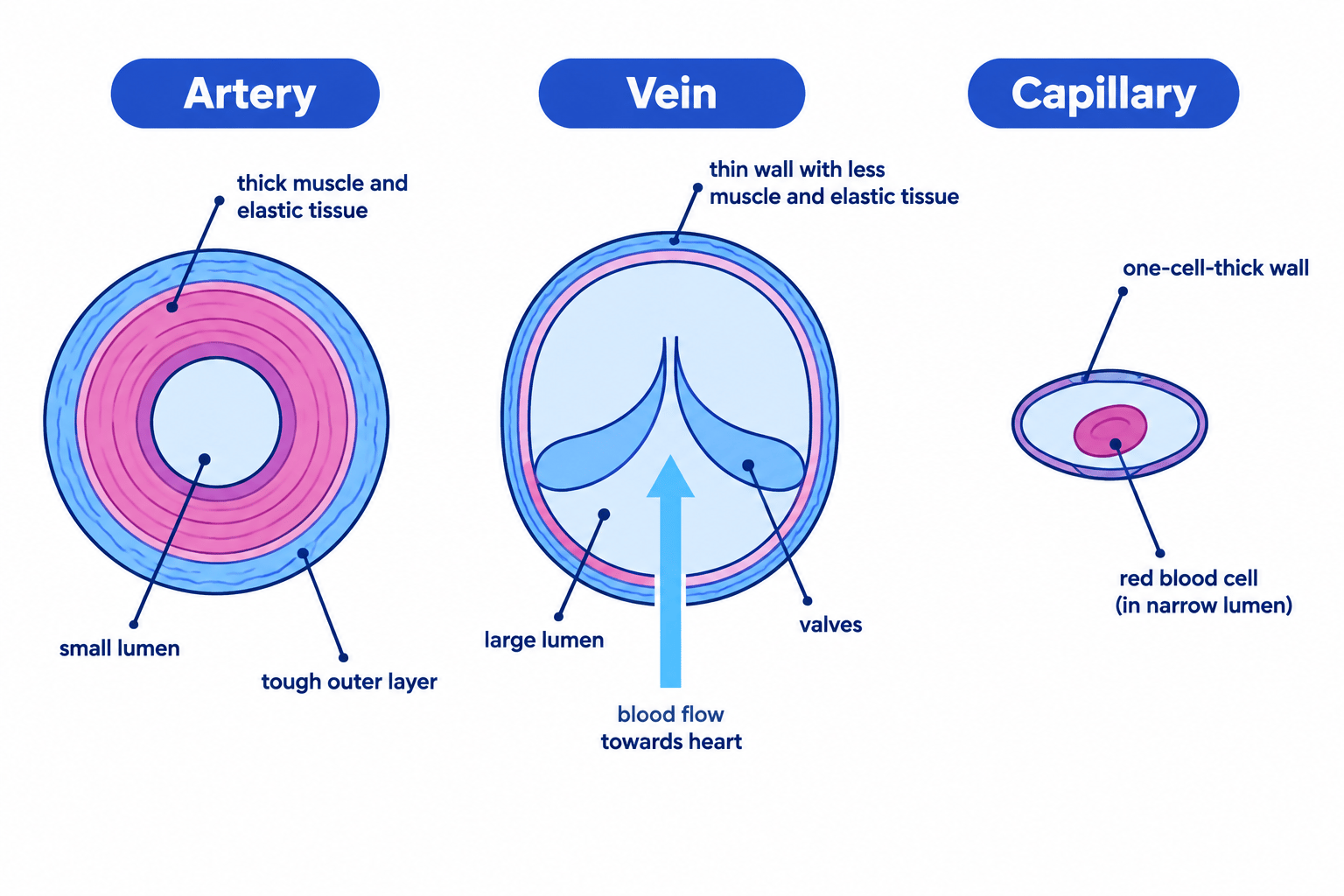
- Arteries carry blood away from the heart in pulses produced by ventricular contractions.
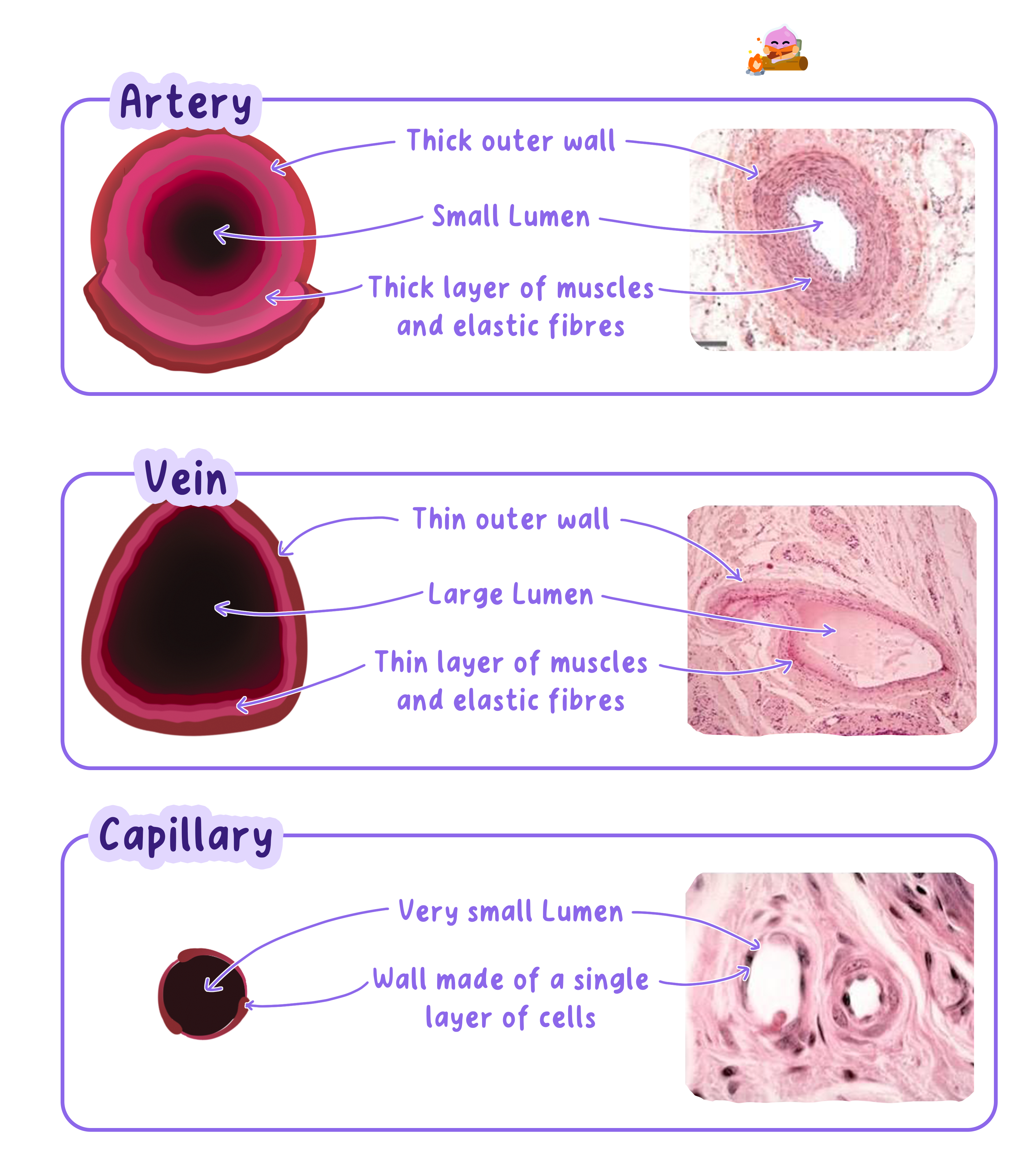
- Their walls contain thick layers of smooth muscle that withstand high pressure and can alter the vessel diameter.
- Their walls contain many elastic fibres that stretch when pressure rises and recoil between heartbeats, helping maintain blood flow.
- A relatively small lumen helps the vessel maintain high pressure.
- A tough outer layer prevents the wall from bursting.
Veins Return Blood at Low Pressure
Definition
Vein
A blood vessel that carries blood towards the heart.
- Veins carry blood towards the heart after pressure has fallen through the capillary network.
- Their walls are thinner and contain less muscle and elastic tissue because they do not experience arterial pressure.
- A large lumen reduces resistance to flow at low pressure.
- Valves open towards the heart and close if blood begins to move backwards.
- Contractions of surrounding skeletal muscles squeeze veins, and the valves make this pressure move blood towards the heart.
Capillaries Allow Rapid Exchange
Definition
Capillary
A microscopic blood vessel with a wall one cell thick where substances are exchanged between blood and tissues.
- Capillaries form extensive networks close to body cells, giving a large total surface area for exchange.
- Their walls consist of a single layer of flattened cells, so substances cross a very short diffusion distance.
- Their lumen is narrow, which brings red blood cells close to the wall and slows their passage through the network.
- Oxygen and glucose diffuse from the blood into tissues, while carbon dioxide diffuses from tissues into the blood.
- Small gaps between capillary wall cells allow plasma and dissolved substances to move into tissue fluid, but blood cells remain inside.
Common Mistake
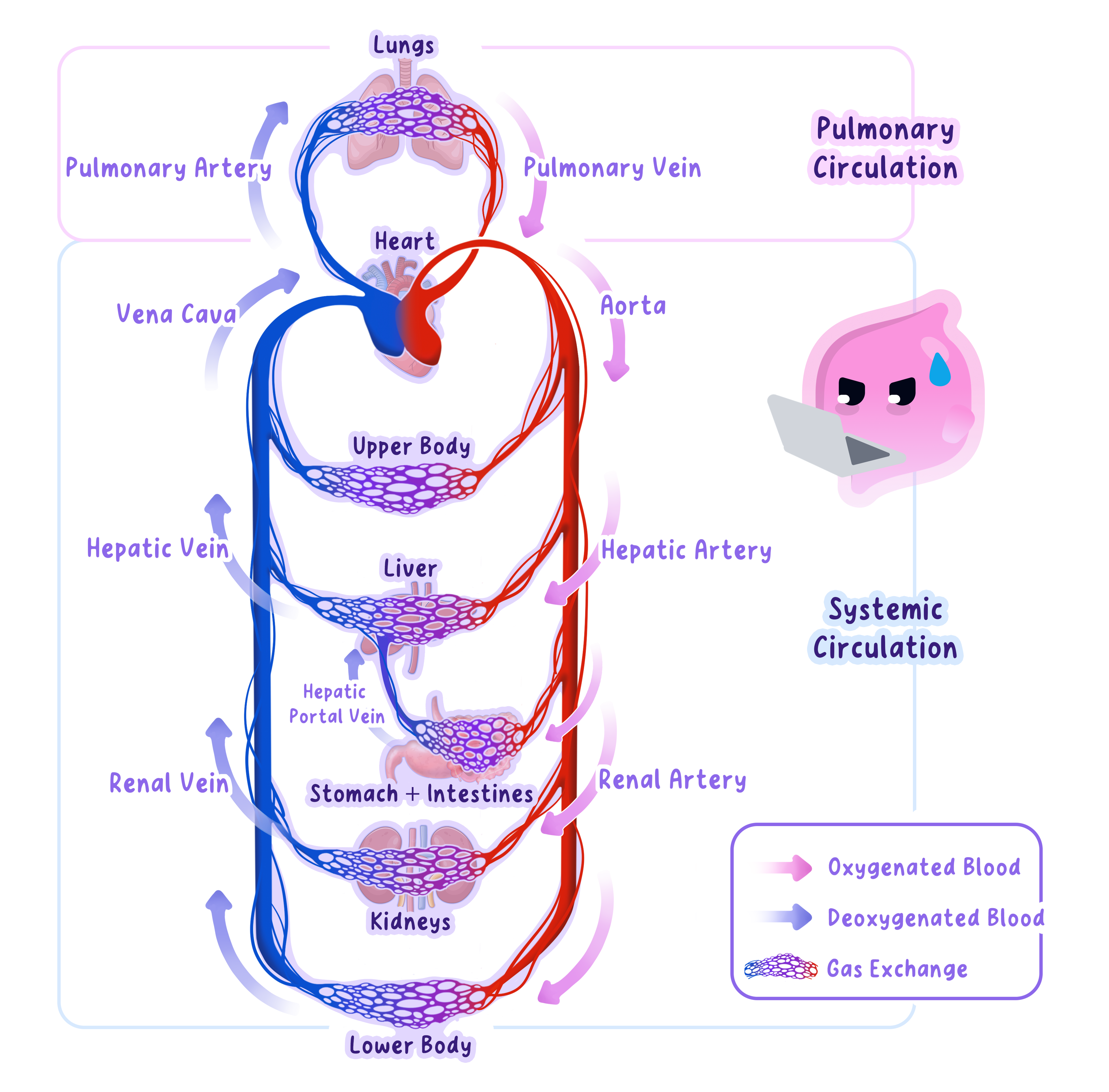
- An artery is defined by carrying blood away from the heart, not by carrying oxygenated blood.
- A vein is defined by carrying blood towards the heart, not by carrying deoxygenated blood.
Pulmonary Vessels Are Exceptions
- The pulmonary artery carries deoxygenated blood from the right ventricle to the lungs.
- The pulmonary vein carries oxygenated blood from the lungs to the left atrium.
- Most systemic arteries carry oxygenated blood and most systemic veins carry deoxygenated blood, but direction remains the reliable definition.
Compare Vessels by Function
- For an artery, link high pressure to a thick muscular and elastic wall, then explain that recoil maintains blood flow.
- For a vein, link low pressure to a large lumen and explain that valves prevent backflow.
- For a capillary, link exchange to a one-cell-thick wall, narrow lumen and large network.
Exam technique
- A structure-and-function answer needs a causal link, such as one-cell-thick wall, shorter diffusion distance, faster diffusion.
- Naming a feature without explaining its consequence often leaves the explanation incomplete.
Pressure and Exchange Explain Structure
- Arteries need strength and elasticity because they receive blood directly from the ventricles.
- Veins need help preventing reverse flow because their blood pressure is low.
- Capillaries sacrifice thick walls for rapid exchange because pressure has already fallen before blood enters them.
Self review
- In which direction does an artery carry blood?
- Why do arteries contain elastic fibres?
- How do valves help blood return through veins?
- How does a capillary wall speed diffusion?
- Why is the pulmonary artery an exception to the usual oxygen pattern?