Blood Has Four Main Components
- Plasma is the liquid that suspends the blood cells and carries dissolved materials and heat.
- Red blood cells, also called erythrocytes, transport oxygen.
- White blood cells defend the body against pathogens.
- Platelets are cell fragments involved in blood clotting.
Red Blood Cells Carry Oxygen
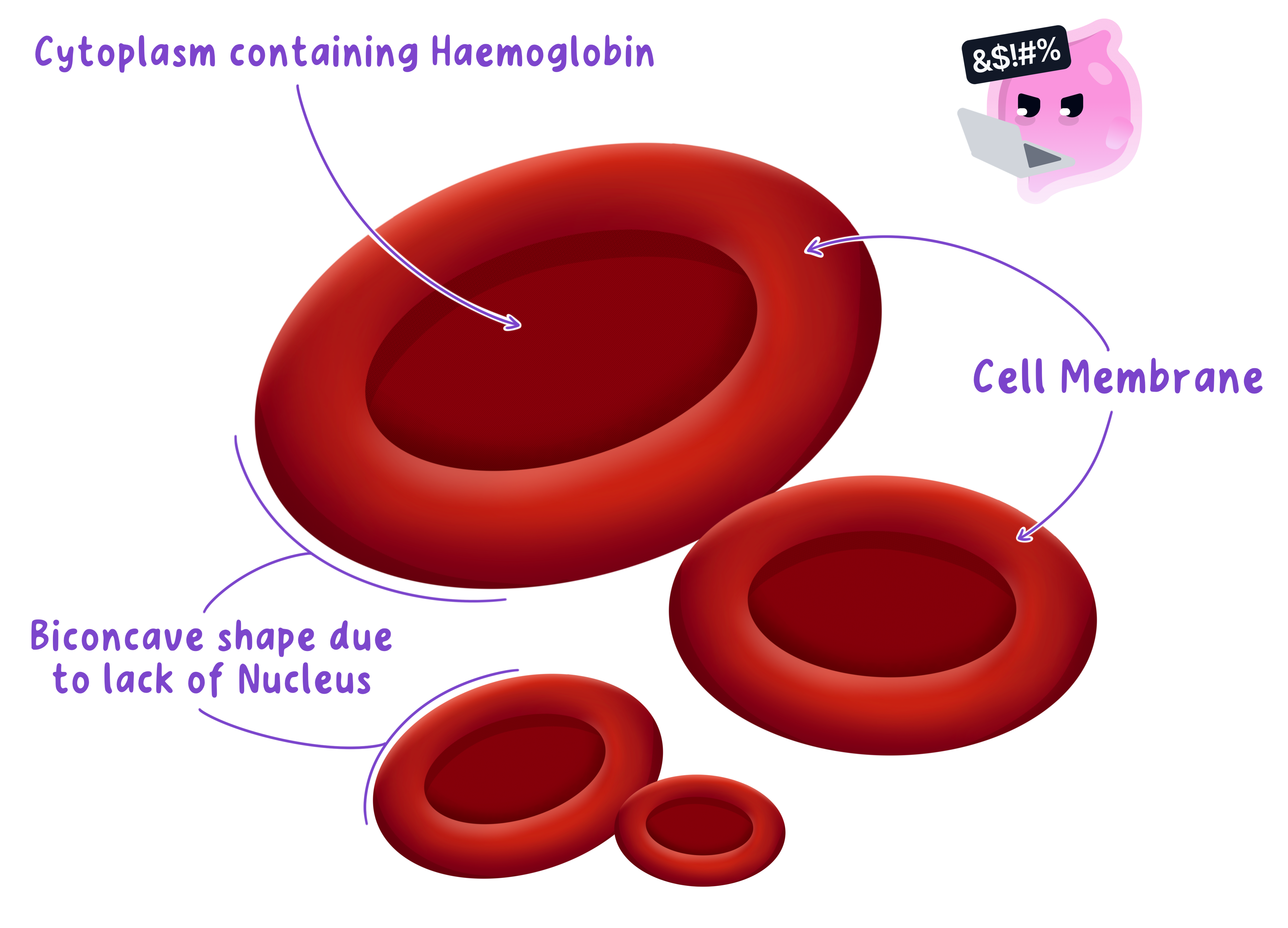
Red blood cell
A biconcave blood cell with no nucleus that contains haemoglobin and transports oxygen around the body.
Haemoglobin
A red protein in red blood cells that binds reversibly to oxygen for transport in the blood.
- A red blood cell is a biconcave disc, so its curved surfaces give a large surface area relative to its volume for rapid oxygen diffusion.
- The thin centre gives oxygen a short diffusion distance into and out of the cell.
- A mature red blood cell has no nucleus, leaving more internal space for haemoglobin.
- Haemoglobin binds oxygen reversibly in the lungs to form oxyhaemoglobin and releases oxygen where cells are respiring.
- The cell is small and flexible, allowing it to bend through capillaries that are narrower than its resting diameter.
Phagocytes Engulf Pathogens
White blood cell
A nucleated blood cell that defends the body against pathogens through the actions of phagocytes and lymphocytes.
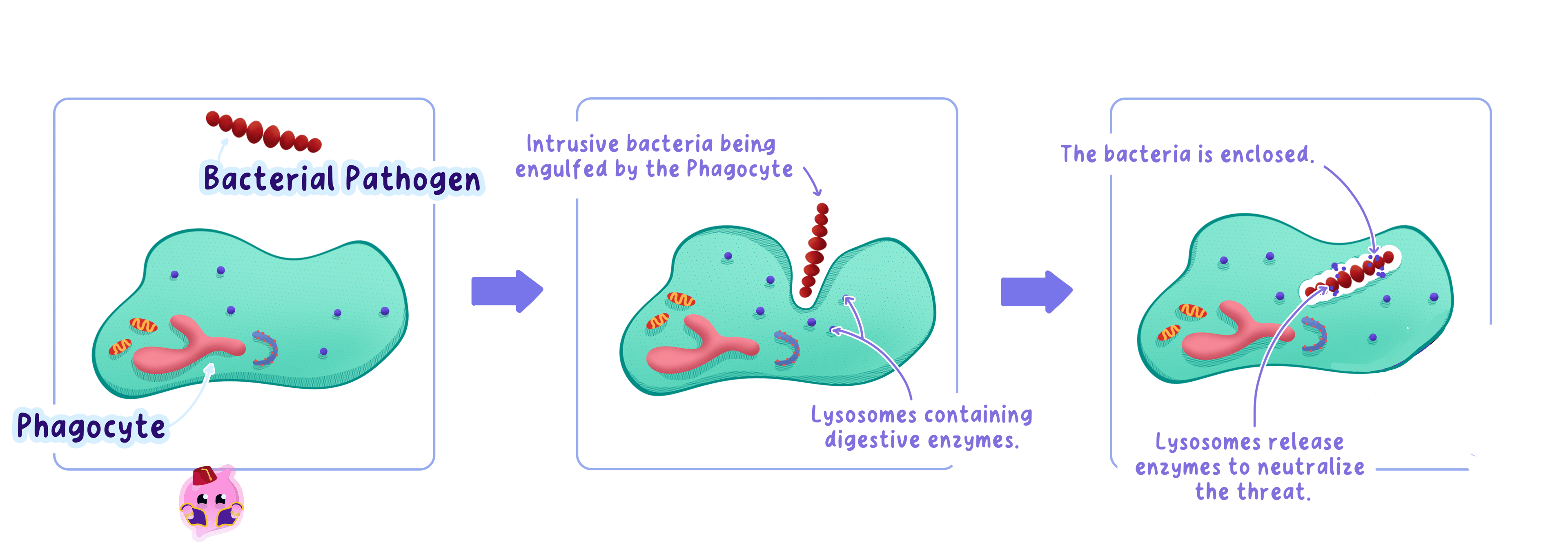
Phagocyte
A white blood cell that engulfs and digests pathogens by phagocytosis.
- White blood cells have a nucleus and can change shape as they move through tissues.
- A phagocyte detects a pathogen, surrounds it with its cell membrane and encloses it inside the cell.
- Digestive enzymes then break down the engulfed pathogen in a process called phagocytosis.
- The defence is non-specific because a phagocyte can engulf different types of pathogen.
Lymphocytes Make Specific Antibodies
Lymphocyte
A white blood cell that produces antibodies specific to antigens on pathogens.
Antibody
A protein produced by lymphocytes that binds to a specific antigen because their shapes are complementary.
- A lymphocyte recognises an antigen, a molecule on the surface of a pathogen.
- The lymphocyte produces an antibody with a binding site complementary to that antigen.
- The antibody binds only to its matching antigen, which helps the immune system identify and destroy the pathogen.
- This response is specific because a different antigen requires a different antibody.
- When comparing white blood cells, state that phagocytes engulf and digest pathogens, whereas lymphocytes produce antibodies.
- Do not write that every white blood cell makes antibodies, because this is the role of lymphocytes.
Platelets Form Blood Clots
Platelet
A cell fragment that helps form a blood clot at a wound, reducing blood loss and pathogen entry.
- When a blood vessel is damaged, platelets gather at the wound and trigger a series of clotting reactions.
- A mesh of insoluble fibres forms and traps blood cells, producing a clot.
- The clot reduces blood loss and blocks pathogens from entering through the break in the skin.
- The clot later dries into a scab while the tissue underneath repairs.
Plasma Carries Dissolved Materials
Plasma
The liquid part of blood that transports blood cells, dissolved substances and heat around the body.
- Plasma carries carbon dioxide from respiring tissues towards the lungs.
- It transports soluble products of digestion, including glucose and amino acids, from the small intestine to cells.
- It carries urea from the liver to the kidneys for excretion.
- It transports hormones from endocrine glands to their target organs.
- It distributes heat from active organs to other parts of the body.
- Blood cells and platelets are suspended in plasma and carried through the circulation.
Structure Answers Need a Function Link
- For each adaptation, name the structure first and then state exactly how it helps the component perform its function.
- A complete red blood cell link is: no nucleus, more space for haemoglobin, more oxygen can be transported.
- A complete platelet link is: cell fragments collect at damage, a clot forms, blood loss and pathogen entry are reduced.
- What are the four main components of blood?
- How does the biconcave shape of a red blood cell improve oxygen transport?
- How does a phagocyte destroy a pathogen?
- Why are antibodies described as specific?
- How does a blood clot protect the body?
